
When the Kindle sold out during the holidays, I guessed that Amazon would end the year selling 500,000 of its electronic books. All I did was roughly double the 240,000 that had sold through the middle of the summer. But now Citi analyst Mark Mahaney has come to the same conclusion, using better data.
In a note today, he cites some numbers in Sprint’s 10Q filings that indicate 210,000 devices were activated in the third quarter, and 100,000 each in the first and second quarters. (Each Kindle downloads books wirelessly using a built-in Sprint EVDO antenna). In addition to the 410,000 activated Kindles during teh first three quarters, he estimates that Amazon shipped a total of 500,000 activated Kindles before selling out in mid-November. (Oprah had something to do with that). If it hadn’t sold out, Mahaney thinks Amazon could have sold 750,000 Kindles in 2008.
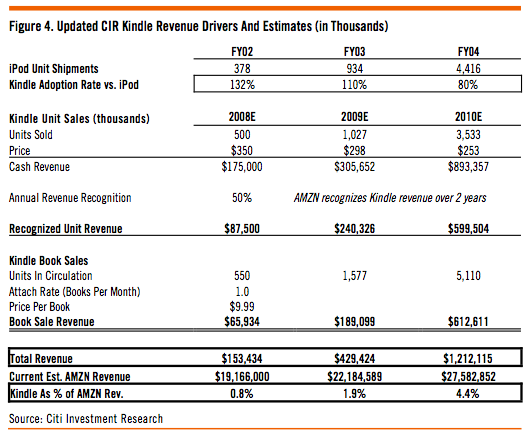
But even the 500,000 estimate would mean that the Kindle is outpacing iPod unit sales in the iPod’s first full year on the market, when it sold only 378,000 units. That means if you turned back the clock and launched both at the same time, the Kindle would be outselling the iPod by 32 percent. Mahaney estimates that total revenues (devices plus electronic books sales) reached $153 million in 2008, but will grow nearly tenfold to $1.2 billion in 2010. That’s a steep ramp.
Good thing Amazon is getting ready ready to announce the second version of the Kindle on Monday. Below is Mahaney’s updated model.
(Dog photo by Nebbish1).


I own one and love it! But I doubt that it will reach 1.2B in 2010. The cost of the device is still very much a barrier to market and out of reach for a lot of people. This is not a $99 ipod shuffle. This is a $379 device that still requires additional purchases to use (My wife terms the device as the “gift that keeps on costing” – I got my Kindle as a gift).
If I were amazon, I would change the device as follows:
1. Give it a wifi antenna – Cheaper to produce, and cheaper to operate. Especially today where there is a wifi signal almost everywhere – especially in coffee shops where a lot of reading is done. That could lower the cost of the device since there is no need for the Sprint connection.
2. Decrease the price of the device but increase the cost of the books when they are first available – Most hardback books are around the 29.95 – 24.95 price range and on the Kindle they are around 14.95 – 9.95. If they lower the cost of the device and up the price of the book, they can make up the difference – same logic occurs the otherway around but it is easier for people to pay $5 extra per book than $379 for the device in one shot.
3. Go the Audible route – lock users in to a monthly plan where they are charged $29.95/month for 3 books and the device price itself is lowered considerably.
4. Release a “Student Version” of the device that has limited functionality (such as only tied to a section of the store relating to their studies) for a lower cost. Then, allow the student to upgrade the device to unlock the features.
I am a true believer that once you get the device in people’s hands, it sells itself. Everyone that I have shown it to wanted to get one but held back due to the price.
Now I can’t wait to see what is new about version 2 and see if I want to update (I kept the box and packaging for the first one so that I could sell it potentially
)
Jim
I like some of your points here. However, being a student, even if Amazon creates a “student version” with limited functionality and a lower price, I don’t think we will be flocking to buy it. First and foremost, the Kindle is an ugly piece of equipment compared to iPods and iPhones students carry today. Also, in terms of buying textbooks and novels for our studies, I don’t think this will materialize. I know I like to highlight sentences, write in the margins, and add post – it notes to pages. Until the kindle becomes sexier, smaller, cheaper, and more functional, I cannot see it become very popular within the student demographic.
Have you ever used one?
You can highlight text, annotate, add your own notes, and lookup information in real time via its constant-on connection.
As far as it being ugly, that is a question of taste rather than functionality.
I remember that when I was attending the University, text books were super expensive. My Automata Theory book was around $125.00 and the professor changed the book each year so used books were out of the question. Now if that book on Kindle is around $50.00 (if you figure that the books are essentially 40% of their original price) then that is something that would help many students. For students, you could even setup a book exchange program.
I started letting my 8 year old read on the Kindle because if she comes to a word that she does not know or understand, she simply presses a button and gets the definition and can continue reading. I see a lot of future in this device.
Jim
go kindle go , and if possible take the EUROPE direction
Kindle is a really cool device….it might seem to be pricey at the first…but if you are a an avid reader…you would love this stuff….
the screen is really good to look at and feels absolutely like a real book…
http://www.livbit.com
Don’t forget about Japan, they love reading books over there!
So, the change in estimates is based on the Sprint 10Q numbers of wholesale activations.
Yet a December 9, 2008 Sprint Press Release contains the following:
More than 200 different non-Sprint-branded devices, from machine-to-machine to telemetry, operate on the Sprint network through a widely respected device certification process.
And a May 6, 2008 release says this:
As part of the planned 2008 commercial availability of our WiMAX next-generation mobile data network, Sprint has commitments from ecosystem partners for Xohm(SM) network access on new and innovative devices, including connection cards, Internet tablets, ultramobile PCs and other consumer electronic devices.
Does this mean that up to 200 different devices could contribute to the wholesale activations?
Has anyone done the due diligence to *ask* Sprint what comprises wholesale activations?
I’m not saying this is wrong, but … it seems like a big leap in logic, particularly since the original numbers floated were called ‘extremely high’ by Amazon.
http://usedbook...-amazon-doesnt/
I am glad that I waited out for the second edition. I have heard some rumors about additions and improvements that are really exciting. And as with the iPod, I think this is the kind of thing that will only get bigger/more accepted by the masses as newer versions come out. There is no doubting its function and ease, just takes time to become “popular”.
I’d be curious to see the demographical data behind those buyers. Are they old fogies looking for something better than buying books, or are they young, ie the crowd that no one thinks reads anymore.
When the Kindle came out, I really thought “this is a terrible idea.” I really never thought that people would actually buy this thing. I guess I was wrong. I was in the Sony Store a few weeks ago helping my sister pick out a laptop and I asked the guy if people buy their version, he said that they sell like crazy. I guess there really is a market for these things.
http://dankalmar.com
http://schoolshift.com
http://twitter.com/dankalmar
“That means if you turned back the clock and launched both at the same time, the Kindle would be outselling the iPod by 32 percent.”
Your logic is flawed. The iPod launched at a dramatically different time regarding digital distribution of goods. If the Kindle launched back in 2002 it wouldn’t sell nearly as much.
Think back to 2002… So I “download” a book digitally to “own” it? Hogwash!
I have to agree with Wayne, it is apples and oranges. The success of iTunes and Amazon itself has allowed the Kindle its success, neither of which was as powerful 7 years ago as they are now. They have made people feel comfortable about a pure digital ownership of a product, and then only recently. If the iPod had launched in a similar enviroment it would have been an even more tremendous success than it already has been.
That is not to say that I am not thilled that the Kindle, which might have been seen as a niche, tech novelty until recently, is making a strong showing.
It is also very important to remember that the iPod was an OS X only device for the first 12 -18 months of its existence.
I also agree with Wayne. The Kindle has been able to achieve the success it has in part because the iPod paved the way for digital goods to be understood by the masses.
Lets pretend that isn’t true though. So the Kindle outsells the iPod when comparing 1st year sales of each. Do you really think that means in the long term that the Kindle will reach iPod mass.
Everybody I know listens to music. About 1 in 10 admits to reading. If even that. I just don’t see the Kindle being able to maintain that kind of momentum.
From what I’ve read so far, the kindle is picking up in numbers in the women demographic. My mom, who is in her late 50s; I could see her using a Kindle but not an iPhone. My mom would never download apps. Kindle is a good transition device for people who are not the typical gadget folks, but still want the benefits of mobile media technology.
I live in New York City and I’ve only ever seen ONE Kindle on the subway.
I seen around 4 in past 3 month, which is pretty awesome because I think people are still scared to whip it out because of some looks they might get
.
FWIW – I’ve emailed Sprint IR and Analyst Relations to determine if all wholesale activations are attributed to Kindle. We’ll see if I get a reply.
Is an “activation” every time a Kindle moves accounts, or is deactivated on a user account and reactivated? I’ve de- and re-activated mine several times, as well as moving it between Amazon accounts.
The Kindle is a great device, but sadly, people just don’t read. Wanting portable music is a much more pervasive need.
Wayne’s right. How can you compare the climate now and apply it to then? The iPod has made a substantial impact to the mainstreaming of downloadable media. The reason the Kindle is doing well at all is because of the pioneering iPod. So to now say it’s outselling initial iPod sales is misleading and flawed.
I own a Kindle and can’t wait to see the second version next week. The reported, larger student version will certainly boost sales assuming that Amazon gets the sales model and content piece nailed down.
Amazon needs a sales model for the student version of the Kindle that will accomodate both individual sales and institution-wide sales.
They’ll need to work with textbook publishers on making enough content available for the Kindle to be attractive. Content will be more important for the student version because instructors, not students determine what books are assigned. If content is limited and students are not able to get most of their books delivered to the device, a Kindle won’t represent a savings over used books and students won’t buy as a result.
Doesn’t seem like a particularly good time to be counting on institution-wide educational sales. The few schools that could afford such a deployment have had their endowments hammered.
Kimber, you’re absolutely right, this is a difficult time to go after institution-wide sales.
However, I wouldn’t rule it out as a part of a long term plan. Private institutions may ultimately consider purchasing devices on behalf of incoming freshmen. Schools like St. John’s University have been doing this with laptops for years, and the cost is often built into tuition. Duke University even did this with iPods for a year or two.
Another opportunity is to obtain some sort of institutional commitment or endorsement. That might include a faculty pledge to adopt textbooks that offer have Kindle editions. If the administration and faculty openly support the device, students will feel much more comfortable purchasing the device.
You have to recall that this is the analyst who said Microsoft’s take over of Yahoo was 90% probable, and he said that *after* Microsoft walked away from the bargaining table. So, you do the math on what his “analysis” is worth.
This analyst has been over-inflating kindle sales for a long time. Even amazon slapped him down and said his figures were “extremely high” when he was saying 380k units. His response to this rebuke seems to be to raise his figures even higher.
Where do I start with the flaws in his argument? Sprint has many devices that get pre-connected like this and he assumes 100% of them are Kindle. In addition, IDPF ebook sales figures put the entire market for ebooks at about the level Mahaney says is due to Kindle alone. But the market includes many other devices and retailers, and was tens of millions in size before Kindle ever shipped, the kindle did not even double what the market was on track to do without kindle, and most ebook retailers report smashing records in 2008 so it’s not like kindle sucked out their air. Therefore, on multiple levels his figures appear to be wildly high.
If you analyze the growth of ebook sales by industry groups right before and right after Kindle shipped, you come to the conclusion that there are about 200k kindles out there, not 500k. So Kindle content revenue is about 2 to 3 million per month tops and Kindle hardware revenue about 6 million per month.
Don’t get me wrong: That’s a lot in the ebook world and Kindle is a smashing success in terms of the ebook industry. But 500k units is way too high and in my opinion this analyst has little credibility on the issue.
The reason these numbers are cited as accurate is because the specific service mentioned is devoted almost entirely to Kindle devices.
The number of non-Kindle devices using that services can probably be measured in the low hundreds.
Joe,
You have confirmation or knowledge that this is the case?
Two press releases from Sprint (quoted in my above comment) seem to indicate that there are over 200 non-Sprint devices that may use this type of wholesale activation.
Surely Kindle is one of them, but where are you getting the only 100s for non-Kindle device figures? They *could* be right but right now there seems to be no way to tell.
Typo in the post
“Kindles during teh first three quarters “
You make it sound as if, despite public ignorance, Apple invented the mp3 player.
will be interesting to see if other companies start putting their voip apps wrapped in a fancy silverlight shell
I haven’t seen anyone make the key point of the environment in which these products were released. Ipods were released with 4% unemployment and booming financial and real estate markets. Now we are nearing 10% and stocks and homes are worth half what they were back then. Truly impressive sales, especially for a fairly singular purpose and quite expensive device. I wonder if these units are secure enough not to get compromised in wifi areas over time as they get more popular. I’ll just check justaskgemalto.com if I end up getting one to check on that.
Cool. I want one.
One, FY2002, was the iPod’s FIRST YEAR in the market. Apple’s Fiscal Year starts in October. The iPod was launched in October 2001, which was Apple’s FY2002. On the Citibank’s analyst’s table, he has FY2002, which is the iPod’s first year, not second.
I have no problems with the analysts estimates of 08 sales. I looked at Sprint’s 10Q from Nov of last year, and it states on Page 42 that 210k devices were pre-activated on Sprint, and that only 3% of those devices had not been sold. Clearly those were Kindles. I did not see anything about 100k in prior quarters, even though I looked in the previous 10Qs. The only info was in November’s SEC filing.
I actually figure Amazon sold another 210k Kindles in Q4, for a higher total the the Citi analyst estimates.
HOWEVER, I think his estimates going forward are ludicrous. The iPod had several catalysts driving its exponential growth. What was launched as a Mac peripheral was later launched as a Windows device as well. They added the iTunes Music Store in 2003. They added more devices to the lineup, at lower price points like the Mini in FY2004, which really got the iPod market exploding. There’s no guarantee that the Kindle will have the same number of catalysts that the iPod had in the marketplace.
I take morning subway in a city that’s around 4 million people and I’ve NEVER seen anyone have Kindle with them.
Amazon is also very coy about Kindle sales numbers and has never really come out and said how many they have sold. I’d take anything they say about Kindle with some reservation. Do NOT trust them!
i would definitely get one if it is cheaper. I have too many hard copy books and it is difficult to move with so many books.
Well, the Kindle actually has to do it before being claimed as outselling the first iPod. I definitely feel it’s technology is outdated since it doesn’t have a color screen. It’s okay if it sells well. It costs more than a typical netbook, so I think people would go the netbook route. Of course, the Kindle is a niche product so maybe it doesn’t compete with anything except another eReader.
One of the things that jumped out at me when I played with the Kindle is that such a large percentage of the surface of the device has nothing to do with actually reading the content.
For the folks that have one, how often do you use the keyboard?
I hear praise (mostly from people that don’t have one) about how convenient the ability to impulse buy anywhere is, but I am struggling to see that as a rule (for me) that would make me consider a Kindle over a Sony Reader or an eSlick Reader.
disclosure:
I have a Sony today and wake up every morning to freshly synced content (newspapers, rss feeds, email, books, pictures, audio) with little to no effort (scheduled polling for updates when on dock) .
The Sony store (which has a good majority of the Borders stock available in Reader format) has near anything I want and I can directly copy text, word, pdf, mp3 and images directly to the device (without having to email to Sony to convert).
thanks for the great article!
Let’s check Google Trends.
http://www.goog...=all&sort=0
I say nope.
*This post has been tagged as PayPerPost.*
You really don’t even have to be LITERATE to enjoy an iPod or MP3 player. I doublt the Kindle will have a fraction of the momentum or broad product appeal.
Think about it. What the iPod had – was millions of us owning a billion CD’s. The consumer _already had_ a ton of content to load in and release the value of an iPod. The Kindle absolutely doesn’t, and implies building a far more expensive library from scratch. And even if you could dump your entire book collection into it – No one RE-reads a book 1000 times over like you can listen to a favorite song.
To compare these two devices is ludicrous – other than saying they’re both electronic gizmos begging for content. End of story.