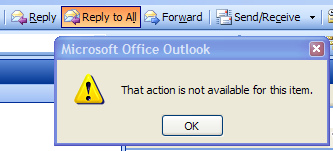
Nielsen Deletes Reply-To-All Button
by Robin Wauters on January 31, 2009

This happened last Tuesday, but we wanted to make sure you’re aware that Nielsen management, after years of research, has finally come up with an adequate solution to cluttered e-mail inboxes and inefficiency in office environments: control-deleting the reply-to-all button from the messaging software.

In a move that could have come straight from Mike Judge’s Office Space, the company has decided to remove the button from their e-mail program of choice, Microsoft Outlook, affecting all 35,000 employees across the globe. In a memo, republished by Folio, Andrew Cawood, Chief Information Officer for Nielsen Company, writes that the measure will “eliminate bureaucracy and inefficiency”.

I’ve never been a huge fan of the reply-to-all button either, but removing it sure sounds like a very extreme decision, and claiming that it will eliminate bureaucracy and inefficiency is just plain absurd.

Memo below.

“REPLY TO ALL” FUNCTION TO BE DISABLED

A Message from Andrew Cawood

In December, the Nielsen Executive Council (NEC) held an Act Now! event to review suggestions from across the business that would eliminate bureaucracy and inefficiency. Beginning Thursday, January 29, we will implement one of the approved recommendations: removing the “Reply to All” functionality from Microsoft Outlook.

We have noticed that the “Reply to All” functionality results in unnecessary inbox clutter. Beginning Thursday we will eliminate this function, allowing you to reply only to the sender. Responders who want to copy all can do so by selecting the names or using a distribution list.

Eliminating the “Reply to All” function will:

• Require us to copy only those who need to be involved in an e-mail conversation
• Reduce non-essential messages in mailboxes, freeing up our time as well as server space

This is one of the many changes being implemented as a result of the NEC Act Now! initiative. If you have any suggestions on how we can continue to improve the way we work, please send your comments to Nielsen Communications [mailto: REDACTED].

Andrew Cawood
Chief Information Officer

It’s funny to me that Nielsen seems to suggest that the change has actually been requested by employees across the board, which I’m quite certain was not the case.

About half a year ago Mitchell Habib, Executive Vice President at Nielsen, managed to accidentally cc all Nielsen employees in a reportedly arrogant note to another employee, ending his e-mail with the now famous-in-certain-circles punch line “Who do you work for, and why do you think copying me on this is appropriate?”.

I suspect that particular blunder led to this strange situation.

Hat tip to BP for pointing to the Folio article and suggesting that we should read the comments. He was right.

My three personal favorites:

“Fine! Who needs to reply to all anyway. I don’t even have electricity on my farm and I never needed to reply to all. Besides it’s known fact that if you “Reply to All” your email goes into Sub-space and attracts Demon Vampires from The Future. It’s your choice.”

“In December, the Nielsen Executive Council (NEC) held an Act Now! event to review suggestions from across the business that would eliminate bureaucracy and inefficiency. Beginning Thursday, January 29, we will implement one of the approved recommendations: removing the “Q” key from all Nielsen Company computers. We have noticed that the “Q” key is only used 19% of the time throughout a typical work day as opposed to the most utilized letters, A, R ,S, T , and L, This results in unnecessary keystrokes, causing a waste of time and silly words that use the letter Q. Beginning Thursday we will remove all “Q” keys, allowing you to type only words without the letter “Q”. Employees who want to use the letter “Q” can now substitute the “asterisk” symbol for all words containing “Q”…. ”

“It is remarkable to see how Mitchell Habib’s harrassing comments to an accidental “reply to all” respondent has led to an initiative to prevent him from humiliating himself again. It is discouraging to see that money saved through layoffs is used to finance discussions about the “Reply to All Crisis.” I wonder how many high-level executives were flown from around the world to resolve this threat. I wonder if those in charge of this brainchild are the same people that disabled power-save mode from Nielsen computers. Keep up the great work CIO! Look forward to a new comedy of errors in 2009. May I suggest eliminating air conditioning?”

Advertisement

Responses

Comments rss icon

  • Haha, I know this has nothing to do with Jakob Nielsen, the usability consultant but Jakob once claimed that AJAX is “bad” UI design because it took away the ability to use the back button.

    • He does have a point. Not saying we need the back button … but AJAX breaks the page model the web is built on.

      • Ajax that ignores how the user might use the back button IS bad. A good example of an ajax style interface that takes the back button into consideration is Facebook’s photo pages. You can flip through and comment on photos without refreshing the page, but the back button still works as expected – reversing through the sequence with refreshing the page.

  • Standard Chartered - January 31st, 2009 at 3:24 am PST

    That functionality has been disabled by Standard Chartered for quite a long time now.

    So, this ain’t something new I guess.

  • I disagree a little with you. I worked once for a large corporation where the “reply all” button did indeed helped to clutter your inbox. This was with Lotus notes and anybody replying all would send you back the attachements files of that precise email. In a move to forced us to clean-up all of those attachements files IT made sure we would only have no more than 5MB of mailbox storage after that you were still able to receive but not send. Truth be told at the times emails were proofs and points of references and it was easier to just use again that same email and its trailers of documents rather than having compliance telling us that we did not follow the procedure and forgot some docs. Problem was not technology but indeed burocracy made by so called black belts consultants who were not living the day to day realities of the business. Forcing us to save the docs in folder where anyone on the team could access it would have been a dream if only the nationwide servers were not offline all the time (because of two many data synchronization !)

  • I have heard a “reply all story” from Volkswagen: After a wrong going mail (somebody looking for a lost mobil phone) to ALL volkswagen email accounts, people started to re-reply all (saying “don`t use reply all”). Cruched the email-server wordwide for an hour. Losses in terms of productivity were more than a million dollar.

  • One of these days, I’ll have to tell you how I singlehandedly shut down AECOM’s e-mail network in the late 1990s by using a “Reply to All”.

  • I live in the Brazil, I read the TechCrunch frequently! And it is not by chance that he is one of the better blogs of the world!! Very good! Congratulations always

  • Classic Nielsen – trying to change the world AFTER the fact. That isn’t innovation or progress.

  • google mail has the mute conversation option for this, a much better solution.

    but mail systems should be smarter then to enable “reply to all” after a company wide email… or even a warning like “you are going to send this mail to x people, are you really sure you want to reply to all”

  • “…Nielsen seems to suggest that the change has actually been requested by employees across the board, which I’m quite certain was not the case.”

    how do you know it’s not the case? did you speak to all the employees at nielsen?

    • No I didn’t, relying on common sense.

      Would you honestly recommend that measure if the huge company you work for asked for suggestions to improve business?

      I’m sure Mitchell Habib did, but that’s another story.

      • Easy answer – people are fed up with getting their inboxes full with mass-mailed emails that aren’t relevant to them.

        Just yesterday there was an announcement sent to our entire department about a slight promotion/reorganization. Fine, I spent 15 seconds on it and pressed “Delete”. It was followed by half a dozen “Congratulations, Firstname!” replies from various people over the next hour, sent “reply to all” of course.

        Even if it takes 5 seconds to glance at and delete each of those half a dozen replies, that is still 30 seconds of each reader’s time. Multiply it by hundreds (or even thousands) people and you have several man-hours wasted.

      • Jumpin' Jehosephat - February 2nd, 2009 at 6:16 am PST

        Yes, Robin, I would. But even if I wouldn’t, stating you are “quite certain” is just so transparently bad – both redundant and irrelevant. You may be certain, but that doesn’t mean you’re right, and your certainty really isn’t relevant to your reporting here if you have absolutely zilch to base it on.

        Worst of all (for you) it actually makes me wonder about the rest of the piece.

      • You know, derogatory comments from an anonymous reader are redundant and irrelevant too.

  • Reply All is misused a lot, however sometimes you save some productivity by removing the button, and lose some by making people type all the email addrs. So its not going to help much. And I am sure, all the smart guys are already on Thunderbird.

    • We have already figured out how to work around the reply all button being removed….

      ctrl
      shift
      R

      They can take the button away but they can’t take the functionaility out of the app.

  • I understand their reasoning, but how about punishing and tracking those who misuse it, rather than eliminating it wholesale for everyone?

  • Maybe this is a tad draconian. I would have, as an alternate suggestion, this:

    1. Hitting the reply-to-all button will go into a compose window as normal.

    2. Upon hitting send, you will be presented with a list of recipients, with checkboxes next to each name, and be encouraged to take checkmarks out of some of the boxes.

    3. In order to incur a cost to hitting reply-to-all, you will now answer a dialogoue box for each recipient, with a minimum one-second delay per box, the question in the box reading, “Does $user really need this memo?”

  • I actually don’t think it is a bad thing as it might actually force people to communicate face to face. !!

    Now if only we could get rid of the stupid “return receipt requested” notifications – or the people who use them on EVERY outbound email – even to announce donuts in the breakroom.

  • Very good move. I removed the “Reply All” button off my Outlook myself some time ago when I accidentally replied all instead of the sender and got annoyed at myself. Didn’t miss it so far.

  • What a silly idea. Clearly they don’t work in Publicity!

  • Ernst & Young removed the “reply to all” button from Lotus Notes as well.

  • Please do a follow-up on the results of this action, and/or follow-up on the results from the companies reported in the comments section.

    Because now I’m curious whether it’s a good idea or not.

  • They should have removed the entire Outlook it’s a piece of turd.

  • How come there’s no ‘Reply to All’ function on blog comments?

    Just kidding, of course.

    As will the Nielsen execs say they were, after a few days of mayhem and even worse productivity problems…

  • sounds like a pretty bad place to work

  • This would have been a great April Fools Day post!

  • I hope he sent the memo by typing out the names of all the employees one by one.

  • Whiny…
    I wish the military would do the same thing. It would save a lot of heartache and bandwidth. I’m in a signal unit and my higher uses that button with impunity when they should know better.

  • Would you imagine innovative companies like Google or Apple removing the Reply-All?

    It is a matter of email etiquette. Companies would better focus on educating on effective email use, rather than forbidding features because some people misuse them.

    Anyway, we live in a world of information overflow, where one must learn to be selective. You do not have to read emails only because you are in copy. Either delete or simply do not read, instead of wasting even a millisecond complaining, or spamming all with a “Who do you work for, and why do you think copying me on this is appropriate?”

    • Actually, I would. Perhaps not removing it, but at least making it much easier to not reply-to-all by accident. Both Google and Apple strive to optimize user experience, and Apple in particular has no qualms about doing so by removing functionality they don’t think serves users’ best interests. I personally prefer giving users more control, but I do see the merits of Apple’s approach.

    • It would be great if you could tell everyone to stop abusing reply all, but it ain’t gonna work.

      The idea that you can change people’s behavior is why most startups and diets fail.

  • Someone should tell them about Yammer.

  • I think the author has never worked at a big company with an email problem. My company has 60K+ employees and I can’t imagine any of them not using email on a daily basis. Here’s the problem. I get 150-200 emails a day. So do all of my direct co-workers, and that seems to be the consensus across most of the rest of business as well. How many of these are important to me? About 1/3, maybe. What happens is that I get added to a thread, “just in case” I know the answer and then never removed. Someone else engages the problem and I stay on the thread… forever. For an average of 4-6 more emails (roughly) i’m uselessly copied. I end up just deleted (or archiving) all these email threads.

    Now, I’m pretty good with my email management(thanks to GTD etc.) so I don’t waste too much time on this crap. However, many of my co-workers spend 4+ hours a day just trying to process all of their email. Without the use of automatic rules and vigilant processing, they’re sunk.

    A simple (albeit too simplistic) approach is to make it difficult to reply to all. This means that when I’m replying to John’s email where he copied my entire team, I’m probably only going to hit reply to John, and leave Suzie, Jimmy, Greg and Cara off. It’s a pain to add those names, and I’m not adding them if it wastes another second. Because of that, several times I have requested that in my team, we stop using the reply-all except in certain circumstances. I don’t know if it’s catching on, but it’s requiring an attitude shift. If this got up to management as “J hates the reply-all button, lets disable it for him.” I’d be pretty upset, because there are several times where use of the reply-all is actually warranted.

    I would like to think that Nielsen is targeting the above situation, but it also addresses company announcements that result in reply all from 20-30 people. These “email storms” tend to happen from time to time, even with more experienced users (misclicking the reply button) and sending to all their peers. It’s embarrassing(sometimes) and a pain in the ass for everyone else, but it’s not that big of a waste of time. A better idea is to restrict company wide alias’ to the BCC field. this means the company will get the notice, and all reply-alls will go directly to the sender, not the entire mailer.

    In short, if they’re looking for a way to cut down on email, it should work. If they’re looking for a way to stop stupid reply all mistakes, it’s incredibly overbearing and wasteful.

    • On your first point, people can be told to think more carefully about who they include. By removing the option altogether, you penalize everyone who includes just the people necessary for the discussion in their emails, as the recepients can only reply back to the sender and the other interested recipients that may have more input or may also need to know the information get left out. That’s trying to solve the problem with a sledgehammer when you need a scalpel.

    • It might also be useful to consider a service like Email Center Pro (www.emailcentepro.com) which creates the opportunity for transparency and organization-wide access to email messages.

      It also comes with collaborative features that effectively eliminate the need for regular use of the “reply all” button.

      The service was featured on Tech Crunch not too long ago: http://www.tech...l-intelligence/

    • I have worked in a large environment and fighting stupid users was a daily task. Deleting that button will at least make it a bit more complicated to do a reply to all, but you will be amazed at how fast even the most inept user learns to do copy and paste …

      It is similar to the “lets make an email free friday so we can focus on work again” – it is email (or reply all( which is the problem, but the fact of uneducated and trained employees who do not understand what they are doing.

      It is a solution, but not to the real problem. And the same employees who requested this probably are highly likely to have an ‘everybody but me’ approach: nobody should use this but if I send something ..

      been there, seen that. will repeat.

  • Removing the Reply-to-all button is not the solution, but limiting the number of recipients (4 has always been a magic number for me; nothing gets done with more than 4 people around my workplace) is a better way to approach. It forces you to choose your intended audience wisely and then allows a conversation with the proper people. It also prohibits employees from spamming the entire company.

  • Check out these 2 links below to see how we deal with reply-to-all’s at Zappos:

    http://bit.ly/replyall

    http://bit.ly/replyall2

    • Cool :) Seems like a nice way to solve that problem, though this kind of thing requires the company to have a culture, which is something that from my (admittedly limited) experience, companies like Nielsen lack.

      By companies like Nielsen I mean big, fat and made entirely out of paper.

  • I wouldn’t doubt this was suggested by the employees – it’s often this “outside of the box” thinking that leads to some of the biggest savings/returns.

    Reply to All not only clutters inboxes, which has an apparent effect on employee productivity and network storage; but, a reply to all usually breeds more reply to alls – in a large organization, there goes the network. Scan through The Daily WTF posts and you will see numerous stories of this happening.

    Back to the returns on “outside the box” thinking: the Air Force has, for the past 3-4 years, really been pushing for people to come up with ways to save money and do our jobs more efficiently. Airman can submit their ideas, and if approved, the Airman is awarded a monetary bonus – save us $10k per year, we’ll give you $10k right now.

    Some of the excellent, and implemented suggestions, I have seen from this program at Vandenberg AFB, CA, are:

    1. Removing the lights from behind the drink selection buttons on coke machines.

    2. Replace outdoor lighting with LED versions.

    3. Turning off lights in hallways of buildings (since all the work is done in offices where the lights are on – and they emit enough light to sufficiently light the hallway).

    There are thousands of other examples across the Air Force, ranging from energy reduction, fuel consumption – even changing the order of parts removal during jet engine repair to save time during repairs.

  • My company totally deleted the reply-all button from our outlook, it doesnt even say you cant use it because its just… not there.

    It forces to you to do ctrl shift r if you want to reply all

  • They could move internal discussions to a more social medium instead. There are plenty of collaboration systems which allow opt in /opt out of threads. Or as one telco in the UK did ban all use of email within the office. External use only. If you have a question use the phone or go see the person. its often quicker in the long run.

  • I think it’s a fascinating idea. In my experience, people rarely hit reply all and then selectively remove people from the recipient list. It’s boolean: one or all.

    Now people will have to mindfully decide who to keep in a conversation.

    • Or, now people will forget to include someone important, prompting at best a slew of new emails to solve the problem, and at worst, duplication of effort because someone wasn’t aware of what was going on.

      Have a little trust in your employees, leave the Reply All button, and offer other channels to work together asynchronously.

      • Reply all doesn’t solve the problem forgetting to include someone in the discussion; they have to be added in the first place.

        The odds of forgetting to re-add someone already in the conversation are significantly less than the odds of needlessly including someone who doesn’t need the email.

        You can always bring the missing party into the loop and catch them up to speed. It’s a lot harder to unwaste someone’s time.

  • I would send my response email to Andrew Cawood and ask him to forward it to everyone on the original list, and explain I don’t have time to search through address books, but he clearly does.
    In other words, not a company I would want to work for, nor one that would want me.

  • Nice to know that Nielsen is now a less bureaucratic and more efficient company.

  • The reply all button is good for spam your co-workers even if the message has nothing to do with them. I know this well through the Army. Really annoying.

  • well maybe it works for Nielsen, but i think there is a feature in outlook which highlights the message that are addressed to you as opposed to one that you might be cc’ed or bcc’ed on

    You don’t have to necessarily read every message that lands in outlook you just have to be smart about which ones you should and shouldn’t.

  • i think that was a good move

  • The tendency of a certain percentage of users to send absurd Reply-to-Alls is a reality, and in any company with tens of thousands of users it is bound to create a problem, no matter how much you educate people. Been there, seen it.

    One idea that occurred to me long ago is to not remove the button, but simply to move it on the toolbar away from REPLY. Even such a tiny change might eliminate some of the unthinking, reflexive use of RTA when REPLY would suffice.

  • When big boss sends an e-mail to all of his employees, and an employee hits reply-all, that reply should never be relayed to all the recipients of the original e-mail, only to the sender (e.g. big boss). That’s pretty much how all mail distribution lists work nowadays, not sure why it’s different at Nielsen. So rather fire your CIO than remove the reply-all button.

  • Personally, I would remove the send-Button.
    Would reduce non-essential e-mails to the max ;-)

    No, I do not think, its a good idea to remove a standard mail feature. People should learn to be responsible for themselves and their work. a good company encourages them to do so. and certainly not by removing buttons from a software.

  • I do agree “Reply all” at times bothers. But i dont think disabling a feature will solve the issue. We have to put right questions to get right answers, for the problems we face.
    1) Why the feature was inrtoduced?
    2) Is the feature not useful at all …?
    3) Is the feature itself is a problem?
    4)The way the feature is handled/used is creating a problem?

    I see that how the end users use the feature is creating a problem.

    To catch a suspect you cant start suspecting everyone then it becomes a problem.

    Steps to solve the problem ..
    1) Educate the end users …? [ we have educated end users only ]
    2) Develop Trust
    3) Bring in SMART solutions, all s/w belong to the era of genius and providing innovative solutions.

    Solution what can i think of is,
    1) Ask a compulsory question do you really want to reply to all & and add terms and conditions and accept to it before reply to all. and this will hold good as long as the list of members dosen’t change. Useful for proper use of mail chains.

    2) If the number of Mail Id’s in the list exceeds by a threshold move it to seperate folder.

    3) If user marks the mail as “junk or Crap” any reply to all will also be treated same way.

    and the list can go on. ,

    Nothing of above had been thought from implementation prespective, just sharing ideas,

    i feel me being a novice user, expert user will surely have better ways of making things work.

    Thx for your time.

  • Working for Nielsen, I can definitely say they like to talk about ‘open, simple, integrated’, but disabling ‘reply all’ just made it more difficult.

    So much for simple.

    Can I get a prescription for ’stupid’ pills? I need to dumb myself down a little so I can accept stupid changes

  • First the State Department edict from last month and now this. It’s a bit of a draconian response, but it’s a very real problem that my company sees everyday in government, corporations, non-profits and even team sports. My son’s sports leagues, for example, have literally hundreds or even thousands of administrators, coaches, parents and players. So, I’ve seen the dreaded “Reply to All” from other parents firsthand and I’ve started a bit of a collection of these emails strings and have printed them out and posted them to what I’m calling a “Wall of Shame” as inspiration for what we do at CircleUp (sorry, sameless plug to follow). We have a solution to this problem called SmartMessages, so please check it out and let me know what you think.

  • Nielsen is SO absurd. glad i jumped that ship before it sank.

    • A Nielsen Employee - February 6th, 2009 at 12:04 pm PST

      It’s silly. Most of us still use Reply-All by typing the shortcut CTRL-SHIFT-R, or choosing Actions -> Reply All. Some people simply go to Tools -> Customize and give themselves back the Reply-All button.

      For those that don’t use these easy solutions, they simply forward it to 5 different people, who in turn forward them to each other, making much more inbox clutter and side conversations – making communications even worse.

      The only people this initiative deters are the ones who were stupid enough to think it would work in the first place.

      • and imagine how many CEO’s flew out and got hotels in NYC for this meeting. Cut costs on bullshitting and save jobs.

        FUCKING GREEDY MORONS- a.k.a The Kohlberg Kravis Roberts & Co., Thomas H. Lee Partners L.P., Blackstone Group L.P., Carlyle Group, Hellman & Friedman LLC and AlpInvest Partners.[13]

  • well they did remove the button but not the fuctionality. Ctrl+shift+r = reply all

  • Anyone heard of rights management or the bcc field ?

  • Hate to break it to Nielsen, you can forward a message to 30000 internal users, only one copy is stored in exchange, the rest are pointers. oops.

  • I think Gmail does reply-all very well:

    1) It’s a two click operation (a regular reply is a one click operation) which prevents incidental use.

    2) You can “mute” an entire conversation (including all future replies) which moves it out of your Inbox.

    While I don’t use Outlook myself, I do think it’s a nice tool for people who do a lot of e-mail, especially in a corporate environment. Reply-all is actually something I use myself from time to time, and while I could certainly live without it, there might be people who’d rather not.

    I think it’s an interesting experiment. Even if they do bring back the functionality in the future (as I think they will), maybe the whole thing will make their employees more aware of the problem.

  • There is a simpler solution. As most of the Reply All problem has to do with corporate mailings that go to all employess, rather then project related distribution lists, the EASIEST solution would be to have the SENDER put all the recipients (distribution list names) in the BCC field. Then, nobody can reply all. Only to the sender. I looked this up and found Microsoft actually recommends this procedure.

    http://office.m...2002371033.aspx

    Just another knee-jerk reaction and a classic example of treating the symptom and not the disease!

  • Only those who have worked for an IT organization led by Mitchell Habib can truly understand the ridiculousness of the request. It is widely know within his former company, Citi, that his keyboard was frequently replaced. The funny part was, there was always a new dent in the wall which looked strangely like a keyboard as well. He has a little man complex. I watched him tryo to commandeer a bus during a company trip because people weren’t loading fast enough.

Leave Comment

Commenting Options

Enter your personal information to the left, or sign in with your Facebook account by clicking the button below.

Alternatively, you can create an avatar that will appear whenever you leave a comment on a Gravatar-enabled blog.

Trackback URL

RealTime CrunchUp Sponsors:

bugbugbugbug
Techcrunch on Facebook