
The Canary At The New York Times Grows Larger As Internet Advertising Keeps Dropping
by Erick Schonfeld on January 28, 2009

The advertising situation at the New York Times is not getting any better. Today, the company released its fourth quarter earnings. Total advertising revenues were down 13.1 percent in the quarter to $1.8 billion. Of that, its total Internet advertising revenues (from NYTimes.com, Boston.com, and About.com primarily) was only $$81.9 million, down 3.5 percent.

Internet advertising only accounts for 12 percent of the company’s annual revenues (for the year, it made $309 million from Internet advertising, up 9.3 percent). But as one of the largest media sites on the Web it is an important bellwether.

When the New York Times reported last November was the first time Internet advertising revenues declined (by 3.8 percent), I called it the canary in the coalmine. In December, things took a turn for the worse, with Internet advertising revenues dropping an even steeper 12.7 percent. (In addition to reporting quarterly results, the New York Times also reports financial data on a monthly basis. Until now. The company announced today that it would no longer report monthly, which is one way to stop a steady drumbeat of negative news about the company’s deteriorating finances).

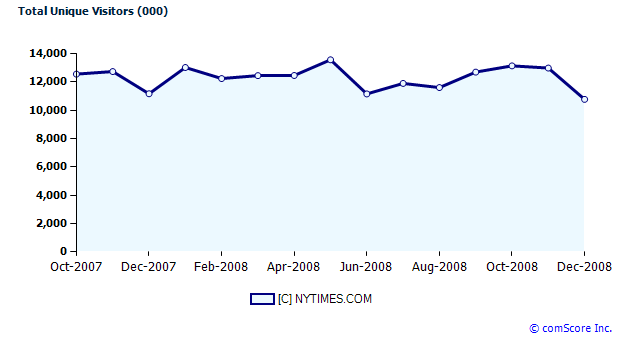
One factor that might be contributing to the decline in online advertising for the New York Times is a 17 percent drop in U.S. visitors to its flagship site, NYTimes.com. According to comScore, the site attracted 10.8 million U.S> visitors in December, down from 13 million in November. Globally, the site attracted 17.9 million visitors in December, down 14 percent. Call it post-election blues.

(Photo by matticgn).
Advertisement

Responses

Comments rss icon

  • I usual always try to look at the bright side but realistically I think we haven’t seen the worst by a long shot. Not in internet advertising, not in American or world economy and not in startup troubles.

    Why? Well all the signs pint into that direction. Companies that have been surviving over the good years just got hit by the initial downturn. That means the ripple effect is just about to start.

    It’ll be rough ride for everybody and hope is not a good business strategy. But things will eventually turn around. Now it’s time to get into the trenches and muddle through the mess.

    • yes and no. i agree that the worst has not yet come, but i disagree that in its wake we will see some sort of return to 2006. the web is showing its colors as a true winner-take-all market enabler. 80% of the web is going to become nonprofit. there’s no going back, each segment will support three players, everyone else will die. 80% of the tech workforce which has spent the last two decades reinventing each others’ sites will have to find new fields of work.

      in the 1920s, there were hundreds of small auto builders. after the depression, most of them were gone. they did not return in such numbers. and thats in a business where location might actually matter.

      • I kind of follow what you’re saying, but demand, budgeting, and the marketplace are a little different when you compare the manufacturing and sale of a family automobile to visiting a free Web site/service.

  • Social media is the future and is evolving rather quickly. Traditional and big media are in trouble.

    • I wholeheartedly agree with the above comment, Church!!!

    • Yep. Print is a dying breed, unfortunately.

    • Seriously: “social media” is a lot more telephone than television. I think you need to be careful before you engender visions of one experience wholly replacing the other.

      • Greg, I agree. I’m an avid social media user, but Twitter, et al, doesn’t replace content. Content can be expensive to produce; but how will the GOOGs of the world survive if there is less trusted content to strip? Besides, I believe NYT’s overall quarterly traffic numbers were up. Like Greg, I don’t think it’s as easy as one being “dead” and another type of media being “alive.” Only thing I’m sure of is there are many orgs. trying to figure out an answer — what it is, and who’s imagining it and going to make money from it, remains to be seen.

  • Your analogy is horrible!
    If the Canary were growing instead of dying, wouldn’t that be a sign that everything is going swell?

  • What kind of headline is that? When there is trouble in a coal mine the canary gets weaker and dies, it does not get larger.

  • I think you may be right about those post-election blues. I was “politically exhausted” after the election, and have spent little time on NYTimes.com since November. Normally I am a daily visitor, now it’s twice a week at best.

  • Post elections blues indeed. I’m looking forward to seeing a resurrection of the “Long Tail.” Social media kinda lost its way in the ground swell of Obama, Palin, Clinton and partisan bickering. Knitting, basket weaving, snowboarding, book clubs, italian cuisine, etc. is where it’s at. Even tech news is slow. Diversify or die.

  • A thought provoking quote from a piece, James Surowiecki, wrote for the New Yorker (12/22/2008) :

    “Papers now seem to be the equivalent of the railroads at the start of the twentieth century—a once-great business eclipsed by a new technology. In a famous 1960 article called “Marketing Myopia,” Theodore Levitt held up the railroads as a quintessential example of companies’ inability to adapt to changing circumstances.”

    “The peculiar fact about the current crisis is that even as big papers have become less profitable they’ve arguably become more popular. The blogosphere, much of which piggybacks on traditional journalism’s content, has magnified the reach of newspapers, and although papers now face far more scrutiny, this is a kind of backhanded compliment to their continued relevance. Usually, when an industry runs into the kind of trouble that Levitt was talking about, it’s because people are abandoning its products. But people don’t use the Times less than they did a decade ago. They use it more. The difference is that today they don’t have to pay for it. The real problem for newspapers, in other words, isn’t the Internet; it’s us. We want access to everything, we want it now, and we want it for free. That’s a consumer’s dream, but eventually it’s going to collide with reality: if newspapers’ profits vanish, so will their product.”

  • Where is the link to comScore report? Or you made it up?

  • This is great news. NYT is the poster-boy of the main-stream media, which is so deformed and corrupted from its origins, it’s ridiculous, and often criminal. Bye bye, NYT.

    • Yea! Liberal media mainstream media elite Sarah Palin should have won but the liberals in the media are running the country! Those damn mega-corporation liberals! Every liberal I know owns some big multinational corporation focused on making dollars while us conservatives are poor on welfare! Sarah Palin 2012! Obama is black! Did you know he’s black and liberal? OMG! His name is muslim! NYT liberals! If it wasn’t for the country run by liberals we wouldn’t be in this mess! I’m off to go snort some more oxycontin and smoke cigars, damn liberals!

  • Gwer – http://www.comscore.com/ … An easy Google search would have taken you there.

    Also, Do you know of the NY Times offering any discounts in their advertising? Anyone know the going rates for Ads in the NY Times?

  • The NYT is one of the more successful canaries on the internet journalistic street. It is of course a ridiculously large canary, but watching the NYT die has no upside. Bloggers breath the same air.

    • Exactly! It is astonishing how often posters on techcrunch miss the point of the posted story and fallback on tired cliches.

      The times website is easily one of the top 10-20ish web properties in the US and arguably the top media property. Certianly it is in the top 5 – in the approach to the election it had more uniques than facebook!

      This is not about old media dying it is about one of the most successful presences on the web having trouble selling advertising! And, as erick states, it is an obvious bellweather for the downturn than everyone is seeing in web ad dollars. How are people so clueless?

      • As Erick states, “One factor that might be contributing to the decline in online advertising for the New York Times is a 17 percent drop in U.S. visitors to its flagship site, NYTimes.com.”

        This may be a result of old media dying.

        How are people so clueless?

  • .. I dont really see what this post has to do with birds…

  • Article Suggestion:

    NYT is a major website with recently falling traffic. Who has rising traffic? How does this compare to internet traffic overall? Any usage patterns to report? Any changes attributable to rapid growth in international use? Any stellar specimens in reaching international readers?

    Best,
    Bengo
    LilNyet.com

    P.S. Thanks for the article. I think the problem with the NYT is the loss of great talent and infiltration by politically correct mediocrities, but that’s just my opinion after reading it for 20 years and finally giving up.

  • I’m the Web Development Director for a relatively tiny local daily newspaper in CT.

    Our web traffic is rising substantially and may actually double this year, but. . .

    That is not and hasn’t been the issue for newspapers. (at least it’s not the main issue)

    The problem is that advertising on the web will never generated the revenue that the print products did for similar sized markets.

    Even with the overhead of print production costs, there just isn’t enough revenue to pay for a workforce the size of these old establishments.

    So maybe they end up being 1/10 of the size of what they were and that may be fine because there was certainly some wasteful practice going on there.

    Unfortunately, lots of people will lose their jobs as this correction comes around.

    Eventually, your average local newspaper will look like a very successful blog.

    Five content producers and maybe a marketing/sales guy and MAYBE a tech guy (me). or they can just used a pre-installed version of Wordpress and drop me. ; )

    • I disagree about the idea of local papers becoming “successful blogs”. I’ve heard this bandied about by local market information companies before, but I believe it is imperative that local papers step up and provide a unique user experience and use all of the social media tools and philosophies out there to develop innovative solutions that enhance their product…the delivery of the news

    • newspaper columns and stories are still the best produced most consumable content on the web. the random junk that is UGC is never going to interesting interesting to mass audience at scale.

      the problem is that newspapers haven’t innovated on how to command premium monetization on premium content. the general ad-overload and lack of price discrimination based on the quality of CTRs is pretty much an artifact of democracy on the web, pushed by Google.

      imagine a local story about a restaurant opening that could be monetized by coupons from that store! i bet there is more money there than $0.05 from adsense peddling cheap medications.

  • i believe that online ad sales is a roller coaster of ups and downs.. it’s almost like watching the stock market at times

  • I think you’re right that political fatigue has something to do with the advertising dip, but I see it as being more indicative of the NYT, and news industry in general’s failure to innovate and create a better user experience. The NYT is testing out a news sharing tool that may lead to increased pagviews and therefore more possible click throughs

  • I sure they are working on viewing rich media websites, with hopes of acquiring them. If acquire the right companies that fit in their genre, i’m pretty sure they would start gaining momentum once again.

    follow me on twitter i’m pretty interesting!!
    http://twitter..../AlexanderBrown

  • Most of the news you guys print comes from these “canaries”. Besides, if this were a graph on Wall-Street, it would be FLAT!

  • NYT need new models who works. Take a look at our system. Its a fast growing ad-system that fits the media model better than any other ad-system out there.

  • Everyone making blanket statements regarding “social media/networks are the way of now and of the future and evermore” are sadly mistaken.

    To put it in simple terms: Facebook, for example, is a content-less framework made up of people with connections. Sure there are party invites and personal photos. Past that — Without media (from, say, NYT) or videos from Youtube or wisecracks from blogs there would be nothing for people to post and talk about.

    What the Times needs is a more seamless integration to a place like Facebook (a la what Techcrunch is doing). Heck, when I try to post a link to the Times without using their “share” tool on an article page… the Facebook entry has no story description nor any photo! You’d think someone would have thought of that…

  • !! I’m not Alex Brown !!

    Something is wrong with FB Connect. I’m logged in as me, but the icon to the left says “Welcome, Alex Brown. You are signed in with your Facebook account.”

    Oops. Does that mean FB has a session issue and I’ve highjacked another dude’s session?

    Hopefully it’s just your implementation of it that’s messed up.

  • Newspaper industry or Online Ad industry? {seesmic_video:{”url_thumbnail”:{”value”:”http://t.seesmic.com/thumbnail/uKYvhlY9Vt_th1.jpg”}”title”:{”value”:”Newspaper industry or Online Ad industry? ”}”videoUri”:{”value”:”http://www.seesmic.com/video/GG4PFytqOW”}}}

    • Canary {seesmic_video:{”url_thumbnail”:{”value”:”http://t.seesmic.com/thumbnail/N4VPZloqKT_th1.jpg”}”title”:{”value”:”Canary ”}”videoUri”:{”value”:”http://www.seesmic.com/video/FdBRSYmHBD”}}}

  • The New York Times produces so much content every day. Unfortunately, its value decays incredibly quickly. There just isn’t much value in providing breadth, like nytimes.com or digg.com.

    http://www.phil...enue-is-or-was/

  • Well… Looking at the graph you provide with this story. It appears to be a seasonal event — look at the whole graph. This is basically in-line with Dec. 07.

    So, sure, the ad industry and media in general are in trouble (right along with the rest of the economy).

    And I’d like to see how many SocNets (like some of the other commenters were saying) will even be around in 1 yr’s time…

    As a veteran of Web 1.0, I can see a much bigger/sicker canary in Facebook’s mine.

    SocNets, unless they include ecommerce (Threadless) or subscription revenue (LinkedIn), are toast without robust advertising $.

    Toast…

  • Be very careful when you much claims such as this:

    “According to comScore, the site attracted 10.8 million U.S> visitors in December, down from 13 million in November.”

    Seasonality is a huge factor. Absent some idiosyncratic development (such as events that generates spikes or troughs in traffic), traffic always falls sharply in December. A better comparison would be to look at a year-ago number for the month.

    Thanks.

  • One of the reasons that the online biz at the NYT saw a decline is that if you’re a frequent visitor sooner or later you’ve seen all the ads before. At that point they become a nuisance. The challenge for them is to not only shift their traditional business model to one that works for online, but to be creative enough to have fresh ad content along with fresh news content. A steep mountain to climb indeed.

    • I’m with Bill.
      NYT has a loyal fan base but they’ve seen it all and been through it all.
      We’re behind you NYT, we’ll climb the mountain with you NTY, just show us your worthy by bringing something different to the masses. I will never knock someone who at least gives a —- and tries.

  • @Kenneth G – You’re right that news needs a better business model, but I disagree that Adicate is the best option, or any other network that simply uses a targeting scheme with the same old tired creative options. Our network, Newsforce Network, is by far the best matched in terms of user experience and relevance to the news reader, and overall a better monetization strategy since it provides a truly differentiated branding/engaging placement. It also resists the price commoditization that hits banner ad networks in a similar way as rich media, because we solve for a corporate communication challenge, not just an advertising challenge.

    Ultimately, NYT should look to make itself more like CNN with a “total news” experience…and it’s well on its way I think. WSJ is doing a great job of integrating video/social since its makeover…wonder if they’re stealing any audience share?

  • Also, isn’t it possible that (increasingly) some people don’t like the material that is written by the NYT?

  • It’s the Economy stupid.

    That’s whats driving the decline, everywhere, in every stat.

    Just like Radio and Railroads CANNOT DIE, so WON’T Newspapers. Some will, but not all.

    The Valuation of many newspaper-only entities may decline, but there will be other Newspapers who will come out stronger.

    This article is ill-titled, ill-researched and ill-written.

    - imoDOTcom -

  • people do not trust the internet enough for it to be a total success for advertising. we do newspapers because we feel close to them. the up side is we are in the privacy of our domain with the internet(or so we sometimes think we are).the headlines with good stories are still good if you afford to still do that.

  • I think you may be right about those post-election blues. I was “politically exhausted” after the election, and have spent little time on NYTimes.com since November. Normally I am a daily visitor, now it’s twice a week at best.

  • I think there are constraints on all types of media advertising in the current recession. If the canary is still alive and kicking, then internet advertising is still in strong shape!

  • This is a great info, thanks for sharing.

  • A canary falling over and dying would be a sign of impending doom.
    A canary growing would be a sign that nothing is wrong.
    See this: http://www.wise...a-coal-mine.htm

Leave Comment

Commenting Options

Enter your personal information to the left, or sign in with your Facebook account by clicking the button below.

Alternatively, you can create an avatar that will appear whenever you leave a comment on a Gravatar-enabled blog.

Trackback URL
bugbugbugbug
Techcrunch on Facebook