
17.1% of all clickthroughs on web advertising are the result of click fraud – the act of clicking on a web ad to artificially increase its click-through rate – according to the latest report from Click Forensics, a company that specializes in monitoring and preventing internet crime. The level of clickfraud is the highest the company has seen since it started monitoring for it in 2006, dashing our hopes that it might hold steady in 2008. The company recorded a rate of 16.3% in Q1 2008.
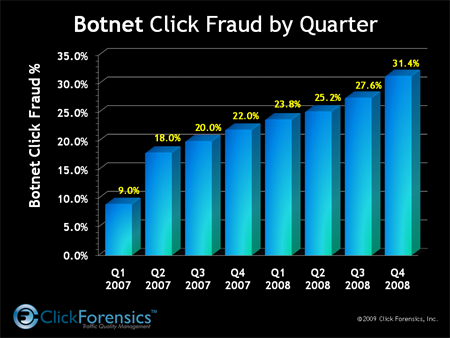
Also alarming is the fact that over 30% of click fraud is now coming from automated bots – a 14% increase from last quarter and the highest rate Click Forensics has seen since it started collecting data. Click fraud for ads on content networks like Google AdSense and Yahoo Publisher Network was up to 28.2% from 27.1% last quarter, though that figure has decreased since Q4 2007, when it was at 28.3%. Outside of the US, Click Forensics reports that the most click fraud came from Canada (which contributed 7.4%), Germany (3%), and China (2.3%).
Click Forensics also notes that it has seen a reemergence with some old-hat tricks, like link farms. The company speculates that the increase may be tied to the poor economy, which has spurred a rise in activity like phishing and other cybercrime.


How seriously do advertisers currently take this? I’m just curious, because it seems like a big problem.
High volume advertisers (read: $10m+ in AdSense/AdWords) sue – you’re talking about millions of wasted advertising dollars once the volume of clicks gets high enough.
Yeah, it’s definitely a major problem. Companies pour serious capital into these advertising mediums and expect that these click through rates are real. My thinking is that if there’s a way to find out that 17.1% of them are fraud, then you could use that same methodology to help cut down on this fraud.
http://www.schoolshift.com
http://www.dankalmar.com
http://www.twit...r.com/dankalmar
Many small advertisers also take click fraud seriously.
As long as the click fraud has the potential of being a few hundred dollars/month, it already pays to get a click fraud software.
For large PPC budgets, click fraud software is a no-brainer.
This doesn’t seem all that surprising to me. Having used Google ads in a former company I was always amazed at the seemingly endless amount of click fraud. And Google, as has been pointed out many times, has no financial incentive to investigate or stop the click fraud operators.
If fraud increases, then ad ROI decreases. If ad ROI decreases, ad bids decrease or advertisers use different ad networks. If ad bids decrease or advertisers jump ship, then Google’s revenue decreases.
Thus, Google has an incentive to combat fraud, and in fact, can gain a advantage by being better at fighting fraud than their competitors.
When Google does detect click fraud in their campaigns you will notice a credit in your billing. I have noticed that this credit has increased every month showing that this click fraud is increasing. I will defend Google here and say that Google does in fact try to detect the porblems and once the problem is found they do give you back your money spent.
I fell into the Google Profits trap. I clicked on an ad that said I had 15 seconds to order a free CD and pay shipping & handling only. I did that and would up with $200 worth of charges that I cannot afford and NO, they will not return my money. It’s a big scam and very deceitful, apparently lots off print to read.
Sherry
Click fruad reporting has always been overstated well beyond it`s real numbers to get investors to sell top search engine stock shares like Google and Yahoo. This fruadulent activity has been reported to the government .This site as well as 126 others are under watch by the government and will be fined.
AHAHAHAHAH.
If you mean that Google is being watched by the government, sure.
The watchdogs actually have Justice Department support on this, especially with large advertisers breathing on the neck of so many congressman.
pay per click will not last forever and is not the best way to satisfy advertisers or consumers. pay per perfomance and subscription based ad models will take over.
AdvertisingLocator.com – finda spot
would that really happen ?
just ads as a business model has no future. site owners have to take advantage of affiliate models that let them facilitate sales of physical goods and earn a comission on each sale.
Even performance marketing is not save from fraud (e.g. cookie dropping) – anyhow the relevant indicator in any case should be the effektive cpo.
Yes, there is the potential for fraud in every ad model. In Performance Marketing, fraud is often the result of affiliates deceiving consumers to get a non legitimate conversion. Transparency solutions help cut down on this.
No way. Editors need to earn money too and that model is way too unfair.
Seems consistent, we’ve been showing a 30% click fraud rate approximately from Yahoo Search Marketing,.
Just started buying google ads for a new project, and after the first $200 spend it was pretty obvious: 30% of the clicks I was paying for were probably wasted by click scripts.
How about decreasing your bid amount by 30% to adjust for the 30% fraud.
Wait, so 70% of click fraud is *manual*?
ahahaha… ohh boy, what a great comment. So poignant and true.
Aside from the millions of effing times I was TRICKED or even forced into clicking an online ad, the only time I’d click them is when I found I had friends in the industry.
lol… this shit is pointless… but to my friend there’s a point. SOOOO click click click for Karma
Interesting article.
On another note, I noticed the TC Homepage looked a little different, maybe fewer adds. Infact I noticed a Google based Add for the first time. Is this something to do with recession ??
Goodluck though.
These ads keep rotating, and you can find adsense and other ads randomly.
Hey Amit ,
Can u shut the fuck up ?
why the hell do u keep spamming on all blogs?
Stop pretending to know what you’re talking about.
Considering this data isn’t from a third-party research company please take it with a grain of salt. Click-fraud is ClickForensics business, of course they’re going to release a report saying click-fraud is going crazy.
EXACTLY… hell, they may even have some labs where losers get paid per 100clicks they defraud, for the same reason the other fraudsters do it… TO MAKE MONEY
someone should finds these guyss and put them away for good!
Surprising Numbers {seesmic_video:{”url_thumbnail”:{”value”:”http://t.seesmic.com/thumbnail/V9pVY9pEU5_th1.jpg”}”title”:{”value”:”Surprising Numbers ”}”videoUri”:{”value”:”http://www.seesmic.com/video/9VfIm9xgxZ”}}}
Here’s a hint, don’t invest in an internet startup based on advertising revenue, BAD idea.
23rd,
picasaweb.google.com/chriswebshare/Tc02?authkey=r40InTPHCxU#5294738096264591826
today
http://picasawe...212936977653522
I’m sure some people can pick better than me. I picked Borland after all. I always liked Turbo C++ builder. But there are WAY better things to invest in than internet companies.
I’d say it’s more like 40% fake clicks. I used to have a large social networking website and saw it on analytics.
I don’t have any investment tips except read finance.google.com, and don’t believe the hype.
Sure there is click fraud. But, for a company to claim to know what the “precise” number is a hoax.
How the hell does one know the exact number is?
Where all the class action lawsuits?
Why don’t advertisers fight back?
good products
Click fraud blows. Web site owners pay the price due to lower CPC. The big bad G needs to focus more of their smarties on this issue.
if indeed click fraud is on the rise and pay per performance and subscription is the future, let the market decides for itself, for the moment, pay per click seems to be doing pretty well, however, pay per performance in some of google adsense product appears to be dying a slow death.
ClickCaptcha, you heard it here first.
Some developer, implement this and become a millionaire. I’ll keep playing with my Ameritrade video game. (oh wait, this is real ???)
any reasonable ppc / internet marketing manager with half a brain is utilizing analytics. so what is some clicks are fraud (it’s bound to happen); as long as you’re measuring results and ROI that’s the important step. while click fraud (OMG!) may sound scary you cause at least measure what impact it’s having on your business. your full page Wired ad for 100k doesn’t tell you crap, other than you’re wasting your god damn money.
as for this bodunk company, get serious. they charge you to install their solution, obviously they are going to post that click fraud is a SERIOUS issue. please. if you have half a brain, install Google Analytics for free (or something else) and amazing the data yourself.
Well said. I would like to add that with Adwords, you can select which sites you would like your ads to appear on. If your not using this feature… then well…
I think I have said enough
I don’t really understand all the hooplah. There is no such thing as “click fraud” because there is no guarantee from Google that the clicks are legitimate (i.e., transactional intent is there).
This is an auction and if you don’t like what you’re paying for clicks — because fraud is too high — then, NEWSFLASH, bid LESS.
Agreed that Google doesn’t have an incentive to address marginal click fraud, but if all clicks were fraud, then advertisers can and will bid less.
Imagine: 1000 clicks at $.50, 50% “fraud”
500 clicks at $1, 0% “fraud”
they’re equivalent.
I have managed very large Adwords budgets and never understood this crap. If you don’t like your lead quality, bid less, and it’s the same net effect to Google, the publisher, everyone.
Alex
If that’s true(it will all self-regulate), then there should be a legal asterisk with a margin of error posted on all bids.
There isn’t.
Why not?
Dude what you say is totally true.
But i would add something to the story. If you think about it “click fraud” its still a bad thing.
The example you gave has an error. Becouse you have assumed that at 500 click there would be no fraud. It doesnt matter whats your bid becouse you still has 30% fraud activity. Regardless of the maximum bid you make. 30% is wasted ALWAYS.
if your max bid is 10 you lose 3. If its only 1 you lose 0.3. So as an advertiser you always lose.
What i would really want to know is that how this company made his “estimates”.
I agree… just bid less.
However, if a competitor is running the click fraud, then that is a different story. If everyone is getting about the same amount of fraudulent clicks, then it doesn’t make much difference.
Wow! this is pure bs. the figure is actually a lot lower then that and google already settled the amount in court.
Canada, eh?
“Click Forensics reports that the most click fraud came from Canada (which contributed 7.4%)”
en.wikipedia.org/wiki/Sponsorship_scandal
en.wikipedia.org/wiki/Airbus_affair
cbc.ca/canada/montreal/story/2008/08/30/gagliano-farm.html
Canada is the fraud capital of the world
Oh look, Harper is the exact same dirt as his predecessors
cbc.ca/canada/story/2008/02/27/cadman-book.html
All Canadians know how to do is cheat people. And make poutine. And smell and speak french, even though they know damn well how to answer you in English.
What am I investing in tomorrow. RAX at the market open. Remember when AAPL was $15, and forrest gump bought a bunch of it. I am forrest gump and I am buying RAX at open. This is just my dumb self and I do not encourage anybody else to or offer any warranty as to the fitness of my investment decisions.
nighty night.
Man, this is racism!
Stupid is as stupid does, I guess.
Jason,
I just replied to you with my newest post about the botnets since I happen to know a bit more about it. It’s the greedy people that clicked but yes I do take botnets into play as well that infected millions of people. Just go to #Bolchat
Great post overall.
Just a test to see if the function is ok.
If we were Google, we would wield out (fight) click fraud as fast as we could.
This is hampering their business model.
16% of $21.80B = $3.5Bn
Google ads seems like a pyramid scheme to me. Not to mention that as Daniel Palestran, CEO of Sermo, said : “Ads by Google is not a business model”.
Well I’m sure Daniel is not sitting at work in a hot tub like Larry Page, Matt Cutts and Sergey Brin
The pay-per-click model that is currently the norm across the whole of the Web Industry, is not only laughable but also highlights the lack of foresight from every Global Business that wants to trade online.
These Global Businesses that have no real knowledge or expertise in operating online, allow all of the major Search Engine Sites to exploit all of the IP held on their individual Web sites – and then use it as a business model across their own Search Sites.
Next these Search Sites then ask these same Global Businesses if they want to bid for certain Keywords that are usually taken from their Sites, for a Consumer pay-per-click model.
Then a large percentage of this pay-per-click model is a victim of Click Fraud, which neither of all parties even understands or plans to investigate.
There is a great opportunity out there for either a current Web Company or even a Start-Up to develop a new Business Model for Global Businesses to trade online, which does not rely on this unreliable pay-per-click model.
Instead of Microsoft wasting time and money in trying to build a Google copycat, they should look at developing this new Search Business Model I am mentioning – which in the long term will totally wipeout the current pay-per-click model.
The solution is to live with click fraud and calculate the number as risk management
Any ideas why Canada?
Is PPC click fraud any different from convenience/drug store shop lifting? It’s undeniably wrong but the cost to prevent the crime is so high that the only real options are stay away from the business or build the cost of the crime into your pricing. Convenience stores learned how to find markups that allow them to stay profitable in spite of shop lifting, I assume any reasonable PPC advertiser has learned to do the same.
At the end of the day it’s just an ROI argument. I’m sure there are exceptional cases of egregious click fraud that merit legal action but for the vast majority of cases isn’t it safe to assume that all advertisers can/should do is compare marginal cost against marginal revenue in order to determine how much to pay for a click?
Does anyone konw the % of Google Search click fraud compared to the % f Google Content Network click fraud ?
Thanks.
Hey — does anybody have click data sets available? I built a few click fraud detection algorithms a few years ago and still haven’t been able to test them .. ping me if you’re interested.
This problem has been around for ages. If there is any increase in it’s reporting it is probably due more to an increased ability to detect fraud than anything else. And I agree with some of the other commentors that google has known about this for a long time and has no incentive to do anything about it. I can’t tell you how annoying it is to do a search and being taken to pages/sites that are just garbage text filled with nothing but google adwords. There are many thousands of these sites.
Good bot or other softwares can easily track and trap these fraudsters.
YOU SHOULDN’T BEING USING PPC AS A LONG TERM FIX ANYWAY
Have you heard about SEO???
I always thought clickthrough advertising was a joke.
Click fraud is a real serious problem. When I dealt with Yahoo, I had to fight tooth and nail to get back the $30-$40k per year they gave me. In fact they could not track it down themselves, I had to tell them what amounts were fraud (I guessed) and they gave it back to me! What a joke. Even though they could not identify the fraud clicks, they gave me money back!!!
Even though our clicks DOUBLED for the month, while ROI and sales stayed the same they still “claimed” they could see no irregular activity.
If the FBI can trace down hackers, why can’t Google, Yahoo track down and prosecute click fraudsters? Because it hurts their revenue and scares advertisers off.
Click fraud is a huge problem that small and big advertisers can’t overcome. At least larger ones have account managers or can afford to pay for detection software.
PPA (Pay Per Action) is eventually going to take over. Google doesn’t want it because they will make WAY less money on it. Not just because of click fraud, but because the ratio of clicks to sales will not provide equivalent revenue numbers. Google can’t jeopardize its $16 billion plus numbers to move to PPA even though advertisers would benefit. Right now, advertisers make less, while Google gets more.
It will take a company to come out and knock Google into a PPA model, it will come, not sure from where or when, but it really has to.
It is serious…if you consider that X-amount of your advertising budget is going up in smoke thanks to click fraud.
We offer internet retailers a flat-fee based pricing model. Users can click as many times as they want, so you never have to worry about click fraud.
If you’re looking for a better online avenue for selling your goods, check us out at http://www.sortprice.com
Click fraud was big in the late 90’s and has come back around because the industry has not put anything in play to protect against it.
Simple analytics and payment 30 payment cycles would cut down on this dramatically.
Affilaite networks are so hyped to get affiliates they pay out daily or weekly which does not give them the time to look at the traffic and detemrine how clean it truly is.
As sites like MySpace crack down on spammers and make it near impossible to spam on the site, these cyber fraudsters are cash stepped in this economy and are pulling out all the old techniques like click fraud, marrying them up with their bot nets and getting away with it.
Affiliate networks make a commission off the traffic thus they will not regulate the traffic and end merchants dont know all the techniques thus they can not regulate it.
Answer is eliminate pay per click promotions or the end merchant can pay the affiliate networks a higher amount to verify the traffic is clean. Bad traffic will equal a temrination of the contract and a penalty of 10% of all monies paid out.
Hurt the affiliate networks bottom line and they will be forced to clean things up
The numbers were gathered by a company that benefits from click fraud so should be taken with a grain of salt.
I am just as curious as some of the others here on why Canada is tops for click fraud. You would think other countries with bigger populations would out do Canada in click fraud.
i can see why there would be alot of click fraud at the time the economy is down… it’s online easy money!
Click fraud is an incredibly over-stated issue because it’s already baked into ROI & conversion calculations. The correspodning spend calculations would go up or down inversely, depending on level of fraud. It’s also kind of ridiculous to discuss this, given that you’re already talking about THE most accountable form of advertising. Marketers should be far more concerned about the fraud of broadcast spend, which is dictated by a sample of several thousand Nielsen panelists for 300 million Americans; or the fraud of inflated readership numbers by the dying print media business. This is a total non-story.
Click fraud is part of the new enonomy. Millions of people who have become unemployed have turned to click fraud to help suppliment their income.
Much like the envelope stuffing schemes back in the pre-internet days click fraud is seen by many as a salvaion in these difficult times.
The latest incident with Hotels Combined people is very bitter experience for any publisher. Hotelscombined is engaged in some sort of scam on the name of fraud click. When it comes to pay-day, they will just send you an email telling that your account has been closed due to fraud click activites and there will be no payment whatsoever. This incident happens with hundreds of publishers every month between 25th to 30th. If the publisher payment is more than 200 US$ than you will definitely receive such email.
New publishers keep joining them and cycle goes on.
God Bless you!!!!! It only happenned with us yesterday. Hotelscombined.com eat-up our US$900 yesterday simply by sending an email. We cannot login to our account, access is denied and our money has gone!!! This is crime! We’ve spent lot of money on adwords and other cpc programs to promote hotelscombined.com but these people are thiefs. Their headquarters are in Sydney and it appears that it is an Australian group of thiefs. Can anyone suggest if there is any kind of law against such crime?
I doubt that click fraud has risen due to the economy downturn. People are always trying to find ways to take shortcuts or buck the system and PPC advertising is just one of the ways they try and do this.
Where does the click fraud happen? I always have a consistent CTR on all my sites and all the clicks are genuine and the few people I know that operate sites also get consistent CTR and none would ever dream of clicking on their own ads or on others deliberately.
I honestly think Clickforensics figures are rather inflated. Its in their interest to make the figures appear worse than it actually is.
Definitely true. I have had some small sites, with 2-3 clicks a day, and then overnight, have 30 clicks until the max was reached!! Totally fraud!
http://www.techsupport4nyc.com
Its good that Click Fraud is being recorded and steps are taking to control it. If you must know google is banning 1000’s of publishers adsense accounts everyday, if it finds out anything related to invalid clicks. And returning the money to advertisers.
I have noticed through click fraud detection programs that the numbers are not that inflated and that they are indeed very high. I have noticed this though 3rd party trackings tools. What i personally do is use one to manage all of my ROI keyword information and the tool prevents and detects all click fraud. I then take the report to Google, Yahoo or MSN to get the money that they owe me. It has worked out great until now.
Michael Baker — http://www.adtr...ckerreviews.com
At order.com we are getting ready to launch a new solution to this horrible issue. Flat pricing shopping comparison. Click fraud is ruining the industry
George Passariello – http://www.order.com