
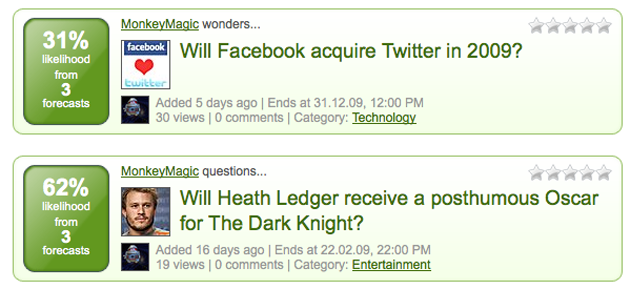
We all love to prove that we’ve been granted the gift of foresight, either through our wealth of knowledge or more fantastical means, like The Force. In the last year or so major websites have been trying to capitalize on this by introducing “prediction markets”, which allow readers to make guesses about upcoming events ranging from hot news items to celebrity gossip, and also generally significantly increase page views and engagement.
Today sees the public launch of a new prediction site called Nostradamical (named after the well-known seer) which is emphasizing the social nature of making predictions. Users initiate predictions in articles similar to brief blog pots, where they can include videos, photos, and text describing why they think something will happen and why it is important.
Once a prediction has been created, other users can leave their own thoughts and use a Digg-like voting system to raise the most interesting predictions to the top, and can also syndicate their predictions to FriendFeed and Twitter. Users that are the most accurate gain points (called ‘Future Minutes’), and can rise in ranking on a 7-level pyramid.
Nostradamical has a fairly attractive and intuitive interface, and some users may enjoy the emphasis on community. But I think the likely winners in this space will be the ones that can integrate into other sites - prediction markets seem like more of an added feature than a standalone community (Nostradamical is going to offer applications on social networks to expand its reach). And the site is getting a late start: it is up against some more established companies like HubDub (which just annouced a new founding round) and Predictify, both of which are already appearing on the websites of some major content providers.


See all


For now, this site seems useless. We’ll have to wait till predictions are proven right or wrong before we can tell if this is just another website, or something of value.
This view is a bit pessimistic I think.
I understand that Techcrunch covers new ideas and startups, but do you really have to cover braindead ideas and startups? What, if any, is the point of such a “predictions” site? It’s a complete and sad waste of time, and investor money, if any is involved. In no way, does this add any value! “Predict world events”. LOL.
And three cheers for their originality - it has become routine, boring, and cliched hearing startups follow the same path, plugging into social networks. Yawn. What’s next? A Nostradamical iPhone app?
I am disappointed.
I agree with you on this point. I can’t imagine why someone would shell out money for this. It’s not new. It’s not better than the competitors. And the ad-based revenue model?
This is going to be one more addition to the long list of useless “web 2.0″ sites that claim to harness the power of the “social factor”, “the community” and such buzz phrases. Moronic really. If there is really an investor involved, I have to hand it to him. What a dumb ass.
I mean can they transform this predictions site into a marketplace where people can bet on predictions? NO, because that would amount to gambling, which is illegal in many countries. So what’s left - ads? Yuck.
I completely agree with you all. This is not only a waste of time but a waste of scarce dollars
I don’t know if you should be THAT harsh on this idea.
Look at dotblu
http://www.quantcast.com/dotblu.com
They have about 1/2M uniques and are growing another 500K and they can offset with their tech expenses with some direct response and branded advertising.
That being said they are probably a bit late too the game and need to have a unique distribution strategy.
I’m sure people are waiting to see if the same thing happens to Apple that happened the first time Steve departed. You’re right - his return to Apple in the 90’s is what saved the Company. Let’s just hope that the next person to take the helm has what Steve refers to as his ‘vision thing’ skill.
Steve’s resume: http://tinyurl.com/74b74
Robin Ogden
I’m sure people are waiting to see if the same thing happens to Apple that happened the first time Steve departed. You’re right - his return to Apple in the 90’s is what saved the Company. Let’s just hope that the next person to take the helm has what Steve refers to as his ‘vision thing’ skill.
Steve’s resume: http://tinyurl.com/4rdhmc
Robin Ogden
Not only this is a waste of time, but contribute to tons of CO2 and globe warming by using electrical power.
I’m sure people are waiting to see if the same thing happens to Apple that happened the first time Steve departed. Thanks
You’re right - his return to Apple in the 90’s is what saved the Company. Let’s just hope that the next person to take the helm has what Steve refers to as his ‘vision thing’ skill.
http://tinyurl.com/jugar263
“prediction markets seem like more of an added feature than a standalone community”
What?? Heard of Intrade?
You’re missing the point. This is primarily a media site based around a unifying idea. It’s a multi-user blog that can generate user-filtered content faster and better than the gazillion one man blogs out there.
Ever taken a gander at CreateDebate?http://www.createdebate.com
Not a prediction market per se but an interesting way to help people make decisions.
There is a lot of hype around prediction markets right now, particularly as a tool for enterprises. Having ten years of experience in the enterprise area of what is sometimes (poorly) known as ‘idea management’, there is plenty of evidence to show that prediction markets are not an effective enterprise tool, and even if they do partially work, there are cheaper and more effective ways of achieving the same goals.
I am writing a paper on this right now, but I can share just one of the problems…
Pubic domain prediction markets benefit by having access to millions of internet users - and so the number of potential visitors to these sites is relatively high. Given a large number of potential visitors, is is not impossible to get good traction. Moreover, when the prediction market is on a simple task where there is great interest, such as an election or working out who will win the World Cup football (soccer!) there may even be a reasonable amount of trading going on.
In a company world, the dynamics are quite different. People do not have time to waste to go into a system, read a large number of ideas or options, and make a reasonable judgment. Also there are obviously fewer employees in a company than there are global internet users - which means that you are playing with fewer potential visitors and contributors to start with.
In a company world, you would like to process several topics at the same time, not a simple ‘yes or no’ option for a known problem. The time it takes to cognitively process the idea and related content is not trivial when you are looking at 20 - 50 ideas… and this session duration rapidly extends to being ‘unreasonable’ in terms of time (ideally a session in a volunteer system like these should take 4 - 6 minutes, and not more than 12 minutes - unless it is part of your day job). So the volume of content and the fact that people have day jobs, dramatically reduces the activity rate within a company prediction market system.
Having said all of that, there are other ways of tapping into the collective genius - mass intelligence - whatever you want to call it - to solve problems faster, better, cheaper. I would urge people to have a look at Imaginatik (www.imaginatik.com) as we have coimbined web technology with a people and leadership process to actually deliver real benefits. For example, just in cost savings alone we have firms like Wal-Mart reporting $36m+ benefits from using crowd intelligence to save money on electricity consumption. Our web site, incidentally, has several case studies on the topic.
Thanks for the article!
Mark Turrell
CEO, Imaginatik plc
http://www.imaginatik.com
Hi Mark –
Not so fast. Many large corporations are achieving enormous benefits w/prediction markets. They are not experiencing any of the problems you claim. In fact, outstanding results have been achieved with rather small populations. Visit the PM Cluster for more information…
http://www.pmcluster.com
Also, nice to hear from you again and Happy NY!
Cheers,
-j
http://www.linkedin.com/in/jheuristic
@Mark:
Can you give some references for the evidence shoving that prediction markets are not an effective tool? I would argue that there is a lot of evidence showing exactly the opposite - that prediction markets actually do a very good job as an enterprise tool, e.g.
Intel on how to manage demand risk with prediction markets:
http://www.intel.com/technolog.....stract.htm
HP on their success with using prediction markets in sales forecasting:
http://www.hpl.hp.com/personal.....020408.pdf.
Jeff Severts from Best Buy in a Mckinsey video interview on how Best Buy use prediction markets:
http://www.mckinseyquarterly.com/Video?vid=3
General Electric whitepaper on why idea markets are superior in idea generation:
http://www.springerlink.com/co.....58u2l4324/
Also, I think it is important to distinguish between prediction markets and idea markets.
One of the very positive findings from HP is that prediction markets are efficient with as little as 12 participants. Getting efficient prediction markets is more about involving people with relevant knowledge and information than just involving large crowds of people.
Getting people to participate is another game. It’s a game of user adoption, usability and motivation. These are in my view general challenges for any (enterprise) software, be it prediction markets, time tracking or idea management. I would argue that prediction markets (or idea markets) are actually better at creating participation, because they actually give people incentives to participate.
As I read your comment, your point is “… the volume of content and the fact
that people have day jobs, dramatically reduces the activity rate within a
company prediction market system”. Please correct me if I’m wrong, but again I would argue that this isn’t limited to prediction or idea markets.
Regarding content, I acknowledge that in idea generation a lot of content is created, especially when involving many people. I would argue that you would need to read through the same amount of content whether using a software like yours or using an idea market like our Idea Exchange http://nosco.dk/product.html. But the beautiful thing about a market is that nobody need to know everything about everything since the price mechanism serves an efficient coordination mechanism of peoples knowledge and information (as Friedrich Hayek proves in The Use of Knowledge in Society). Voting mechanisms does not do the same.
Also, whether you vote or buy shares in ideas doesn’t affect participants’ time consumption. The only difference is, that you have an incentive to keep following and collaborating on the idea when you own shares in it.
Best,
Oliver Bernhard Pedersen
http://www.nosco.dk
Hi –
The PM Cluster network has been tracking the explosive growth in prediction markets and collective intelligence since 2004. There have been some small regulatory and political bumps along the way, but there is enormous growth, popularity and success. The next PM Summit and Collective Intelligence Coference is next week in SF.
http://www.pmcluster.com/SFO09.htm
Registration is open and all are welcome.
-j