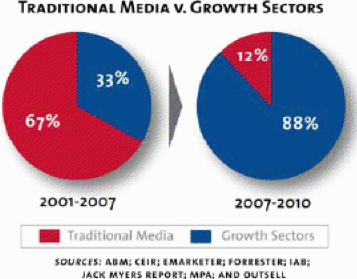
Yet more evidence that the future of media is digital (in case there are still any doubters out there). In a report released this morning, boutique investment bank Jordan, Edmiston Group estimates that between 88 percent of the publishing and advertising industry’s revenue growth over the next few years will come from four sectors: Database & Information, B2B Online Media, Consumer Online Media, and Interactive Marketing Services. In other words, it will be coming mostly from the Web. In contrast, between 2001 and 2007, only 33 percent of industry growth came from these sectors. The other 67 percent came from traditional publishing businesses such as newspapers and magazines (formerly known as print media—the report does not cover TV, radio, or outdoor advertising).
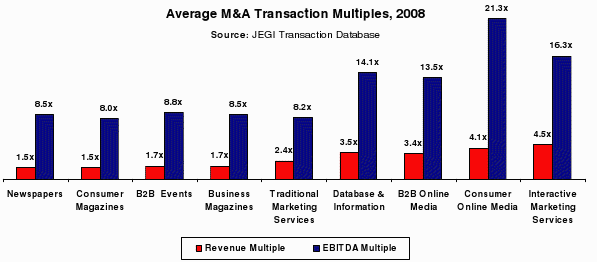
To the extent that there will be any growth at all in the publishing industry, all you need to do is look at the multiples paid for different businesses to see where the growth is going to be. Last year, consumer online media companies sold on average for 4.1 times revenues and 21.3 times EBITDA. Database and information companies sold for 3.5 times revenues and 14.1 times EBITDA. Consumer magazines, on the other hand, sold for only 1.5 times revenues and 8 times EBITDA. Newspaper multiples were about the same (1.5X and 8.5X, respectively, see chart below).
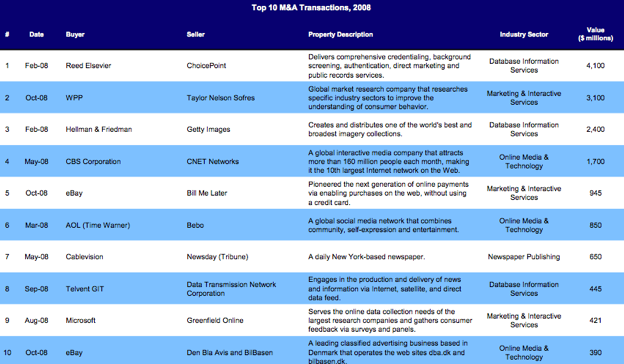
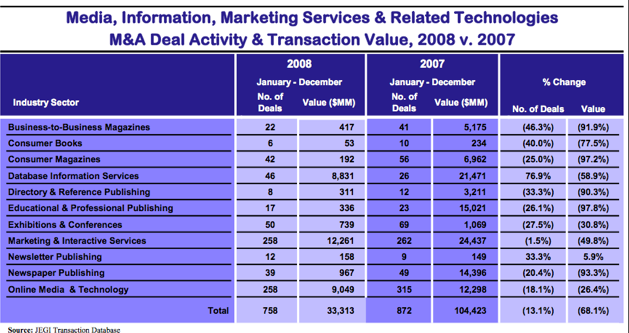
In a year when the value of venture-backed mergers and acquisitions were down 51 percent, M&A activity in the publishing industry was down even more. Jordan, Edmiston counts a 68 percent drop in the value of publishing media deals from $104 billion in 2007 to $33 billion in 2008. Most of these are not venture-backed startups, but many of them were tech-related. Among the top ten media M&A deals in the report are CBS’s $1.8 billion acquisition of Cnet, eBay’s $945 million purchase of Bill Me Later, and AOL’s $850 million acquisition of Bebo.
The Top Ten Media M&A Dealsof 2008
- Reed Elsevier buys Choicepoint ($4.1 billion)
- WPP buys Taylor Nelson Sofres ($3.1 billion)
- Hellman & Friedman buys Getty Images ($2.4 billion)
- CBS buys Cnet ($1.8 billion)
- eBay buys Bill Me Later ($945 million)
- AOL (Time Warner) buys Bebo ($850 million)
- Cablevision buys Newsday ($650 million)
- Telvent GIT buys Data Transmission Network ($445 million)
- Microsoft buys Greenfield Online ($421 million)
- eBay buys Den Bia Avis and BiiBasen ($390 million)


Great post. Interesting
the money is going to this noz http://www.then...z.wordpress.com
Why is the acquisition of “Bill Me Later” considered to be media M&A deal?
Because they’re going to Tweet everyone’s invoices, and create rich, widget-izable, customized headlines of who’s behind on payments. I’m sure it will leverage the social graph, so that this can be broadcast synchronously with your other updates.
Just my $.02
So thats great for big companies or embrace the web… but what about local companies who aren’t exactly fort. 500 but have a strong regional saturation….
Moreless, what Im saying…. is how will “Joes Honda” buy media…..
It’s interesting how the difference in number of deals between 2008 and 2007 isn’t relatively that large, but the difference in the value of those deals is huge. Just shows how the valuations and the amounts that these companies were being bought for in 2007 were ridiculous.
A musical farewell to the magazine business:
http://www.yout...h?v=EjlvYOmXLc8
funny link. can we safely say that companies purchased have all lost 50% of there valuation since purchased?
I believe print as a medium will continue to decline and eventually die to the power of the digital media. Another decade or two and I would say goodbye to bookstores, news stands, etc. My younger sister didn’t know what a record was. Next generation wont know what a book is. Oh, and don’t forget about the flying cars.
Jesse,
I don’t think print as a medium will go away completely, but I think it will change significantly.
I think the content will change more than anything. The days of print as a medium for the news are very limited indeed and will probably change sooner than 10yrs.
A good case study could be the Snail Mail / Email situation. Snail mail is still around, but it’s role has changed in our society.
I believe it may be a similar situation here.
(but, I could be wrong)
You’re right, Troy. No new media have completely replaced previous media. The only thing that changes is the format (CDs instead of vinyl and magnetic tape, for example) and business models (gone is most local TV programming, besides news; Radio shifts towards conservative commentary).
Radio did not kill newspapers and recorded audio media. Television did not destroy radio. Sure, certain businesses with outmoded models failed, but the surviving businesses in a particular medium shifted focuses, adapted to the new landscape.
That said, the Web, with a better infrastructure and enough bandwidth can replace all these things and then some.
It’ll be interesting, that’s for sure.
there will never be a better replacement for reading a good book, magazine or newspaper when your sitting in the restroom. it will never be completely over for print media.
PrintingLocator.com – handle media
I think it has to be noted that people are choosing to receive their information in a different fashion. It’s more convenient to get your news from a podcast on your Zune/iPod than it is to unfold a newspaper while on the treadmill at the gym. It’s faster to “tweet” news than it is to write notes and publish it later (evidenced by Chris Brogan’s tweeting from CES this week). Society changes on a larger scale, yet the smaller markets will still want things delivered the “old fashioned way.” We all do at one point or another, whether it be for nostalgia or circumstance
Over at oDesk, we have been seeing a large amount of web growth.
Tech work related to blogging has really gone up in ‘08
http://www.odes...skills-in-2008/
and overall demand on web technologies are our highest areas
http://www.odes...php-ajax-mysql/
The web migration of media is old news to most people that read this site, but shockingly lots of small and medium sized publishing businesses out there still just don’t get it yet…….
There is a somewhat fine line between the digital/tech lifestyle and those that just take part in it due to necessity. The direction of the trend is clear-100 year old print newspapers are losing readers year after year with their only growth in online literature. I listen to the conference calls of these firms at work occasionally, everything from the New York Times to the Wall Street Journal.
Great article.
What about the purchase of Reuters by Thomson to create Thomson Reuters? That would be a new #1 on the list. I think it was for around $14B.
Database Information services looks really good. Any examples?
So Micheal, I guess this would go against all your ever-scaring articles about how the IT industry is doomed beyond return…
Dealflow in this industry will not diminish in the near term. The challenge is identifying those intersections for optimizing harvest in the mid-tier companies. Is AdMob on someone’s radar?
As CEO of a publishing company which focus in a niche b2b markets these findings are not suprising or scary. We run a blended approach, luckily we have the leading procurement magazine in Europe and one the one of the top online portals for procurement executives. At present the blended model works well as readers still want are willing to pay for the printed magazine and advertisers still want advertise. However recognize in the future these trends will change thus we invest heavily online for new product releases and brand extensions.
The biggest change I think we will see in the niche B2b space in the next 3-5 years is the death of the controlled b2b magazine, which will be replaced controlled enewsletters and websites.
Finally, I’ve been telling my B2B colleagues this for at least 4 years. Better for me if they keep their heads in the sand!
Great article. Thanks!
just because a investment bank writes an article it doesn’t mean they are right … after last year i would actually doubt anything they, or for that “the money” says. it seems to me money is usually a bad indicator of actual trends.
then, what is it with ebay showing up on this list … and especially their acquisition of bill me later? neither of those companies are media, or even marketing. i can come up with all kinds of data if i mash up data sets. they could have just thrown US auto companies together with newpapers and shown us the downward trend … hey people listen to the radio/media in their cars.
i am sorry, but this is one of the weakest pieces of research i have seen in a long time to make a point that yes is obvious … the print media have a problem in the US. but that doesn’t mean those companies are doomed.
This shift applies to any business – even local as questioned above (e.g. add an information product to your offering, start advertising online, set up an affiliate program).
This is all driving demand for smarter ways to advertise and that includes affiliate marketing.
Don’t have a business? Looking for a J.O.B.?
Jobs in Aff. Marketing are opening up too…
Ref: http://www.affi...-marketing-jobs
Great information and comments which I wanted to thank you for. Love the opportunities in affiliate marketing, and hope to figure out how to explore them.
Here is the link (http://tinyurl.com/6wynvb) to the Peachtree Media Advisors, Inc. year-end report summarizing the M&A activity in the interactive and out-of-home media sectors in 2008.
The highlights from online media M&A in 2008 are as follows:
In 2008, there were 707 merger, acquisition and capital raise transactions in the online sector of media (92 more transactions than the 615 in 2007). The 707 online media deals were comprised of 348 capital raise transactions and 359 acquisitions.
The $16.9 billion in reported deal value in 2008 represents a decrease of 62% from the $44.4 billion in reported M&A transaction value in 2007 for all of the U.S. online media sectors. The 2008 reported deal value by sector:
o Consumer – $6.2 billion (36.7%);
o Business – $4.8 billion (28.4%);
o Mobile – $592 million (3.5%);
o Enabling – $2.5 billion (14.6%); and
o Commerce – $2.8 billion (16.7%).
In 2008, $3.5 billion in reported deal value of venture capital flowed into all sectors of media, representing a 22% increase over the amount of reported $2.9 billion in capital raised in 2007. The Enabling category had the largest increase in the amount of capital raised attracting $892 million in 2008, which represents a 124% increase over the $398 million raised by the sector in 2007. The Mobile sector also saw significant gains in investment capital. The Mobile category raised $341 million in investment capital in 2008, representing a 488% increase over the $58 million raised by the sector in 2007.
The top five sectors in terms of volume of transactions (not reported deal value) for equity raises in 2008 were as follows:
o Video & Online Games – 59 capital raise transactions;
o Social Networking – 57 capital raise transactions;
o Web Applications/Enabling/IT – 47 capital raise transactions;
o Mobile – 35 capital raise transactions; and
o Blogging/User Generated – 27 capital raise transactions.
Best,
John
John H. Doyle II
Managing Director & Founder
Peachtree Media Advisors, Inc.