If you could search your friends’ thoughts, interests, and activities, would that be a better search experience? In many cases, it would be. Searching for restaurants, books, or movies, would turn up recommendations from people you actually know. If you are researching a trip to Florence, Italy, you might discover ten friends who have been there already, and could ask for advice on what to do. These scenarios have been the dream of social search for a few years, with both startups and search engines taking a stab at it. But so far it’s been a failed dream.

Yahoo’s experiment with social search, Yahoo 360 MyWeb, never took off. is being shut down. It was a rudimentary social search in that relevant bookmarks from friends showed up as search results. And search has never been Facebook’s strong suit. It handed search over to Microsoft, but the search experience on the site is poor. It is difficult to search much deeper than your friends’ names. You need to go to an advanced profile search page to filter through their interests, activities, or other profile categories, for instance. And forget about searching your news feed.
Yet social search done right could become very valuable for Facebook. And it would be even more valuable for Google. (They already know how to make money from search). It is also an opportunity for Microsoft Live Search, but they are not really inspiring much confidence so far. So let’s set aside for a moment the unlikelihood of any Google-Facebook deal or partnership (given Microsoft’s investment in Facebook), and let’s imagine how the two could help each other.
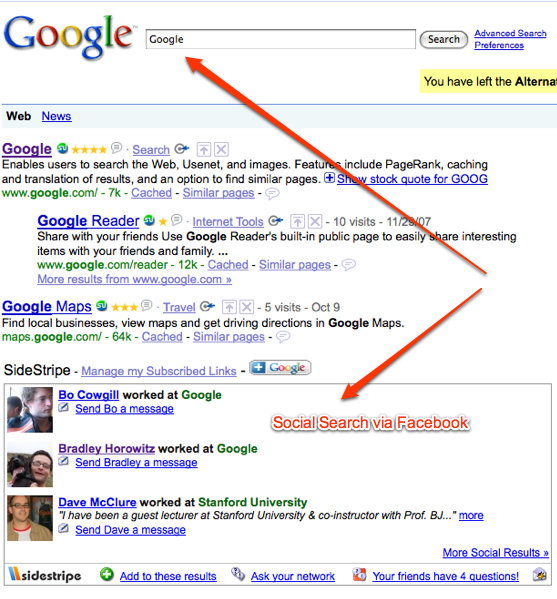
Even if Facebook/Microsoft figures out social search, it is more useful on Google, which is where most of us do our searching. To get a glimpse at what this might look like, you can try Sidestripe, which is both an add-on widget for Google search and a Facebook app. Sidestripe is like Glue for search (Glue is a browser add-on that shows you whether anyone in your social networks has expressed interest in the book, movie, restaurant, product, or other things mentioned on whatever page you happen to be browsing). Similarly, sidestripe indexes all your friends on Facebook and parts of their profiles (where they work, their interests, etc). When you do a search on Google, a box with Sidestripe results appears after the third natural result, giving you a sense of whether any of your friends might be experts on the topic. For instance, when I do a search for “Google” it turns up Facebook friends who work at Google or are somehow affiliated with Google, and looks like this:
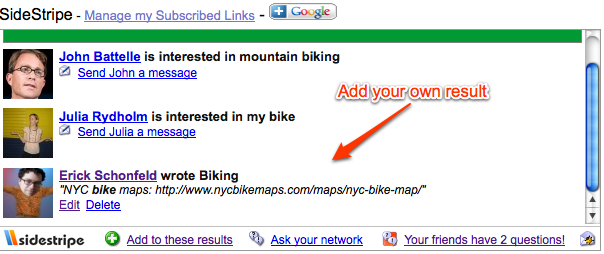
A search for “biking” turns up friends who are interested in biking. You can also add your own knowledge to any search result, and it will appear as a subsequent result (although it does not let you add links, which I consider a major bug). Or if you still can’t find what you are looking for from either Google or Sidestripe, you can ask all of your friends a question from inside the Sidestripe box on Google about the topic you are trying to learn about and that question shows up in all of your friends’ feeds. Any answers then become indexed and searchable.
Sidestripe is barely out of alpha and still frustrating to use because more often than not the Sidestripe box remains empty. When there are results, they are interesting. It is hit or miss. As more people use Sidestripe, this should improve. But I think a big part of the problem is that it does not fully index my social graph, and certainly does not return results from my News feed.
Yet making Facebook’s News feed searchable (on Google) would go a long way towards realizing the dream of social search. The Facebook feed already aggregates what my friends are doing not just on Facebook but all across the Web (Twitter, Flickr, YouTube, Digg, etc.). It’s like Friendfeed in this respect, but with many more users.
The trick to making all of this seemingly random data useful in search is to come up with a social algorithm that can rank it all accordingly. For instance, when I search for Florence, Italy, friends who have lived in Florence, Italy should show up, but so should friends who have recently taken pictures there or Tweeted about Florence, and maybe in that order. This kind of ranking is a hard problem to solve, and it is what Google is good at.
Imagine instead of Sidestripe, the option to add Facebook Connect to Google search, which would then turn on social search in results (these should only appear when there actually are social results to show). They could keep the Q&A capability in there as well. It would add an entirely new dimension to search.
Of course, Google has its own Friend Connect program, and wants to monetize it with Friendsense. But just as search is not Facebook’s strong suit, social networking isn’t Google’s. All my contacts are on Facebook. They are the ones I want to search. And everything I’ve described above is a big opportunity for Microsoft, if they can pull it off.
But the best results, IMHO, would come form a combination of Facebook and Google.


See all


Agreed Mike. There is a good possibility that Google can chance that in 2009 since social network monetization is turning out to be much difficult. If not buy out then there are similar other possibilities for Google too!
But would be watching this space much would be unfolded in coming year.
—
Sampad
this is eric’s blog, mike’s not here.
my name is sampad swain…. i own a mansion and a yacht.
the future of social is open id portability and the positioning your open id widget on strategic niche vertical channels. the sooner fb users can get out of the fb box and into the net in a balls to the wall open id social format, the sooner they can mature and become social networking adults.
BuyLocator.com - purchase paradise
Great to see the conversation shift. Hope Erick didn’t mind that mistake
—
Sampad
Stop Spamming you retard.
Freudian analysis:
Mike wrote the post. Mike is the author of the first comment. Mike replied to the first comment. Eric is happy to have his job.
Scoble had this harebrained idea years ago, I can’t believe you just blathered four pages about it.
Sounds like you need a break from your Facebook cult. Nobody cares where your friends went on vacation.
umm sure hey do..friend referrals are still the best way to sell
Yeah, friend referrals are still the best way to sell….only if you trust that facebook contact..
Facebook is overpriced IMO - there is no way Google should shell out that kind of cash.
Not saying it isn’t a potential good purchase, but they are FAR overvalued. If Google could get it on the cheap - buy buy buy. But 15+ billion? Please.
Not going to happen
Facebook and Google have a rivalry going on because Facebook has invested a lot in having a walled garden or at least a garden they control. Google would love all that data I’m sure.
mark wont sell it anyway
In your headline you proclaimed “Google should buy Facebook”, then went on to list reasons why Google won’t. Sigh.
You see, negating yourself is not self-deprecating, and only the most forgiving would find amusement here.
You praised “social search”, then mentioned Yahoo tried and abandoned it.
Google and Facebook have in many ways totally opposite philosophies (for instance, one is open, the other is closed), plus, the commercial reality that Facebook is firmly allied with Microsoft makes Google’s purchase of Facebook a zero possibility.
Yeah, earth is round, no, earth is flat, no, earth is square… It’s good for a Saturday Night Live skit though.
Which one is open? If you say Google, how so?
Sorry, the world is “complicated.”
Earth is round AND flat.
You can’t argue with someone who take two positions at the same time.
Do you understand? The world is not all black OR white.
Adam: “Earth is round AND flat. You can’t argue with someone who take two positions at the same time. ”
What you actually mean is that the world is a flat disc, which of course it is.
Depend on how high you are??
Goog should add full social networking functionality to Gmail. People want to log in just once and have access to one place for email, IM, social networking, etc. Goog should try for domination by becoming the only major site that provides all of these things from a single interface? Buying facebook is not the way forward.
They will, they are… Igoogle, Picasa,Youtube, Gmail, Gtalk…
They really dont need facebook.
Seb
sigh….
I thought you wrote *good* articles?
my only problem with this is people just don’t use facebook to search.
if people want to search they google end of story, its what people know. if they want to chat or keep up to date with friends they facebook.
I think the future of earnings are classifieds and music etc. Also I wonder if direct marketing is an option (lets say coke add a new application aimed at a demographic and then pay facebook to send a message to that demographic about it).
right, that is my point. It makes more sense to search Facebook from Google.
on fb we tend to use fb’s search for friends and the browser search for other sites…
Facebook is only a subset of the social media graph and as mentioned above a closed subset…
You should revisit the Delver social search experience.
Typo: I meant http://www.delver.com
It happens to be the biggest subset by far, and there is nothing stopping Facebook from ingesting other social media activities from across the Web in people’s news feeds. Already happening.
If Facebook can’t monetize it, Google won’t be able to either. At the end of the day, it’s not a business. Facebook is exactly what it says it is, a ’social utility’, a.k.a, a place to go where people don’t want to look at advertising.
What a coincidence, this is exactly what http://www.tallstreet.com/ have done.
I think at the end of the day that’s the biggest appeal of social networks. Being able to have everyone clustered on one website and to know the likes and dislikes it huge and eventually someone will be able to monetize it. If Google ever purchases a network with potential, the output could really be scary. With valuation where they are these days, if Google could buy Facebook, it would be a great do!
I’m not thinking that Google would buy Facebook because … Google probably thinks it can build much of the the functionality on it’s own with that it already has from Google Accounts, Google Reader info, Google SearchWiki.
Seems to me that Google would reason that it doesn’t need Facebook to realize the Social Web - and, perhaps, it’s the other way around - Facebook might need Google.
But that would be more of a partnership, not an acquisition.
I like Google, and I “love” Facebook, same as I like salt and sugar in my food and drinks, but I don’t even want to think or let alone imagine that Google should acquire Facebook. It won’t even pass the Fed’s anti-trust commission.
However, if Yahoo could get a chance to acquire Facebook (to help bring a little life back in Yahoo), or Microsoft, which has already poured lots of cash in Facebook, then that would step up the competition in order to effectively rival off Google, and that would leverage the playing field.
Erick, you’re not looking at search the right way. I’d place my money on Facebook/Microsoft coming up with a way to make searching for information on Facebook easier. Also, you’re argument for Google is weak. You say that social search on Facebook would be useful but more so on Google since that’s where most people search.
First, didn’t most people search on Yahoo! and AOL and other search engines before Google?
Second, you’re assuming that people will continue to want to conduct searches primarily on search engines which might not and will almost certainly not be the case. I think the direction of social search is going more in the direction of Twitter and Facebook.
I also think that much of search and Internet activity will go back to portal style but in social contexts like Facebook.
A few weeks ago after word of Facebook’s failure to buy Twitter, Twitter was compared to Google and Facebook to Yahoo! Though it probably won’t help either, perhaps, Google should go after Twitter and beat Facebook that way.
I dunno if Google would ever buy twitter. They bought http://www.dodgeball.com a looong time ago and never did anything with it. They both use texting to update your friends about what you were up to an stuff like that.
I also just realized that they own http://www.jaiku.com, which is basically twitter with a different name
Facebook can just do that “social search” period.
Using the social graph for search is definitely one of the potential game changers in search, and is part of the semantic web future. The data in the graph is personal, spam-free and ultra relevant for the searcher. But just combining Facebook and Google will not do the trick. How would you expect Facebook’s graph to be correlated with the data that Google indexes, that has no affinity to people, rather to web pages?
You can get a clear picture of how such social ranking will work in delver which delivers a lot of this vision already today, see this example use case. We presented the major challenges involved in building it in a recent search technologies seminar, see slides here, and also released search add-ons that deliver it as a layer on top of search results, similar to SideStripe (but in a mature stage).
Ofer, you need to explain that delver.com is not voluntary or opt-in…people’s public and/or private information is posted for them with no ability to edit, change or delete anything, and all the text and photos are stolen and posted without any links to original content or resources.
Sam, I respect your criticism, but I also respectfully disagree. That’s the nature of search engines (I don’t know of any opt-in search engine, do you?), please see a more elaborate response I gave on a similar thread.
And let’s set the record straight - all data indexed by Delver is public (and indexed by Google too, for that matter), all is linked back to original content or resources. If you have a specific case to point out, let’s make this a constructive debate, rather than blatant inaccurate accusations.
Search engines such as google and yahoo only offer LINKS and CACHES back to the original content whereas delver.com is NOT a “search engine” because it actually posts ALL myspace and flickr text and pictures AS THEIR OWN, meaning that delver.com and their hosting server are fully reponsible for violating copyright laws.
Since delver.com does not have authorization or permission to post people’s pictures and friends, they are essentially STEALING the information from the original source. Sounds like you are confused about the difference between a SEARCH engine and a legitimate SOCIAL NETWORKING SITE.
And please clarify why pictures continue to show up on your website after they’ve been deleted on the “original source” you allegedly link to? Or why there is no way to edit, change or delete any information on YOURSELF?
Sam, I appreciate the discussion, thanks for keeping it going.
I am not confused. Delver is a search engine, not a social networking site. Just because it indexes and lists your connections, Google’s Social Graph API doesn’t become a networking site.
Document texts and images are displayed in the Delver’s search results just like any search engine, and images are not even cached (did you actually use it or are just assuming?…).
But it’s reasonable you see controversy here, any disruptive concept will seem controversial until it becomes mainstream, so it was with many features we take for granted in search engines today (cache, metasearch, image search, news search etc.)
This could take facebook developers into another stratosphere that is currently not recognized.
Amen.
Social search and discovery are going to define the future of Social networks. At some point, we need to create value for social network users other than just connecting them with friends. I am the founder and CEO of Cruxle (http://www.cruxle.com) that is aimed at creating the same value proposition. Cruxle is a social entertainment discovery engine that helps users to discover their favorite Movies, Music, TV Shows, Books and Videos — all in one place. Cruxle recommends not just in one category like Movies, but recommends across categories. For example, if you like a Movie, Cruxle can recommend Music, Books, TV Shows, Videos that you might like.
The interesting part is Cruxle derives these recommendations from MySpace by mining & analyzing user’s interests and conversations that happen between users. This is the first step towards creating value from Social Networks.
Please check out Cruxle at http://www.cruxle.com and let me know your feedback at feedback@cruxle.com
Shameless spamming plug!!!
Very, very few will follow the link to your site — meaning that from now on, your site will be on the losers list…
Lisa, I didn’t intend to spam this chain. Since we work on the same area, I just thought of sharing our ideas and what we do with this crowd in order to bring more combined thoughts to this topic.
Sorry, if it appeared to be a spam.
I don’t know if I’d call this spam. This is actually a relevant comment thats posted to a relevant blog post (search via social networks).
Cruxle looks like it has potential. Doesn’t look as glossy, slick or polished as some of the big players in the niche, but potential nonetheless.
Lisa, post your resume so I can put you on the “Nein!” list for the future. If you’re going to complain about someone make it the *Locator.com guy.
How about building a search engine powered by yahoo’s BOSS and use facebook’s Connect and show social results alongside the normal web search results?
Great idea.
Google know about what sites I use through the links they worked out via FOAF and XFN starting at my home page. Using that information in search would be great to tell me which of my contacts on various services knows about a topic.
http://code.google.com/apis/socialgraph/
We don’t have to rely on closed services like Facebook.
I have never understood why people would go to a destination site if what they really wanted was the expertise of people they trust? Isnt a model like http://www.lijit.com where social graph searching is distributed among publishers really a more interesting way to deal with this? After all, I immediately apply context to the search but the selection of the publisher (the application of trust), and then the results that are returned from the publisher’s network are relative to me and my query in a way that a general destination search engine could never provide.
The other benefit of this model is the ability to track the actual influence of a publisher outside of their traffic, or incoming links. Imagine finding a small publisher, who exerts a high level of influence in a niche subject. Wouldnt the combined social graph search results from that publisher be way more valuable than anything Google or Facebook could ever produce?
Facebook messages are searchable. Shouldn’t any other search in Facebook be of the same kind i.e per user index?
I like what you’re sayin’. Google should buy Facebook. But they’ve already got Orkut. And I think Mark’s got something against Google. He won’t sell. While the whole “being more open and social” thing would be beneficial to both consumers and providers, I don’t see it happening anytime soon. But it’s certainly something to hope for in ‘09.
Why does Mark have something against Google?
I wonder if Facebook SEO will open up next.
Good prediction though, I wouldn’t be surprised if Google made a move for fb.
Erick,
Good post and certainly an important topic for, at least 2009.
My response is along 2 axis: first, I think that Lijit has been doing social search for years. Their whole business took off because they let people filter the search results through a lens of one or more friends. Clearly, their success is a testament that there is a value, at least to publishers.
Secondly, I think that it is not about friends who a searching or searched for the same thing in the past. It is about the results that they ultimately found useful. Just because someone clicked on the page, does not mean they found it useful. Just because I looked at Rome on Wikipedia means that I’ve been there or like it.
It seems to me that overlaying a set of friends sentiments on top of the current web is what is ultimately going to be very valuable. Of course this is exactly why we are working on Glue and why Glue is the way it is.
Alex, I totally agree
It’s why some intersection of what Lijit is doing on a publisher level and Adaptive Blue is doing on a personal/semantic level is interesting.
Because the information on the web is getting too vast, the time of destination sites for deep, contextual search is past. We are at a point where education is the final barrier to adoption.
Only people I’ve met online (or roughly online) have blogs, but not any non-tech people. Lijit’s addressable market that is also monetizable is very small.
Adaptiveblue collects way too much personal browsing information.
Nobody has an information-finding problem except those that spend too much time on the web.
Glue has a marvelous concept. However it may not be a cut for everyone. Rarely people visit website anymore. RSS everyone’s startpage. Unless they want to comment, they won’t visit the site. This left organic traffic as a prime source of Glue’s data.
Is this true? is there any special trick where I can harness the actual value of Glue?
Phil,
Glue only remembers last 20 things, like books, music, movies, that you visit. Beyond that it only remembers things that you like explicitly.
Toni,
Most people visit book, movie, music, etc. pages. This content is not consumed via RSS only news is.
Alex
Why doesn’t Glue work with search? It should.
Google should focus on youtube, monetize it finally as they promised.
I just wonder if VC’s hundred millions of dollars and former Google employees haven’t helped to monetize facebook then what can help.
There is 2 sides to social search 1 for consumers and the other for advertisers/brands. It’s not about keywords and matching but social density and affinities. Facebook is going to hold out for an IPO (my2c) Creating discovery for brands is key to making a better experience but a consumer social search for linking ads or better ad servicing is not going to work as people expect. I know first hand since working with many in this business making relevant context around topics and showing those connections is more valuable to the advertisers. The other major element is we here are like .000001% of the world that gets this and the others that would pay for some service are not even thinking about it. Will be a fun 09 seeing how is still standing and the biz models that really do work.
If you guys are true journalists, why don’t you just stick to reporting facts and leave the opinions to entrepreneurs/companies.
I can tell when TechCrunch is reporting facts and when it is publishing analysis or opinion, both of which are also an element of traditional newspapers written by “true journalists.”
I am not sure I agree with Erick on Google’s buying Facebook, particularly since he has questioned the acquisition of YouTube, but I am sure that I appreciate technically informed, intelligent people with clearly stated, strong opinions. It makes me think. It is why I read TechCrunch.
Google should buy Facebook?
You might as well put 3 webcams in everyone of our bedrooms…
Social Search or even the Social Graph will never take off, even with huge inputs from the likes of Google or Facebook/Microsoft.
You see when we search on sites like google, we mainly search for products and places, instead of known people.
Of course we may have our lists of friends on social networking sites, but when we cant find them online we can easily find them in the real world.
Socialising online is a great way to keep upto date with many of our closet friends -but at the end of the day when we really want to express ourselves with our friends, we all prefer meeting face to face at a bar or a club.
If we were all living inside a bunker then ‘Social Search’ would become totally relevant.
But until that happens most people will continue their Social Search in the real world.
Most of these ‘Social Search Experts’ need to go out abit more.
What a stupid article.
This makes about as much sense as Google buying digg. Let’s get off the web 2.0 koolaid, that is like, so 2008.
I agreed with this ass hole.
It is an interesting idea, but, Erick, how would you propose that such an innovation be monetized?
same way all search is monetized, paid ads based on keywords. Facebook has 140M members, multiply that by what goes into their news feeds every day, and that’s a lot of relevant search inventory for Google to throw ads up against.
Good point. However, there’s a big assumption here in order for it to work. You are assuming that people will give up their privacy on a massive scale in order for this to work. In addition, the value that this offers is not THAT much superior to current offerings. Thus I would argue that it will be a long time until social search is ever “done right,” if it’s ever done at all.
Don’t mess with my search..I don’t need no social crap on my search page.
what blows me away here is the presumption that the data on the social network should be as easily accessible as that being indexed in a commercail web. I do not understand or agree that my data on fb or myspace should be so accessible - indeed the opendoor policy on my data makes me more reluctant to share any data at all - what the web 2.0 folks ought to spend more time thinking about is their customer as a real person as opposed to a font of free data - the paradox here is that the greater the accessiblity you imagin the ore you underminde the willingness to share the data - my analyses of Fb makes very cear that after the age of 20 people start to get wise and they start to decrease their data online - you need to figure out how to overcome the very real risk of datasharing before it ever becomes available - for example there is not a chance in hell I will ever use FB connect becuse the risks of exposing my FB account data and friends to the self serving interests of FB and their commercial vendors
Agreed. I don’t want my personal data indexed, just like some people threw a fit when Scobleizer used the Plaxo FB script: http://www.techcrunch.com/2008.....-flubs-it/
Times change, I suppose, when you are a FB connect participant.
Privacy is a big issue here, you are right. Anything you put on Facebook is pretty much public. Since you are searching your own feed and friends’ profiles, I think the privacy issues are surmountable. Everything in the feed has already been broadcast. You are just retrieving it via search.
Profile data is a more sensitive different issue. But again, this is information people are putting out there.
interesting.
what should google pay for facebook?
happy holidays,
brad
2x revenue.
Well, we are completely biased here at Delver, but I definitely believe that the social graph will be one of most important signals in indexing the web and surfacing relevant results in years to come. After all, a great portion of the content generated online today falls under the UGC category, and one of the most initial observations is that the Google link-analysis “authority” model cannot work for UGC, simply since such content will rarely have as many incoming links as a Wikipedia entry. We call these short pieces of data Micro-contributions (Twitter is the best example of such data; a flixter movie ranking is another or even a comment such as this one can serve as an example) -> short pieces of data whose value is mainly derived from its social context around a specific intent. Find a twit from a friend recommending a Sushi place in San Francisco when I’m visiting town is great - but Google (today) will never surface such a subjective result (I’ll probably end up getting a Yelp review and ending up at the Fisherman’s Wharf
One of the main challenges in the social space is figuring out user’s intent and taking smart, query-based decisions as to whether the user should receive “objective” authority-driven results such as a Wikipedia entry, or a “subjective” result qualified by the searching user’s social cloud.
Ofer Egozi, Delver’s Product Architect (http://www.alteregozi.com) recently spoke at the IBM Research Center on the challenges of social search. His presentation can be found here - http://www.slideshare.net/ofer.....sentation/.
I am certain about one thing: Whether it’s Delver, our (much-feared) friends in Google, Yahoo or any other search player - whoever gets social search right is going to be a big winner in years to come.
Note: I just saw that Ofer published an interesting related post on our blog at blog.delver.com, titled The Present of Social Search.
(Please don’t treat this note as one soliciting visits to our blog, yet as a pointer to an extension of the discussion)
Cheers,
Liad.
I won’t comment on Google buying Facebook ’cause I don’t think it is going to happen (at least not in 2009…) but I’m very excited by your post Erick. You point out that Social Search is potentially a great concept but it is still under delivered. I think you are right. However let me focus on what I think is still an open issue: what is Social Search?. I don’t think Social Search means something like searching your friends social content only (for example their FB accounts..) and getting a valuable answer to your search keyword out of that. I think Social Search is more like searching the whole web (the whole Google Index I may say..) with your engine but through the help of people who know more than you about that search keyword. In other words the Social factor should improve the value of the overall results and not substitute the results. Having said that of course the results could be even better if some large but closed web worlds were included in the Index (for example Facebook accounts). We at Xoost are working hard on our Social Search platform focusing on that idea: building a user-driven Social Search engine that brings together people to do the experience of searching, finding, submitting, ranking, sharing and connecting around search keywords and web pages from every corner of the Web (at least the open web, for now). Xoost.com searches the top engines on the Web - Google, Yahoo, and MSN Live Search and builds up a Search Community on top of them. The path is still long and hard but we are improving our product on a daily basis and we think Xoost is on a promising way. Thanks for your post Erick, cheers, Felix
Hello
why techcrunch has not Chinese version,if I translate the article on techcrunch to my website,is that allowed?
Eric, I think are confusing Yahoo! 360 with Yahoo’s MyWeb service (http://www.techcrunch.com/2005/06/29/profile-yahoo-my-web-20/), which was a full social search engine and ranked results based on which items your friends liked.
You are right, I fixed it in the post. Good catch.
We all know the rumor of why Z’berg held out last year was b/c he was waiting for Google, but then he came out saying he doesn’t want to sell FB. Now that a $15 billion valuation is grossly absurd, he’d be nuts not to consider offers (if Google could afford it - they’re not exactly worrying about solvency, but that doesn’t mean their balance sheet looks great right now). Facebook’s management answers to a lot more people now than they did just two or three years ago. Apparently, things are a lot different there and the WonderKid doesn’t like it too much (but that’s just rumor).
Erick: nice piece, but i think you’re missing the big picture.
the New New Thing isn’t going to be how Google can make Search better by adding Social capabilities (altho that will be helpful, it doesn’t dramatically change the playing field).
rather, the opportunity is for Facebook to monetize the News Feed better by incorporating more transactional information (via FB Connect & payments, if/when they get it together).
consider that most offline transactional experiences are not typically done by everyone researching & reviewing before making purchases — that’s alpha geek behavior. on the contrary, most people are lazy, and simply copy their friends’ behavior. this is contrary to the online reality which currently is that search intent is the primary monetization vehicle.
however, for every zealous mobile phone geek who reads up & searches for the best deal, there are 10 lazy bastards who are his/her friends who just want that geek to tell them what to buy. if this were to be mapped into online behavior, then whomever can use historical transaction data to influence future purchases through social connections would have a great new way to make money via people’s current addiction to watching / browsing their News Feed (which might display their friend’s recent purchase behavior).
Facebook is halfway there with Connect, but they need to develop or integrate a payment service to also get the transactional data. or, they could just buy Mint.
(full disclosure: yes, i’m an investor in Mint
Typical PayPal Mafia mindset
Transactional data in the feed is just one thing that should show up in social search. So should your pictures from Florence and the fact that you once worked at PayPal (if I’m searching for “Florence” or “PayPal.”)
There are many ways to monetize the news feed. Making it more searchable would make it more valuable.
And, yes, Facebook does need to launch its payment service, but that is a different post.
Fascinating idea… but I doubt that it will ever happen.
Yes, your comments are about the emerging market officially term Vendor Relationship Management.
Basically in VRM, products/services are linked into social networks, and branding/advertising ends. Direct sales happen which are driven by product relationships and identity systems to match a buyer to a seller.
It has failed simply because it will kill advertising revenue and branded products. It will be a revolution in buying. The corporate sector wants branding to allow price control, price fixing, retail price maintenance, and brand selection.
Shouldn’t Facebook just improve their search? It only takes a few seconds longer to go to Facebook to do a search than to type it into Google. Are people this lazy? Remember, Yahoo used to “be” search. Who would have predicted back in the ’90s that Google would quickly swoop in and kick them to the curb? The masses were quick to adapt to Google, and contrary to what a lot of bloggers have been theorizing, I’m sure they’ll be just as quick to adapt to the next generation of search, whoever leads that charge.
I’m all for innovation but Google needs to stick to their core, not add unnecessary niche features (not to mention the privacy implications Google + Facebook would create). One area I think Google will tackle soon is creating more value for advertisers and publishers through geo-location.
Also, while they have certainly made inroads onto a large chunk of the Web, this post implies that Google dominates all search. This is a narrow view of search. Direct navigation is a HUGE industry. Millions of people type generic keywords straight into their browser (ie: productname.com) instead of using a search portal at all.
Yes, I recall when EVERYONE talked about Yahoo! (in 1998).
History can be unkind.
It’s must be complicated.
wishful thinking erick. but google myspace failure has already shown social network doesnt move the bottomline.
>If you could search your friends’ thoughts, >interests, and activities, would that be a better >search experience?
Depends. I use online search (ie ‘googling’) to 1. find facts and 2. to look people up. I’d argue Google’s success so far has come from #1 and personally I’d piss me off if my queries for “python datetime object” returned FB profiles of python hackers I don’t give a shit about. I think the potential of doing “social search” is huge but I believe it should be marketed in a totally different context … maybe in realtime mobile apps - LBS?. Imagine checking out the cute girl in the bar, is she single? Or WTF should I talk about with this guy next to me: horses, cows, cars? Maybe the graph should even suggest introductions? (think dating, think academic/professional collaboration).
Why Google Should Buy Facebook ? Price of Facebook ?
Google is going to do something much better than Facebook. In about 5 seconds all the users will migrate to Google’s much better social networking engine.
Cause it’s not only about your friends. Social search should be about searching though all the users preferences and activities. A good social network will find new friends and new activities for you to experience.
Facebook is cr#p really compared to the kind of social network Google is preparing. It’ll all be based around Android as well cause your social life happens where you are and follows you everywhere in your pocket, it’s not on your computer.
Great article! I completely agree with all your points. I can’t wait until one of the search engines out there figures this out. I blogged about this back in October, with a slight spin:
http://www.realsoftwaredevelop.....at-google/
Google or Microsoft, whomever does this first will give a lot of people a good reason to either “stay” or “switch”. Right now, Google works, there is no reason to try anything else.
Miguel