Have you nominated someone for a Crunchie today? »
Knewton Takes Adaptive Learning To The Next Level
by Erick Schonfeld on December 23, 2008

Textbooks are so yesterday. Yet student backpacks are still weighed down by them. Replacing those textbooks with software has been one of the great white whales of computing going back at least to Alan Kay’s original Dynabook concept 40 years ago (which he is still working on). Today, there are a slew of startups tackling the problem of e-learning (Brightstorm, iKnow, Grockit, PrepMe), and some progress is being made.

The low-hanging fruit seems to be test preparation and video tutorials, but the bigger prize over time will be augmenting or replacing printed textbooks and increasingly penetrating the global education market. One small startup with the ambition to take that prize is Knewton.
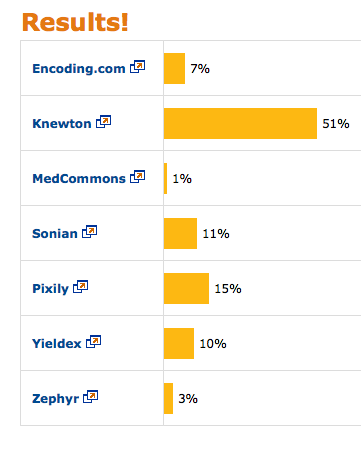
Based in New York City, Knewton raised $2.5 million last May from Accel Partners, First Round Capital, Reid Hoffman, Ron Conway, and other angels. The company was very much under the radar until it showed up as a finalist for the Amazon Web Services Start-Up Challenge last month (see video below). The company is built entirely on Amazon’s cloud computing services (EC2 for computation, S3 for storing video tutorials, and Mechanical Turk for fine-tuning its test questions). And currently it is leading in the voting for the Startup Challenge, with 51 percent of all votes cast. (That kind of online voting can be easily gamed, of course). Actually, the Startup Challenge already has its winner: Yieldex. Knewton did win the popular vote, though.

The founder and CEO, Jose Ferreira, used to be an executive at Kaplan, the test prep giant. Knewton’s two chief test designers, Len Swanson and Robert McKinley, wrote the scoring algorithms for the adaptive learning tests used by, respectively, the Educational Testing Service (which administers the SAT, GRE, and AP tests) and ACT.

Adaptive learning tests are taken on computers. The questions get progressively harder or easier depending on each student’s answers. Thus, they adapt to each student’s knowledge and abilities. Knewton is taking the adaptive learning concept and applying it first to online test preparation services. It is not cheap. Right now it offers a year-long subscription to prepare for the GMAT test that costs $1,390. The company guarantees a minimum 50-point jump in a student’s test score or their money back.

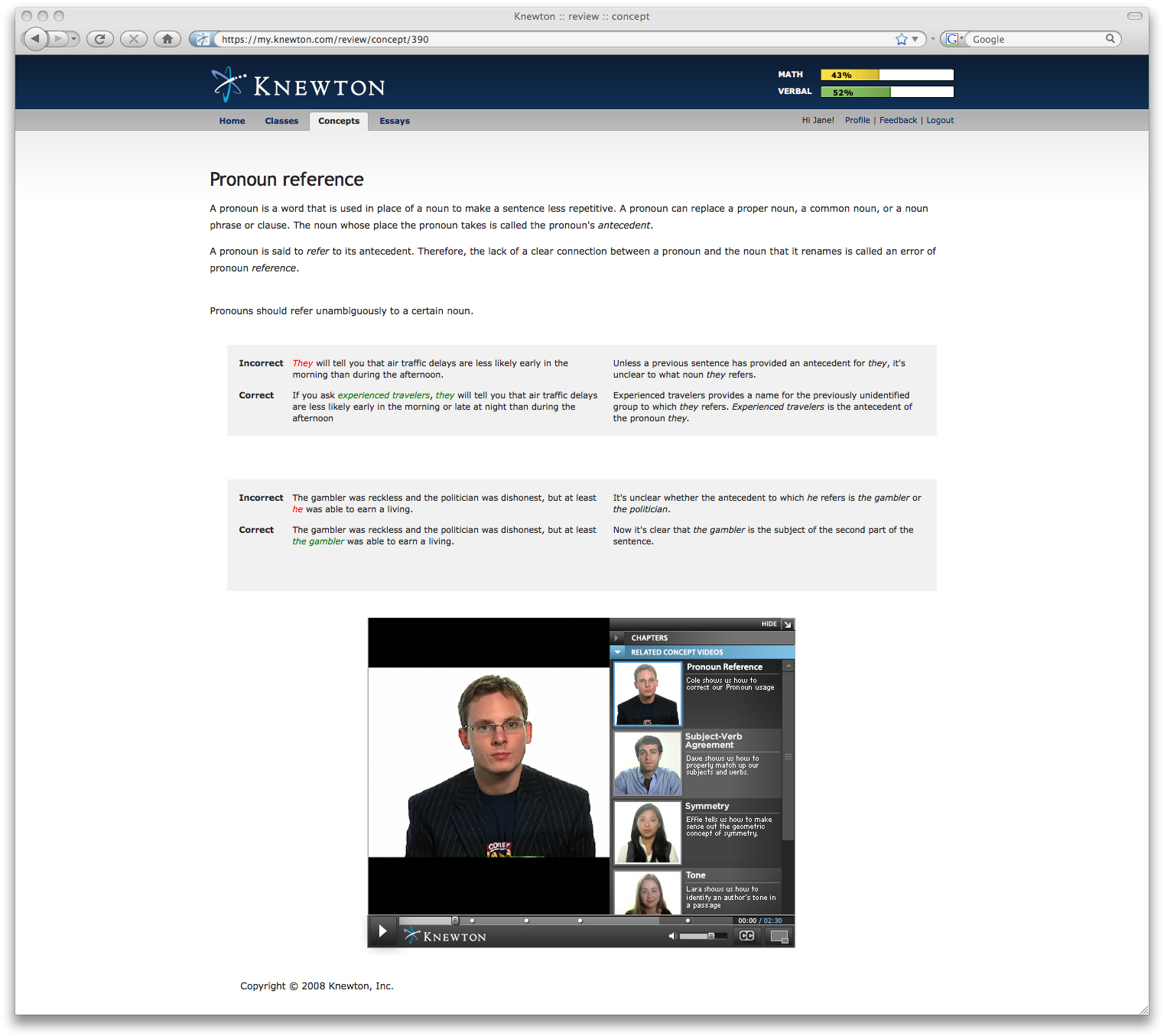
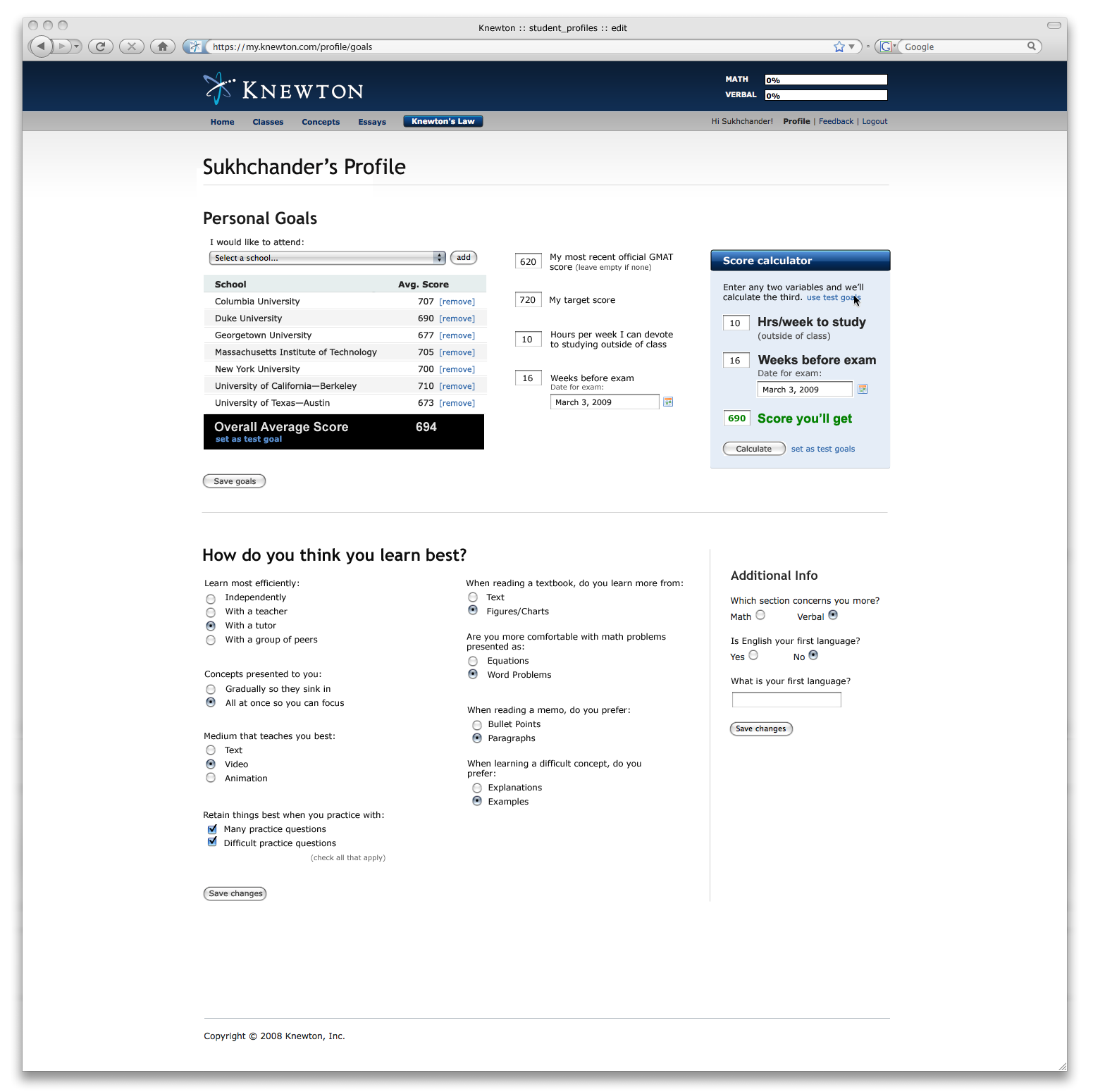
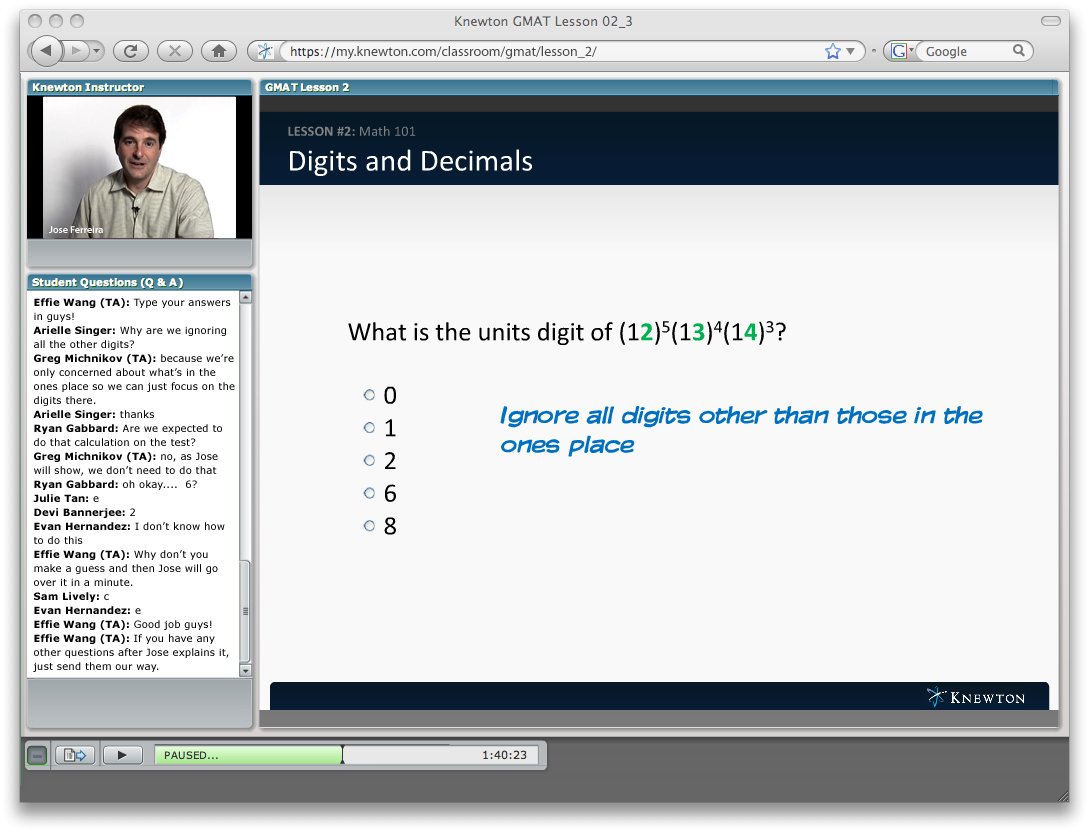
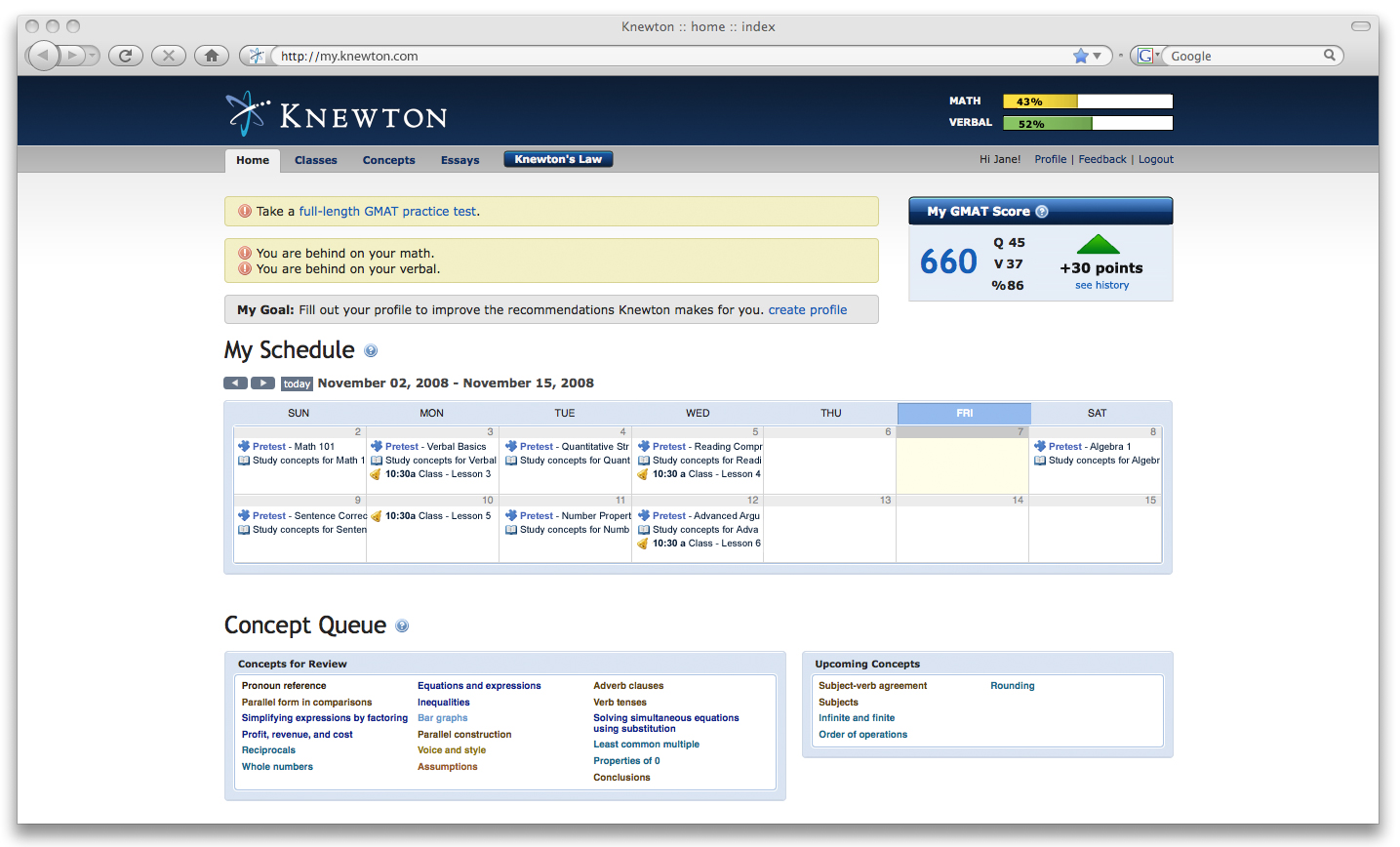
The service combines live video chat with an instructor in a whiteboard environment, along with learn-at-your-own-pace sample questions and tutorials. Knewton finds the best teachers it can get and pays them $500 to $800 an hour. In addition to the virtual classroom, Knewton keeps track of each student’s progress in mastering the thousand or so concepts that can be covered in each test. A “concept queue” keeps the students abreast of what concepts they have mastered and which ones they are weak on. They can click on each concept tag to dig deeper. (See screenshots below).

A big “Knewton’s Law” button automatically presents the next concepts and tutorials each student is ready for at that particular moment, based on what they’ve covered and how they’ve done so far. The content is delivered in whatever format (text, video, animation) and difficulty level that student learns best from for that particular concept.

A color-coded progress bar tells them how they are doing in different categories such as math or verbal. Knewton also shows students what their score would be on the test if they took it that day, based on the questions they’ve actually answered. Students also receive alerts for upcoming classes, homework deadlines, office hours, and the like.

Knewton plans to expand beyond the GMAT to other standardized tests, but the really big opportunity is to apply its learning engine directly to online textbooks. Ferreira explains the concept:

We tag content down to the atomic level. A student who accesses a digital textbook, for instance, any given day they come in, instead of the same syllabus every day, they get a new syllabus based on the concepts they know and the ones they don’t know. If they learn best via video, they get that. If they learn best with text they get that.

Several textbook publishers big and small are talking to Knewton about pursuing partnerships, says Ferreira. Baking adaptive learning techniques right into the textbooks could one day make the online versions of textbooks much better learning tools than the offline versions. Not everubody learns the same way, and the one-size-fits-all approach that the textbook industry takes today needs to be changed.

But can textbooks, tweaked with the right software, ever become good teachers in their own right? The prospects of such a future raises more than just pedagogical questions. The Teacher’s Union might have a fit if software like Knewton’s ever threatens their jobs, but education is so broken in this country that anything that make students smarter should be embraced with open arms. Unless, of course, textbooks are going to cost $1,000 online instead of $100 in print.

(For more of our coverage of e-learning startups, read our profiles of TC50 finalist Grockit and Japan’s iKnow).
 

Advertisement

Comments rss icon

  • Surprised you didn’t mention http://www.studycurve.com which is like a social site for homework. It would be a nice addition to electronic textbooks as its focus would be connecting people in a peer to peer networks in simple Q and A’s which often fill in the blank spots left by textbooks.

  • Interesting. Schools have a LONG way to go to truly leverage the new mediums of learning. Not just the web , but with virtual learning worlds and beyond. Schools are so focused on AYP (due to NCLB) if it is not on their state assessments they have no use for it. The emerging nation wide assessment infrastucture for web & virtual worlds will go a long way to smooth over some of the issues faced by schools.

  • Too bad they can’t learn how to make a video with a stop button. Nice forced-media consumption for this press release of a story.

  • “$500-$800 an hour”? Where do I sign up? ;-)

  • There is a ton of money to be made by the company that comes up with the killer app for the education sector. I think Amazon’s Kndle is a small step in that direction and I feel we are only a year or two away from seeing such a device really take off. Keep in mind that new innovations ramp up so fast now as compared to only a decade ago. Once a truly great edu-based device comes on the market it will only take a year for every one to have one. Delivery systems like Amazon make it possible to get these to all students fast.

  • LearnHub has the world’s largest free GMAT question bank. Its wrapped in a social interface where students can help each other too, along with lots of other resources. Why pay $1400?

  • Isn’t this what prepme already does?

    • Top experts — Knewton has the people who built Kaplans course plus the people who built the actual tests.

      • I’m not sure how that makes Knewton better – everyone who tutors at PrepMe has to have a near perfect or perfect score and extensive training. Tutors are paid based on how well we do. I tutor for the ACT and SAT – it looks like you guys do GMAT so I’m not sure what the issue is here. It just sounds like you guys are doing for GMAT what we already do for ACT and SAT.

  • Knewton, congrats on the TC coverage. Turns out my RA from Stanford works there now…small world.

    Erick, One thing I’m confused by is the Startup Challenge part of your post. Didn’t Yieldex win this already? Maybe this article was written a while ago and not posted…?

    http://aws.amaz...-from-amazon-2/

    Regardless, being a finalist is a big accomplishment and the more press given to companies (like Knewton and PrepMe) doing personalized online education the better imo. It’s an idea whose time has come.

  • interesting product, but please do not include autoplay videos that can’t be turned off in future posts.

    thanks.

  • While there is the upside in that they are partnering with the content creators to make this option available, I would prefer to see functionality like this wrapped up in an open source e-learning platforms such as eFront or Moodle which are more accessible to schools and students to adapt to their organizational needs.

    That way, instead of this being a proprietary format, adapt it or extend the SCORM (or similar) standard to allow for content to be produced in support of “adaptive learning” format. Content providers can then publish it to the open standard and it can be used on any site/device that supports the open format.

  • If you want free gmat practice: gmatclub.com. It’s simple, but they have what you need.

  • Kudos to Knewton for bringing innovation to the test prep space! Jose and team, I look forward to kicking off our discussion as planned early in January to discuss Knewton’s role in the Beat The GMAT community.

    Eric
    Founder, Beat The GMAT
    http://www.beatthegmat.com

  • XLPrep.com offers a self-paced, online, low cost alternative. Check them out: they have a free trial that has helped many prep for the GMAT with a stong success record.

  • Until the revolution overthrow the current manufacturing model of learning in our formal education system, I think these startups will always be competing in the consumer or corporate learning space.

  • The idea of adaptive learning is blessed and I gave a try to Knewton’s free trial after their first exposure here a few weeks ago. (By the way, they started at a $799 price for the “first 1000 users”.)

    Knewton’s practice tests seem to be of good quality compared to others I found such as:

    http://www.800score.com/ (5 tests, $39.95)
    GMATPrep (free from mba.com)
    http://www.crac...m/gmat-test.htm (5 tests, $19.95)
    http://www.manh...t.com/store.cfm (6 tests, $39)

    The rest of their offering, however, seems to be lacking.

    1. The video lessons are utterly boring and tedious. Most of the instructors in the videos look like they could indeed be great teachers in a classroom setting, but no charisma comes across this medium. Be prepared to literally dose off. The slides accompanying the lectures are also very dry and boring.

    2. The practice problems are supposedly ordered in an optimized way, in terms of topics and difficulty levels. I assume this has a small efficiency advantage over solving problems from some standard problem collection, but I couldn’t feel their system significantly “adapt” to me over the entire course of my trial. On the other hand, it has several annoying limitations such as not being able to influence (not to mention choose) what you’d like to work on based on your mood (not even verbal vs. math).

    3. Knewton’s claim is to adapt to how I learn best, but in practice it merely asks to fill in the profile page how does one think that oneself learns best (e.g. bullet points vs. paragraphs). Any adaptation beyond that seems to me dubious, like Knewton deciding at some point that despite me choosing “bullet points”, I actually learn better through “paragraphs” and then giving me “paragraph” versions of content…

    4. Although there are some useful aspects to using Knewton, their price seems in a totally wrong ballpark given their actual added value. ($13.90 would seem about right.) I find it difficult to believe that 1,000 students have already paid them $799 for this and if so then their real achievement is in the field of marketing, definitely not education.

    Most importantly:
    5. Knewton ignorantly (or hypocritically) relates adaptive learning to adaptive testing. They boast having adaptive-test-algorithm experts on their team, and imply that this makes them experts at adaptive teaching. Not so: the world of teaching is immensely different (and obviously much more intricate) than that of testing, just as the world of cooking is immensely different and more challenging that that of eating. Knewton’s testing experts are statisticians, not pedagogy masters and this fundamental shortcoming blindingly shines through. Unfortunately, even their experienced GMAT instructors can’t bridge this gap.

    In conclusion:
    • Great idea
    • Good quality GMAT practice tests
    • Very poor learning experience
    • Misleading marketing messages
    • Disproportionately high price

  • As somebody who has taught both traditional university classrooms and standardized test preparation at leading institutions, I can tell you that teaching test prep is significantly different from teaching actual course material. Standardized test prep is helping people who already know the material to recognize a couple tricks specific to standardized tests. Test prep students tend to be motivated with a short term goal in mind. Actual coursework with typical students is a whole different ballgame.

  • I agree with what most of you are saying. As a tutor i feel teaching students for a standardized test like GMAT requires meta-cognition.

    We need to constantly regulate our own thinking- is my thinking in this context appropriate? Am I considering all possibilities? Why did I go wrong in the problem? What aspect of the problem have I ignored?

    Why am I reading a passage very slow? How do I get over the blocks? What is the best method to succeed? These questions and many more… and doing the needful.

    A basic form of meta-cognition is study skills.
    While preparing for an aptitude test, you must be more interested in HOW you are thinking than what problem you are thinking with.
    That is how to

    - Deconstruct the problem into smaller portions
    - Set individual sub-goals and solve a problem
    - Identify the relationship between parameters
    - Convert the problem from verbal /numerical data to equation or diagram
    - Assume value and verify whether the data satisfies the conditions or not
    -Observe intricate pattern in the set of numbers given
    - Summarize a passage
    -Check the meaning of words in context of a passage
    - draw inferences from a passage
    And so on..

    I at http://www.sema...slearning.com// have co-developed the science of thinking curriculum. Have a look and let me know your two cents. You can also email me at george@semanticslearning.com. Cheers

  • does anyone else know of some new, cool, and innovative new learning platforms online other than the ones that have been listed?

  • I work in a VC that operates in this space. I have heard that Knewton is interested in PlatinumPrep, which works on a radically different paradigm.

Leave Comment

Commenting Options

Enter your personal information to the left, or sign in with your Facebook account by clicking the button below.

Alternatively, you can create an avatar that will appear whenever you leave a comment on a Gravatar-enabled blog.

Trackback URL
bugbugbugbug
Techcrunch on Facebook