Study: Newspaper Websites Are Still Figuring Out This Whole Conversation Thing
by Erick Schonfeld on December 18, 2008

Newspapers are still lurching their way around the Web, a new study finds, but at least they are making some progress. The Bivings Group released a study today that quantifies the Website features of the top 100 newspapers in the U.S. Among the findings: Nearly every newspaper site has reporter-written blogs and some form of video; features that elicit content from readers are on the rise; podcasts and mandatory registrations are down; social networking features are pretty much non-existent.

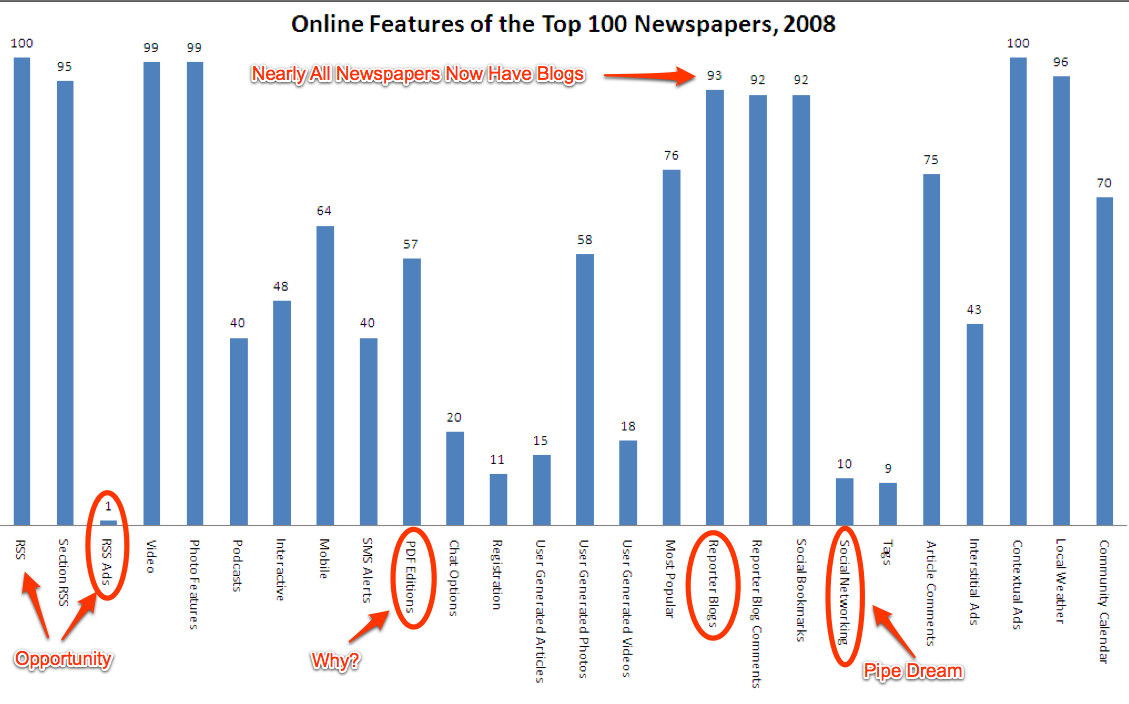
You can pretty much see all of the findings in two graphs, which I’ve marked up. (Click on the images for a larger view). In the one above, which shows the penetration of all the online features on newspaper sites, 93 percent have reporter blogs and 100 percent offer articles in RSS feeds. Yet only one percent put ads in those RSS feeds. That seems like an opportunity, even though most RSS ads are complete garbage and readers hate them.

In terms of reader-submitted material, newspapers are more comfortable accepting images than words. More newspaper sites accept photos from readers (58 percent) than videos (18 percent) or articles (15 percent). Comments are less controversial, with 75 percent allowing reader comments on articles. One thing I found curious is that 57 percent of newspaper sites offer their editions in PDF form. Why? A PDF of a page, maybe, but nobody prints out the whole edition.

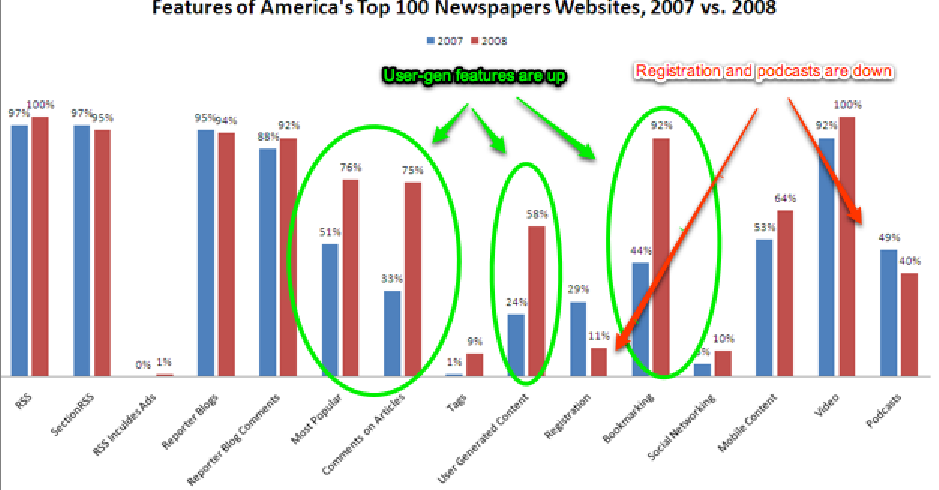
The graph below shows the biggest changes between this year and last. Newspaper sites that incorporate user-generated content is on the rise (58 percent in 2008, versus 24 percent in 2007), as are comments on articles (75 percent in 2008, versus 33 percent in 2007) and bookmarking (92 percent, versus 44 percent).

Sites that require registration are down from 29 percent to 11 percent, which means that most newspapers have finally figured out that putting up any barriers, even a temporary one, between readers and articles simply drives readers to other sites.
Advertisement

Responses

Comments rss icon

  • On a related matter for them, revenue, one issue with news websites and magazines is that many of them can’t use their content to serve up relevant ads. There’s going to have to be better behavioral and demographic targeting of ads within their content.

    • These newspapers that are not require registration and not monetizing their subscribers are merely hastening their own demise.

      If all newspapers wised up and stopped allowing free and unrestricted access to their content, their content would increase in value and they would be able to charge advertisers to access their high end audiences.

      Something offered for free has no value. It’s not Web 1.0, it’s not about market share or first mover. This is about survival.

      • “Something offered for free has no value.”

        … so google should charge a subscription for search?

        radio is “free”, radio is ad supported.

        Many local daily/weekly hardcopy papers have always been free and have always been purely ad supported…

        Something offered for free is just free, that does not mean it has no worth or cannot monetize content in other ways.

      • Drew – what don’t you understand? By not charging a subscription like WSJ, or requiring registration and monetizing the signups, or not sending dedicated ads to the readers, Newspapers etc. are giving their news away. For nothing. It is nothing like radio – which is way lower cost and now mostly run by machines. Rush Limbaugh sells 20 of his 60 minutes to advertisers each hour. He’s an idiot, but clearly smarter than current newspaper publishers.

        Free local newspapers are ALL ads. Try to ‘read’ one sometime.

        Google charges its users of paid search. You are just their chum.

        You can’t make up ‘free’ in volume. There are not enough display ad impressions in the universe to make up the difference between paying $1.00 for a newspaper filled with full-page ads by premier brands and all that same news over the internet for FREE. Newsrooms are very expensive.

        Why do you think that newspapers are going out of business? Clearly you are not reading enough of their material, online or otherwise. It’s because their advertisers are dying, or moving online. Problem is, the newspapers are following the wrong advertisers – the ones that are dying, not the ones going onto the web.

        Check out Poor Richard’s Almanac. Ben Franklin didn’t become wealthy by giving his news away, and neither did William Randolph Hearst. It’s just not a good business model – that is the point.

      • “If all newspapers wised up and stopped allowing free and unrestricted access to their content, their content would increase in value and they would be able to charge advertisers to access their high end audiences.”

        Ha.

        No.

        If all newspapers “wised up and stopped allowing free and unrestricted access to their content”, people would just go elsewhere for news… Like tv station websites and local blogs. Newspapers would close even faster because, without traffic, there is NO model at all.

        Not to mention Google makes way too much money on google news to let it die. If you think they wouldn’t dig deeper to both create and aggregate content to keep it alive, then you haven’t thunk at all.

        It’s a pretty idea, pay-to-read, but it is many, many, many years too late. The Pandora’s box is already open. There is no closing it now.

        “Free local newspapers are ALL ads. Try to ‘read’ one sometime.”

        Well, you better get used to it.

        That is the only model that has any potential right now. Free papers are still profitable; Especially local papers. Look at Gatehouse media… Their entire operation is failing EXCEPT CNC (aka metrowest unit), that segment is profitable. Likely not 20% profitable but defiantly profitable.

        “You can’t make up ‘free’ in volume. There are not enough display ad impressions in the universe to make up the difference between paying $1.00 for a newspaper filled with full-page ads by premier brands and all that same news over the internet for FREE.”

        You are right. But that level of profitability is just gone. It isn’t time to make up the difference, it is time to redefine profits in print media.

        “Newsrooms are very expensive.”

        Yup. and there is the problem. A massive reduction in expenditure is the only way to survive for them.
        No more 12th floor downtown luxury offices.
        No more $3,000 fish tanks.
        No more plant masseuse (I am not kidding).
        No more plush condos for mediocre execs who refuse to move at their own expense.
        No more high commission pay for ad “execs”.

        “Problem is, the newspapers are following the wrong advertisers – the ones that are dying, not the ones going onto the web.”

        I totally agree. No argument there at all.

        “This is about survival.”

        Totally. Until papers get rid of old world publishers and move on to young and fresh models and management, Print Journalism and the print industry are sadly S.O.L

  • I wonder when Wall Street Journal will let down the guard and let us read online content without paying for a subscription.

  • PDF edition…For people who use an electronic reader.

    • Uh…You mean because downloading many many megabytes of information every day to squint at a tiny screen just to see content that was actually intended to be printed out onto a very large piece of paper is just so much fun.

      Ever hear of HTML?

      Or maybe you’d prefer that TechCrunch PDF every story they write and have it ready for you to download every day?

      Yeah..Didn’t think so…

  • pressdisplay.com – by far the best newspaper site

  • A lot of newspapers offered a PDF version as they mistakenly believed people would pay a subscription for it (why anyone ever believed that is a mystery to me as well). Additionally the idea was that those subscribers would be counted as print subscribers which is where newspapers make 90% of their revenues.

    after many false starts it is great to see newspapers are making real progress here however there is a long long way to go.

  • It’s not an easy transition for the century+ old newspaper industry. They think very much in terms of the printed page. However, there is opportunity in where the newspapers are faltering in transitioning to the web. An example would be how Craigslist has become the new standard in classifieds. As for the beloved comic strip, that’s why we’re building http://www.zingerding.com

  • Surprised to see the downturn in podcasts. Is this an indicator that its popularity has peaked or have newspapers just shifted their focus to live content and blogging? Podcasts can draw an audience if the host can find the proper niche and present content well. I’d like to know how well NPR podcasts are received.

  • Now that comics.com and gocomics.com along with several sports websites exist, I no longer need a print newspaper.

    It would nice during snowstorms for newspapers to utilize twitter.com by allowing everyone to report how the snow/roads are in their area so that someone about to head out can plan their commute better, or even decide to stay home!

  • While I can’t speak for the “real” newspapers (non University newspapers), we (The Baylor Lariat) would put the PDFs online, not only for those that might want it for whatever reason (since it’s about 2 minutes of effort a night to convert / upload the new edition, it’s not a big deal), but also to show advertisers that, yes, their ad did indeed make it into the final print version (because they can’t all come down and pick one up).

  • Sorry, but I don’t follow your logic on the RSS ads… if readers hate them, how is this an opportunity??

    There is a reason RSS ads bar is short, although IMHO 1% is already too much.

    RSS ads is a terrible idea, period.

  • If only the music industry could get a clue…

  • Now the question is: are the UV and the PV growing for the sites of those newspapers?

  • I wrote to our local newspaper, the Palm Beach Post, about buying online remainder ads to spread awareness of our company, http://www.takemystuff.com. Their told me to call back in February. Business must be a LOT better than I thought, despite that their website seems to be chock full of house & CPC ads.

  • I could envision using a PDF download of the entire paper for a train commute. It’s easier than doing a webcrawl if you need the whole paper but plan to read offline. Or perhaps as an archive of the day’s news (modern microfilm?).

Leave Comment

Commenting Options

Enter your personal information to the left, or sign in with your Facebook account by clicking the button below.

Alternatively, you can create an avatar that will appear whenever you leave a comment on a Gravatar-enabled blog.

Trackback URL
bugbugbugbug
Techcrunch on Facebook