
As a European, I’m always happy to see web companies translate their interfaces in other languages besides English. It’s common business sense, since a lot of potential users simply won’t even take a look if the application is not available in their local tongue, and they certainly won’t stay long when all their local friends start trying out a competing service that is. Anyway, FriendFeed understands this too, which is why they’re opening up to a bunch of new users by translating their lifestreaming interface into German (will that be the end of Freundefeed?), French, Spanish, Japanese, Russian and simplified Chinese.
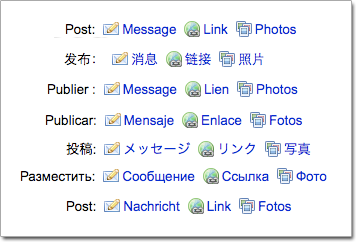
For FriendFeed, essentially a one-stop shop for the social networking updates and news items from your friends, this is a logical step to take. The startup says nearly one third of their users experience the service in their own language, so it makes perfect sense to translate the interface to cater to them, too. The startup also says they’ve gone with the most popular for now, but that they’ll be adding more languages in the future, enabling more people to find the right settings to turn off IM updates, for example.
We’re curious to find out if this internationalization will help FriendFeed get their own hockey stick moment much like Twitter did over the Summer. The service was launched about 14 months ago by four ex-Google employees Bret Taylor, Jim Norris, Paul Buchheit and Sanjeev Singh, and raised $5 million in Series A funding in February of this year.


See all


Catering to specific languages has been important for a long time with many kinds of websites, and should be even more so with social sites. Sounds good!
thank you http://www.eskibirsaat.com
In today’s global economy it is important for all companies to start branching out into international waters to stay competitive.
I’m inviting everyone who reads this TechCrunch comment I posted to join me on my blog
http://www.ShawnDrewry.com
to use “Google Friend Connect”
Stop on by!
To bad friendfeed looks like its made for children, else it could be really popular.
Jake you should check out MySpace
All they they really had to do is google translator api and would translate in many other languages. Or they could of translate FF in more languages not just the ones above.
Strongly disagree. This one a rare example of normal translation of the interface of a startup, not the usual hardly understandable texts that constantly keep me switch back to English after checking the newly-introduced Russian translation. Unfortunately machine translation is far from perfect, even that by Google - and I will argue about that forever. Google spoiled startups that now think they can get the translation done for free - frustrating users with poor or very poor translation all the time.
As i commented of Friendfeed, i don’t think that translating into Russian is really required/ Thing is that FF is for super media geeks. In russia people like that all read (at least read) English. And they are used to it - they have their computes OS’es in English, their cellphones, TV menus and so on. Russian translation of any web app is always sooo confusing. Even Facebook with their crowdsourced approach - they didnt make it right. So my thumb down on Russian translation (especially considering that it’s not available in any of the popular encodings right now - i see only weird symbols no matter what i try).
Generally - it will lower the chances for me to read something cool from a german- or french-speaking person on Friendfeed.
Kirill, while I can agree that it is not particularly needed now as FF is for supergeeky Russians for now, it is quite obvious that they are looking to expand their reach in our country to more mainstream users who could embrace the tool - and I personally think it should be more than welcome.
By the way, I personally switched back to English for the simple stubbornness of not wanting to deal with Russian where I know everything perfectly well in English and Russian just looks awkward to me. But as a professional translator I have not seen anything particularly wrong with FF in Russian - even though I am usually the first to criticize all the crowdsourcing attempts where it comes to user experience in languages. I did not look with enough attention maybe as I did not have enough time to play with it but all in all I usually tend to notice a poor translation immediately - and FF has not been the case.
Svetlana, Friendfeed is never going for “more mainstream users”. The site has a very narrow audience.
FF is like an old singles bar.
Mom and pop will never need friendfeed. Their kids don’t use friendfeed now either.
Like in a singles bar for old people, the inhabitants think it’s ESSENTIAL. The rest of the world, passes.
for now, yes. but information overflow hits more and more people. friendfeed is a tool to organize the mess
Bien, y tu robbin. I think this is a new opportunity to expand the service.
Oh come on. Like a web site translating their interface into other languages is news. Did they have to write you an angry letter to get you to post this?
Another new microblogging site came out. I think this one has some promise though, being that it integrates with twitter:
http://yonkly.com
Thanks for the article. I don’t know about hockeystick growth, but they certainly will get long sustainable growth as a result of internationalizing their website. We see it all the time. Quarkis.com specializes in providing website internationalization services.
And in Italian??
In fact, the title has a little mistake. In spanish the word “que” has the accent (tilde) when used on questions and exclamations. And the spanish languages uses both opening and closing question marks. So it should say:
Bonjour, Friendfeed, ¿qué tal?
Greetings from Madrid, Spain
But it’s correct in portuguese.