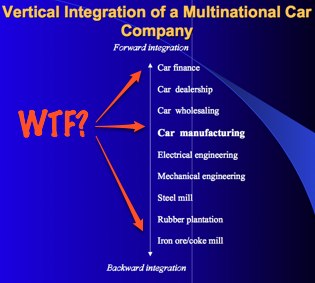
Everybody these days has some advice for the beleaguered U.S. auto industry. Bail them out. Break up the unions. Do something about the dealerships. Do something about spiraling health care and pension costs. Design cars people will love. Etc.
There’s always the “be more like Apple” advice that’s been going around for a couple of years. Make the iPod of cars. One that people love so much that they’ll pay a premium for it. Robert Scoble handed out pounds of this kind of advice a couple of weeks ago.
But there’s a reason why the car companies can’t build the iPod of cars. It’s because they’re so weighed down with all the logistical nightmares of actually building the stuff that goes into those cars.
Apple doesn’t actually make any of the parts that go in the iPod or iPhone. Factories, mostly in Shenzhen, China, do that. Most of the big PC manufacturers don’t actually build computers or any of the parts that are in them. Every part is made by different companies that specialize in building that particular thing. Even final hardware assembly is outsourced. Dell and some others do some final assembly themselves to allow for easy customization, but they are quickly getting out of that business, too.
If the car companies want to be more like Apple, they need to stop building any actual cars.
Vertical integration kills real research, because every company is doing their own work. With personal computers, every component has a vibrant and competitive market that drives innovation, quality and cost control. The big PC brands just design the final product and outsource the actual building of it.
Every major car manufacturer designs their own engines and drivetrains, manufacturers many of the important parts of the car, assembles it, manages a network of dealers and own their own finance companies to help people pay for those cars. Over the years they’ve dabbled in outsourcing, but the current trend is actually more vertical integration, not less.
Who’s the Intel of engine manufacturers? Why isn’t there one?
The best way forward for the automotive industry is to rip itself apart and start doing things sensibly, like the PC industry does. It won’t make any one company more stable, of course. In fact, it means competition will regularly drive companies at every point in the process out of business. But none of those companies will be in a position to drive our economy south if they do go out of business. Someone better will just take their place.
Does this mean our cars will be built in China? Yeah, it does. There’s no avoiding that. U.S. workers are just paid too much to build cars any more. Detroit may become the center of the car design world, with highly skilled and highly paid workers designing the iPod of cars, but the parts will be built elsewhere, and assembled elsewhere.
There’s a counter argument, that Toyota is the most vertically integrated car company in the world, and also the largest and healthiest. I argue that they’re the only ones that can do it profitably over the medium run in such an inefficient market because they have scale. If the market changes, which it is, that vertical integration model will fail.
And here’s the thing - this kind of change could never happen quickly in a normal market. There are just too many people negatively affected to make it work. But right now, with the auto-makers on the edge of collapse anyway, all we have to do is nothing to make this happen. Let the big car companies fail. Don’t bail them out. Their assets will efficiently move to the highest value use. There’s a good chance that ten years from now we’ll have a whole new crop of U.S. auto companies designing (and overseeing the assembly of) some really awesome cars.


See all


icar
icar mini
Excellent story, Mike.
Finally.
Once again Arrington proves he knows nothing about business.
There are many reasons why you’d want to own your supplier (leverage, etc). It can be a good thing in a well-run company.
The problem is we have morons at the big 3.
@MyCashyCash… Sounds like you’re saying none of the PC manufacturers are well-run. Would they be better off if they built everything in-house like the big three? They may be morons at the big three, but replacing them would not solve the problem.
I have to go with Mike on this one. The PC makers have the right idea.
I will say that one big problem seems to be fucksticks who register domains like cryharderfaggot. Bullied as a kid and out for revenge? Just my opinion. I could be wrong.
Wow, he really does have that domain name. What a prick.
Here’s an early Christmas present for you “Guy Dominic” of JohnnyRoyale LLC. in Portland Oregon:
The domain cryharderfaggot.com is officially registered to:
Guy Dominic
JohnnyRoyale LLC
Portland, OR
What’s that? You don’t understand the gift? Try Googling your name or company name in about 24 hours. This page will forever expose your douchebaggery to anyone who wants to look you up. Have fun finding a good job anytime in the next 10 years or so. It’s the gift that keeps on giving.
Have a nice life.
Ditto that. Does Mike really not know that car manufacturers already do share engine technologies with each other? It’s called a licensing fee.
The car business isn’t anything like the desktop PC business that Mike talks about above. PCs are designed to use interchangeable components….except for laptops, which don’t.
Cars already use standardized parts where possible, like the wheels, dashboards, frames, ENGINES. A lot of these parts are already manufactured in China and are shipped here for final assembly.
As to the China argument: seriously dude, have you not paid attention to the Chinese manufacturing side problems of the past 3 years? A product made in China is a product that will not pass safety inspections.
Yes, but what worked for one industry may not necessarily work for another?
–
http://www.inkampus.com
Boy do I agree with this! Good read!
well said, and the precedent certainly exists at all levels (heck, Porsche has the boxter built from kits in Scandinavia, natch)
Actually, Porsche is discontinuing that relationship in favor of a outsourced mfg for Boxter closer to home.
Cars aren’t computers, a significant aspect of car ownership is service and repair. A large part of the value of a large scale operation is a national dealership and service network. Would you buy a car that can only be serviced where it was manufactured?
I like the modular approach myself, agree, lets tip it over while its already falling and rebuild.
Start with the most generic, plain, borderline muted configuration possible… low curb weight, 75 mpg standard, 50% recycled materials for structural elements, and configurations that emphasize typical use cases (in town, vs. long haul commuter)
Scion-esque lunchboxes on wheels for everyone.
Aftermarket bling and upgrades would create huge retail markets in general assuming there was sufficient disposable income to warrant this. Imagine if people could customize a vehicle without resorting to “Pimp My Ride” service companies.
accessories are a big market for phones.
I’ve run an aftermarket car parts website for years, its always done great. Keeps our cash flow nice and our cars well built and german. There is no shortage of folks willing to customize and make their ride unique. Its one a few spaces with true innovation left in automotive market. Providing a better platform just means more can get involved.
See the SEMA show
the aftermarket story is a great one where the cookie cutter car market really needs to think about modularity.
One of the things I love about my Mustang (not really an eco-friendly cookie cutter car) is the range of tweaks and modifications I can make with little more than a cross head screwdriver, a couple of sockets and a couple of hours
Apple actually does a ton of vertically integrated manufacturing. They are building the mainboards now, and they just bought a semiconductor company to make the chips.
For the iPhone, yeah, But I believe that’s because it’s still a forming market. Or it’s the exception that proves the rule. your pick.
“The exception that proves the rule” is a cop-out. Exceptions do not prove rules. The still-forming market thing might have legs, though.
great article…
I’d agree with this, but this cannot happen with any of the current U.S. automotive corporations or the unions they are enmeshed with. The entire system would need to fail then be reborn. You’re talking about a huge risk.
There may be a separate approach — if the unions allow for it. The big auto manufacturers split their design arms into separate companies, then let the manufacturing organizations ‘just figure it out’ — whether that be through tightening controls, cutting costs, tight negotiations with the unions, or even offshoring. However, the manufacturers might be able to save at least a portion of their companies by spinning off the R&D divisions into separate and autonomous corporations.
they can fail now or they can fail later.
I agree 100%, however people don’t want it to fail “on their watch” and so this unsustainable system will continue to grow.
The unions and management will say that they already have this system in the form of companies like Delphi. That just happen to have one large customer.
The US government should take most of the money they will eventually give to the car manufacturers and instead fund a marketplace like you describe.
Life is all about risk, either you induce it on your own or have others apply it onto you… either way, I got to agree with Michael, they old way of doing business has proven to be a dismal failure (twice for Chrysler) for the car industry.
Jon
http://dreamclue.com … get the message!
That is ok.
tks
hold on — who’s going to actually buy the icars if 10% of all American jobs disappear?
Agreed. The purpose of a bailout is not about making the best possible cars (as great as that would be) or maximizing the auto industry’s profits, it’s about keeping millions of Americans employed.
Given better products, more people outside the US might buy US cars. Consider GM vehicles made in China. They’re selling quite well there.
Certainly, the emotional issue is saving US jobs. But a band aid will only hold for so long. Then what?
Cool post.
GM should be broken up into two sorts of companies:
(a) platform (b2b)
(b) brand (b2c)
Let the Platform company focus on designing the car platforms that all the brands will work with whether it’s a small 4-seater or an SUV. The Platform company can focus on the technology end and pure-research like making the cars greener. This is really the Intel of the car industry.
Then spin off the individual GM brands into their own consumer facing businesses that look for suppliers for the parts to build the platform. These guys would be like the Dells and HPs of the car industry.
Michael Arrington: I agree in general with your suggestion that the US automobile industry get out of the manufacturing business but your argument would be stronger if your graphic was up to date. US auto manufacturers are no longer producing iron, coke, rubber or steel. Retailing is done by independent dealers.
You might be surprised at how much of today’s cars is designed and manufactured by outside vendors who deliver parts, assemblies and systems to assembly plants. Ford still designs and builds engines and bodies but interiors, electronics and many other components are purchased.
yeah, i understand that the car companies no longer own ore mines to make into steel. But the level of vertical integration is staggering. And the dealerships are a huge contractual burden on them.
there’s no way to fix it without letting them fail completely and letting the market take control.
As a former mechanical engineer, though this idea has merit, it simply is much more complicated to put a IC engine together than it is to put electronic components on a board. The system has to work, fit in an attractive chassis - AND be safe. Moving one linkage just a few degrees - all of a sudden requires customization in a have dozen parts… Electronics are simply much more flexible than mechanical components. Just my opinion.
Right. Not everything can be equated. Electronics are smaller and naturally more modular. If a chip fails it doesn’t usually kill people. I’m not saying it wouldn’t work but it is a lot harder than a phone. Boeing is trying something like this for their new plane and it isn’t working out so great for them.
I lost you when you said this idea is a former mechanical engineer.
He said mechanical engineer, not English major.
The market response of a failure will have an unwanted effect on the modular approach. I’m willing to bet that if your advice is taken you will not live long enough to see a rebound.
The modular approach is already in practice. Problem with the modular approach is the some loan backing comes from the auto makers. When your only customer is a manufacturing facility and they cut orders you can’t pay them back. Sure there are problems with the system. But a total abandonment will have a terrible effect on the US market
yah!
Mike, you make some good points, and overall I like the thesis, but it’s non very nuanced. We already get parts from outside the US, and I thought we even had some factories outside the country that did assemble cars.
Comparing the process of designing and implementing an automobile to an ipod, isn’t directly comparable. Its infinitely more complicated and there are general matters like personal safety that have to be accounted for and need to be strictly controlled.
Also, I wouldn’t overlook the advances Toyota has made. There was a great harvard case study we did on them in our MBA program that showed how they revolutionized supply chain management (vertical integration) - i think this is it - http://harvardbusinessonline.h.....erral=2342
Apple is great in part because they focus on their core competence - design, user experience, and marketing - and outsource the rest. Thats in part why they get high premiums.
If Detriot takes away their assembly of cars, they may just find, that with no OTHER responsibilities, they still aren’t that great at designing cars anyone wants to buy.
But I guess we’ll all find out soon enough.
I agree with you.
Finally, some sanity here!
My only question is (for Mike and everyone else) is that who would be in a position to acquire what’s left over?
I’m not too sure Toyota would, and many other car companies may not be in the position to purchase the remains either.
I believe you could find private equity (eg. KKR).
I think the natural deal would be GM selling the production factories to Toyota or Hyundai with some guarantee of buying the produced cars under GM brand. I am sure there will be buyers.
It would be like “sale and lease back” of an real estate asset.
So if its better to outsource manufacturing of cars, prove it. Anyone buy into this idea that also has the ability to actually do the things required?
No?
What a surprise. Turns out every radical new idea requires someone who can champion it that is also capable of seeing things in a new way.
And, as is usually the case, this rarely comes from the “visionaries” in the media, blogs or mainstream.
@Michael Arrington: This is a great take on the state of the industry. Certainly not the first time the auto industry has been told to cut out verticals and focus on IP and marketing, but it is one of the most astute.
Getting this to actually happen is another thing, of course. These companies are so invested in the status quo as to resort to social extortion rather than attempt to fix deeply flawed business, management, and - yes - manufacturing and sourcing practices.
The only way these companies will or should survive is if they can change radically and sustainably.
It makes no sense to say that auto manufacturing should be outsourced to China because US autoworkers get paid too much. If we do that, they won’t get paid anything at all. The whole point of saving the US auto industry is to keep people employed, which they won’t be if everything is made elsewhere. We have to find a way for Americans to actually produce stuff, because the number of people who can be employed in designing cars is minuscule compared to the number who can be employed in building them.
it can’t be saved in its current state.
So forcing U.S. workers to compete with slave labor is the way to go? And then after you’ve moved the workforce overseas who can afford to actually purchase the vehicles?
There may be better solutions, and maybe car development is too labor intensive. I know Detroit automates the process more in their foreign plants. I don’t know the “solution.”
But I think the problem is larger and more complex than has been proposed in this post.
sounds like you should move to europe.
“I run an internet tech blog, so I know how to save an entire manufacturing behemoth based on a single analogy of an mp3 player.”
Michael Arrogant, you’re like the Bill O’Reilly of nerd land.
It sounds like Mike is unfamiliar with Toyota, Honda, Hyundai, or Kia, which all make cars IN AMERICA just fine.
HMMM…blows the crap out of his entire argument.
When AIG was bailed-out, I was one of those who thought that if a company was too big to fail, it was too big to exist. Same applies to GM and co.
Mergers and take-overs make things more complicated, not more efficient (unlike what deal makers, aka banks, think) and therefore you get to that complex vertical integration with slow, heavy, long processes. That creates oligopoly which goes against free market and against what’s described in Mike’s last paragraph.
This is why the bail-out is wrong because it won’t fix anything in the long run, it will just apply a small patch on the surface of the issue.
Fundamental shifts are necessary which the bail-out won’t bring.
Although those deep changes lie in rethinking vertical integration, I am not sure it also implies outsourcing in China. 1. Chinese cost index is rising faster than anywhere else. So what may be true today (cheap Chinese manufacture), will not in the long run. 2. China (or India) cannot become the only one production center of the world, it just can’t. 3. Of course and fortunately, one can make a profit without manufacturing in China… if the free market conditions explained further above are met.
Last, generalizing outsourcing will destroy local employment, therefore local demand for… cars.
then outsource to mexico. the market figures this stuff out.
How about “outsourcing” to the US??? Toyota, Honda, Hyundai, and many other foreign manufacturers somehow manage to build cars AND parts here in the US.
Sounds to me like you’re too invested in your own solution to realize that if they can do it here, so can we.
China outsources to Malaysia, and I believe that this outsourcing will increase as demand exceeds Chinese manufacturing capability (and cost.)
How many Michael Arringtons does it take to change a light bulb? None. Because if it is dark, market will change light bulb itself.
I like the article though
“How many Michael Arringtons does it take to change a light bulb? None. Because if it is dark, market will change light bulb itself.”
You’re correct - it is none, because the market will display need and provide profits to the entrepreneur that does innovate and comes up with the most efficient way to change the light bulb.
Michael, it’s easy populist ideology to promote creative destruction without providing fair time to the actual destruction. Your analogy, while useful in sparking dialog is childishly naive and devoid of any apparent understanding of business or economics.
The US auto industry employs 1 in 10 Americans, largely through the effects of technology intensities, and the resultant dismantling of vertically integrated strategies. By contrast Apple employs just 10% of the people employed by a single auto manufacturer, GM. Your tepid attempt at analogy totally fails to reflect scope and scale; critical elements in any forward looking strategy. You would never make it as an executive in any meaningful industry segment.
You may view yourself as being part of John Galt’s fictional family tree, but the truth is your economic daydreams are remarkably devoid of understanding or insight. True vertical integration (as defined in those old-fashioned hardbound versions of HBR) were remodeled many decades ago and the auto industry has moved beyond your mis-informed view, serving as testament to your lack of understanding of business fundamentals. Your apparent boy toy fascination with offloading manufacturing skills and resources to somewhere outside the US suggests a propensity to give up and fold your cards when things get difficult.
I can only hope your propensity for avoiding the work required to overcome complex issues extends to your junior journalistic ventures into economics.
forget cars already…i want my anti-gravity powered vehicle!!
Yeah! I’m with ya on that one.
I’m trying to figure out how this suggestion is anything other than “move the aftermarket to the front office”… I mean, essentially, all this optimization, customization, fitting premium/superior parts to a specific chassis ALREADY happens, it’s just called something else, and it’s not “built in” to the process (except, in a really limited way, kinda, with the Scion brand).
I’ve lost the link, but there was an article, maybe half a year back about a guy using “off the shelf GM parts” to retrofit gas cars to run diesel (including a Biodiesel Hummer) - and when he showed it off to the GM engineers at a show/conference, none of them could figure out how it was possible.
And, honestly, I wouldn’t go as far as Michael’s comment - there are MANY good reasons to NEVER outsource production to China - less transport costs, pollution, and you could save all those Detroit jobs (and hell, move jobs into all 50 states for that matter - design in Motor City, manufacture in Cleveland, and the dealers become kit builders/mod shops one and all.
Certainly, if the “awesomest engine” could hit the market on its own, there would be shops lining up for miles to figure out how to get one, and fit it safely into their cars. All this “can’t-speak” is just thinking in the now, instead of in the “can be” future.
Imagine, buying a car online by selecting features you wanted, then narrowing down to a compatible set of parts, which is then built to order by the same guys who will service it for the next 5+ years (who suddenly have a whole world-wide community of fellow build-servicers to compare notes with/get bragging rights over). Save ALL the jobs, make everyone in the chain more valuable (and more local to everyone).
Only thing I can’t figure out in this scenario is how safety and insurance would be managed/guaranteed effectively.
is this what you are looking for?
http://www.lincvolt.com/
Oh yeah, I just realized - this is just the tire business, expanded to every part of the car. Somehow, someway, there are standards for making the tires safe (my memory just dredged up “firestone” for some reason, but whatever), no matter what car they’re rolling on. There are clear measures for what tire fits what wheel on what chassis. This can totally be expanded to the rest of the car. Why not? And, like I said before, you’d also have a choice of builders/installers in your neighborhood (or a little further out, thanks to yelp)… Not everything would have to be BTO - but the locals could fab up several of the “most likely sellers” at any given time - there could even be features tailored to given regions/climes… If anything, it’d kill a lot of the over-compromised models that exist now (Subaru Baja, anyone?), and bring out some truly innovative, or even crazy designs (Subaru Baja, anyone?)
YEAH!
(beginning to think someone caffeinated my turkey)
The guy you are talking about is Johnathan Goodwin. Fast Company did an article on him here:
http://www.fastcompany.com/mag.....ssiah.html
Great stuff and very infuriating. Even the Governator in California is buying his conversions!
Great opinion piece, but that’s about it. I be damned if every car had the same engine in it like an intel processor but only the outside was different like a computer case. The reality is, Auto Workers get paid average of about $38 dollars an hour to supervise machines that are putting together most of the cars. Nothing wrong with this, but when you are making duplicate cars with different names, ex. Silverado 1500 and GMC 1500, Tahoe, GMC Denali, you’ve got twice the overhead making duplicates or very similar products. Spend the money on diversified product lines or alternate brand names that don’t compete for the same market space and operate lean like most succesful businesses
its something like $2,200 in health care costs in the price of every american car. doesn’t work.
Universal Health Care will bring down health care costs.
You free market bums won’t be finished until the middle class disappears, will you? Regardless of the real problems (the US sucking the teets of big oil and stupid auto management going along with it), your solutions are always “break up unions. outsource. screw over workers.”
Give me a break. Why are you whining about cars and not banks? Why is no one talking about bank teller unions? Because unions were never the problem! It’s the wealthy people that have been driving this country into the ground.
i don’t think that they should outsource the production.. it cuts to many American job. why don’t the other countries raise minimum wages so that everyone in the globe as an equal standing with their wages?
wow.
Teacher: And what do we call that children?
Children: Comm-u-nism! [said in unison]
That is not communism, which has failed and cannot work.
Wages globally can be raised, at least partially, to mitigate the competitive advantage of slave labor. Oh yeah, and we can get rid of child labor, too.
You suffer from a lack of imagination, and you’re glib insults reveal your lack of knowledge about capitalism.
I really, really hope you’re being paid no more than minimum wage.
the point is the minimum wage ur calculating is built on us costs ….in chindia and india living costs are much lower…..
u can get a rental housing in the suburb of a major city for as little as 40-50 $ a month…food is low….etc.
so living wage always corresponds to living costs which are much lower here…
also someone said slave labour now i dont know abt china but india has labour uninions who determine wage and wotrking cond…
Very nice article, now hopefully Bush or Obama or the senate will read this and let the Auto Industry fail. The thing that we don’t want to see if them getting bailed. These companies will fail even if the finance industry didn’t collapse in the first place. Still loving that web puppet going to the senate.
True, inflated union fees, health and pensions don’t help and are impossible for the big 3 auto makers to get away from. Although Honda and Toyota manufacture in America, they don’t have the same over inflated agreements with the American Unions.
Vertical Integration kills innovation? What about American Apparel?
One of the best posts I’ve seen on this site. Thanks for the thoughtful commentary. All this talk about 2 million jobs lost ignores the ability of the market to sort things out.
Why can’t we have lots of small companies instead of one big one? Why do 3 companies need to dominate American cars until the end of time? Subsidizing these companies is squelching innovation and preventing us from moving forward.
Arrington - Kudos - great piece .. I read techcrunch for the breaking news .. first time I’ve read a piece that was this thought provoking and original.
Almost thought I was on gigaom and had to double check the masthead
Looking forward to paying a lot more attention to your writings. All the best!
Sorry - I forgot to add. The last thing American car makers are is vertically integrated. They outsource plenty of things - the actual selling of the cars, the advertising, much of the distribution, customer service, etc. One could argue that those are the areas that Detroit is most profoundly beaten in and could use more control and attention.
What you mean is that their production is integrated. (In reality, it is not since they use all sorts of independent, third party products within the cars.)
I believe andy grove wrote this in “only the paranoid survive”… vertical integration is ideal for new markets. Apple is still <10% market share and they havent reached a price point to reach the mss of the dells or hps of the world.
horizontal integration is where matured markets flourish. Not to say single company can do it better, but not three in a single industry.
If we think the electric car is a new automobile/a new market, than an expensive vertical integration model will most likely succeed to easily penetrate the market. Lets hope Telsa inspires the new generation American Automobiles (although it is owned by a Swede
It’s pretty well established that Apple has no desire to ever compete for the breadcrumbs HP or Dell fight over. They have a premium brand and are one of the most profitable tech companies around. As such they have no need to dilute that brand with cheap or inferior products, any more than BMW or Mercedes “need” to produce a $12,000 econo-box designed for the masses.
What you are proposing makes sense, but you have to realize that it is mainly an issue with the american car companies.
In Europe and Japan there is much less vertical integration. In fact a lot of the car development is outsourced to huge supplier companies that are mostly unknown to the public - Bosch, Denso, Continental and many more. American companies tried to install a similar system with the instigation of Delphi, but failed spectacularily.
There is an Intel of motor development. It’s called Robert Bosch GmbH (At least when it comes to Diesel)
There is also an Apple of car manufacturers. Let’s call them Porsche, BMW, Lexus although that is a bit of an insult as these companies generally deliever solid engineering.
The problem of the american car companies is that they failed to find a profitable nieche and tried to survive on scale alone. By now it is too late to “reinvent” the companies. Eco friendly cars could have been a lease for a new life, but the Japanese and European car companies are way ahead in this department as well.
The problem with Detroid being thé place for car design is that they need to move designers from Alfa Romeo, BMW, Volvo to do the work. The current Ford like designers just don’t have it, designing an Apple style car.
It could well be that the move to electrics and other alternative vehicles could give rise to more “boutique” automakers that take off-the-shelf components and use them to build specialized and/or designer cars. Think of the many motorcycle shops throughout the US that buy engines, frames, wheels, seats, and so on, and produce custom bikes.
In fact, in many ways that’s kind of what Tesla is doing with their vehicle…
An excellent book call “The Innovator’s Dilemma” covers the subject of disruptive innovation and also discusses “highly integrated” solutions and modular.
It’s a quick and very interesting read.
interesting…. too bad it would reduce american work force shipping even more of our jobs to overseas sweat shops
Always great to see fresh thinking in automotive, but as someone who has been in that industry for some time, the lifecycle and economics of consumer products are different enough from auto to make MA’s suggestions impractical. Consider the fact that cars have 5 year development cycles, and tend to be replaced about as often, you just don’t have the fast tech turnaround times of other industries. It also means you won’t get a startup with say, a new engine design, cuz no VC would want to wait that long for returns. So automotive is more similar to the processor industry than CE like apple, and we know where that ends up (basically intel, down from dozens of vendors).
Also, I think there is more supplier competition than you may think: porsche earns more in engineering services than in selling cars; suppliers have been spun out from their automotive homes (with little success), aftermarket brands like alpine earn their living from OEM, not consumer, and so on.
So, what’s the solution for automotive?
1. It’s a crappy business, like airlines. There must be consolidation of brands.
2. The unions must be done away with. US makers simply won’t be competitive with them.
3. There must be a culture of efficiency, not bloat. Keep in mind that designing for automotive is more akin to military than anything, and has been that way for decades.
We can kill the unions ONLY IF we get guaranteed national health care and retirement benefits.
Remember, the rest of the globe’s governments provide the benefits that the unions get from the automakers.
The employer-based system is failing. This is about more than just the car industry.
The middle class is hurting right now, and thats who buys Ford, GM, Chrysler vehicles.
The other thing that they have fallen behind on is support of the aftermarket. They want to keep control, keep gouging customers at the “stealership” thinking thats a good plan. What they don’t realize is that people are now researching repairs on their own online, getting it done for less.
When there are so many interesting products being developed each year by these new aftermarket companies, people will seek out ways to install them.
Over time we’ll see that there is much more support for vehicles done by people than any one company can do alone, and they need to recognize that. Custom parts are manufactured in garages and sold on automotive forums that far exceed what the OEM supplied.
These companies need to be more agile and willing to give up all the “control” before they are gone.
at least where i live, the middle class buys toyotas and hondas.
Yes, toyotas and hondas are popular here in Seattle too. But really what it comes down to is brand names. When I think of Toyota or Honda I think “engine that runs forever”, and when I think of Ford or GM its “oversized, inefficient and old.”
The difference is clear when you look deep within the organization to the assembly lines and manufacturing plants. Are they efficient? Do employees have confidence in their employer? If no, then things need to change, and change needs to happen NOW because they are already behind. The problem is they have no real solid process for changing, as everything about the assembly line is do just what you are told and don’t think about the rest. If the people at the top follow suit then they will fall and take taxpayer money and the economy down with them.
Here’s one, you think Ford, GM or Chrysler would follow Google’s lead and give some employees 20% time to come up with new ideas?
A few small changes could dramatically increase efficiency and productivity if they would listen to the workers, make them feel important and most of all don’t have them fearing whether or not they can afford to put food on the table from one week to the next.
I believe the changes are coming, and it will come from enthusiasts who have passion for the automobile. Replace the boring old regimes with people who can spark new ideas and make them happen. Give them a place to exchange ideas and quickly inspire others to get out in the garage and innovate. Allow them the chance to become recognized for their knowledge and abundant research. This in my reasoning behind http://www.tuneyfish.com an automotive how-to community.
I respectfully have to disagree. My modest proposal…
The auto industry needs to learn how to trim the fat. We here complaints about Finance CEO’s getting ridiculous bonuses and complain, the auto industry falls along the same lines. Wages and bonuses are ridiculous for factory workers, which leads families that have generation upon generation look for the easy way out and head straight there instead of getting a higher degree of education that would increase productivity a lot more. Factory workers are paid $20/hour or even more. Having basically going around door-to-door and listening to people’s point of views about educations in towns is quite depressing, no one cares and simply relies on the auto industry. American priorities are really mixed up as of right now. Pensions there put a college professors tenure to shame. That’s just the beginning, the infrastructure could use a make over that would help with efficiency.
But looking at this from an economical standpoint, focusing on CAD (Computer Assisted Design) and CAE (Computer Assisted Engineering) would help automate things and produce new jobs. Automation of manufacturing would increase efficiency similar to the automation of the production of the integrated chip. Outsourcing a majority of this manufacturing process (or any for that matter) will take away the point of even keeping these companies. Yes, the companies profits may be higher in the short run, but think about the loss of all the service-related jobs that go along with it. Engineering, accounting, lawyers, etc plus the manufacturing itself. If you automate, you keep the service related to manufacturing and you keep the ability to make the product. Both providing jobs and helping the economy.
OK a rebuttal:
“Every major car manufacturer designs their own engines and drivetrains, manufacturers many of the important parts of the car, assembles it, manages a network of dealers and own their own finance companies to help people pay for those cars.”
No they don’t this is just silly. My British car has a French/USA engine, a Japanese transmission and German anti braking system plus who knows what else from where. The manufacturer just decided to use these components from suppliers, because A they are good at it and B it is cheaper. They didn’t actually design and make them as it makes no sense to when you can buy say a transmission from a company that devotes all its time and resources into making the best gearboxes it can. A bit like a chip maker or hard drive manufacturer does.
Regarding the finance when I last bought my latest new car the dealer used a major bank as its finance not it’s own. But maybe this is different based on country.
Coming from a green / innovation standpoint, the US auto industry has long rejected opportunities to evolve and adapt, and the writing seems to be on the wall. Detroit needs to take a page out of Europe and Japan’s books, and stop building and marketing bigger and more hideously inefficient vehicles.
Economies of scale mean that manufacture of smaller, more efficient vehicles would result in huge savings for the industry - if only Americans could wean themselves off SUVs.
Together with the big 3, we can all learn from this. Just a thought experiment…what could be the redefining outcome if the big 3 become defunct and are replaced by tons of emerging auto manufacturers (e.g. Tesla) whose outputs can be afforded by the masses only after several years?
Perhaps that period between the “big 3 collapse” and “alternative affordability” may spell the rise of “true” mass transit in America (despite the spreadout geography of the US). I’m not sure…Thoughts?
Awesome idea, makes complete sense. Problem is that those health care and pension costs won’t go away for a while because the major car companies are obligated to those until they are off of the books (when the people, umm, expire). I think that before the car companies do anything they will need to file for bankruptcy to gain the debt protection that will allow them reorganize and do things that would seem revolutionary for a car company, such as those described in this insightful blog post. Thank you Mike, great post!
This is ecaxctly what FIAT is doing in Italy / world in the last 5 years Michael..
Fiat is slowly moving the manufactoring process out of Italy (but still owns the factories abroad) and is building platforms for other brands.. but it’s a slow, slow process.
I think that if a giant like FIAT is doing this, you are maybe in the right direction Michael.
Fiat still makes their own engines I believe.
Not only they make their engines, right now, they make the most advanced and efficient diesel engines in the world.
Are you serious? This is most ridiculous stuff I’ve heard for awhile (except the point that they need to change processes. However not how you propose) You want that car manufacturers start to create cars which:
- Are broken when you buy them from the store
- Will broke definitely after two years.
- Are more expensive
- Shining outside, technically low quality (like Apple, builds all their stuff cheaply in China)
Holy.. why not propose e.g. DO LIKE TOYOTA.
Haha it’s so true. Apple products don’t last more than a couple years, and the ipod is what he based his entire analogy on. What an ass.
Stop making useless ugly cars PERIOD!
Interesting article…
What are companies like Tesla doing to address this issue? I’m sure a lot of the engine design was there, but weren’t they originally outsourcing to Lotus to make their cars?
It will be interesting to see what the new crop of car companies do. Perhaps they can lead to a better model.
Tesla has been trying to build many of their components, and as much of their drive train from scratch as they can, which is one reason some say, why they are floundering. They also modified the Lotus Elise design so much that it dramatically increased the cost (such as lowering the door sill 2 inches.) reportedly something Martin Eberhard disagreed with. (He was subsequently ousted.) BTW Tesla has an electric motor, not an engine.
A TOYOTA in Europe has the most expensive parts due to coming from
China. Outsourcing the manufacturing will not drop the car prices.
Not to mention people that will not have their jobs.
At least in Europe they make cars we can love.
There is one gaping hole in your logic here, and that is one of safety and reliability. It is all well and good to look at the electronics market, and say that everything should be done that way, but it forgets that the vast majority of electronics products are complete crap, because they are utterly non-critical systems. It is all well and good for a company like Apple to take some questionable electronics, wrap them in a pretty case, and market the hell out of them. It just brings in more money when the product dies a year later. This is fine, because when it fails, all that happens is you are without music for the time between when your old iPod dies, and you go buy your new one. That model doesn’t exactly work with the brakes on your car. Can you imagine what would happen if you had to send your new car in 3 times to get the breaks to work? Well, you probably wouldn’t live long enough to get it to the dealer that third time.
If the sound chip in my computer ends up causing a conflict that slows performance and occasionally crashes my computer, it is an annoyance, and the fix is as simple as getting a new motherboard, sound card, or computer. The worst that happens is I go without my computer for a couple of days. If the turn signal on my car were to occasionally cause the steering to become unresponsive, that would be a significantly more serious issue, almost undoubtedly resulting in a collision. If my phone shuts down of its own accord once a day without any warning, that is an annoyance that might cause me to drop a call. If our cars did that while in operation, it would cause fatalities.
You are seriously overlooking the flaws of cheaply manufactured electronic goods, because you can afford to, while taking the amazing reliability of cars for granted. Sure, cars may break down, and not start, and have all sorts of mechanical problems over their years of life, but they are still immeasurably more reliable than modern consumer electronics. If any automaker released a product with the reliability of an iPod, they would be so buried in class action suits and wrongful death suits, that they wouldn’t stay in business more than 5 years.
many electronic components are used within medical and defense critical systems , and the systems work just fine.
Yes, and those are typically designed by the company providing the system, not by whichever parts manufacturer happened to have a large enough stock this week, as consumer electronics are designed.
I am not saying it is impossible to make reliable electronics, I am saying it is not a good business model to design critical systems as one would a fluff piece of consumer electronics.
What about, just stop creating the annual model? I.e., slow down production - produce a well thought out car every few years instead?
re: “Don’t bail them out…”
Mike.. Thank you for this breath of fresh air..
I would like to add that not all car companies who build cars the US are cut from the same mold.. Labor cost for some near $80/hr. Others closer to $40/hr.
However, if ‘Card Check’ (a horrible idea IMHO) makes it through the Senate ( WSJ Yesterday >> http://online.wsj.com/article/.....lenews_wsj ) that could change..
Card Check wouldn’t really affect Detroit that much. Unions (and the bad management that let unions control it) have already pretty much destroyed it. The real problem comes when Unions try to reach from the grave of increasing irrelevancy to take over another industry or two. When will people learn. The modern union is relatively useless. Its time passed. There are no more Norma Rae’s… they all moved to Indonesia with the manufacturing jobs.