
Last month, peer-to-peer lender Prosper stopped all new lending on its site because of scrutiny by the SEC. Prosper agreed to register under the Securities Act, a process which can take months.
Yesterday, the SEC issued its formal cease-and-desist letter (embedded below or download PDF), outlining its reasoning for characterizing Prosper as a seller of investment, something prosper had vigorously resisted in the past by arguing that it was merely a marketplace matching lenders and borrowers. But the SEC is having none of that.
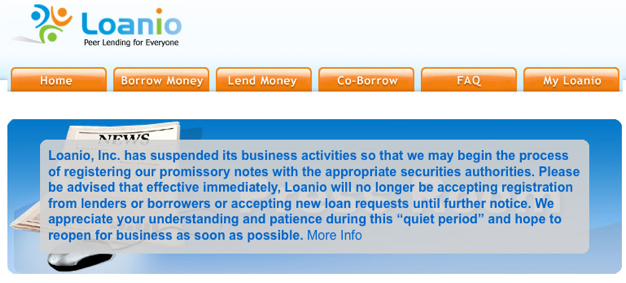
And it is not just Prosper, but all P2P lenders, that are on notice. Loanio, a new entrant into the P2P lending arena that just launched last month, has suspended new loans until it registers with the SEC as well (see notice below). And last April, competitor Lending Club was the first P2P lender to temporarily cease operations (the SEC approved its registration, and its members are now lending again in about half the states, including California which gave it the go-ahead last week).
The SEC letter makes clear why it considers Prosper a seller of securities and why it should be regulated by the SEC:
Thus, the Prosper notes are securities under Reves because: (i) Prosper lenders are motivated by an expected return on their funds; (ii) the Prosper loans are offered to the general public; (iii) a reasonable investor would likely expect that the Prosper loans are investments; and (iv) there is no alternate regulatory scheme that reduces the risks to investors presented by the platform.
Even though Prosper is not lending the money itself, the loans would not exist without Prosper. The letter gets into some more detail:
The notes offered by Prosper are investments. Lenders expect a profit on their investments in the form of interest, which is at a rate generally higher than that available from depository accounts at financial institutions. Prosper’s website has included statements that the Prosper notes provide returns superior to those offered by alternative investments such as equity stocks, CDs and money markets.
Lenders rely on the efforts of Prosper because Prosper’s efforts are instrumental to realizing a return on the lenders’ investments. . . . Prosper established and maintains the website platform, without which none of the loan transactions could be effected. Prosper provides mechanisms for attracting lenders and borrowers, facilitating the exchange of information between borrowers and lenders, coordinating bids, and effecting the loans. It provides borrower information to potential lenders via the loan listings, including credit ratings.
. . . Furthermore, under the terms of the notes, Prosper has the sole right to act as loan servicer of the notes. In this capacity, Prosper collects repayments of loans and interest, contacts delinquent borrowers for repayment, and reports loan payments and delinquencies to credit reporting agencies. Prosper also exclusively manages the process of referring delinquent loans to collection agencies for payment, and selling defaulted loans to debt purchasers. Since the lender does not know the borrower’s identity, the lender would be unable in any event to pursue his or her rights as a noteholder in the event of default.
. . . Rather, the Prosper lenders rely on Prosper’s continued operation of the platform in order to transact and to recoup any gain on their investments.
Obviously, any startup hoping to get into P2P lending should read this letter. But this reasoning probably also applies to other investment sites, such as social stock-picking sites, hoping to turn the information on their sites into investment products.
SEC Cease And Desist Order To Prosper – Get more Legal Forms


So does this mean I don’t need to payoff my $12K prosper loan?
Yeah what’s the deal with current loans through the site?
I’m pretty sure you still need to pay it off. Collections are still out in full force.
You borrowed money so you have to pay it back. What kind of an a55hole are you? Would you defraud the lender just because the lender might have difficulty in enforcing the contract in the courts?
Yes. Even if the original contract is void there’s still other theories of contract law, like unjust enrichment, they could come after you for. Of course, you could probably turn right around and sue them for fraud, racketeering, and all manner of other bad things they might have inadvertently been party to. But let’s get real, unless you honestly feel you were duped you should pay back your loan — it’s good to have an alternative avenue for consumer credit than the completely corrupt mainstream banking system. And if you do feel you were duped you should be a grown-up and call and discuss that with them and see if you two can find a mutually agreeable way to work things out: we need new methods of banking to be successful.
Contract law is voided when the contract violates federal law. Prosper may be held liable for borrower’s debt. Lenders will need to go after Prosper for money. That’s why a bunch of lawyers are looking for Prosper’s lenders to make money. This looks like a win for them.
Mike, you say “Contract law is voided when the contract violates federal law.” The U.S. Constitution says: “Congress shall not impair the obligation of contracts.” Therefore, your example here is just one more example of how the government as a whole is illegal because it doesn’t serve the people or the country since it continues to violate the U.S. Constitution. You say: “Lenders will need to go after Prosper for money.” What you don’t say is that the entire court system in this country is fraud and treason. Read all about it at http://home.abs.../Bankfraud1.htm
What Michael says, namely: “But let’s get real, unless you honestly feel you were duped you should pay back your loan.” makes far more sense than what you have said here.
I was thinking it was only a matter of time. Hopefully they figure it out so all people involved can get their money or pay it back.
thank god for the SEC intervening and keeping us safe from these dangerous, complicated financial products.
just imagine the shape our economy would be in if they weren’t so diligent in enforcing regulation and keeping everything on the up and up.
oh wait.
Is this a surprise for anybody?
I am a lender on both Prosper and Lending Club and I think it is unfortunate to see alternative lenders being shut down in the middle of a credit crisis. At least Lending Club got cleared, and I hope Prosper will be back soon.
Good!!! They should leave the sketchy lending to the professionals…
OK so the Banks can’t no longer afford to lend money due to the financial crisis, the credit system is broken… and now, just when someone can lend money and keep the economy going, they are stopped… congrats USA
and the reactionary comments go into free fall. they have not been shut down they have been asked to register with the SEC. try READING, you know, that thing you learned at SCHOOL!
Prosper shut down? Come on over to Lend4Health. Make loans to families who need it for their kids. Interest-free, no SEC worries.
I never made any money with Prosper. There are too many defaulters on that site… even AA’s default rate is very high.
You just don’t know who is most likely creditworthy and who isn’t. Of course you can never know for sure, but look at my lender stats http://www.lend...LoanManager-com and you see I’ve made a bunch of loans (most) to B, C, D borrowers, none of whom have (yet) defaulted. Now I probably jinxed myself, but of the 35 or so loans I’ve made (from 2006 to June 2007) none have defaulted. I stopped making loans in June 2006 due to the sh*tstorm you could see on the horizon at that time.
This just kills me. Sounds like we as citizens need to petition congress to write some new laws that allow company’s to do P2P lending. This way they can apply regulation that make sense for a lending marketplace and keep the SEC from apply last century laws to this century innovations.
Of maybe my cynical side wins out and it’s the financial services industry lobby that caused this to happen?
Alternate may be “P2P Lending from the Caymans, anyone?”
Since Lending Club is already approved by the SEC to do business, things are looking very good for them. More borrowers due to the credit crisis and few p2p options.
http://prosperl...-loanio-to.html
Prosper is one of the most dishonest companies out there. When they shut down, they claimed in several forums that it was completely voluntary on their part and had to do with the “secondary market” they’re creating for trading notes between lenders.
See prospers.org for more information, in particular Fred93’s blog. They keep getting caught in these half-truths and outright lies over and over again, and I don’t know why anyone would trust their funds to them.
I give Prosper 2 months until they’re in the deadpool.
The most fun with Prosper is during tax time when you have to enter 20 cents 30 cents in schedule D for 100s of items. I started pulling my money out 1 year ago but still there is some left.. hope I can recover…
I often consolidate all that stuff. I do the math for them, and if they audit me, they can redo it themselves. They just want to make sure they get as much of your money from you as they can. The nasty time-consuming paperwork they make you do is just icing on their make-the-people-fear-us cake.
One would *think* that some of that $40M in institutional money would have gone towards dealing with this proactively rather than reactively…
What a travesty. If one wants to lend money to another in a P2P marketplace this should be encouraged not discouraged. The system in this environment is self regulating. Lender beware for sure, but this is providing a much needed and valuable resource for people to acquire loans that they can get elsewhere.
As they say – you arent somebody until you get sued or become subject to government regulation. These guys were probably getting so much traction they instigated fear among the big institutions and as a result the DC machine came out in full force to influence regulation…ugghh
ZOPA is done in the US. Loanio doesn’t have the funds to finish or probably even begin the SEC process.
I moved my last bit of funds out of Prosper last month and over to Lending Club. With so much VC money, how could only ONE of these companies be doing things on the up and up? Unbelievable.
I guess all the banks, investment firms, and insurance companies that are getting a bailout, must see these start-up lenders as a threat! Probably told the SEC that they just can’t endure the competition and that SEC better do something quick.
What is sure to happen is these companies will just move operations off-shore and hit the international market. We will see start-up companies outside the US benefiting from the P2P lending while the US falls still further behind.
Really too bad these gov’t agencies/regulators weren’t so concerned with all the big fish that put hte economy in the current mess. Too many idiots with low IQ’s in important gov’t positions.
I don’t think the low IQs are the problem. The system is designed to thwart real help for the little guys that provide the major competition to the big guys. Low IQs are kind of sought out for this purpose. Forgive my cynicism. I have the unfortunate habit of paying attention
So let me understand this – the SEC shuts down peer-to-peer (meaning parties of equal standing) site for loan origination to product me but does not understand what has resulted in multi-trillion dollar fraud offering by the major “regulated” financial institutions that resulting in the recent financial collapse. Glad they are paying attention. Oh, I am soooo safe now.
So let me understand this – the SEC shuts down peer-to-peer (meaning parties of equal standing) site for loan origination to protect me but does not understand what has resulted in multi-trillion dollar fraud offering by the major “regulated” financial institutions that caused the recent financial collapse. Glad they are paying attention. Oh, I am soooo safe now.
Big mistake, the SEC is preventing progress. Maybe the government wants to see their multi billion dollar investments in shitty banks not be disrupted by trimmer web based solutions.
In all fairness, most of the borrowers on prosper are about as subprime as you can get.
And to me, the SEC’s argument seems quite reasonable; they simply are requiring registration.
That being said, I would never loan on prosper; not only are the risks high, they are hard to judge.
I think p2p lending is great and needs to be encouraged. So, is Lending Club the only p2p lender that can legally operate now?
I could never understand how they were able to do this legally in the first place. I think if GW Bush wasn’t in office and been looking the other way, this sort of business would never have been allowed off the ground. We had banking and lending rules for a reason. They’ve been flouted for years and look where it got us.
The Banksters are afraid that credit unions and p2p will kick the chair out from under their scam.
Fiat money is backed by our future taxes, which is backed by our own labor. They charge us to barrow our own money.
We don’t need them any more than artists need the RIAA to sell their music.
How stupid can the banking industry possibly be? The banking morons caused this financial crisis and now they are lobbying the government to shut down innovation. The fact that the SEC is shutting down one of the biggest innovations in the banking industry in the last 100 years. Pier to pier lending (an EBAY for loans) is just further evidence of how desperate the banking industry is at trying to retain control of money distribution, lending rates and liquidity. If you can’t get a loan from your neighborhood “moron” banker why not bypass the traditional system and borrow from someone on the internet? Seems reasonable if you have a good reputation and credit history. Its a disgrace and I think this will only cause more sites to start because it actually works. Look up “Micro Lending” and see what it has done to entreprenuers in Africa. Yes there is risk but it can be diversified and reputation is everything. Reputation is EVERYTHING!
Uh… In case you were unaware. We’ve had a little too much innovation in the banking industry. The biggest innovation being the Credit Default Swap which is a hell of a lot more innovative than P2P banking. The innovation in the credit markets has been fast and furious for 8 years. This has culminated in the failure of so many of these innovations, just as it did in the first tech bubble. We have banking regulations for a reason, to protect us. When all the innovation is designed to skirt banking regulations which includes P2P lending, then you end up with the problems we have now.
Don’t get me wrong, I think there is a place for P2P lending, but I think it needs to be regulated for the protection of the parties involved. Additionally, most third world micro-lending goes through established banking institutions on the ground. That would include organizations like Kiva who works with established local lenders.
If you can’t get a loan from your neighborhood “moron” banker why not bypass the traditional system and borrow from someone on the internet? Seems reasonable if you have a good reputation and credit history. Look up “Loan Shark” and see what it has done to entreprenuers in America.
So again I’ll reiterate, that’s why banking regulation is so important. When you learn something about the long history of money lending, then you’ll have a better understanding of why the SEC did what it did.
Prosper is a great company. It inspired me to start my own company. I used prosper and lost money, nevertheless I really like it. CEO Chris Larsen is exemplary leader.
This is sarcasm? Right?
This could be the death knell of the industry. Don’t blame the SEC though, both of these companies could have (and did) see this coming for months and simply stuck their heads in the sand.
I saw this coming a while back. That is why I tried my hand at doing a p2p lending site using collateral. Sort of like pawn lending with a peer to peer twist. I come from a pawnbroker background and this is an excellent way for people to borrow money during these tough economic times. The problem with pawnshops is that the public view them negatively because they don’t understand how the process works. If this style of lending could be created in a web based format, it could work in p2p lending if lenders had to compete to make loans backed by collateral. People would be more flexible than pawnbrokers and would make for an interesting platform. I have the idea fully mapped out, but could never afford to pay developers the funds necessary to pull it off. The key to collateral or pawn loans is that they are regulated at the state level. There are some models such as The Provident Loan Society at http://www.providentloan.com that do collateral loans online. So this is nothing new. It would just need someone to take this format and create a p2p platform around it. It would also need the expertise of someone with industry experience to head it up. Might just be the perfect solution for right now. Lenders would have collateral to cover defaults. Borrowers would have a better pool of lenders to leverage their needs above and beyond the local pawnshop. No SEC regulation. As long as the laws in the state in which the business resides are followed, it could create a win-win situation. Pawnshops are a very lucrative business. I used to work for the biggest one of all in Cash America. This would be a great way for both borrowers and lenders to benefit. Lenders could cash in on this industry and borrowers could get more money for their items without the hassle the pawnbrokers give. Also, it would definitely be geared toward high ticket items that can be shipped easily. There are also several other important things to consider, but this is a comment section on a blog and there is now way I could cover everything here. Any developers out there looking for a project to do for fun, this might be an interesting one. My personal blog is http://socialcontroversy.com. Anybody interested, check me out.
I dont think the http://www.providentloan.com is more useful than the web mentiond in the post.
I first heard of Prosper and felt in love with the idea. I invested $2,000 and I am a somewhat happy lender at 6% returns.
However, their management team’s vision and overall execution fell waaaay short of what was sold. They lacked the leadership and bravado necessary to do things right, and ultimately disillusioned the lenders (read more at http://prospers.org).
Zopa was an unfortunate implementation of the p2p concept, and never took off. Loanio came 2 years later than announced, only to disappoint when it looked like a poor copy of Prosper with even worse sub prime loans.
Unfortunately, this leaves us with only one player that seems to be doing things right. I have been moving my money to http://LendingClub.com as I think they are the only company poised for success. I scared the hell out of me when they were the first to say they were going into a quiet period, but how great it is now that it has the approval from the SEC. I’m getting 10% returns there.
I really hope Prosper, Loanio, Zopa or even a new entrant can reinvent themselves and accompany Lending Club in growing this concept.
We really need an alternative to the banking industry!
Are this p2p lenders allowed to lend to people overseas and vice versa. Interesting alternative but i think it’s scary with current economic climate.
Oh btw
Check out the new look JobsTAXI at http://www.jobstaxi.com
New Jobs. SK+G. Frog Design. Blue Fang Games. HCA. Dror.
There was a related discussion on a financial blog a few weeks ago. (I’m Thomas Barker there too.) The author thinks our current system is so broken, it can’t properly manage capital formation any more. Not because of anything Machivellian, the system just isn’t well connected enough to industry in terms of knowledge and trust to service its needs.
I think the SEC should make new laws on microfinancing and midsized financing sites over the internet. to block this type of financing is reverse of what the economy needs
I’ve been watching Prosper for the past few years and thought the concept was interesting, but the implementation lacked. Based upon the comments by the SEC [in the attached letter], they appear to have fairly represented “why” Prosper is being ordered to cease operations [under their current model].
I would say that any P2P lending site, that acts in a manner to control risk for the lender, is operating as a either a broker or investment firm. If you want to create something new, you need to stop relying on “old” tools – such as the credit reporting agencies and standardized repayment models, etc. Taking the same basic principles of lending and borrowing and applying the “innovation” of the internet and bidding process does not create a “new” way of doing things, it’s just an extension of the existing method for making lending and borrowing.
What we need to a completely new method, one created from the ground up, totally embracing new risk models, new evaluation models, new repayment models, etc. If it was truly innovative, it would be “new” from top to bottom.
Personally, I hope someone figures it out – the old system is broken and the only people making any real money [in most cases] are those that have it already.
Folks, this is not bad news for p2p… I don’t understand why so many of you are looking at it this way.
What the SEC is saying – both through this Prosper decision and their recent approval of LendingClub – is that p2p IS a legitimate investment model. It’s a security, and if you want to be a p2p site, you have to register your model with the SEC and get approval, like any other investing vessel.
LendingClub registered. They’re good to go, SEC-backed and all that good stuff. Another p2p lending site that was making news – Pertuity Direct – supposedly registered a while back as well. I’m sure they’ll get approved if their model is sound. Prosper didn’t register, and now they’re offline until they do. The SEC just rolled up its shirt, dug into the p2p concept, and created a set of supportive, regulated measures for conducting business in that arena… that’s what the SEC is designed to do.
Eric is spot on. Prosper will still be open and operating as long as it registers.
I wonder how Virgin Money will face this issue…
Randy San Nicolas
http://www.prep...denterprise.com
Agree this is not all bad news. But, Prosper is facing some tough challenges that they’ll survive if they are willing to work with the SEC and adapt.
Lending Club is a successful testament that it is doable.
Unfortunately for Prosper, being the first in the market is not a differentiator anymore.
I am a lead plaintiff in the Prosper class action
To participate in the class action lawsuit against prosper contact
Phillip Kim, Esq.
The Rosen Law Firm, P.A.
350 5th Avenue, Suite 5508
New York, New York 10118
email: pkim@rosenlegal.com
tel: (212) 686-1060
What are the conditions for participation? How much can I expect to get out of the lawsuit? What is your percentage take on the outcome and how much are you going to ask Prosper to pay up?
I have about $2,500 in prosper.com and want to know if I will get any of this back.
I’m a lender on Prosper and will not be participating in any class-action lawsuit should one materialize.
Lenders need to take responsibility for the results they get so they will learn from their mistakes and not be doomed to repeat them.
The fact that these securities are unregistered is immaterial to what happened to the lenders because unbridled greed drove many lenders to bid on listings that should have never been funded in the first place.
The “rotten egg” dot-com stocks of a decade ago were fully registered securities, for example, but irrational exuberance drove people to buy them anyway.
Privatelender above wrote a book about how to lend on Prosper
He has 301 loans in which 81 are late or default.His business is selling books.
http://www.eric...s/PrivateLender
His estimated ROI is -2.25%
He’s still living in the dark about whats going on.
I’m a big fan of Kiva and Lending Club.
I tried prosper when it came out. Their whole model did not make sense: Do I really have to compete with other lenders to give my money out? Plus, they provided little information about the loans, so how am I supposed to know how much to charge. I think Prosper was doomed from the beginning.
Kiva is great, you know you are not getting any returns other than the benefit and satisfaction of helping others.
Lending Club is the best P2P lending site if you want to get good returns. Price is set (you take it or leave it), they provide much more reliable information about the loans, and it helps you diversify more. Plus their default rate is more manageable and expected (mine is around 2.1%, while I am making 12% returns).
Propser is in deep trouble. Hopefully they will emerge again one day but they need to change the way they do business. P2P lending is maturing and it is a good thing for everyone
I am so glad the SEC is cracking down on these millions of American trying to help each other out.
I am a lender with Prosper. I hope it will come back soon.