
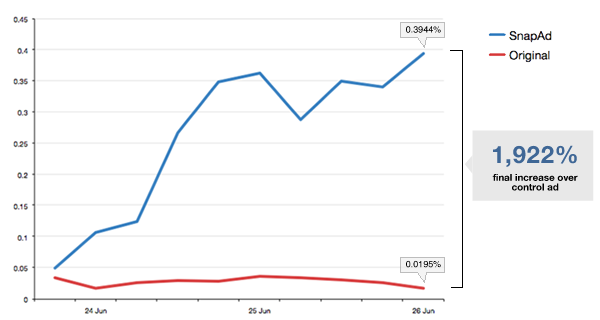
It’s rare to hear about genetics and advertising platforms in the same sentence, but new startup SnapAds has put together an ad service that effectively combines the theory of natural selection with banner ads – with very impressive results. The startup, which shares a number of founders with Weebly (though the two companies are unrelated), has created a system that dynamically adjusts the appearance of banner ads over time to maximize engagement. And it seems to work – a three day trial campaign for a recent film saw an increased clickthrough rate of 1922% over three days (not a typo).
To create a campaign, advertisers provide SnapAds with a special Photoshop file containing a number of specially-tagged layers with all of the art and text assets they’d like to potentially display in their banner. Advertisers can create rule sets specifying which layers are allowed to appear together, allowing them to ensure that SnapAds never generates an ad that is nonsensical or potentially offensive. Once all of the rules and assets are in place, the platform can get to work.
The process initially begins by displaying ads with a smattering of random combinations of the assets. As time goes by, the system identifies the most successful ads and allows these to “live on”, further modifying them towards perfection as the failures die off. Co-Founder David Rusenko says that a fully refined ad takes around one million impressions, but that the system never stops optimizing. Because user interest in an ad will typically wane after it’s been seen multiple times, SnapAds will continue to modify the ad indefinitely. The platform can also recognize when certain ads are more successful at different times, and will keep multiple branches of an ad “alive”, showing each at the appropriate time.
Rusenko says that to use the service advertisers will need campaigns consisting of at least 1 million impressions (SnapAds is not currently self-service), and that each ad is recommended to have 3-6 variables with 2-8 possible values each. Today’s announcement coincides with the launch of a SnapAds-powered campaign on Reddit and Wired for the AXE Detailer (man loofah).
While the initial results are promising, it’s too early to tell just how successful SnapAds will be. The system isn’t magic – it can’t automatically generate a new, especially appealing button or image. These assets will all need to be provided by the advertiser, and if there is nothing innovative to work with, SnapAds will only be able to offer slightly different permutations of the same generic ad. That said, provided the ad agencies can come up with a little creativity, the SnapAds service could prove to be very successful.


Nice use of the genetic programing technigue for a web business
That sounds like a great idea, but it seems like it would be very easy for all the major ad networks to setup a system like this if it really turns out to work so well, so SnapAds might have a lot of competition soon.
what do you mean easy? The way I see it, it’s non-trivial, technology-wise. You have to integrate with photoshop, there’s apparently a time factor, and split tests are not easy to implement
It sounds a lot easier then it is, the psd layered thing would turn off a lot of advertisers because it’s not easy for them to do that. Most would require a web designer or graphic artists. So they’re limiting the market down to about the major players and corporations.
Integrating with the PSD is relatively straight forwards depending on what you support – GIMP and many other programs can read these.
If the algorithms themselves are genetic, then it becomes extremely trivial.
That’s not to say it’s not a good idea – it’s quite clever, but replicating it would not be hard.
Very intresting approach to banner advertising, I can see this being a great way to try variables in your banners, and find the best set, I did look through the site for some pricing, and I couldnt find any, Ive emailed them and will be posting on the pricing, once I reviece a reply.
Rich
http://tech4000.blogspot.com
Excellent idea. Genuinely impressed with a startup for a change.
This looks like a fantastic idea, but it seems like it could be very hard for all the major ad networks to design a system like that if it really turns in to work so well, so SnapAds will have a lot of competition someday.
nice! how much do they charge for that?
Sounds like a great idea although I wonder how the context in which ads are presented (page and viewer) contributes to ‘fitness’. There’s more to it than just the visual-cfa combination. Nevertheless, absolute conversion rate is impressive (even if you do not believe the improvement over the control ad). Kudos!
Awesome stats! btw – the snapd.com link is incorrect in the CB widget
Wow, wonder what Dotomi would think of this.
Reading this I felt the same way as when I read how google worked 10 years ago, clever application of “simple” concept.
Lets now wait for the “intelligent design” version of ad optimization and see which one wins
Can you imagine a company more suited to take advantage of this type of technology than the GOOG?
uh…this is called “optimisation” and conceptually it’s nothing new. professionals running campaigns don’t just sling one ad up on the internet and hope for the best.
however, their system that can take a .psd file and serve out hundreds of permutations of a single ad is quite cool. it removes the need for some manpower and lowers campaign setup time, at least. however, the actual mechanism of choosing better performing ads over ads that aren’t receiving any clicks…that’s like ad serving 101.
“professionals running campaigns don’t just sling one ad up on the internet and hope for the best”
Exactly.
Some nice features… might have to look into this a bit more
Brilliant.
When I studied genetic algorithms in college I never thought I’d see it used like this. How trite…no thanks.
If they want to get more efficiency, the company should use some sort of collaborative filtering, or single value decomposition, and group the eyeballs into buckets. Therefore each bucket represents an abstract class of gender/interests/values/age/geography. Afterwards, pair match eyeballs according to click through rates for particular instantiations of iteration of ad mutations. In essence you’re finding positive collaboations between clicks, and bucket types. For instance, if you’re displaying a movie banner, guys would prefer to see the female in the foreground, and the dude in the background. Whereas females would prefer cute guys in the foreground, and dudes in the background. It’s a simple mutation, but can lead to increased click throughs.
errr.. should read:
“In essence you’re finding positive correlations between clicks, and bucket types…. “
Running ads are very difficult to do. But making it appealing will help
So, anyone here ever click on an ad more than once a month?
It can think…
Heck, why stop at such generalized optimization? Maybe us chicagoans prefer a certain style ad. Or us early twenties, college educated males prefer a certain style. The more statistically significant variables you adjust for (or in evolutionary terms, the better fit to the ‘environment’ the ad is), the more effective an ad would be. In fact, get good enough, and here is the scary part–we wouldn’t be able to tell the content from the ad!
(That last one is taking it a bit far I guess… changing color schemes on a spiderman ad wouldn’t make me confuse it with content, haha)
This business model adds values, 1932% increase of CTR isn’t trivial, and it’s all done by computers and algorithms, it will be loved by the split testers across the ad industry, and I hope all major ad engines can add this feature eventually.
says they are owned by Weebly at the bottom of the site: ©2008 Weebly, Inc. All Rights Reserved.
lots of innovation occuring in display space.. search isn’t everything! see, e.g. Tumri (not the luggage!)
also… what would happen if killer display met targeting met a new form of social advertising on facebook? see: http://blogs.ra...up-the-process/
Clever, and yet another example of using a sophisticated algorithmic approach to solve an optimization problem in online advertising. Our service (YieldBuild) works at the ad spot level instead of the creative level, but we see significant improvements by defining this problem space and optimizing across it.
Kudos to SnapAds for working with ad creative to optimize at the ad level. Shows there’s still a lot of work to be done to make ads perform better.
I wonder if the same can be done with Text Ads like on Adwords, YSM or other networks like Chitika. Implementing it in text will be a lot easier. Adwords has this option of running your ads in optimized mode, but I am not sure if they take into account so many factors like Geographies, Time etc.
Well done Greg and the team!
Kudos for a really brilliant team.
no sound in the video what gives?
i still dont understand whats so special about them the video wasnt useful.
I love snaplayout! <3
Nice. Multivariate testing is certainly under-appreciated in this space. I would expect that every ad network will be interested in taking advantage of this. True added value.
Seems also like Adsense or other text ad networks could offer a few different phrases and calls-to-action for a given campaign without breaking the bank. No photoshop integration required.
CG
Simply brilliant.
WAY TO GO BUDDY! Hope you make millions of bucks!
I’d be interested to know if the optimization rule is just click-through rate increases (passe) or if the optimization rule can be something different, such as back-end conversion rate lifts.
In designing optimization systems myself, sometimes the opt objective is clicks, sometimes time on site, sometimes lead conversions, sometimes back-end sales. What would be truly nice is if the ad version optimization algorithms can be designed to shape the funnel in a way we could choose.
The other comments about geotargeting or profile-based optimization are spot on–there is a high degree of probability that different audiences (in different cities, at different days of week, times of day, on different websites) will respond differently.
Taking this one step further, the real goal of an ad server should be to know in advance what versions are pre-designed for each target audience. Since publishers (through the collective learning of their ad server software) know which types of creative and campaigns/offers work, there is no reason why SnapAds should be allowed to get away with just the geewhiz of a Photoshop integration. Let’s make sure they’re pushing much further into some of the above areas.
David Shor
@David Shor:
SnapAds isn’t some Photoshop gimmick — we’ve chosen Photoshop as it’s already in the workflow of the existing creative team, and it’s simply used as the input mechanism of choice. Most of our campaigns contain hundreds of thousands, millions or billions of possible creative permutations, a capability existing ad servers do not have, and far beyond simply A/B testing a set of 10 creatives side by side.
Having said that, you’re spot on in the rest of your comment. We optimize to whatever an advertiser considers a success, whether that be higher engagement, more clicks, or greater sales.
We can and do optimize to different data: geotargeting, demographic, etc, depending on what is available. While we are still able to see increases when optimizing to a site’s entire audience (as they often share a certain amount of preferences), greater gains are made when pushing down further and optimizing with additional information.
Hope this answers your questions. Feel free to reach out if you’d like to take this offline.
I give SnapAds credit for solving the problem of genetic ad optimization very well.
What about incorporating similar technology across the entire spectrum of ‘buzz’- advertising, marketing, PR, blogging, etc? Wouldn’t it make sense to use the same approach for blog headlines, for example?
Or what about genetic multivariate testing that optimizes for the combinations of features customers think are important in a product/service/app? There is a great book on that topic called “Blue Elephants”.
Well done folks. Just wish I had an ad with 1 million impressions so I could tinker with your software. Anyone know of great multivariate and A/B testing software for other domains where combinations of variables matter?
right idea in the right time & place will result in a mountain of money
Has a single person here on TC used this product? Seems like a lot of talking without a lot of tasting… Save the congratulations for solid execution.
And it seems like there’s already competition for this… from AdaptiveAds, AdReady, and GoogleDisplayAds.
Anyone have any idea if the backend post-click-thru metric (i.e. lead conversion) takes a beating as the CTR increases 20x? I suspect so, but not enough to offset the considerable gains from the increased traffic. Brilliant stuff.