
Why do certain videos on YouTube become mass phenomena while the vast majority of videos just get a handful of views, if any?
Riley Crane, an American post doctoral fellow currently researching at the Chair of Entrepreneurial Risks at ETH university in Zurich/Switzerland, says he has the answer: According to him, the success of online videos can be explained with physics.
Crane claims every time a YouTube video turns into a hit, the development takes the form of an “attention spiral”, a geometric pattern that partly follows physical laws. He discovered that a decrease of popularity with certain videos, for example, can be explained through methods usually utilized in modeling the aftershocks of earthquakes. He believes social systems on the web follow the rules of physics and can therefore be analyzed mathematically.
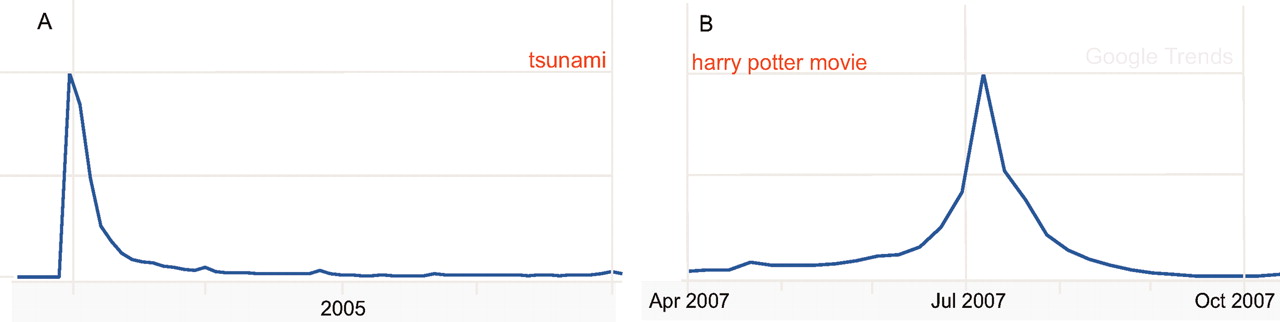
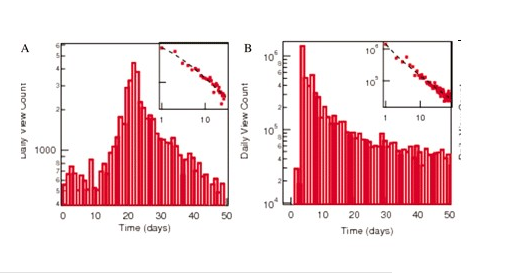
The popularity of YouTube videos can be characterized through curves visualizing increases and decreases in the number of viewers and the amount of attention they pay to each video. For example, the following graph shows two different attention spirals (top left: level of search activity following the Tsunami that hit part of Asia in December 2004; top right: the volume of search queries for Harry Potter between April and October 2007, bottom left:views of Harry Potter videos on YouTube; bottom right: views of tsunami videos on Youtube):
After researching the usage of about 5 million YouTube videos over 8 months, Crane found out that only 10 percent are viewed more than 100 times a day. According to Crane, the popularity of these videos can be measured through distinguishing whether a burst of activity was observed after a large-scale “exogenous” (external) shock or whether it’s the result of a number of smaller “endogeneous” (internal) factors that had a cumulative effect. Also, it seems to be important to take into account the extent to which web users can influence others to take action (what he calls “critical” vs. “subcritical,” where the latter term means exerting influence is impossible).
Crane categorizes especially popular videos into three different classes:
- “junk” (exogenous subcritical type, videos that quickly pick up and lose viewers / see the green diagram at the bottom left in the picture below)
- “viral” (endogenous critical type, videos spreading through the site through word of mouth / see the red diagram at the top right in the picture below)
- “quality” (exogenous critical type, videos that attract attention quickly and only slowly lose their appeal over time because of their high quality / see the blue diagram at the bottom right in the picture below)
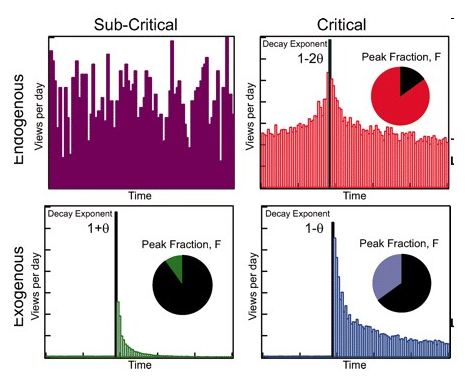
Junk videos are characterized by a significant peak that contains the vast majority of views and fail to spread through the site. In contrast to quality videos, viral videos show precursory growth before peaking out and decaying slowly (see the Harry Potter example above, diagram A): It takes time for the endogenous phenomenon to build up and spread within the network. Quality videos, however, reach the peak much faster as a reaction to an external “shock” but also decay slowly (see the Tsunami video example above, diagram B).
Crane claims that viral and quality videos show very characteristic patterns over a specific period of time, supposedly making it possible (through the analysis of tendencies) to predict if a video has the potential to become a super hit.
The final goal is the development of an encompassing and science-based online trend monitoring system. The university newsletter writes (German only) Amazon is currently in negotiations with Crane to integrate his model into its site, hoping to predict the potential of newly listed products at an early stage.
The critical factor here (and one of the long-term objectives) is to correctly determine the tipping point, the point in time at which the viral effect kicks in and sales or (in the case of YouTube) views of videos take off. Details of the model developed by fellow researcher Didier Sornette and Crane can be found in the October issue of PNAS magazine (available online here).


now, this is some thorough analysis. well done!
SCIENCE!
“After researching the usage of about 5 million YouTube videos over 8 months”
I think somebody is looking for an excuse NOT to work if you ask me, any other employer would have fired him long ago. I don’t see any science here, just “claims” and “hopes”. I ain’t buying any of it. It’s equivalent to somebody finding the physics behind lottery winning and developing a model to support their idea.
How do I know this is true? Well, where are the tests proving his theory using actual videos that he tracked before they became a “viral hit”? In other words, if this theory holds water, he can predict with relative accuracy what will and not become “viral”, which he has failed to do. This is a hypothesis, not a theory.
Jon
http://WoodMarvels.com – Create Unique Memories
@Jon: It’s a theory, not a hypothesis. It’s called statistics, and 5 million videos over 8 months is evidently enough to be statistically significant. Do you know what PNAS is? It’s the Proceedings of the National Academy of Science. You can’t get a “hypothesis” published in it.
Don’t understand what statistically significant means? Let’s say I want to know how many people in LA are men and how many are women. Let’s say I pick a random group of 10,000 people and I find that 5500 (55%) are women. Do I need to poll everyone else? No, 55% of the whole will be women too, +/- a few percent. This has a rigorous scientific definition if you’re still skeptical.
He based his study on past data, and like any theory based on social phenomena, doesn’t hold true EVERY time. Nobody claimed it did. Relating something to physics doesn’t make it physics, but it sure works better than having no theory at all.
I’m glad I don’t work for you– I would have been fired a long time ago for being smart.
I agree with Jon, there isn’t much that is useful here.
It’s like studying the falling of raindrops, and finding that once in a (long) while a raindrop will produce a certain waveform when it strikes the surface. Well, whoop-de-doo.
What is important is to be able to predict before a particular raindrop falls, what kind of waveform it will produce. File his research under “U” for Useless.
I think internet marketers (those fond of creating viral marketing videos) would appreciate Crane’s discovery more than YouTube users. Great discovery and will look into this further. Thanks for sharing.
Great article Serkan, thanks for bringing that to our attention.
Ok, so a researcher has done plenty of work to visually describe consumer consumption on online video content. And suprisingly, videos that are a flash in the pan reflect consumption data that…looks like a flash in the pan. And videos that were more popular…didn’t die out as quickly. So far this falls into the “duh” category.
Nothing up there even touches on prediction or modeling. So for marketers, its pretty useless.
Not trolling, and would love to be proven wrong or corrected.
Interesting…I have comment not related to the article itself, hope not too
irrelevant here..
While I tried to get the full article, faced the same good old ‘payment issue’. I have seen the same barrier to knowledge with IEEE, ACM, and others. I am all for them to make money, but $10 is a lot of money in other currencies. Their $10 barrier may have stopped so many possibilities of new results, papers, conferences or even new fields of research. It is about time we open the knowledge for the world not just a few who have powerful currencies in their wallets.
Regards,
Subhankar Ray
You can get PDFs of the article from my homepage so that you do not have to pay. Thanks for all the comments, both positive and negative. Send me an email if you’d like to know more.
I’d think that it is a lot more useful to predict the success of the video by being able to compare characteristics before they’re launched. You can only asses its potential once it has hit the web.
If I understood correctly and this is what the article says, how does it help prevent flops? What good does that kind of prediction offer if you have to invest in creating the video and/or product? You basically need to have everything ready in case it goes viral.
@Daiver That’s the point. There is no benchmark formula for creating a viral video. You get lucky with a confluence of internal and external factors and it clicks with a mass audience. The key here is a tool that helps the author, distributor, etc. capitalize on that effect and more quickly mobilize to maximize monetization. Looking forward to reading more in depth.
Even though “practical data” is needed to be able to make statements (which means videos have to gain some traction first), he says his model can help marketers decide whether to throw marketing resources at a certain video/book/etc. at an early stage, for example to reach the tipping point.
Like Daiver says above, if the model works, companies can be ready when a certain video goes viral, for example by preparing a follow-up video in time.
Great post. Fascinating how physics are applied to the age-old questions: “What makes a video popular.” It makes sense, but I’m sure there are some anomalies in there. Thanks for the post!
Informative. Great research.
Oh btw.
Check out http://www.jobstaxi.com
New Jobs. Razorfish. Art.com. Edge of Reality.
Those scientists and their so-called “science” — the reason this video of mine got almost 3 million pageviews is because it just rocks.
http://www.yout...h?v=MJJHk4hSFB4
where did he get the data from?
interesting well done.
whether his findings are true or not is not important.
The idea of trying to find a pattern in viral videos is in itself genius
Here a Dutch entrepreneur predicts the US election outcome based on the YouTube sites of Barack Obama and John McCain: http://www.chan...&id=2762357. He uses the keywords on the pages, type of video’s and music of the video’s.
Funny how anything people can’t comprehend easily, e.g. mathematics, is considered to be ‘useless’. US ignorance will take down the US.
I’ve been collecting data on daily views of YouTube videos as well as weekly subscriber data for over 2 years now. I do see plot curves like Mr. Crane describes. I think that certain Types of videos by certain Channels can be predicted to fall into one of the four catagories, rather than just looking at any video picked at random. Analysing data can help spot which kinds of videos might be popular and which videomakers might become future YouTubeStars! Another company that tracks video views is TubeMogul and they have some good papers on their Research page related to view curves over time and what makes a video popular. http://www.tube...earch/index.php
Nice write up, Riley.
http://www.yout...h?v=dF7cbKMJ-rg
Great article, Serkan, thanks for the write-up. I’m on the TubeMogul team and love this stuff. KennyCrane beat me to noting our own research on the topic of video views over time.
It’s worth noting that we now have technology to measure second-by-second audience behavior, so we see drop off rates, rewinds, how people arrived at the video, and more. Perhaps we should be in touch with Riley to see if there are interesting studies to conduct.
Check out my website where you can calculate how many videos your YouTube videos will get. It’s based on this research.
@Governor: While your enthusiasm is great, your website does not really capture much about the research.
seferis-giorgos-gipsosanides.gr
Attention spiral downward spiral of civilization as we know it.