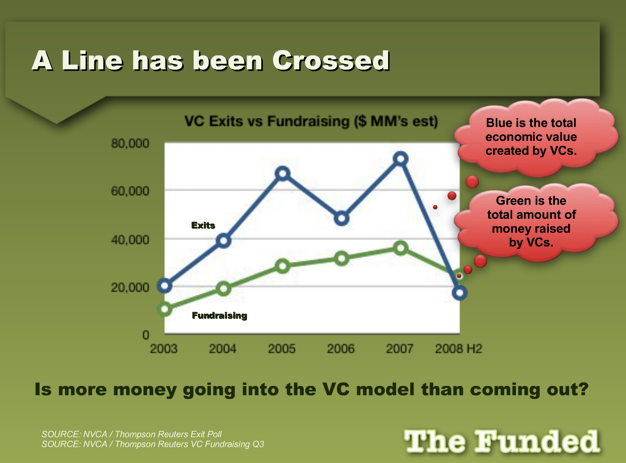
At a recent presentation at Harvard Business School, Adeo Ressi argued that the VC model is broken. That is nothing new for Ressi, who is the founder of the VC-rating site theFunded. He is kind of like the Nick Denton of the VC world, always saying that the sky is falling. It’s just that at this moment he happens to be right.
The slides from his presentation are embedded below, but really all you need to look at is the one above. It shows that the money going into VC funds is now more than the money coming out of VC funds. That line was crossed last June and there is no going back anytime soon.
The big institutional investors who tend to put the most money into venture funds as limited partners are hurting right now. They’re other investments have gone south, they are over-leveraged, and there is buzz that some are pulling back from their commitments to venture funds. They certainly aren’t eager to pour in more money, especially when the net returns just aren’t there any more.
When the lines cross over again, we can all relax. But until then, it won’t be just startups that need to tighten their belts. VCs are on notice too. Their once-flush investors are now squeezing every penny. And some VC funds just won’t make it.


The number of VC funds has exploded since the last burst. So to say that a number of them will fail is just a market correction. To look at this data and say the VC model is broken is fallacious and sensational. Plenty of funds still have plenty of cash and are still investing and plenty of startups are still hiring. Just mostly not the ones you cover since people are recognizing that most web companies are as retarded as they were the last time.
Agreed. Everyday, we read TC posts and learn of many, many companies getting funded.
“the money going into VC funds is now more than the money coming out of VC funds” Any idiot, including Erick, would realize that there is plenty of money to invest.
The slowdown means that VCs must be more careful and fund companies with a real chance of success -and good returns.
Erick cannot help it; he is still trying to be a “journalist” who spread *only* bad news…. because ‘good news’ do not sell anything.
Erick is getting smaller and smaller with every posting, which are shittier and shittier…. And this is not good for TC.
I agree with ghunda.
great presentation.
The Valley is to blame as The definition of “success” has changed.
Success used to be creating a product that generated enough revenue to allow that company to grow and expand. Tht success attracted interested buyers and the opportunity to continue growing, or selling, was the end game.
Today, success is defined as having a concept that is plausable enough to pitch a VC–and receiving financing from them. Nothing more.
An entire subculture–Startup Schools–was created to feed that myth. But like ponzi scheme, it only works when there is someone around the corner willing to continue buy the company despite no revenue model.
But Mike Arrington and Valley VCs didn’t invent this idea. A bunch of guys in Grand Rapids Michigan did back in the 1960s. Perhaps you remember the name:
Amway.
Well folks, the music has stopped, the funding has ceased, and the startups must now rely on the marketplace to generate revnue to survive or–dare I suggest–profit.
Crazy idea, huh?
Richard,
I’ve been gone from the high-tech industry for 8 years now, but, if my memory doesn’t fail me: isn’t this, in part, the reason (the definition of success has changed) why we had the web 1.0 bubble in the first place?
Lot’s of companies full of “hot air” but no substantial and tangible business proposition?
Best,
Diego
To Dick Hertz…(ouch)
I have no vested interest in Amway, but perhaps you should look a little more closely at their financials before you call them illegal- as a ponzi scheme usually doesn’t last 40 years before its shut down.
Perhaps the real ponzi scheme is the stock market itself, and all the IPO’s force fed into our pockets via mutual funds…thus priming the pump for such vast amounts of funding, going into such baseless business models.
The cream will rise to the top but VC’s need to look beyond their usual club they have created and reach out to start ups outside of the box!
@Erick,
It appears 2005 was when things began going awry. Seems the economic value to VC investment ratio has been getting smaller since then, hence Adeo Ressi has been on to this problem for some time.
I’d be interested in seeing the equivalent but for angels.
It will take a while for this to really start to sink in. However, this is an industry that has been begging for a reality check. The numbers just don’t work at this scale, particularly in web and mobile. Great deck and theme, Adeo.
Chris, are you proposing smaller investments with an eye to smaller exists – say 7 or low 8 figures?
If so, I agree with you.
It is an interesting presentation, but the whole “line has been crossed” concept is a bit misleading.
I suspect the flip of economic value vs funds raised is cyclical. What do these lines look like if you go back more than just 5 years? Give us 20 years + to really evaluate.
I imagine its like many companies in this current economy…some may loose money this quarter…this year, but they still have long term value and invest through the downturn to emerge triumphant.
So lets not fan the flames on this one, Mkay?
If he is right, this could be a good thing though, right? As in, the VC funds that aren’t up to par get weeded out, you’re left with the better ones.
The flip side is that with less VC’s, will there be less funds for entrepreneurs or will that amount not change with the number of VC’s in total?
i agree with Mike – great presentation. its too bad that this actually is reality – and has been for the last year at least. yes – the VC model has to be fixed.
Chart is misleading. Exits are 3-5 years from funding. Blue line should be shifted accordingly.
I agree with Ankit. The reality is that like any other correction process the fittest will survive. If a VC provides no value to a startup beyond just funding…then they will not survive. The VC’s that provide true value to thier clients have seen great returns and will continue to do so. The system is not broken…just being corrected.
Hey Randy:
If the fittest are to survive, why is it the VC’s responsibility to help them succeed. The PRODUCT, not your banker, makes or breaks you in most cases.
Which is entirely Dick’s point–I think. If a VC can help a solid product, all the better. However, “true value” is always determined by the market, not by the guy lending you the money.
The reality is that I believe we are saying the same thing here. I agree with everything you state, however my only point is that if a VC has a vested interest in the success of the company, I am not sure that they should sit back and just watch the game play out. As an investor myself I will do what I can to help the company with introductions, advice, etc. It would be foolish not to as it is my money invested to see that company succeed. Unfortunately not all VC’s are created equal, and those that help clear the way to success rather than being a hurdle to success are the ones that will survive.
I agree 110% that the offering from the company needs to stand on its own and provide value to its clients. Again…I think we are saying the same thing here….
Great presentation. One problem that the presentation overlooks is the diversity in the different types of VC models.
Most ‘bulge bracket VCs’ who raise $400-800million dollar funds and participate in multi-round funding (this is a term I got from Josh Kopelman during the Web 2.0 Summit panel that discussed the same conclusion that there are big problems with the VC model) simply can’t create the returns needed in todays IPO & early exit market.
At the same time there are many great companies that are doing $40-$150 million in revenue, very profitable who have been VC funded and will be in great position to take advantage of a more sane public IPO market when it emerges (2-4 yrs).
The challenge for this larger VC funds is that since the IPO market has been closed for so an extended period of time and exits are going to be closed for many years to come (aside from consolidation plays in the M&A market) they are going to be coming to the end of life of their funds without having returned investors money. This coming on the heals of the meltdown of so many other asset classes will be the end of many funds.
This presentation describes this very well.
That being said, there are many small funds who don’t exist on heavy management fees – that can return investors money at various lower levels of exists. Some of these are two dependent on selling companies to Google, but many more invest in deals with post money valuations under the $10, $15 and $20 million range. They also tend to release capital in small chunks tied to the stage of the company and real proof points.
This allows them to accept smaller exits in the private M&A market as big wins and support companies with longer scaling timesframes that are cash flow positive.
These companies will need an exit market at one point, but I think this class of VCs will be even more popular & profitable. You’ll see thousands of LaunchBox Digital, Softtech (Jeff Clavier), Josh Kopelman, TechStars, SeedCamp and Betaworks. This will be a farm system for later stage VCs where investors & entrepreneurs interests are aligned and there will be more diversity in structures, fees, reasonable exit & revenue expectations.
This is the type of change that Adeo Ressi calls for, but Erick and he are not giving enough credit to the fact that this change has been occurring for a number of years and will prosper in this market.
Disclosure: I’m a venture partner in two funds in Canada that fit this profile. We haven’t had the easy follow on fundraising assembly line that exists in other Tech centers so we’ve had to start changing our VC industry before this crash occurred. Jury is still out if we can make the model pay – but I think it’s a better approach.
I believe the VC industry will hollow out in the middle. Most mid-size funds are gonna be dried up, leaving the smaller funds and larger late stage funds.
Austin, Sounds like a re-visitation to an incubator style model where a tiny seed money is mixed into an entrepreneurial stew. Little capital is recalibrated with a lower exit potential – say $1M total investment for a potential $5-10M exit.
Like buying the very best depressed corporate bonds today, in 2009 some folks will make some INSANE returns by buying out positions in the secondary market. Even investing in the bottom of the top tier at a 50% discount leads can lead to incredible turns. Smart investors made huge returns in ‘02-’04 buying out the quality venture positions of investors who couldn’t make capital calls or wanted to run out of the venture market.
Some good points, but also a bunch of hyperbole. The recommendations are also underwhelming in some respects. Let’s see, VC funds aren’t returning enough economic value? The solution? Fund 25% of companies instead of 10%! Be less selective to make better investments. Yeah…
The graph doesn’t show sentiments that I hear regularly now. Now is the time to build value. It makes sense that less revenue will be coming in right now, but if you invest in things that are undervalued right now, you will achieve great economies of scale when the values start to rise again.
@Nadav is right that exits trail about five years, so the value created today is largely based on investments made in 2003 and 2004. The chart shows 2004 investments into VC firms are larger than the YTD exits of 2008, as well.
@Greg, the point about making more investments is that the VC funding model is likely missing unique deals, and these unique entrepreneurs struggle to grow businesses that can one day be quite large due to a lack of available capital.
The larger point is that the VC model is clearly flawed, has not changed in some time, and needs to be fundamentally re-evaluated. The goal of this presentation was to spark a dialog about what a better model might look like among Harvard professors and students. When the deck leaked, everyone is now invited into the conversation.
The slide is meaningless. All it shows is that the economy is bad.
For investors, all VC has to do is outperform other asset classes. On that front, the data looks good: VC has consistently beat NASDAQ and the S&P 500. See . VC returns for one year are +5.1, whereas NASDAQ is down -11.1 and S&P 500 -13.8.
More money coming in than going out shows VC’s strength, not its failure. It means investors are buying despite the downturn — you’d expect investors to flee at a much greater rate when the data is showing a lack of exits.
Also, a lack of exits might speak more about the IPO markets and large companies doing M&A than it does to the value that start-ups are creating from investment. To measure this, you’d need to look at the profit of venture-backed companies.
You can find the numbers I cite here: http://www.nvca.org, in the “VC Performance Q2 ‘08″ pdf.
Amen.
Fantastic presentation.
Reality hurts.
Great presentation!
Btw
Check out http://www.jobstaxi.com
New Jobs. Nixon Inc.. oDesk. Rockstar New England. FixYa. Snap. Gorilla Nation.
This is third rate analysis.
@Nadav, @Greg, @ghunda all make valid points. Most of all you should be looking at asset class IRRs, not ‘total cash in and cash out’ — that’s just basic economics.
In addition, there’s no consideration of the cost structure: evaluating more potential deals in the ‘other’ category is expensive because they’re harder to triage. Reason there are few good firms is there are few good VCs — it’s an extremely difficult thing to be good at. So good partners’ time is limited, hence they rely on trusted third parties to filter dealflow. Which works: partners with good reputations earn them by doing good deals which help build their networks which help improve dealflow, etc.
No question that the current exit environment sucks, but that was true in ‘01 and ‘02. If exit market remained closed indefinitely then that would be a problem, but that’s forward-looking.
You need much better data and very careful reasoning to draw any general conclusions about whether the “model is broken”. For a start there’s something like a power law distribution of returns by fund quality. A very small number of partners at a fairly small number of firms actually make most of the returns.
Better still, ask the professionals. Quiz a selection of sophisticated LPs who perform this analysis for a living. Even better, since actions speak louder than works, look at whether they’re still writing checks.
sbrown had the most commonsensical argument around. This presentation is just trying to feed off the mass hysteria in the financial markets. And yes, the highlighted chart shows that investors and funds are acting rationally by not selling/exiting, unless really forced to do it and the near static curve of the total amount of fundraising shows that some people actually know how to invest. VC investments are such a tiny fraction of most of the institutional investors’ portfolios that I really don’t see the compelling need to liquidate, unless of course you’re seeing a bubble. But doesn’t the dropping curve on exits just show that funds are unwilling to exit when times are bad?
As I have understood it, VC investing is not leveraged the way buyout M&A -deals, because of the weak cashflows associated with startups. So that’s not forcing exits either.
This really just tells how the economy is bad – and not really anything specific about the VC-industry.
But naturally investing processes can always be streamlined.
While I do not agree with the slide completely, the slide show has some excellent points, particularly around where VC’s concentrate their investments. However, much of that has to do with human nature. People (and yes, VC”s are people) are looking for a certain level of security and safety, so they invest in who they know and what they know. Ideally it’s both, but it has to be at least one. Take a bio-med deal to a chip oriented VC firm and if they don’t know you, good luck!
Case in point. I’m an adviser to neosonik.com. Revolutionary technology, wireless HD audio and video in full 5.1 surround, 200+ feet through walls, nominated for Best in Show at 2008 CES. Problem is that VC’s don’t understand medium to high-end consumer electronics. And even though we can show we have PO’s from stores around the world (including the biggest AV chain on the planet) and we will be cash flow positive AT LAUNCH and make gobs of cash, we have had zero success.
Why?
Simple.
#1. VC’s don’t understand the market
#2. The management team is part of the “old boys network” (ie they didn’t go to Stanford)
It’s very tough to get over human nature. VC’s have been given huge sums of money and they cannot make a wrong move, so they stay in their comfort zone. And that is the problem.
You don’t make a killing in the comfort zone. To those who take great risks come the great rewards. VC’s need to get a little more Venture in their Capital.
(Let me make a quick correction: The managment team is NOT part of the old boy network, that’s the problem)
Respectfully, I might disagree. I was a VC for 12+ years and eventually left because the mode, while not broken per se, doesn’t scale very well at all. And like any market, a flood of capital brings down returns for everyone. Let me illustrate with your example. This is a bit of a generalization but will serve to make the point. High-end consumer electronics is an interesting and, probably, profitable market. But it’s not particularly high-growth. Regardless of how good your technology is and ow many CES Best in Show awards you’ve won, unless you’re in a high-growth sector – or better, a hyper-growth sector, VCs can’t afford to pay attention to you. Why? B/C every deal they do has to have a 10X or better return opportunity – or, put another way, a 50% IRR hurdle – at a minimum. That’s because 1/2 of their deals will fail. Even KP, Sequoia, Benchmark, VantagePoint, etc have 1/2 or more of their deals return $0. The winners need to be sufficiently large – not a 2X or a 5X return – but a 10X return or greater – to make up for it. It’s very, very, very hard to get a 10X return – with a new entrant or start-up – in an industry that’s $300M or $400M in total and growing 5%-8% a year or less. Trust me. The obvious question is “Why are they so bad at picking deals – you gotta be able to do better than a 50% hit rate, no?” No. It’s really akin to a batting average in baseball. You might make contact more than 50% of the time, but a lot of those are ground outs, long fly balls caught at the fence, or, frequently, strike outs. Picking winners at a relatively early stage of a company’s life is very hard – you just don’t know – and a little bit like trying to identify the next Nobel Laureate or Tom Brady or Alex Rodriquez – but do so when they’re still in Kindergarten. You might get it right on smarts or raw athletic talent – but so many other factors HAVE to go right to become a Super Bowl QB or a steroid-popping, over-paid 3rd basemen on the Yankees that it’s impossible to know at the outset. You pick and invest deals that ALL have that kind of potential and then you work like hell to help the realize it. And even then 1/2 or more die an early death.
I left VC to become an LP. In that position I saw the return data – over long periods of time – for almost every VC fund on the planet. For all but about 30 or 40, it’s not pretty or predictable or really that compelling. It’s FAR easier to make consistent returns as an LP in small, mid-market buyouts than VC – by a long margin. The analogy, if you’ll excuse it, is that small buyouts are like investing in that same pool of kids but now at the end of their college career. You can see A LOT more. Raw ability but also drive, ambition, character, interpersonal skills, etc. So much easier to pick winners and guide them to greater success.
my two cents. You can blame VCs all you want but the entire return model is challenged. A few really do justify the hype and the accolades and the fees/carry. But it’s less than 1% – if there really are 4800 VC firms in operation – a number that seems very high to me.
BRR
I was unaware that all venture capital was put together and divided up equally amongst all those requiring it, and that all profit from venture-funded enterprise was likewise shared equally between all investors.
If only every investment and return could be isolated, then this wouldn’t be the sky falling after all, it would merely be the odds of return deteriorating…
You don’t want to say that someone is falsely crying wolf if the wolf is really coming.
See my response to this post at: http://www.vcca...e-the-vc-model/
Well finally we can forget about wasting our time chasing VC’s and focus on getting the job done. Follow-up issue: Is there still a need for TechCrunch?
If there’s no need for TechCrunch, why are you here?
Well, I don’t know if it is broken but the game has changed. For us at Combo, we’re not going back into any meetings with VCs until we’ve shown sustainable profits for a few quarters. Which won’t be long!
Well the VC’s will always miss great opportunities to make great returns by continuing to avoid the adult industry………….maybe one should set up an adult fund……….
Good question regarding whether TC will have a future. Mike: curious if you have considered an exit strategy for this publication given the dim outlook.
Also curious whether TC ad revenue is declining along with everyone else in the market.
Thanks.
There are many viable businesses that are cratering in this year. They sell real products and have real margins. This is a very tough environment.
So I don’t think these results necessarily indict venture capital. It could just mean there have been fewer IPOs and acquisitions. That is what that top line represents, isn’t it?
Also, I think this chart would be more useful if the data points were quarterly rather than annual. I could be wrong, but last I checked, 2008 wasn’t even over.
@ Diego, my apologies as I should have been clear that “boring” was meant to be sarcastic. We are actually a pretty exciting company and have changed stock discussion forums forever…I just think we’re “boring” by Silicon Valley standards for making money as opposed to building a useless deadpool app.
George
There has always been crisis, bubbles, with technology and VCs. Who knows about the “The Go-Go Years: The Drama and Crashing Finale of Wall Street’s Bullish 60s”? Then there has been the PC, the disk drive bubbles. As a European, I am very impressed by the pioneer and obviously speculative culture that you have in the USA. It is why you have Intel, Apple, Cisco, Oracle, Google. What is next? I do not know. May be it is the end of the Roman (oops American empire). Honestly I doubt it. Yes there is too much money chasing too few ideas. But great ideas will come and come again. I have been a VC and I know their + and -. I quit but I still believe it is a very much needed activity that will contribute to great start-ups growth.
interesting presentation!
At http://www.growvc.com we will be tackling this issue….
Here are some further thoughts on the presentation and the VC model in a written form:
http://www.adeo...odel-is-broken/
Luckily for more sophisticated LPs, they don’t have to settle for average industry returns.
Хорошая статья, узнал много нового!)
Agreed 100%. I’ve been pounding the table on this for 3 years now. Too many “cool” apps vs. real companies. It was just unbelievable to watch VC’s shoot themselves in the foot, while also destroying the Web 2.0 ecosystem by encouraging “entrepreneurs” to build useless apps vs. real apps. They now deserve to suffer.
Having said that, don’t forget about the role blogs such as TC played in destroying the ecosystem by continually reporting on useless apps and dumb VC investments.
We couldn’t get Mike Arrington to even return a phone call over the past 18 months, despite having 7-digit revenues and profits….but he and the rest of the TC cast would make sure we heard about every jackass with a useless app (+ equally useless names and logos) that dropped into the house and begged for coverage.
VC’s and bloggers destroyed the Web 2.0 ecosystem. They will now live with the consequences. To recover, everyone in Silicon Valley is going to have to grow up and start focusing on “boring” companies that actually deliver a real product/service to real customers for real cash.
We (boring companies) may not have 1 billion kids creating 1 zillion page views … but we’re not sitting in the deadpool either. Had VC’s and TC focused on boring companies like ours, thus signaling entrepreneurs to build similar boring companies, I guarantee the entire industry would be far better off today.
Instead, we now have a wrecked ecosystem from entrepreneurs (aka “kids”) right up to VC’s. The funny part is that Silicon Valley is shocked that things ended up this way.
Next time, spend less time at parties and a little time looking at companies east of Sand Hill Road. Dumbasses.
Yeah, I’m pissed.
Regards,
George
are u pounding the table with your fist or your forehead
George,
Question (and I admit it: I’m very new and green to the whole Web 2.0 industry): why can a company be both EXCITING and SUCCESSFUL at the same time?! Have you read Seth Godin’s Purple Cow book? I love his concept about being “remarkable” and how successful doesn’t necessarily need to be boring. May be you can think of way to make your company just as exciting as it is successful!
Best,
Diego
George,
If I may, one last comment: is TC really, partially, at fall here? We can argue about who they mention and who they don’t and why… but ultimately isn’t it up to each of us to decide if the information presented is pertinent and correct or not? I don’t think that TC is the first “media” institution to get reports wrong and/or misrepresent certain ideas/news. But again, aren’t we all “grownups” here that can think on our own? TC presents a bunch of info every day… all we have to do if we find something interesting or may be a bit untrue, is do some research on our own and come to our own conclusions instead of running around solely based on what TC says!
If I park my car in a bad neighborhood and leave my brand new MacBook Pro in the passenger seat, only to come back later on and find out that someone broke into my car and took my laptop, do I get to blame Honda or Ford for not installing bullet-proof glass and re-enforced doors? Or is it my fault for not using my OWN brain?!
Best,
Diego