Free: Pack Of MySpace Branded Playing Cards »
Spot.Us Experiments With Citizen-Funded Community Journalism
by Erick Schonfeld on November 10, 2008

Newspapers are dying across the country. Local papers are shutting down, Gannett is laying off 3,000 people, the Christian Science Monitor will no longer put out a print edition, and even the New York Times is facing a serious cash crunch. Can citizen journalism fill in the gaps?

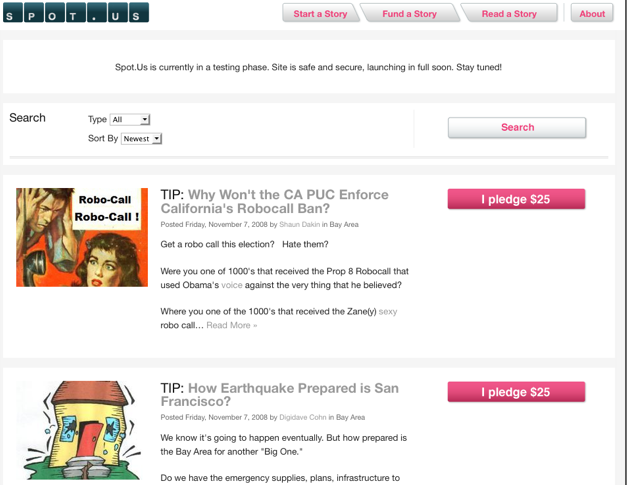
David Cohn thinks so. Today, he launches Spot.Us, a not-for-profit experiment in community-funded journalism. The site is a hub where freelance journalists can pitch story ideas and readers can pitch in money to pay the journalists to report and write the story. The focus of the site is on local, community issues around the San Francisco Bay area—the kind that supposedly get short shrift by city newspapers. But Cohn hopes to expand the concept to other communities.

Some of the pitches on the site now include

How safe are San Francisco Bay beaches and water a year after the Cosco Busan oil spill?

No dog park in Pacifica?

Why Won’t the CA PUC Enforce California’s Robocall Ban?

In contrast to other citizen journalism sites such as CNN’s iReport, NowPublic, GroundReport, or CJReport, there is not much room for citizens to participate in the journalism other than voting with their cash and submitting tips. Especially when it comes to local issues, local citizens are often better informed than an outside journalist. But turning the entire process over to readers doesn’t always produce the desired results either, as CNN found out recently withe the false “ireport” of Steve Jobs having a heart attack.

The site is part of a trend, though, in what I call mediated citizen journalism. There are still some controls in place. For instance, the Examiner.com is approaching local news by creating a virtual newsroom out of a corps of regular citizens, whose blog posts are vetted. Similarly, TC50 startup IamNews, allows any media site to turn its readers into reporters without giving them access to the publish button. Spot.US could add a little more participation to the process.

Also, I am a little bit suspect that the tip jar approach is going to produce quality journalism. Most people don’t care enough about these issues to a pay a couple bucks for the local paper, much less pitch in $10 or $50 to send a reporter out to write a story that they might not see for days or weeks. If Spot.US wants to engage citizens in creating quality journalism, they have to be able to contribute to the research and writing themselves, and even share a byline.

Below is an email Q&A I conducted with Cohn about Spot.Us:

Q: How will this work exactly?

1. Anyone can create a “story tip” – and people can pledge to it. An example of a tip.
2. Reporters create pitches – people donate to pitches (real money is exchanged).
3. Finished content is made available to be republished for free UNLESS a news organization buys exclusive rights to an article. If a news organizations wants exclusive rights they must either (a. Donate 50% towards a pitch early or (b. if the community has funded 51% or more – then a news org must donate 100% towards the pitch with extra proceeds going back to the original donor (similar to Kiva.org model).

Q: Who can become a Journalist?

Anyone can be a journalist. I decided NOT to try and define who is and isn’t a journalist. I thought that would be a step backwards. BUT: On a pitch you must explain your qualifications and journalists are encouraged to fill out their profiles which include giving their work history and work samples. We also encourage donors to look at a journalists profile before they donate.

Q: How are the prices set?

Right now the prices are set by the independent freelance journalists. But you must explain what you will deliver and justify the money you are asking for.

Q: How is the money split up, where does it go?

90% of the money goes to the reporter who pitched the investigation. The other 10% goes to an independent fact-check editor that is assigned to the story. This person is actually another journalist in our system, not a Spot.Us staffer. The Fact-Check editor’s job is to do fact-checking and ensure fairness in the reporting. They must approve the final story before it is published.

Q: Where does the story appear? Who enforces deadlines? Are there any deadlines?

The story will appear on Spot.Us but will be made available to any news organization to republish for free. The only exception to this is if a news organization pays 50% or more towards a pitch. In that case – they get first publishing rights to the article.

There are no deadlines – but the reporter isn’t paid until the pitch is published. We try and find pitches that are evergreens. We don’t suspect it is possible to crowdfund to hire a reporter to cover the fire across the street ;)

Q:Why only local stories? Aren’t there big, juicy, national stories that need to be told (and that would attract more funding)?

Good question with a few answers.
1. The Knight News Challenge which funded Spot.Us is supporting research and development that would support local reporting.

2. We believe there will always be large national news organizations like the NY Times, WaPo and CNN. But local newspapers are starting to face real hardships and it’s reasonable to imagine a world where local papers like the SF Chronicle, or Cincinnati Enq, etc disappear.

These papers played an important role in our local democracies and we want to make sure that the role they played continues. Journalism will survive the death of its institutions. We do hope to expand to other regions beyond the SF Bay Area soon – but we want to prove ourselves in this market before we expand.

Q: Is Spot.us set up simply to present pitches, gather tips and funding, or are here tools for letting the crowd help report the story as well?

Right now, the only way the public can participate is by donating to a story or creating a story tip. In the future – we want to let them be fact-checkers, leave comments on stories and even donate man-hours towards pitches, instead of just money.

Advertisement

Comments rss icon

  • Sounds good for an experiment, but doesn’t seem it will take off anytime soon. I still prefer my CNN news.

  • Thanks for the writeup.

    I’m willing to admit Spot.Us still has growing to do – including giving citizens more direct access to do the actual reporting. In the future I picture spot.us as a marketplace where people can contribute money OR time – depending on what they want. Not at all that different from IAMNews.com – except we have a crowdfunding engine.

    No matter what, though – I am a big believer in the role civic journalism plays in our democracies and I think we should, as a society, figure out how it can continue to thrive despite economic forces.

    Now is the time to experiment. So…. ONWARD!!!

    Davd{AT}Spot{dot}us – if anyone has any questions.

  • This is a great idea and I look forward to supporting it. Citizen Journalism is key to democracy.

  • The news world is a changin….someone has to lead the charge maybe spot.us is it, but newspapers are on their last legs this type of financing might be the only realistic way to get local stories done in 2 years…but i dont really know what im talking about so we shall see….cnn sucks

  • Congrats to David Cohn–a true trailblazer and innovator in the citizen journalism space–on the launch of Spot.us. David’s plan to crowd-source journalism funding offers the kind of new thinking we need to help the newspaper industry survive and evolve.

    I think Spot.us also learns from the successes of the 2008 presidential campaigns in interesting ways: grassroots funding, empowering citizens to engage, and focusing on the issues that matter locally.

  • So if I pay to have someone write about something, who gets the money generated from the reading of the article? As in, if some other site wants the articles to appear on their site for certain topics or categories, and they pay for that, do I get that return? Or if ads are displayed in the article, who gets the return?

    Basically – what is the motivation for someone pay to have an article written? Are we banking on people to who want to support a topic or issue that affects themselves? (Not a problem if it is, but the critical point should be clear)

  • Good luck Dave! looks great!

  • “But turning the entire process over to readers doesn’t always produce the desired results either, as CNN found out recently withe the false “ireport” of Steve Jobs having a heart attack.”

    Didn’t TechCrunch post a false report in June that Yahoo and Microsoft talks “were back on,” helping to create a 15% pop in the stock price? http://www.tech...-talks-back-on/

    whats the diff? You guys are supposedly the pros?

  • It would be awesome if my local newspaper where to go out of business and be replaced by community reporting. This way I wouldn’t have to wade thru hateful biased republican propaganda gibberish on a daily basis. There would at least be some different points of view and objectivity.

  • looks ordinary

  • Erick, you wrote “Newspapers are dying across the country. Local papers are shutting down … ”

    Can you support these two clauses with, you know, actual proof?

    Also, for another experiment in local news, check out thebatavian.com.

  • Why not a dot com? I understand it is a not for profit, but why lose on the traffic? I have seen numerous examples.. but this is not the worst. The name stands by the heart “spot us”

    • good point, I’m not the biggest fan of the spot.us domain name, but…I like the site/what Dave is doing for “community funded reporting” (if he would expand the site to include news coming out of Galveston, then he’s really be on to something =)

  • This is an interesting idea though I, like the author, am not 100% convinced of its success. The problem comes from the pricetag that people are supposed to pay for these articles. Like what was stated, many people don’t have $.25 for a paper so why should they be expected to hand out $10 for an article.
    The point still remains that paying citizen writers is the way to go, and paying them on an incentive based system is also very important because it functions like Digg.com: the better stories/writers get shuffled to the top of the pile.
    What if the writers were paid based on advertising? For example, if I write a good article about the oil spill, the page which my article is on will get more hits than a bad article about the oil spill. Then, in order to reward and keep good writers writing, I get a cut of the advertising dollars made on my page. The better the article, the more readers, the more pageviews, the more money made in advertising, the more reward for the writer.

    • Agree with your comments wholeheartedly. There is a glitch in the revenue model for both sides. It is a great market to get into though.

      Btw
      Check out http://www.jobstaxi/com
      New Jobs. Garage Games. Infinity Ward. Funny Or Die. KickApps. Gracenote.

    • It’s a new model and takes a little getting used to, but you can’t think of it in terms of “$0.25 for a newspaper.” For that $0.25, you don’t get to decide what the stories are, you just get to read a copy of them. It’s more like “for $20 and maybe some organizing (so my friends donate too) I get an editorial voice.” That might not be much on a national scale, but on a local scale? To whip up support for a story about more stop signs on your kids’ bus route before the next town budget meeting? That can be a powerful tool for the public.

      Spot.Us is ultimately a *marketplace for freelance journalists*. Ad-rev cant be the primary payment; the money has to come up-front. Citizens are paying for professional attention on stories they’re interested in.

  • Cool idea. Freelancers have a number of avenues to make money online these days. Hope a big publisher like the Post or Times would adopt this service atleast partially to bring in fresh style and narrative.

  • The idea is very interesting, but it seems to hold on to many of the old media ideas that are associated with content creation in the old world medium of print journalism.

    In todays new world of real time content created in “ambient” social communication platforms; having editors and story suggestions is more akin to a cave man drawing pictures of the hunt long after the hunt has happened.

    We now live in a medium were you are the town crier as well as the listener.

  • I don’t know if this will work. It will probably sway either right wing or left wing but hopefully there will be editors vetting the stories.

  • I hope this works out. It could really shake things up and keep old school journalists on their toes.

  • We’ll see if people put their money where their “interests” lie.

    Free is a very powerful force on the internet. Consumers expect news to be free now. It will be interesting if consumers / voters / neighbors actually put down some money.

    OR… will they rely on the MSM that they despise so much but that the blogosphere can’t live without?

    Cake and eat it ?

    We’ll see in 10 years if there are any independent newspapers around.

    As I heard some journalist say, “it is expensive to have a journalist in Iraq, it is cheap to blog in your PJ’s at home.”

  • Caveat — we’re developing neighborhood blogging service http://Neighborlogs.com so this is partly plug.

    First, congrats to Spot.Us and here’s hoping it finds the magic and works. More activity in citizen journalism is good regardless of business strategy, etc.

    One of the biggest problems for citizen journalism supported by charity and giving is equity — basically, it’s not fair. Some readers will give, many won’t. The cycle makes it even less likely the givers will keep giving.

    I prefer approaches which allow 1) entrepreneurial leaders to own the site’s content and business, 2) multiple levels of citizen contribution from ‘front page editor’ to ‘ commenter’ and 3) compensation driven by advertising that is directly related to the quality of the site.

    Advertising is the great ‘equity’ equalizer. All readers give!

  • As a former editorial-page editor of the San Francisco Examiner and managing editor of the SF Independent, the flagship of a set of defunct community newspapers that once had the largest distribution in the U.S., I was doing community journalism since the early ’90s. I find this intriguing and plan to bid out a couple of stories myself, but I just can’t see how this could possibly work as a business model in the long term. If it continues past its initial, noncompetitive funding, it’s going to be because it provides weaker, smaller papers (or other media) with an extremely cheap source of content. In order to be a cheaper choice for these papers than keeping a stable of their own stringers, the pay will have to be low enough that the writer has no motivation to produce real quality. One of the many problems with many newspapers these days is that they’re undermining their own future by trying to cut their way out of plummeting income. However, I would be very pleased if spot.us proved me wrong.

    • Tom Prete Wakeup Call - November 13th, 2008 at 8:58 am PST

      Hey Tom:

      You realize you are blogging on a website that provides feeds to several major newspapers throughout the country, thus eliminating the need for local technology reporters.

      You do realize that, right?

  • This is all good feedback. I love it!!!

  • Dave:

    Hold on to my resume in the event TC stops writing stories I can piggyback on and openly cheerlead.

    I also do magic tricks. Ask me to show you how I regularly make objective, non-conflicted reporting “disappear” before your very eyes.

    Warm Regards:

    Dan Farber
    Founder/American Shill
    CNet
    San Francisco, CA

Leave Comment

Commenting Options

Enter your personal information to the left, or sign in with your Facebook account by clicking the button below.

Alternatively, you can create an avatar that will appear whenever you leave a comment on a Gravatar-enabled blog.

Trackback URL
bugbugbug