Textbook Rentals Big Business – Kleiner Perkins Goes After Chegg
by Michael Arrington on November 9, 2008

Five year old textbook rental startup Chegg is really starting to ramp up sales, we’ve heard. The average college student, they say, spends $900 per year on textbooks. Chegg saves them 70-80% of that by renting them the books instead of selling them outright.

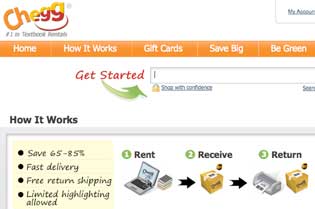
Here’s how it works: students find the books they want by searching by ISBN, author, title or keyword. The rental price for the semester or quarter is just 20-30% of the full retail price, and are delivered within eight business days. At the end of the term, the students receive a pre-paid shipping box to return them. Students are even allowed to highlight books (but no writing in them).

The company was founded in 2003 at Iowa State University as a classifieds site. In the fall of 2007 the company changed their business to textbook rentals.

Revenues have soared to a roughly $10 million run rate, we’ve heard from a source, who also says they’ve just closed, or are about to close, a second round of financing from Kleiner Perkins – $15 million at a post money valuation of $60 million.

Chegg had previously raised $2.2 million from Gabriel Venture Partners and Maples Investments.

Update: The Chegg CEO is saying this report is “not accurate,” so we dug further. The company signed a term sheet with Kleiner a month or so ago and were aiming to close it by the end of October. Our understanding is that they had a competing term sheet from NEA as well, and have tried to get Sequoia to the table. The size of the round might also be larger than $15 million now. We’ll see what other information we can get.

Advertisement

Responses

Comments rss icon

  • What an interesting service. However, I still want to know when we’ll start seeing advertising in textbooks take cover the cost of the book. I know the idea has been thrown out there a bunch of times in the past, but I’ve yet to see any publishers actually try the model.

    • Math Question 1: You drink a can of Pepsi. Draw a graph representing the relationship between satisfying flavor and relaxed contentment.

      Geography Question 1: Describe the socio-economic benefits derived from living and working in Marlboro “flavor country.”

  • As a college student myself, I really wish this service would be more wide-spread. I can’t even begin to imagine how much money I have wasted buying $200+ textbooks that aren’t even used that much!

    • everyone can use any of the textbook rental services – it’s nationwide! just sign-up.

    • This is the same idea that every college bookstore uses for textbook buyback. You pay $100 at the start of the semester and sell the book back at the end of the semester for some amount, basically just a rental. The cool thing about Chegg is that they have a much bigger pool because of the internet and they can spread the depreciation of the textbook over more buyers. Hence the savings.

      • Chegg is WAAAYY cheaper than textbook buyback, which is a scam IMO.
        You’re getting back 70-80% back here whereas you’re actually losing that same amount in a textbook buyback.

  • silicon valley dropout - November 9th, 2008 at 11:42 pm PST

    wouldnt have worked for me i liked to keep my books.

    • You can keep your books at the end of the semester if you want. Or you can buy them up front and return them for cash back at the end if you change your mind.

  • Also, 8 business days? A week and half for delivery for a book a student would use during a 10 week course?

    It’s like these company never bother to understand the market their serving.

  • Interesting service.. will work only in US because of high book price

    • Not sure of that. In India, there is a large market for second hand books in colleges at least. A lot of these books are also passed on from Seniors to Juniors.

      I wonder how this will work out in India, and whether you could tie up with schools to provide better prints and textbooks to their students.

      In my school in Philippines, books were always provided by the school itself.

  • Bear in mind that if this takes off big-time, then textbook prices will increase even more (and therefore the rental fee will follow).

    Of course, you could argue that it’s no different to DVD rentals, but DVD rental companies pay a special fee to the distributors for that right. With books, if Chegg buys enough books to supply the student base that needs that book for each semester (or year), then the authors and publishers lose out on residual sales.. and will therefore not be financially inspired to produce good books or will just crank the price up to compensate.

    I’m not against Chegg’s business model by any means – it’s very enterprising – but as an author with one textbook out there (I’m in it for the experience, not the money, thankfully!), I’m intrigued as to what developments like this will mean for textbook authors. After all, if Chegg takes off, it could buy a serious number of books to distort things, whereas libraries only have so much money.

    • I would add here that text books are nearly always updated bi-annually, so Chegg will need to update the range consistently, hence I think the authors will still be okay. It will be many book shops in between that may suffer the most here, however we shall see.

    • Im pretty sure authors and publishers only make money from the first sale of the book. After that they dont make a dime off of used books wich is really what Chegg is going into

  • yeah.. elsewhere we used to rely on photocopier.

  • They’ve really come a long way:

    http://web.arch...tp://chegg.com/

  • Interesting business – That would have saved me lots of money in college.

  • Of all the startups I read about on TC, this one seems to have the most promise. Why didn’t I hear about them in 2004 when I was a Georgia Tech freshman?

  • Having been a cheap college student once myself not too long ago, I think the best rental strategy is to buy used and sell back on Amazon. You can get the product faster sometimes and “rental” costs are much lower given that used books don’t depreciate as bad as a new one does. Secondly, you can get an even better deal by simply buying an older edition of the desired book and photocopying problem sets from a friend to make sure you do the right homework. Not a bad idea but still not cheap enough for the cheap college student. Calculus hasn’t changed much from the 10th edition to the 11th edition :-)

    • i think your are underestimating the amount of work that takes. Just give me a book that i can use and then return without having to think about it… Thats the best way to help out college students

      • Don,

        You obviously work at Chegg. buying a book on Amazon is very easy and selling it back is just as easy. In my experience for a very common book it will take one to two days to sell if priced right.

  • TYPICAL_BAY_AREA_DEVELOPER - November 10th, 2008 at 1:16 am PST

    Most people here are too young or are SF carpetbaggers and have no memory of teh Webs 1.0 biggest flameout (per number of posts on FuckedCompany.com), BigWords.com.

    College Textbooks. Heh.

  • great service.

    Who are the competitors in the marketplace with simlar biz models?

  • This is an innovative idea but I am unclear on where the profits are coming from.

    I remember most of my textbooks having a shelf life of about five years maximum. At 20-30% of face value, they have a large capital outlay for a fairly low rate of return over four or five years. I can see that they will make almost all of their profits from those who damage or lose textbooks and pay the full price – but this is hardly an ideal model as these customers will not feel satisfied.

    I don’t see publishers offering any sort of discount to Chegg either, given that they are ultimately losing out on sales.

    Am I missing something obvious here? Once the distribution costs are taken into account this doesn’t seem to be a hugely profitable business.

  • Looks like textbooks on-demand. Or textbooks in the cloud? Or even TaaS .. textbooks as a Service :)

    I am just curious what the next vertical market will be for this business concept. Overall I like this idea as it saves money.

  • They’ve really come a long way:

    http://web.arch...0;..chegg.com/?
    I take a look at the article . of course they are tell us the same thing

  • great service,
    i think other dot companies will soon copy the model of Chegg

  • typo in last sentence: Should be “Chegg”, not “Chugg”

  • I have been using the Chegg service for 2 years and love it. The only textbooks I buy now are the international versions in English that sell for less than the rental, which are few and far between.

    Glad you profiled them here, they are doing a great job and deserve the attention.

  • I am working on a canadien version. If anybody is interested in joining me, please email me at info@utextbooks.ca

  • hate to tell you… this isn’t that new a concept.

    as for books with advertising, there’s http://www.freelookpress or http://www.freepresslook.org. these guys already have textbooks that are being published with advertising.

    the textbook model is broken, and to be frank, it won’t get any better until enough students decide they want to change the situation. the adoption textbook list is critical to knowing which books are to be used by upcoming classes, at which schools. without this knowledge, the book you have may/may not have any value to someone else. if this information where able to be efficiently gathered/used/distributed, the spread between buy/sale of used books would decrease, eleminating then need for the existing used book model, as well as the rental model. students could simply interact between each other on an ad based system, or for a small transaction fee.

    extending this concept, if you have the ability to get the adoption textbook information in mass, then you also probably have access to the favulty in mass. this gives you the ability to determine which profs are willing to use electronic textbooks that are ad based/sponsor driven. if you have a sufficient number of profs, across a reasonable number of depts, it then becomes a pretty straightforward process to create a publishing house for creating peer reviewed textbooks, that are electronic, ad based, and pretty much free to the end user/student.

    this model would reduce the need for the huge distribution costs, along with the huge sales force that the major publishers have implemented.

    the difficult issue that this model has to face is that the symbiotic relationship between profs/schools/publishers is going to be a hard nut to break.

    peace

  • These guys are putting ads into college student emails, so why not text books?

    http://wrapmail...-is-shaping-up/

    dk

    • Maybe for community colleges, but nt respectable institutions. Wrapmail is a very gross and overly commercial way to use your friends and acquaintances.

  • Good for them!

  • Advertisements seem like a good idea for textbooks. However, can firms who fund college or science programs ever influence the students or faculty?

  • These days, the motto is: It should serve, be affordable and convenient, Chegg is doing that right. http://www.youtechno.info

  • Advertisement is making us stupid. Don’t get me wrong, I believe in it but not when I am reading a long piece. Flow keeps me concentrate. I think you should be concentrated when you read textbooks.

    • there are plenty of ways to advertise without being obnoxious about it…

      you can have a selection of ads/coupons in the back of the book/electronic text. the key is to make the coupons/ads relevant to the user.

      -a 20% off subway coupon
      -a 10% off movie rental for 5 netflix rentals
      -a 20% off coupon from hertz car rentals
      -a 10% off 1st month rent from the local college appt complex…

      the list is endless…….

      the beauty of this approach, is that if the text/exlectronic text is pretty much free, you don’t care if the user copies it, and gives it to others in the class! also, you’re able to get a pretty good feel for how the coupon/ad is doing as you can track how it gets used. and of course you can do all this without stamping on a user’s privacy!

      peace

  • This does NOT surprise me./ The DISASTROUS credit crunch has meant I lost my job AGES ago and have NOT bneen able to get EVEN so much as an INTERVIEW in the past SIX months.
    The thought of being able to HIRE text books INSTEAD of having to buy them is going to make my (re) education MUCH easier – ESPECIALLY as I bunked a LOT of school first time round!!!!!!!!!! lol
    They used to call me Julian “Truent’ Meteor!!!!! rofl

  • Congrats Chegg!

    Chegg is featured on iLetYou ( http://www.iletyou.com ), our product rental search engine with over 100,000 different products for rent.

    Seth Godin blogged about the difficulty of the NetFlix model applied to new product categories at http://sethgodi...netflix-of.html. He’s right in so far as most product categories won’t magically work as an exact copy of the Netflix business model, which is why it’s so interesting to see these new online rental categories emerge and inevitably morph.

    However, as many comments rightly point out, the textbook model is broken and an efficient market will seek out solutions to fix it. I’m very excited to see what Chegg has in store!

    • hey rodger.

      chegg, while nice and growing isn’t the solution… chegg is applying a bandaid to a gaping wound.

      to “fix” the issue you need a couple of things:
      -students who really do want cheaper textbooks (ie, electronic books that the student can use pretty much however they need to, while respecting the copyright)
      -profs who do give a damn about the student, and the obscene high price of textbooks, and who are also willing to take a look at alternative/peer-reviewed textbook/content.
      -the ability to efficiently get/compile the adoption textbook list data. this is critical as these systems would then provide entry into talking with the prof, which then reduces the need for the huge distribution/sales costs associated with textbooks.

      start to solve these issues, and you can create a $100 million biz, if you don’t get shot 1st by the major academic publishers…

      peace…

      • Hi Sam, thanks – interesting and broad thoughts. Peer review and collaborative learning is also not a new concept, but no solution has gained widespread traction.

        From a Computer Science and Engineering education, textbooks were never the primary source of information. Research papers are standard; and collaborative tools are used regularly. However, you could never spurn the textbook entirely without suffering. Standardized information is just a part of the curriculum mix.

        Starting on the challenge of reinventing education content by starting on the textbook component gives Chegg a more realistic chance as any to lead a change.

      • roger…

        again, you’re missing a huge point that i’ve tried to make. chegg, like all the other books systems require the student to come up with the isbn, in order to “track” the book. the reason for the isbn, is that’s the way the books are tracked/linked by the prof. so what you really need is an efficient method of generating this adoption textbook list across a vast number of colleges.

        if you have this list, you can then provide the student a way to directly buy/sell/rent/trade/etc.. with other students without having to use a chegg. you’d then simply charge a very small transaction fee, or have an ad based model, and collect the revs…

        the student would be able to tell which courses would be using his book for the next semester from not only his college, but the surrounding colleges as well….

        you;d then build upon this kind of system, by being able to talk/interface with the profs, to see if they’re up to potentially using the electronic books…

        the use of the information systems/technology then provides a serious barrier to entry from other startups, as well as providing a way to distribute/sell into the prof community, if they’re up to considering the electronic textbook.

        the costs of operation of this kind of model are dramatically cheaper than the traditional book creation process…

        if you want more dialog, hit me up at bedouglas@earthlink.net

        peace

      • Hi Sam, I got your point. Buy/sell/trade of goods, and specifically textbooks, isn’t new either. A central housing matching textbooks to courses would certainly be useful but like most ideas out there, it’s not the usefulness of the idea holding back widespread usage – it’s the adoption uptake. To build an optimal textbook rental (or buy/sell/trade) system, you’d eventually want something like this. I look forward to seeing what’s in store.

      • hi roger.

        again, i think you’re missing a point that i’ve made. a key issue that all online sites lack, is that they don’t have access (in mass) to the adoption textbook list from the colleges. if you had this list across 2000-3000 colleges, then you can reliably figure out which books are going to be used by which courses.

        the point i’m making (among others) is that if you create this list/process, then you can easily place on top of it, the app that allows the student to directly buy/sell/trade/rent/whatever with other local students, or students in other schools that are in close proximity).

        this process would then pretty much eleminate the need for “used book”/rental sites (assuming that the user base of the site was sufficiently large) which is the user asoption issue. but this would then become a marketing/business issue, and given the apparent success of chegg, i would argue that the potential for success would be high.

        but a critical success factor would be the ability to cheaply.efficiently/reliably build/compile the adoption textbook list.

        peace

  • I wish this was around when I was in college. I wasted so much money on textbooks I never looked at once the class was over. Most books I couldn’t sell back and even buying used books added up. This can be big time.

    Craig
    http://www.budgetpulse.com

  • Chegg can’t scale. The market is moving toward an e-book model. Textbook is the thing of the past.

  • Chegg is a terrible service. Myself and a few friends used the service this semester and were all very disapointed. Textbooks arrive one at a time from various companies across the nation and were all atleast 2-3 weeks late. They also have no customer support. Good concept however they haven’t figured it out yet

    • I don’t know if I would call it “terrible,” although I have had my concerns with their apparent lack of customer service as well. So far, all of my books have arrived on time and in excellent condition. One of the books was brand-new direct from Amazon.

      These guys have saved me a few hundred dollars this semester, so I’ve got no complaints.

  • Don’t you hate it when your professor has his own book that he makes you buy… except it’s crappily bound, and still cost $200 dollars and was made on a photo copier?

    Yea, I don’t see how they are making money unless they are getting a bulk discount on books. And what’s to stop Barnes and Noble from doing the same thing? Except they can negotiate even lower prices…. sorry Chegg nasty…

    • B&N will not risk cannibalizing their main business to compete with some small start-up. Craogslist did just fine against Ebay. You are so clueless (except you choice of search engines), that I would guess you have little to zero real business experience. Probably still in school…

  • This is actually a damn good business idea. That is painfully rare nowadays.

  • I do not see any official press release from Chegg or KPCB on the financing. Michael Arrington, was this deal every done?

  • Amazing! I had never heard of this service until now and I must say that I’ll be giving them a shot next semester. My books usually run about $500 per semester so this will save me tons of money. I totally agree tom, a rare gem of a great business plan.

  • I think several issues are being missed here:
    1) the creator of the textbook….it takes enormous TIME, THOUGHT and effort to write a textbook, yet the opinions here leave out that aspect…as if it was irrelevant. If textbooks were free….then someone has to subsidize the time and creativity of the writer, or else all you get are “mashbooks” such as described above…poor printing, lousy binding….a waste of trees.
    2) textbooks need to be dynamic….constantly rewritten to meet the rapid change in research/concepts. The current model only allows for “updates” if a book has sold well enough to return to the hard print publisher a sufficient profit. Of all of this, the current model only hands the creator less than 10% with NO ADVANCE given for any of the illustrations, photo rights, writing….
    3) advertising cannot cover the cost for maintaining/creating the above. Knowledge is valuable.

    Universities are moving towards their own online digital presses, which allow for “cheap” access to the textbooks required for every course, written by their own staff, or shared through a partnership agreement between schools. “Lite” versions of printed textbooks would only occur if one wishes to keep “selected” chapters for their own personal library/reference. Returns to the university/creator are significant, and the discount to the students the same. These texts, which are online websites, can be modified/updated instantly. Used printed books deprive the author and the publisher of sales..which damages the print runs for books. However, online subscription textbooks offer the best for creator/distributor/student.

    • hey larrian…

      hat to tell you, but i seriosuly disagree with your comments regarding advertising sponsored books, or sponsor supported books. have you really done any analysis to support your statements. given that you’re pushing the same old textbook model, albeit in partnership with the university, i seriosuly doubt that you;ve really looked into whether this can/would work.

      i fully agree with you that in order to have serious, well written books, you need to pay the authors. i’m inclined to believe that you can generate enough revenue from the ad/sponsor model to make it work. how do i know? i’m currently researching this very topic!!!

      it looks as though you can afford to pay the author close to what the majority of authors are making for the book, in a given category. and the advertising/sponsored possibilities are quite intriguing as well. a sponsor can place an ad in the book that’s going to be used for the grad level accounting class!!!

      but here again, as i mentioned in previous posts, the issue you run into is that the prof/school tends to look at the student as an ATM. will you sitll have boutique press houses, sure. just as you’ll still have the university press. will every school, want to create their own, calc II book, hell no!!

      let the competition begin!!

      peace

  • How do they deal with new editions of the books. From my experience, new editions come out almost every year.

  • looks like they’re hiring software engineers http://www.crun...ob.php?jid=5671

  • We have a geloaction based book store. Just deployed it last week. Check up out. You might find books in your area.
    http://www.booksrhere.com
    Booksrhere

  • It’s the blockbuster effect: Chegg will make a killing here, not just from the rentals, but from all the kids who’s books will be destroyed, never returned, written in (highlighting is ok) or worse.

    • I think they will have the “blockbuster” effect as in somebody else will come along and ruin their business. In Blockbuster’s case it was VOD, and I think the Kindle will kill this thing in a year, two to three tops

  • Sam…I couldnt get an active link to your website.
    As someone who is a medical professional ( urologist) and has published/contributed to medical textbooks and written popular books ( so I know the models) and have published my own books very successfully….I can tell you the cost of printing/editing/transportation, storage, distribution cuts….let alone marketing….leave less than 7% of NET profits ( the contracts from the major publishers state this current 2008) for the author…who is “owned” by the university.

    Advertising is definitely an option on a website..sponsorship from relevant companies..but many are severely cutting back their advertising dollars, let alone the number of textbooks they will actually create/print…going more for the digital model in which the author currently only gets the same percentage, though the cost for the publisher just shrank considerably.

    I am currently working with major universities and medical institutions in the model I described in the above post. However, I would be happy to continue a discussion with you through my email account if you would like further information.

    • larrian…

      the link is http://www.freeloadpress.net, but the site isn;t mine. it’s one i came across early during my research.

      i think you miss my points. regarding electronic textbooks. i believe that it’s possible to create an electronic textbook that’s as good/if not better than traditional hardcopy textbooks. furthermore, i believe that the peer review process can ensure that quality is maintained via the process.

      the overall process, based upon the prevailing etchnology can reduce significant portions of the cost to build/create/distribute the textbook, but only if you already have an ability to “reach”/interface with hte prospective faculty member.

      if you want to discuss further, feel free to contact me at bedouglas@earthlink.net

      peace

  • Can anyone say Amazon Kindle? Who really likes carrying books around?

  • I always felt the text book publishers are unfairly making money repackaging Newton’s law or good old Calculus under different covers every year, and forcing the professors to use different books every semester.

    On the other hand, number of text book publishers has dropped from about 5 to about 3 in recent years, which mean industry may not be making that kind of money.

    It will be interesting to see how wikibooks [free book project] and Chegg will impact that.

  • Why not have a used textbooks store on campus? At UWO about a dozen years ago you could buy used books before the term and sell them back when the term was over. Maybe cost you 20-25% of the cover price in total.

    Of course used textbooks and this rental model get hit by the textbook publishers bringing out new editions every year.

  • Killer, awesome idea! Love this.

  • Brilliant idea. Wish this was around when i went to college. Would’ve saved a lot of us a lot of money.

    Boris
    http://www.thewebwar.com

  • I have been using/promoting Chegg.com on my site ever since I learned about it from our university newspaper. It’s a great service. My favorite part of the business plan is the fact that they plant a tree every time someone rents or donates a book.

    For any fellow affiliates out there: Have you had trouble getting paid?

  • These rental sites have been pretty effective in saving students money and I love what they all are doing…Its a pity it wasn’t around all along…here is another rental site worth checking out http://www.skoobit.com…I have used them and they are great…I prefer there pricing structure than chegg or bookrenter especially for the textbooks I rented…

Leave Comment

Commenting Options

Enter your personal information to the left, or sign in with your Facebook account by clicking the button below.

Alternatively, you can create an avatar that will appear whenever you leave a comment on a Gravatar-enabled blog.

Trackback URL
bugbugbugbug
Techcrunch on Facebook