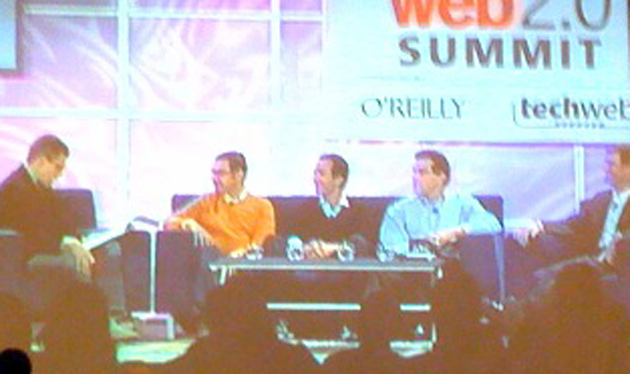
Slide founder Max Levchin just kicked off a panel called “The Platform Advantage” at the Web 2.0 Summit. Participants include Google’s Vic Gundotra, Microsoft’s David Treadwell, MySpace’s Amit Kapur and Facebook’s Elliot Schrage.
The panel began with a general debate on exactly what a platform is, and how each of the companies play in the space. Kapur says a platform has to create an ecosystem that includes a core base of users, tools to build applications, and an advertising network to monetize the platform. Kapur also let’s something slip - saying that MySpace will soon release a payments platform and a virtual goods platform.
Schrage says the Facebook platform is a place for users to interact, and for developers to take advantage of that social utility.
Treadwell, from Microsoft, is talking about open standards and advanced tools that let developers easily create applications. He highlights the iPhone platform as a great example.
Levchin says that everyone is talking about openness, but in reality every one of the platforms represented on stage are closed to some degree.
Gundotra says you have to disambiguate the term. Schrage focuses on the results - that developers can get far more traffic and engagement on Facebook than they can on their independent web applications.
Kapur says the most important thing is to build developer trust by having clear rules and guidelines - a clear slap at Facebook and their constantly evolving policies that tend to anger developers. Levchin (who runs one of the companies that has been in the middle of the Facebook politics) agrees, and notes that Microsoft’s Windows platform has done a good job over the years with consistency and backwards compatibility.
Schrage weighs in on Facebook’s behalf and distinguishes between technical and policy issues. He says on policy its important to be transparent and tell developers what’s coming. He says Facebook has sometimes failed to communicate changes to their platform and it’s something they’re still working on. He says over 400,000 developers have signed up to Facebook Platform, and they’ve had to scramble to scale. He also highlights the importance of community, and creating opportunities for developers to work with each other.
Gundotra (Google) says Facebook and MySpace aren’t true platforms but are extensible applications, similar to Office in the Windows world. He says the web is the important platform that we are all developing for. Open Social, Gundotra says, is an attempt to focus on the web as the platform.
Schrage says open standards are great, but they take too long to emerge. Experimentation with proprietary formats in the meantime is the right thing to do, he says.
Levchin brings up the next topic, asking how the platforms react to developers that start to make too much money by competing with them (again a slap at Facebook). Kapur says MySpace won’t break developer trust by competing with them.
Gundotra says it’s a recipe for disaster to have a single company control the platform. Innovation slows to a release every five years (referring to Windows). Using the open web allows fast innovation, and no one controls the platform.
Gundotra says “It’s Windows v. the web. And the web has won.”


See all


No Yahoo?
No Force.com?
No chalkley.org?
“a general debate on exactly what a platform is”
“Kapur says a platform has to create an ecosystem”
None of these turkeys know what a “platform” is. The BS continues…
kapur meant “a platform is to create a digestive tract.”
a platform boils down to your channel, stage, domain name, presence, location and software on the net. its a person or business communications social broadcast station. the quality will be gauged by a combination of where you broadcast from (domain) and what software tools you use to allow this exchange of communication to occur.
businesses and consumers will always pursue social broadcast location platforms that are the most used and vertical to there content. these niche vertical channels have yet to be developed in a strategic multichannel uniform resource manner. who ever does this first just might be on to something.
StrategyLocator.com- planned success
No Flash?
I met Vic at Google IO. He’s a really slick guy.
What is clear is that choosing your permanent dancing partner this early in the cloud platform battle may send you home with a date you don’t want your mother to know about. Be sure to keep copies of everything on your own computer until the best system is known.
With Microsoft going to take two years to get their platform fully functional, it may take some time to sort this all out.
Unfortunately, I’m sure most platforms will remain walled gardens and these companies will do whatever they can to keep you from leaving your partner once you leave the dance.
Be sure to ask for a prenup before making any commitments to any of these folk.
Bunch of jokers deciding how to make developers life miserable.
http://vidsonly.blogspot.com
windows vs web? are they not in different league? how can the web replace an OS? it doesn’t matter how powerful the web is, a comp without an OS is as good as a tin metal that does nothing… OS will always be around, so is the web… it should be Office vs Web.
Wow, what a bunch of windbags. I hate to say it, but Microsoft is the only one with a real platform (okay so Google app engine has potential). Why? Because you can build whatever you want.
A social network can only have a platform if you have Web 2.0 myopia and believe that everything must be social to gain any market traction. Even if you believe that, it’s still quite a leap to believe that Facebook’s interface is good enough to be the center of every social web app.
Bottom line. Facebook is impressive. Their platform is easy to use and provides a ton of benefits. However any company tying their fortune exclusively to Facebook are just throwing the dice. It’s like some South American countries pegging their currency to the dollar. This brought them lots of immediate benefits like stopping inflation, but at what cost? They basically handed over the keys to their economy to someone who doesn’t even know they exist.
As much as Schrage wants to trumpet Facebook as a magic flute for traffic and engagement, he conveniently ignores two things. First, the population of people who hate facebook and will never get on it for any number of reasons from privacy to fad nausea. Second, the automatic “cheapness” brand that any facebook application inherits simply by virtue of using the same API as thousands and thousands of garbage apps over the past year.
The facebook goldrush is over. The best strategy is to build a real web application that you have control over, and then also build tight integration to Facebook where it makes sense. That way you can capture the upside of the Facebook platform without the unconscionable risk of throwing all your eggs in that basket for a temporary boost in developer productivity.
Its not as black and white as Gundotra would like us to believe. Web is definitely the future but it’ll have to come with a lot of help from the client. It’s more like more of web and less of Windows. If MSFT has to survive as a powerful force in the future, they have to embrace cloud computing.
It’ll be tough as its a classic cannibalization strategy.
And I’m very surprised that Yahoo! wasn’t on the panel. Say what you may, but Yahoo! Open strategy is only one with power and reach to make for compelling publisher and consumer scenarios.
It’s interesting to see the 4 titans of the Internet debate what a platform is. They all talk “Openness” yet neither really offer it - when you can create “apps” that can go ANYWHERE (Facebook, MySpace, Google, MSFT) and that are not locked to one “platform”, then you will have the openness that they all claim to offer.
As long as there is this factionalism of “Web 2.0 platforms” there will never be a true Web 2.0 Ideology.
platforms are successful if/when they have:
1) code library / feature abstraction — so developers don’t have to build everything themselves
2) customer distribution — so that developers don’t have to market everthing directly themselves
3) monetization — so that developers can collect revenues
it’s arguable there are many other platform issues & requirements — security, scalability, standards, user authentication & support, etc. however these 3 primary aspects are what make platforms tick.
sometimes platforms can be successful if only 1 or 2 of the items above are working, altho if you want a dominant platform it’s helpful to have all 3.
Facebook has done an excellent job with the first 2, altho because their distribution incentives were creating user experience backlash, they had to dial back distribution. Also, until FB has payments in place, and has setup aligned monetization with their developer community, they are likely to be reluctant to really open the floodgates on distribution. If/when they have payments rolled out, expect them to spin up distribution again, probably through 3rd-party news feed stories.
MSFT is far from having a functional web platform, primarily because they have not figured out a web distribution story for 3rd parties. while they have tremendous reach via Windows and the Web, they have not translated that into consumer internet platform distribution opportunities. they also do not have a payments story (good reason to buy eBay/PayPal or Amazon, but don’t hold your breath). Still, given Microsoft’s historical dominance & belief in platforms & developers, i’d expect them to get there eventually… but it may take years.
Google’s “platform” to date has primarily been search (& indirectly SEO/SEM). However, while they are a juggernaut in search, their platform efforts to date have been lacking, tho promising for the future. OpenSocial has a long way to go, AppEngine is still fairly new, but if Google ever *does* open up properties like YouTube and Gmail and the main search platform to developers, then the sky’s the limit. Certainly Google has no lack of distribution, but again like MSFT it’s mostly direct, not on behalf of 3rd-party developers.
MySpace does seem to be following cautiously in Facebook’s footsteps, and given their existing footprint in music & entertainment (not to mention their already significant spam issues with user communication), it seems appropriate for them to move slowly. But they have shown progress over time, and if/when they implement payments they will likely attract a good deal of developer attention (and in fact, since FB dialed down distribution, MySpace has already drawn some of that audience in).
not mentioned: Yahoo, LinkedIn, SalesForce, Hi5, Bebo, Friendster, Orkut, other international players.
sorry for the double comment spam above.
expanded commentary “Successful Developer Platforms Have 3 Things: Features, Users, Money” is now a separate post on my own blog.
@Gabe
Your comparison of Currency Peg to integrating with Facebook is an EXACT description of what really happening.
We should be looking at bringing innovation at the fundamentals rather then promoting our crappy MEGA applications.
Very intresting post !
but how sarcastic , everyone is talking about openess !