
One thing we are finally going to learn in this down market is whether social investing can hold its own against the pros. There are many Websites devoted to social investing—Cake Financial, SocialPicks, StockMantra—each with their own twist. Add to the list Piqqem, a site run by Crowd Technologies that just recently came out of stealth. (Crowd Technologies is also the company behind StockMoose, which it launched as a quick experiment to test some of its technologies). The company raised about $1 million in June, 2007 from some serious angel investors, including Mike Markkula (the first investor in Apple), Mike McCue (founder of TellMe), Brad Handler, Stefan Roever and John Levinson.
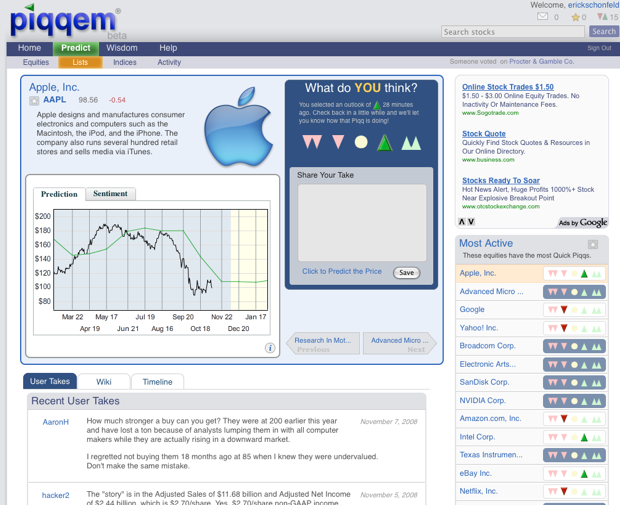
Piqqem collects votes from its users on where they think a stock’s price is headed. For any given stock on Piqqem, before you can see what the crowd thinks you have to give your own prediction. You can do this with a simple rating system (two arrows down, one arrow down, a neutral circle, one arrow up, or two arrows up) or by actually plotting a specific price in the future on a stock chart. Piqqem collects all of these predictions and tells you what its members are collectively thinking about each particular stock.
CEO Jett Winter explains:
In general, we differ from the other sites in that we are a true wisdom of crowds sourcing application. That is, everyone gets one vote and they can vote as much as they want. We then aggregate and report the results. We don’t try to find the best single stock picker (like virtually everyone else) as that really isn’t wisdom of crowds anymore. Further, there is no weighting based on your ability to invest.
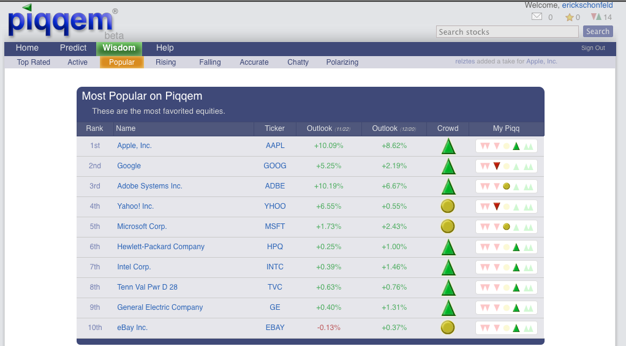
Rather than take the advice of any particular pro, Piqqem pulls together everyone’s opinion and generates a collective opinion. You can see this on the site, which offers lists for the top rated stocks, the most active stocks, the ones where sentiment is rising, and the ones here it is falling.
If nothing else, Piqqem is certainly a good place to get ideas for stocks to invest in. But does it really have any chance of ever beating the market? Like any social investing site, its picks are only as good as the people who contribute to it. But beyond that, there is fatal flaw to this approach.
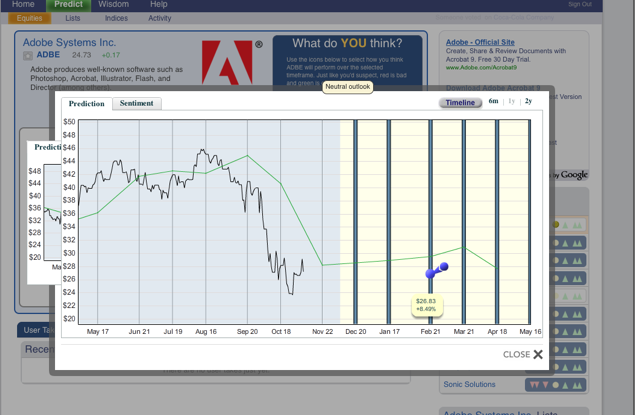
When it comes to stocks, the best prediction market out there is the stock market itself. It is the biggest prediction market out there, with millions of people predicting the future price of stocks every time they buy or sell shares. All of those predictions are aggregated together in the form of the price. To think that a few thousand, or even a few hundred thousand, people on Piqqem can do better is naive. And in fact, if you look at the prediction lines on Piqqem they already closely hue the actual stock price.
Winter counters that Piqqem willwork because it takes money out of the equation:
The votes today, in the market, are also weighted based on money. If you have a lot of money you can move the market and set the price. In our view, the crowd as a whole has more “information” than any one entity in the market and over time the information the crowd knows will become evident to the people with the money. As the people with the money figure out this information they will move the market in the future—but hopefully we’ve predicted it before they move it!
Sorry, I don’t buy that. The votes should be weighted by money. If someone is willing to put down a million dollars on the shares of Apple going up, that should count more than someone who just puts $100 down (or worse, is just clicking on a Website). Money not only makes the predictions of a market better, it also makes it harder to game the system because there is more to lose if you turn out to be wrong.
Secondly, even assuming Piqqem is perfect and it does produce better stock picks than any one individual could, investors will quickly discover and then it will become a reflection of the market. Piqqem does not exist in an information vacuum.
Nevertheless, it’s still a fun site. Here are some screen shots:


See all


the crowd as a whole has more “information” than any one entity in the market and over time the information the crowd knows will become evident to the people with the money
Sounds good, but doesn’t the amount of noise increase as well? There’s nothing in this story that tells me that they’re doing anything about that. Obviously they can’t guarantee that some of the information (how much, we don’t know) won’t be bad, so where’s the upside? Lowering the odds and return for all participants? Insider information is what’s profitable in the market, always has been, so why give up that edge? You might as well just invest in sukuks and be done with it.
If you believe in the wisdom of crowds then this idea should work. They just need to get enough people to tell them their opinions.
It’s a great idea and very timely too.
The market itself already determines price based on sentiment and all known information. And as Chuck mentions, the market for options already is an indicator of an asset’s expected value in the future. That is, the price of a put/call option on GOOG is determined by investors’ sentiments and expectations.
If you believe in the “wisdom of the crowd”, sounds like Piqqem is trying to predict the wisdom of a massive crowd (the entire market) with a small one (users of the site). I don’t see how this can be more accurate at predicting the future, especially since users don’t perform much research because they can’t put their money where their mouth is (while market professionals do so for a living).
Piqqem collects votes from its users on where they think a stcok’s price is headed.
Don’t you mean “stock’s”..
Isn’t this exactly what the options market does?
The options markets sets prices based on underlying volatility and interest rates. Since you can “create” a stock buy by selling a put and buying a call at the same strike it follows that options just reflect the stock’s price. The premiums of those puts/calls vary based on the underlying volatility, but the option prices are in no way a predictor of future prices.
You could argue that put/call ratios have a meaning, but that is just one more indicator, just like the piqqem sentiment would be.
Could this happen? {seesmic_video:{”url_thumbnail”:{”value”:”http://t.seesmic.com/thumbnail/SXsdUas9aE_th1.jpg”}”title”:{”value”:”Could this happen? ”}”videoUri”:{”value”:”http://www.seesmic.com/video/aeWZyLTDUB”}}}
stay on’em Dan. keep’em honest. wallstreet aka stockmarket aka big board aka gambling aka casino. better odds because companies control the house and create the cards.
RiskLocator.com-calculation experts
Isn’t the crux of crowd wisdom the notion that with increased sentiment you yield increased accuracy? Once you reach a certain volume of sentiment, the noise ratio is already factored into that equation.
I think they’ve done a good job of making what is traditionally some pretty dry subject matter much more compelling to the types of folks that will invest the time online in making reams of stock picks.
I will say this, with the volatility of the market in the last couple months, this idea just got a whole lot more interesting to a whole lot more people. That alone makes it one to watch.
I think a major point is being missed. Sentiment which the Piqqem site does a good generating is valuable as another data point along with traditional fundamental and technical analysis. I’m not sure I would use sentiment alone, but given the irrational movements in market recently another ’sane’ reference point is welcome and I think here to stay!
Good point shortsqueeze. There is no one piece of info to use in isolation when it comes to stock picking. Piqqem provides another data point to feed into the decision process. And as Erick says it is a good source of ideas — and fun.
If you consider this information as valid input, you are better of taking that money to vegas. Then go find a table with a spinner and a ball and put your money on the red square. You have a bit shy of 50% chance of doubling your money.
The fundamental flaw behind such sites is their failure to understand the mindset of an online investor. Specifically, an online investor believes he/she alone is capable of beating the market. Hence, why they opened an online account and tossed away their broker.
To now think the same person is going to rely on social stock picking to make a stock pick is idiotic. At best, a typical online investor will make his own investment decision and then curiously browse such sites to see what others think - but they will never change their minds based on what a crowd or anybody else thinks.
As such, social stock picking sites are all doomed to fail. You heard it here first.
Regards,
George
Not only that, but that best it can ever do is mirror the market. As soon as they have any success then more people will start using it which will drive the predictions back to market levels.
If this site works so well that it drives predictions back into the market then it certainly may no longer be useful - but the mere act of getting to that point will have already made it a multi-billion $ deal.
Bad idea. People will just suggest stocks they have invested in for creating a rally or the ones they have a vested interest in. Follow Warren Buffett.
“The votes should be weighted by money. ”
I agree. That’s why we have the real stock market.
Couldn’t have said it better myself.
We’re going to be investing in a venture with a similar model so this has been a nice education about the space; It’s obvious that the space has many merits and it’s also obvious that a lot of tweaking will have to be done to reach the point where one can rely on such crowd_gathered information.
Question!
#1 Can this concept be refined by allowing people to post rumors/information they may have heard about a stock and allowing others to vote on the same so that people can use the site as a hotspot for information? You can come to some kind of ebay_ratings about how correct a posters rumors are; votes are etc.
#2 To make the whole system more authentic, and throw daniel’s china idea out of the window, can each contributor be charged a subscription fee to join ? or to post ?
#3 Maybe a merger of twitter/friendfeed/erstwhile ragingbull all in one?
Thoughts?
Maybe I missed something, but what prevent the average teenage kid with a lot of time to waste of creating an account on such site and to vote randomly?
If enough people do that, without ever owning any stock, that will just kill the concept isn’t it?
I’m pretty sure that if there was a kid voting randomly he would be cancelled out by the other kids voting randomly.
The idea behind the Wisdom of Crowds (it’s not just a clever name, it’s theory with a book and everything) is that you NEED outliers who don’t know what they are doing and are doing it randomly. All of this ostensible “noise” adds up to a sum greater than the parts.
Again, no one knows for sure if it will work or not, but people voting badly isn’t a detriment, it’s practically required.
Using the wisdom of crowds to determine the direction of the market … in a sense, this seems awfully similar to the efficient market hypothesis, which isn’t exactly new. And, what have we learned from the real market? EMH is BS because people aren’t rational.
STOP USING SOCIAL BASED SITES TO MAKE INVESTMENT DECISIONS!!
It is your moeny, and unless you have plenty of it and wish to lose some, do not use any of the social based sites to learn about investing in stocks. Any publicly available information is useless, and can not sustain outstanding alpha for a long period of time. Get over it.
This site makes sense to me. I’ll invest opposite the crowd!
Wisdom of crowds.
http://vidsonly.blogspot.com
Sites like this are all doomed to failure. This was tried back during the dot com boom with sites like http://www.stockjungle.com and they all pretty much failed dismally then. Marketocracy has a better approach, although it also has its flaws. Relying on the crowd to choose investments is a sure fire way to either lose money or get mediocre performance. Stick to index funds or find a really smart and talented investor or trader that knows when to go with the crowd and, more importantly, when to go against it.
I find such a concept intriguing but I wouldn’t necessarily base investment decisions on this site. If any of you watch Mad Money (or read/listen to Jim Cramer) knows that he is not a fan of analysts who are paid to recommend stocks. Now having followed Cramer for a few years, I have also noticed that he himself is about 50/50 on his own stock picks to the audience. These are experts on the subject who are sometimes about as good as a coin toss so why is there so much bashing about novices getting together to pick stocks?
The crowd is a “crowd”. it does not lead - it follows. so asking the crowd where the “leaders” [inside information people, analysts, hedge funds, etc.] are taking it, is like asking a fish ןin a school of fish where the dolphin is heading. On the contrary to crowd stock picking, GStock at http://gstock.com uses a different approach to social power - it collects computing power from the crowd to form an immense simulator and uses it to detect stocks with higher probability to rise. It’s the power of the masses in the REAL sense of the word :))
makes sense to me - sounds like a very intersting idea! I would love to see a feature similar to “Power seller” on ebay, i.e., know that this user gave great predictions in the past.
my comments at http://www.commentino.com/orim
Using the “wisdom of crowds” to predict a good stock would entail the crowd voting at the same time. As described, this seems more like it is simply tracking crowd sentiment/time.
I was surprised to see no mention of The Motley Fool’s CAPS in this article. I’m biased as I work for the company, but CAPS is easily the largest of the social stock picking applications, so it seems a bit lazy to miss it here.
So far, the star quintiles are performing in stairstep fashion, with the 5-star stocks far outperforming the market, and the 1-star stocks significantly underperforming the market.
The original poster has it right — the market itself is the best mechanism for crowdsourcing. There is a role for social media, though, but more along the lines of sideline commentary (http://www.wikinvest.com) and anonymized track-record sharing (www.covestor.com). The mysticism of the crowd-sourcing crowd will fade, but the era of internet-enabled team investing is just beginning. All those little-old-lady “investing clubs” are just getting online now.
@jim
#1 users CAN enter rumors/information on a financial timeline and the wiki for each stock (tabs for “timeline” and “wiki” are located underneath the graph on each stock page). but there’s no system for rating the correctness of users, though perhaps this is a feature that they’d consider implementing.
#2 an interesting proposal. but couldn’t the same be said for digg, StumbleUpon, even Wikipedia - that few users could essentially game the system? and yet governance evolves….
#3 Piqqem does, in fact, have a twitter feed: twitter.com/piqqem. or did you have something else in mind re FriendFeed/RagingBull?
and @everyone: keep in mind, Piqqem is not advertising crowd wisdom (or lack thereof) as a stand-alone source of financial information, but as one in a portfolio. the question of whether/under which circumstances/for which industries/etc. the crowd can predict stock movements more successfully than expert analysts/the market is still, in my mind, an open one!
ppp
1. The wisdom of the crowds only works if every contributor acts independently from the crowd… Sort of blind vote. Clearly not the case here.
2. We are relying on the assumption that consensus drives prediction and hence better than the market returns. As any good VC knows, arbitrage opportunities are only where there is non-consensus, or disagreement on the future… If you are betting right.
3. A content and polling website can thrive even if its predictions do not work. Knowing where the public opinion is - however skewed - could be enough to generate interaction, content and a loyal audience.
It can be interesting to see what passes for “conventional” wisdom. Will everyone follow the crowd? And how accurate will they be? One of the things that makes this sort of social media Web site interesting is seeing how accurate things turn out to be — and adding your own voice to the mix. I’m a part of the Inner8 community, and I love how there’s a combination of total wisdom, and the ability to see individual results. I love making who has been accurate part of my research into the stock market. Of course, as mentioned above, a great deal of research into investments should come from a variety of sources.
Crowds are like sheep, and sheep don’t always make good investments. http://tinyurl.com/48fntq
Our philosophy is a bit different. Rather than focus on stock picking, we’re developing analytical tools to help investors better manage their portfolio’s risk, to optimize their risk-return, and to find uncorrelated stock ideas to their portfolio. http://portfoliomonkey.com
I’m surprised at this superficial post.
1. Piqqem is NOT social investing.. the average estimates of the public means nothing in terms of decision.
2. You mention Cake and Social Picks (Ha! SocialPicks closed the site my uninformed friend).
3. MarketGuru.com is the best site I know that can actually be called social investing.
Nobody wants stock tips - people want smart people to follow.
MarketGuru has the ball on this one boys, no doubt - I’m with miller on that one.
I can’t believe you’d even mention SP.. they’ve turned into a news site.