MySpace, Auditude, And MTV Have Just Figured Out How To Monetize Online Video
by Jason Kincaid on November 2, 2008

Since YouTube heralded the era of user-uploaded videos, media corporations have been fighting a hopeless battle to regain control of their content, sending out endless waves of DMCA notices in a vain attempt to take down countless clips scattered across the web. In the last year sites like Hulu have made progress – it’s finally possible to legally embed a clip of The Office in your blog, but publishers continue to lose out on millions of video clips that were uploaded without permission.

Now MySpace – a site that once seemed the antithesis of innovation – has implemented an exciting new ad platform called Auditude that may change the way content owners treat uploaded video entirely. The new platform will automatically identify any uploaded video clips from a number of shows produced by MTV Networks (including my personal favorite “The Daily Show”), and will display an overlay when the clip is played that shows which episode the clip originally came from, its original air-date, and links to online stores where users can buy the entire episode.

In the past it has been nearly impossible to effectively monetize user-uploaded videos because they are typically tagged with such informative titles as “REally cool!” and “hilarious”. The Auditude platform ignores this information, relying solely on fingerprints taken from the clip’s audio and video data. These fingerprints are matched to prints in Auditude’s massive database, which spans over 250 million videos and 4 years of television content, all sorted by show and air date.
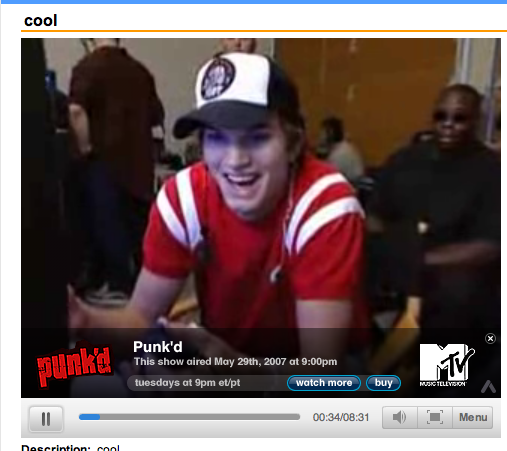


Even more impressive: Auditude can fingerprint a portion of a video that is only a few seconds long and identify which show it was originally taken from. Once the clip is identified Auditude will overlay an ad within the video, allowing publishers to monetize their content even when it was uploaded by someone without permission and without any legible tagging information.

MySpace will be implementing the system with initial support for content from MTV Networks, with shows including The Colbert Report, Punk’d, and Sarah Silverman. So every time you post a clip of Jon Stewart ripping on the presidential candidates, someone is going to get paid, and users won’t have to deal with the often-clunky proprietary video players offered by each network. And instead of trying to prevent these clips from making it onto MySpace in the first place, content owners will want users to upload as many as possible.

Unfortunately, this may prove difficult: after years of being told not to upload these videos, users will probably take a while to warm up to the idea. But if it catches on (and it probably will), expect to see content owners flock to form partnerships with MySpace – there isn’t currently another video platform out there that is able to identify and monetize content this effectively. We’ll probably also see the Auditude platform implemented elsewhere as other sites try to catch up.

Last year YouTube launched a similar service called Video ID that gives publishers the option of either taking down illegal content or placing ads on it.

Advertisement

Responses

Comments rss icon

  • ProfitLocator.com - November 2nd, 2008 at 8:35 pm PST

    This is progress, finally!

  • Looks like an amazing product. This could be the huge for video based websites. We could start seeing a lot more content now. I love it.

  • So this would be like Gracenote, except for video?

  • About Time!! seriously these guys are finally getting it

    • You are so right. Viacom, NBC, et al. have been massively shooting themselves in the foot by failing to understand that people uploading snippets of your stuff are fan(antics) that should be nurtured rather than harassed. In fact, they should have all been uploading out-takes of their content on YouTube and elsewhere THEMSELVES…

      Here is what I wrote a few months ago:

      “… If they were even marginally Web-savvy, they would have surfed the YouTube wave themselves, and would now be positioned a lot better than they are.

      This way they could have LEVERAGED YouTube for their own purposes, sending people from there to their full-scale episodes. I said 2-3 years ago that I’d be willing to pay $1 for each of my favorite Daily Show episodes, etc. Why did Viacom fail to see that they could have had their own iTunes-like TV content distribution?!?”

      http://business...part-by-piranha

  • One middle man paying another…

    What this ignores is that these networks have only limited rights to distribute this content within a certain geographic area. Therefore, they only have rights to make money on content served within that area. How does this system account for that?

    YouTube has been doing this for awhile with their content ID program. I don’t think it will change anything in the long run though. Just like everything else has been, video is a different ball game on the internet and what worked for television does not necessarily work online, nor will it pay as well.

  • Pretty cool stuff. Hopefully youtube will start making some real money now.

  • If it works. The following is a bold statement:

    “Full audio and video matching. No false positives, no false negatives, 5 seconds to make a match, multi-match processing (e.g. mash-ups). ”

    I wonder how it works if you overlay audio over irrelevant video. In any case, while this is a great tech and many publishers will want to buy in, I don’t think users are going to respond to in video advertising. I know sites like Hulu are getting positive results, but they have high quality content. No one is going to want to sit through a 30 sec pre-roll to watch a highly compressed 1 minute clip from The Daily Show.

    • Your comment is the most perceptive here, maybe there will be competitions for the best mash-ups that confound the Auditude system. It all sounds very hyped, I for one am looking forward to taking it through it’s paces.

  • This is dead simple, and less intrusive to the user as it’s highly relevant.

    Great job – MySpace. Where was the YouTube/Google product team when this happened?

  • Cool, but what if flip the video horizontally? Does this still work?

  • You win for being a fellow Daily Show / Colbert Report fan — Those are my favorite shows! I really can’t wait till their live election coverage this Tuesday.

  • Even if they can deal with the geography issues (which aren’t trivial at all) there’s still the underlying philosophy of the whole industry -in most cases the talent isn’t getting paid for this (unless all their contracts have changed? Either that or a lot of talent just got decent lawyers) and won’t be happy with it. It’s just the way the contracts in the industry works – you get paid for nicely quantified and well known terrirories – if something goes viral on the internet and an additional 90 million people see it the talent won’t get paid, the networks/owners/studios/production houses won’t want to pay them and it’s all right back where it started.

  • The best ideas are the simplest. This is obvious.

  • jason, you’re way too optimistic. This still annoys people to no end. The thing that wins is going to be the thing that annoys the people the least which means something like an ad shown on the side, not these overlays.

  • So, if Youtube launched a similar service last year, what’s so great about this? Youtube is still a terrible business and monetizing only about 4% of its content at best, right? Meanwhile, they’re paying massive amounts of money to store and stream economically worthless content.

    Even if they got this working at 100% capacity for any professional content illegally uploaded, then you’ve still got all the other UGC that they are completely unable to monetize. So that’s all expense and no possible revenue. Awesome!

    This technology does nothing to address this fundamental problem with UGC. It’s not as big as a deal as Jason is making it out to be. It will ultimately save Google and News Corp a couple lawsuits, and create a trickle of revenue (relatively to total revenues for those corporations). But online video, and especially UGC, is just an unbelievably terrible business. Time to face the facts.

  • Add SEO indexing of keywords to a hotspot ad tag at a designated video frames and you’ve monetorisation of video but I don’t know of too many editors/ publishers who will take then time if it’s not easy to incorporate or generated return on time invested.

  • I hope this idea works and corporate English Premier League noticed about this.

  • I wonder what type of advertiser would want to have their ads jammed within a video clip uploaded by some random user on MySpace. Poker sites? Porn sites? Obama?

  • UGC videos that get any views are usually correctly tagged. otherwise, search engines wont find them.

    this technology may please the studios, but does little for the viewer…

  • I really like the idea of being able to watch the stuff I like when and where I want. This move seems very positive, since it sounds like it allows the producers and artists to collect money, and I can watch TDS and Colbert w/o going to clunky sites. I would be concerned if this gets in the way of the viewing experience, but a transparent ad that pops up that gives me a link to go buy a discounted DVD of the show … SOLD! This really seems like it moves content into the 21st century.

  • The most interesting part, I find, is probably that networks will now be making money on (probably) illegal content. That’s an interesting legal turn I would say. I am looking forward to see the first DMCA turned down by a court because of “not an illegal upload, but a medium for advertisement” or something.

  • no matter how great the product, unless myspace finds a way to stop choppy start stop videos, it won’t matter. they have the worst stream in the world… and their ‘auto-start’ function when posting on a blog is killer… it kills the incentive to post anything (who wants something that fires up automatically? – let people chose when and if to watch the thing).

  • let’s hope they will restrain themselves from advertising too much!

  • I really like the idea of being able to monetize UGC and think that this is a great step forward. My problem is that I’m not sure how they are going to go about inserting the advertisement itself.

    Originally, the tiny channel logo superimposed over the lower corner of the TV screen was not too bad and it didn’t interfere with the content. Now however, they have gone wild and sometimes cover the bottom third of the screen with moving, flashing content that really distracts from the show I’m trying to watch. In fact, its getting so bad now that sometimes vital information is covered up by these advertisements. While watching some Science Channel show I couldn’t read the names of the people talking for all the crap telling me what was coming up next.

    So, if they can do the advertisement tastefully, or at least not obscure or detract from the main content, I will be very happy. If not, someone will probably come up with a way to strip it out again. :)

  • finally youtube near to serious solution

  • How about also paying users for their own videos, aka ‘real’ UGC and not only the professional mega-corporations who own the professionally produced content that users upload? What about if i upload a sng i made by myself on my Synthesizer and it gets millions of views a month or whatever, do i get paid?

  • Perfectly fine!!! Monetizing your investment is essential and really great to have found ways to monetize video optimization. Thanks.

  • How well are they going to be monitoring this content?

  • I think the most significant aspect of monetizing video (and other forms of online content) that is being overlooked in this article, and in the comments that follow, is the long-term viability of selling digital content, let alone “content” in its physical form (i.e. CD’s, DVD’s, etc.)

    While Apple and iTunes will continue to milk the bridge between yesterday and tomorrow (i.e. today, ha!) and monetize digital media using a last generation physical world model built around tangible goods, I have little doubt that investing in the selling of digital content constitutes buying in to a shrinking, albeit still huge, market, that will ultimately die a slow painful death.

    Of course, the likes of Amazon, Walmart and others have every reason to take advantage of their massive presence and infrastructure, and push consumers towards buying both online and off (given that both of them have the luxury of also selling physical/tangible goods), but I can’t help but get frustrated when people fail to understand the very nature of the web as a medium and the impact this has on foreover changing the rules of Intellectual Property, not to mention business models.

    While it’s certainly encouraging to see competition push the likes of DRM towards obsolescence (http://www.read...pple_itunes.php), I can’t crown yet another model built around flawed assumptions of the medium as having” figured out how to monetize online video.”

    The key to monetizing online video resides in monetizing attention. Attention can indeed be converted into dollars via the sales of tangible goods, but these goods should not be informational in nature. Rather, if they are real-world products, they must be introduced at a relevant/convenient time and/or place so that the user is open to engaging with an ad, seeing it as useful, not as annoying. Obviously, advertising does not need to be limited to the sales of physical products, but can also have a variety of other end points, be they somewhat concrete, such as the sale of a web services or generation of a “lead”, or more amorphous, such as for the purpose of branding.

    Many of you have identified another issue, which is that this model doesn’t address the increasingly significant subset of “UGC” that is entirely creative, and not based on “pirated” copyrighted content. While this is certainly true, and I praise you for recognizing that the long tail of UGC does not revolve only around “professionally” produced content, I see you making some of the same mistakes I witness regularly by independent “artists” who fail to see the incoherence in simultaneously embracing the “free web” as a highly scalable, unparalleled marketing mechanism, and yet who want to lock down their content by requiring others to pay the equivalent of royalties to them.

    Essentially, these no-name artists want to leverage all that’s good about the web to build their brands, but then flip the switch, and monetize in the way that traditional artists and associated record labels do once they’ve achieved some form of notoriety.

    What many fail to see, is that if you wish to enforce royalties for artists, you must have an automated mechanism for tracking where your work is being syndicated to, and then, at least ideally, you need a mechanism for restricting access and/or enforcing payment (DRM, anyone, ahem!), not to mention regulating the “unauthorized” use and/or distribution of such works!

    Forgetting for a second the fact that the vast majority of these prosumers will not reach anywhere near the levels of demand required to monetize their creations in an increasingly flooded market space, as well as the inherent hypocrisy of it all, do they not realize that with the advent of next-generation business models (not to mention the reality of piracy), they would be WAY better off monetizing via other means?

    While I am a very ardent supporter of the Creative Commons licenses and associated “Free Culture” movement, I am highly skeptical of attempts to high-jack what I believe is at the heart of this movement (making things easily re-usable and re-mixable for the benefit of all) by utilizing a combination of Non-Commercial licenses (some which prevent derivative works altogether) and what amounts to being a disguised form of DRM, to enforce royalties on digital content that can be reproduced and distributed ad infinitum at essentially what amounts to zero cost.

    So what’s the alternative? I am not advocating relying exclusively upon the donation model (which is an opt-in form of contributing to the creator, rather than an attempt to enforce the sale of digital content), although there are early signs it should not be dismissed, but I believe that platforms which enable the creation and sharing of UGC can be combined with next-generation recommendation/advertising engines, to reward those who succeed in creating content that earns attention, by sharing some of the revenue generated with the creators.

    Ultimately, one could imagine a world where the system is the “middle man” and whereby creators essential own the platform (Open Business Models, anyone?), taking the idea of peer-to-peer to the next level. For now, I think it makes sense for businesses (such as eBay and also some of the innovative peer to peer lending companies) to take their “fair share”, but there’s no reason why the equity of such businesses cannot be owned by the users themselves. This is the future!

    Sorry for being so verbose and at times abstract. While much of what I’m talking about may sound like it’s relevance is in the far distance future, essentially, what I’m saying can be boiled down to:

    “Monetize by brokering the attention of users via intelligent recommendation, rather than by trying to utilize web video as a glorified preview to selling the “real” thing. The web video is the “real thing.” The user is not just watching it en route to accessing the “full” version. The user will NOT pay for it. ”

    It may very well be that the folks at Google realize this, and that explains why they have not focused their energy on optimizing this model (which they needed to create in order to keep the lawsuits at bay, not to mention some of the technology is re-usable in contextual advertising), but instead are trying to brew the next generation of ad sense, not only for video, but for the web in general.

    • I’m not sure I entirely agree the piece of content is the “real thing”. In a way yes, but there’s plenty more of the “real thing” that the user may be interested in. So why not use that piece of content to lead the user to an environment where they are allowed to “consume more” of it.

      Basically, that’s what you are saying about using a recommendation engine. Why can’t the associated products be the “full series” or “more episodes” etc etc. Watching long form content on a computer is not nearly as pleasant as a television. Eventually, our computers and televisions will converge, so it won’t be quite as problematic.

      But until that happens, I don’t know if you can get away with the ad-supported model for premium content, there just isn’t money in there. You have to actually sell something to the consumer. If it can be contextually relevent products from a recommendation engine, why can’t it be programmed goods from the copyright owners, like MTV has done?

      Online video at this point is good for mostly one thing – marketing.

    • The user is not just watching it en route to accessing the “full” version. The user will NOT pay for it.

      This is the key point. I certainly have no interest in “owning” an episode of, for example, The Daily Show. None.

  • It seems to me that this allows Myspace to identify owned content but does very little in terms of monetizing that content. How often — really — have you watched something on Youtube and said “Geez, I’d like to buy that!”

    All this appears to do is to provide some ammo to the copyright holders that the technology exists to deal with takedown notices efficiently.

  • Speaking of getting credit for content… http://www.audi...?p=341#more-341 is a copy and paste of the same words that TechCrunch published with no accreditation. Was this licensed or does anyone (like Michael or Jason) feel ripped off?

  • What about mashing up tv material and putting advertising and music into the mash?

    There’s a new biz mod….

  • At last they figured out how to get real money and hopefully it will worth the investment.

  • I still prefer Hulu and while it could catch on, I don’t like using Myspace because it takes so long for pages to load with vids. if I wanted to watch videos I would just go to Youtube.

  • Still a ways to go but good start.

  • As usual, there’s very little business analysis here. While MySpace streams a bunch of videos, it still isn’t a video destination site and the total ad rates for these videos, particularly music videos will be pennies. Remember, the reason MTV got into actual television shows (ie Real World) is because they couldn’t make advertising money off showing music videos. Similarly, can a blog post with a clip of The Office bring in any kind of advertising revenue worth talking about even at scale? Doubtful. In any case, the content folk will pull in well over 50% of the ad revenue leaving scrap margins for Auditude and MySpace. Interesting technology that will probably find a better use elsewhere but there’s no business here.

  • I’m really losing faith in these tech blogs. Getting a bunch of amateurs to write about these things only works if all they do is report the news without opinions, because their opinions are largely uninformed and tend toward sensationalizing unimportant developments. Take, for example, the title of this post. Ridiculous.

    Mashable is a huge example of the problem. Their commentary is basically useless. It’s written by a bunch of college kids who know nothing about the industries on which they comment. But I’m seeing this more and more on TechCrunch as well.

    The blogs are bloated from the web 2.0 bubble – just like the companies themselves. With all the talk of companies reigning it in, perhaps the blogs should think about that too.

    TechCrunch has become a lot more like a “real” media source than a personal blog. But it still editorializes like a personal blog would. Does that really help us as a community? Does blogging just mean that a new batch of major media players will spring up, except that they’ll have lower standards and allow one writer to pontificate on 15 different industries about which he knows nothing? The whole thing just seems really silly. Should this blog be as influential as it is?

    Maybe I’m just misreading the purpose of TechCrunch. Are you guys shooting for the lowest common denominator here? It seems that way in this article and 85% of its comments. “Gee Wiz! MySpace just solved the monetization problem! This is great!” Ok. Whatever.

  • P.S. Give me a blog filled with people like ghunda! Let’s get a real conversation going.

  • The concept sounds great. However, I don’t feel that profiting directly off of piracy is the key to monetizing online video. This still doesn’t motivate or reward the distributors — and we’re assuming they’re stealing content. Essentially, all the work has to be done for you before Auditude goes and rakes in any potential revenue.

    If people are figuring out how to get the most impressions with a video, they’re the ones creating value and opportunity. Similarly, this only works for streaming video sites that agree to work with Auditude. There’s definitely progress here… but still a lot to be ironed out.

  • Once thing content authors should do is imprint a hidden watermarks using steganography…such that the watermark doesn’t lose it’s information even if videos have been re-encoded (e.g. HD source to flash).

    Not easy for videos already released without watermarks, but should help combat this problem in the future.

  • Another comment,

    TV has become part of our culture, so it makes sense that people would like to share clips here and there.

    But does that mean TV networks should attempt to monetize short clips? Hello no. Who wants to see ads for a 5-minute clip?

  • Online video, It looks fine~

  • а что с картинкой?

  • вот же нафлудили…

  • Я вот не понимаю,обычный пост, а столько комментов…

  • Well im glad this thing is becoming legal, I have receive 100s of emails from people asking me to take down http://tvradionet.com just because of videos posting that are already on the web! Its a paint!

  • Someone send me a copy of the DMCA to my email because of my site at http://tvradionet.com
    I hope that myspace with this new innovation help us publisher make some money!

  • Успех любого сайта в Интернете заключается в ежедневном обновлении. В вашем случае, оно просто необходимо, только тогда у вас будут постоянные посетители. Это также как в автомобиле, нужно постоянно бензин доливать в бензобак, тогда автомобиль будет в движении. Это пишу не просто так, пишу как человек, у которого есть тоже свой сайт.

  • После долгих блужданий по зафлуженым форумам,
    так классно зайти на увлекательный блог и почитать по настоящему
    интересную статью. Вот за это Вам большое спасибо!

Leave Comment

Commenting Options

Enter your personal information to the left, or sign in with your Facebook account by clicking the button below.

Alternatively, you can create an avatar that will appear whenever you leave a comment on a Gravatar-enabled blog.

Trackback URL
bugbugbug