
Virtual goods have massive monetization potential, but many sites simply don’t have the resources to build a virtual goods engine or to produce assets that its users would be willing to pay money for. Boston startup Viximo, launched earlier this month, is looking to offer sites a turnkey solution.
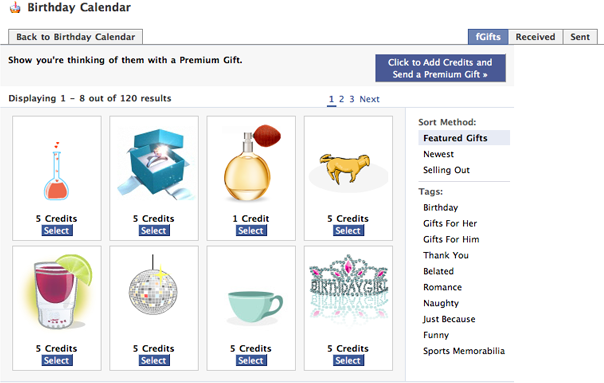
The company has built an embeddable gift store and showcase that can be integrated into any site, and also features its own microtransaction system (you can use your own system if you’ve already got one in place). Viximo CEO Rob Frasca says that while the site’s all-in-one package and ease of use will be a big selling point, its most valuable (and difficult to replicate) feature is its large library of digital assets. For now Viximo is offering virtual gifts similar to Facebook’s popular gift store, but Frasca says that the platform supports puzzles, ringtones, or any other kind of virtual good.
Since its launch earlier this month, Viximo has formed partnerships with a number of Facebook applications, as well as stand alone websites looking to integrate their own stores. Launch partners include Always Athletes, which produces a Facebook app called My Sports Career; We’re Related, a Faecbook app with a reported 6.5 million active users; Birthday Calendar (another Facebook app), and World Winner, a standalone site.
To help build up the library of goods it offers, Viximo has launched a community site for so-called “digital da-vincis” – the artists that craft each of these assets. Using tools on the site (along with their own art programs), artists craft and then upload digital assets which are placed in an online gallery. Third party publishers can browse through these galleries looking for virtual goods they’d like to include on their sites. If an artist’s item gets chosen, they will receive 20% of every purchase (their names will also be included alongside the image for attribution).
Viximo has built a powerful platform that should appeal to a number of social applications and websites alike, but it also has some potential flaws. Every site that implements Viximo has the option of allowing it to be a ‘universal giftbox’ – meaning that a gift given on one site will also appear on another site. But they can also choose to tie their gifts exclusively to their own sites. This could become frustrating on Facebook profiles, as each application could potentially have its own giftbox, which would be both confusing and ugly.


I’ll just never understand why people would pay money to send someone an image. Am I alone? Do people have too much money? What a beautiful business..
BTW..typo in the article:
“along with thier own art programs”
I don’t understand why people buy this crap either, but they do. Viximo stands to make a lot of money.
Damn.
File this under the “why didn’t I think of this first?” label.
This is genius. Charging people to email their friend a picture.
*forehead smack*
Genius.
Viximo is great. I’ve tried their site out a bunch and it rocks. I’ve tried a few of the virtual good services out there and they’re by far the best.
Who are you and where did you come from?
Hahaha yeah. Seems like their own employee.
Read below, idiots.
Somebody is getting defensive….:)
I’m willing to bet any TechCrunch reader $50 that Spencer Fry knows somebody that works at Viximo. Any takers?
Got to love the trolls. Someone praises a company and then that person must have some sort of secret agenda. Actually, Todd Gray (if that is you real name), I started using Viximo as a tester having found out about it through the digital art community. Loved it. I now know one person that works there. Big deal. I also know people at Google, Apple, and many other big companies, should I not praise their products because I know people that work there? I guess I shouldn’t sing the praises of the new MacBooks b/c I know some of the Apple designers. Please get a clue.
“Santino, never tell anyone outside the family what you are thinking again…”
You’re an idiot Spencer
*SaI – Spencer an Idiot
Techcrunch readers don’t like it doesn’t mean it won’t succeed. I never knew why so many ppl were/are still using Myspace. It was so web1.0 wasn’t it? and it still is. There are just so many teenagers whose buying/spending behavior is mysterious to me.
As for the bet, you would’ve won if you were betting on me. I talked to some ppl on the team earlier this year for job opportunities but apparently screwed up. lol.
My only complaint is that their name and logo look almost identical to Vimeo.
I thought I was the only one that saw this. I can’t believe how nearly identical they appear (especially considering the similarity in the name)
Branding fail.
While there are some slight differences it is very similar.
http://h.photos...x/logos-e0d.gif
Yep, I thought the very same thing! Logo design mistake.
I Like Vimeo {seesmic_video:{”url_thumbnail”:{”value”:”http://t.seesmic.com/thumbnail/FxEoTFIT9X_th1.jpg”}”title”:{”value”:”I Like Vimeo ”}”videoUri”:{”value”:”http://www.seesmic.com/video/S9Ue7VztGb”}}}
Cyworld in Korea, QQ in China and DeNA in Japan made over 100 million USD each last year from digital goods (over 500 million USD for QQ and likely reach 1 billion USD this year in SALES not valuation – and with over 50% profit margin). I don’t buy them, but many do. Viximo might have a shot at an even larger market and help monetize many social web properties.
We have more (free) info QQ/Cyworld/other on http://www.plus8star.com
I worked with these folks recently. Good vibes + Excellent People + killer product = big winner
I just don’t see how Viximo can make any significant amount of revenue.
Any online community that is big enough to have any meaningful volume of virtual gifting between users should be big enough to build its own virtual gift function.
Am I missing something?