Is The Economic Crisis Affecting European Startups At All?
by Robin Wauters on October 20, 2008

A lot has already been said and written about the current economic crisis, and how the financial meltdown is and will keep on affecting startups in the US. VC’s and angel investors are telling their portfolio companies to say goodbye to the good times and batten down the hatches, and at the same time raising the bar for new financing rounds, while startup CEO’s are executing substantial lay-offs and some company founders are even jumping ship altogether.

Little noise seems to be coming from Europe though, as if the downturn isn’t having an impact on the industry here at all (or at least not yet). Not that we’re rooting for that to happen, of course, but it’s a trend worth noticing. It’s hard to say if it’s merely a matter of perception, considering there’s not really a culture about being open and transparant on dealing with internal challenges here. Or could it be that European startups simply haven’t been hit by the tidal wave yet, while previously considered rock-solid banks and insurance companies all over the continent are fighting for their lives, governments are nationalizing like crazy, and even entire nations are facing bankrupcy? I think it’s safe to say they will feel the sting of the recession soon enough.

But unless I missed them, I haven’t noticed any public (or should I say “leaked”) statements from European VC’s advising their investments to prepare for tough times, nor have I seen many announcements from European startups doing lay-offs or shutting down altogether. The exception proving the rule in this case: Fleck, whose founders put the service up for sale last week, although this decision wasn’t driven solely by the economic crisis as far as I can tell.

I also took note of Martin Varsarvsky subtly criticizing Sequoia, which owns 1% of his company Fon, for not raising any caution flags a year ago when the first signs of a pending recession were already quite visible. He’s also one of the few who publicly states that there have been “painful cost reductions” at Fon, even if they have apparently been dealt with six months ago.

Other than that? Nothing but deafening silence about the challenges ahead and how startups in Europe plan to meet them.

And yet, Max Niederhofer from Atlas Venture recently wrote that he’s seeing “first, quiet shutdowns” – quiet seems to be the keyword here – and that “companies looking for follow-on financing likely won’t get it in the current environment.” Inevitably, the number of first rounds of VC funding and the valuations that come with them will go down in Europe, too. My guess is that the effects for fledgling startups will be less visible in Europe and remain under the radar for some part, but I’m quite sure they will cut just as deep as in the rest of the world.

I’m very curious what the vibe at the upcoming industry conferences like Web 2.0 Expo Berlin and Le Web will be like. Loïc Le Meur said that he’s not witnessing any decline in interest from sponsors or attendees for the latter.

Editor’s Note: This post was written by our newest contributor, Robin Wauters, an entrepreneur living and working in Brussels, Belgium. He’s the organizer of Plugg, the European Web 2.0 Conference, and has followed the European startup scene closely.

Advertisement

Comments rss icon

  • economics crisis is coming to us ,eu and china can not stand alone ,web2.0 is poor

    • A very creative advertorial for Fleck, Fon, & Le Web :) I read a whole para before I realised that the issue is not so much about how European startups weather through the economic crisis. Looking forward to the Web2.0 Expo, though

      • Fellow TechCrunchers
        I’ve just done what the blog posting intended us to do. Checked out Fleck & Fon.
        Here’s a brief review – Fleck is a mixture of Ping.fm & Bebo, and Fon is a Community of people making WiFi universal and free. I’m looking forward to the creation of a social network tool akin to MyBlogLog – but equipped with instant messaging functions & a photo album (of course!) :) So, I guess I might (possibly) keep an eye on what Fleck & Fon’s future upgrades (if adequately reminded, that is)

    • Seems fashionable now to say that but the truth always was and will be: if you provide a useful service, you’ll linger. If it’s just a fad, it’ll fade…

  • If it’s a global economy on the way up, then it’s a global economy on the way down. What forced the credit markets to collapse was the over leveraging of assets from financial institutions. American institututions were leveraged at around a 30 to 1 ratio. Once it started, it was a domino effect. European financial institutions are leveraged at around 40 to 1 which means there’s more risk there than there is here in the states. To date, European governments have acted quick and have hedged off collapse for now. The answers to the financial system moving forward is a global process, not a country to country one anymore. That being said, there is plenty of cash available for start-ups but caution is the focal point in today’s environment.

  • I read somewhere that UK tends to mirror good and bad economic trends of the US within 3 months. So perhaps we might feel the jolts then. Although saying that European VCs have always been super cautious when it came to investment. A very strong business model (making real money generally from the start) was always their priority. I’m guessing if that was the trend then perhaps there is no reason for major changes in European VC investment culture?

  • Ok.
    Last week was USA
    This week is Europe
    Next Week is South America
    Week after is Africa & ME
    Three weeks is Australia
    Four weeks is Antartica

    What happens in week 6

    Please post lottery numbers for Weds. Thank you in advance.

  • It could be because European Startups are usually more conservative and focused then the Silicon Valley Startups. It could also be because some of the layoffs we saw here were more about cleaning up bad performers and getting some PR for being a courageous entrepreneur. I think that Paul Graham’s essay around this topic is the best. The downturn will help everyone focus on the essentials.

  • The bursting of bubble has spread to Europe. It’s those of no business model or “me too” are dropping like flies. I guess it’s a “flat world”.

  • The European start-up scene is very different to that of Silicon Valley – you guys all seem to know each other, speak the same langauge and 80% of start-ups are congregated into an area that spans only 50 miles. In Europe, there are over 20 different languages and the distance from London to Tel Aviv (the second largest technology centre outside of the valley) is over 2000 miles. There is no community sense of community here.

  • It seems most companies stay quiet until they’re going off the cliff. There may be several balancing on the edge, but we won’t know until they go over.

  • There are more differences. Europe is a lot less VC oriented than the states. In most european countries, if you build a company, you build it with your own money, families money, or ideally, you make money from the start. Raking in millions in VC money is very uncommon. Those that do manage to do it are seen as very ‘US like’ and often frowned upon. The disadvantage of this is that it’s harder to create startup based solely on good ideas. The advantage however is that businesses in europe are generally much more stable and solid.

    Another thing to note is job security in europe. In most european countries, you can’t just lay-off a bunch of people. It involves lawsuits, huge costs; job security is a lot higher in europe, you cannot just lose your job. Companies that fire a whole set of people are quite in big trouble. This has the affect that people hire a lot more cautiously. You grow more steadily so the risks are lower, and when things go bad, you gradually shrink, usually by not renewing temp contracts.

  • I was under the impression given the falling of banks last year in the UK that they were already in bootstrapping mode persay…. and the USA has only just cut back.

  • I agree with some of the comments, such as:

    -USA does the leading (generally) in this department and EU does the following.

    -A bunch probably drove over the cliff this summer and early fall and are rightly embarrassed about that. Many of those ones are not advertising their errors, much preferring to suffer in silence until the herd itself goes over the cliff (it’s less embarrassing to go over that cliff with a bunch of other lemmings instead of you be the only one).

    -Still, I think *somebody* over here is missing opportunity to demonstrate some balls and leadership. It’s there for the taking right now. Nobody wants it? Why are you waiting for someone else to go first, guys? Leader? Anybody??

    Cheers,
    Chris

  • As a CEO of a European Startup, I can say that the global economic issues haven’t hit us personally yet. I’m quite optimistic that this actually a great time to be building a startup, as long as you’re capital efficient. Perhaps some of the bigger, VC-funded companies with high burn rates will suffer, but leaner, agile startups are doing okay.

    For those interested, I wrote about our experience here: http://blog.new...cred.com/?p=162

  • Having been a CEO in the US and Europe at Mondus who pulled the exit break shortly before the crash in a cash only exit. I then switched to be a VC shortly after the dot.com bubble in the US, I can assure you it is going to hit Europe in the same way as the US. Europe is just a lemming of the US at this stage. Just look at the stock market, how the rest of the world follows the DOW and NASDAQ performance.

    The VC’s should just kiss good-by to the returns of the funds invested in recent times, meaning 24 – 36 months prior to the bubble bursting. In addition this burst is much worse than anyone before. This is based on the debt market exploding rather than equities.

    While I agree as an entrepreneur and CEO that the time during a recession is great to build a company as long as you have the capital, the return of 24 months prior to stock market crash investments in Series A’s will be lost and washed out.

    Fellow entrepreneurs and CEO’s button down your shirts and keep executing.
    Alexander Straub (Straub Ventures) http://www.straubventures.com

  • Everything in Europe will depend on what is happening here. It’s going to be alright. Innovation will win. This isn’t pets.com we are talking about here.

  • I’ve just been to barcamp Berlin3 this weekend. Surprisingly few investors present, but i was told they would come later on for web week??

  • Goodbye to the good times… Those were there? Trying to get funding in Europe has always been very, very hard. Quite a few startups are hard-nosed, small flourishing companies who have come to see their handicap, a lack of capital, as the reason for their independance. The result is that many don’t rely on outside funding. This may also be the reason why they never become really big.

    Thos small, medium-succesfull companies will probably survice this “crisis” without much trouble.

  • @Alexander Straub: I’ve sent your company a message using your contact form, but noboda has replied yet.

  • Start-ups in Europe are less over-hyped compared to US.
    Less money has been pored into the start-ups by VC’s – in many start-ups no VC money.
    Less people have been hired as most of them were operating on a shoestring.
    Thus less employees to be fired or even to be considered to fire as the costs involved are too high.
    Still the global downturn will have its repercussions on the revenue of the start-ups.
    The better (with the real business model http://dodaq.com/en/) or already having reach (www.netlog.com http://www.bragster.com) will survive and become stronger.

  • I can just focus on a single statement in this article:

    “Little noise seems to be coming from Europe though”

    This is a general theme. Whether the news is about something good, something new, something bad, or about the economic crisis, “little noise” ever seems to come out of Europe in this sector. Europe is a quiet, depressed little continent whose inhabitants can barely understand each other – we tend to be quiet!

  • Recognizing that which is a product of arrogance and also shameful behavior.

    Our lexicon of business activities is being expanded daily, thanks to the “wonder boys” on Wall Street. We are learning about derivatives, collateralized debt obligations, credit default swaps, recapitalization, puts, short selling and so on. We are gaining a new vocabulary from the recent meltdown of the financial system and expected slowdown of the real economy worldwide.

    Where did this debacle begin? Well, it began in the center of human community’s banking and investment houses in the financial district of NYC. Supposedly, the “brightest and best” among us go to Wall Street, know what they are doing and do the right thing. Unfortunately, such assumptions turn out to be colossal mistakes.

    How did this calamity occur and why is the human family in such dire economic straits? It appears that grotesque greed and a culture of corruption have come to dominate significant operating systems of the global political economy.

    Powerful people in high offices within huge business institutions with access to great wealth are recklessly and deleteriously manipulating the unbridled expansion of the global economy in the small, finite planetary home God blesses us to inhabit.

    Self-proclaimed Masters of the Universe have surreptitiously “manufactured” a sub prime “asset bubble” and perversely fostered its uneconomic growth within the world economy. Not unexpectedly, this asset bubble did what bubbles do. The sub prime bubble burst and made a mess. Global credit markets have frozen, stock prices are tumbling and the value of the dollar is gyrating.

    Evidently organizers, managers and whiz kids overseeing the global economy, and the unraveling {ie, deleveraging} of the worldwide sub prime swindle, are running the artificially designed financial system of the global economy as a pyramid scheme. This is to say that the international financial system is being operated so that most of the wealth funneled pyramidally into the hands of a small minority of people at the top of the world economy where this wealth is accumulated and consolidated. Note that thirty percent of annual corporate profits end up in the accounts of a tiny number of people. At the same time, the vast majority of people on Earth, near the bottom of the global economic pyramid, are left with very little wealth. Does the economy of the family of humanity exist primarily to provide wealth to the already stupendously wealthy? The “bankstas” among us evidently think so.

    In the 1980s, this extremely inequitable method of distributing wealth and arranging business activities was called a “trickle down” economy. We have been repeatedly told how this ‘rational’ economic scheme is good because it “raises all ships.” And yet, from my limited scope of observation, the billion people living on resources valued at less than one dollar per day and the additional 2.7 billion people being sustained on two dollars per day of resources now appear to be stuck in squalid conditions. The ’ships’ carrying these billions of less fortunate people {ie, more people than lived on Earth in the year of my birth} do not appear to be lifting them out of poverty.

    Steven Earl Salmony
    AWAREness Campaign on The Human Population, established 2001
    http://sustaina...t.org/index.php

  • Ivo is right…you can hire in Europe…but when it comes with lay-offs then it’s much harder than in US.
    This is an advantage for the employee (job security) and a disadvantage for the employer (the company is not that mobile, cannot move as fast as their counterparts in US).

    Besides that, it seems in Europe they are not panicking that much about this crisis…

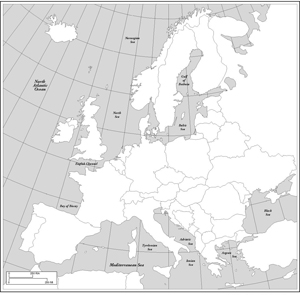
  • Well, if it comes to Europe startups… I wonder how many of you can enumerate like … 10 countries from Europe?:) Fortunately you provided us with a map, Robin, thanks :) Anyway, i recently found a nice startup from POLAND ( i bet You dont know where it is ) http://quotag.com/ Think there’s something similar, but im not sure,.

  • That’s like the worst map I’ve ever seen.

  • I’m a French start-up CEO.
    No real “crisis issue” there ; we always were very cautious about cash burn rates anyway so…

    Still raising decent amount of capital money without serious difficulties.

    Probably because we don’ t need to pay our top mngt staff 150K + equity :-)

  • Congrats with your first post here at Techcrunch!

  • The experts says that crisis will not be over until 2010 !

  • David Dzidzikashvili - December 13th, 2008 at 7:06 am PST

    Current global financial crisis was a result of greed by large investment & financial institutions, CEOs and individual investors, whose policies dragged whole world down and resulted in inflation, unemployment, foreclosures and bankruptcies. The worst still yet to come in 2009. There is a need for more stable financial system that leaders around the world can agree on to guarantee long-term stability. In addition, the investors who personally were involved in the greed schemes that caused the economic chaos should be arrested and jailed for their involvement in the world economic catastrophe. We can’t tolerate anymore some individuals’ greedy aspirations ruining the lives of people around the world.

  • USA’s FAST ECONOMIC RECOVERY IN 2 STEPS

    Step 1 – STOP THE BAILOUTS and FIX THE BANKS
    - Solve the loan problem.
    - Solve the derivative problem.
    - Reassemble whole loan mortgages

    The U.S. economy is shrinking fast, because businesses cannot get loans that they need to operate normally. Banks and lenders already own $ billions in bad loans, and they are afraid to make new loans. The government gave $ billions in bailout money for banks to start lending, but banks hoard the money to save themselves.

    Our financial system became untrustworthy, because it mixed $ billions in bad loans in with the good loans. Now, banks do not trust any of the loans, and the entire credit market stopped working.

    The U.S. economy will continue to shrink until we untangle the loans. Once the bad loans are isolated, they can be fixed one at a time. Then trust will be restored. Credit will flow, and the economy will grow.

    So far, our government is spending $ trillions on bailouts and pork projects, out of ignorance and political ideology. The real solution is much less expensive than that.

    The USA has fixed this problem before, and it is not hard to fix again. This is how:

    A) Start with the Resolution Trust Corporation (RTC), which the federal government setup to solve a Savings and Loan problem in the 1980s.

    B) RTC buys up securitized mortgages and derivatives to reassemble whole mortgage loans.
    1. “Securitized mortgages” are home loans that have been bundled into large groups and sold to investors. A group of about 4,000 mortgages can be “securitized” and sold just like a stock or bond. Investors like to buy groups of mortgages because they receive all the monthly house payments.
    2. Some groups of securitized mortgages were subdivided into smaller pieces, called “derivatives.” However, both of the fancy names refer to mortgage loans.
    3. The problem is that many bad loans (with no payments) got mixed in with good loans. That turned the all the securitized mortgages into bad investments, which are ruining our banks. It is a huge problem, and the government has to fix it, before our economy will recover.
    4. Total securitized mortgage and derivative market is estimated at $1.3 Trillion by a Professor of Economics at Ohio State University. (Also see the graph from Deutsche Bank at “The Death of Securitized Mortgages” http://www.nake...-mortgages.html )
    5. Government should buy up securitized mortgages and derivatives at the lowest market price, which is set via a reverse auction. (Google on “reverse auction”.)
    6. Squatters, who sit on their mortgage derivatives, in order to extort big $ from the rest of the system, can be forced to sell. (Law is analogous to eminent domain, or sales forced on cybersquatters that registered the domain names of well-established companies.)
    7. Government pays mortgage derivative squatters at market price set by previous reverse auctions, perhaps with a penalty to the squatters.
    8. Sellers give up all rights. No new law there.
    9. Banks, investors, and insurers now have cash instead of questionable mortgage loans and derivatives. So, the banking system is healthy with cash to lend.
    10. Credit will flow, and the economy will grow.

    C) Government reassembles whole loans from securitized mortgage components and derivatives.

    D) Government sorts the newly reassembled whole loans (mortgages) into groups according to risk/quality.
    1. Government uses traditional mortgage experts and guidelines to sort the home loans into quality groups, for example, a high quality group would include homeowners with 20% (or more) equity in their house at today’s market price; and house payments that are 25% (or less) of homeowners monthly income.

    E) Government (RTC) sells the reassembled whole loans to traditional mortgage banks.
    1. This solves the problem of renegotiating home loans with homeowners. Read on.
    2. Law must be changed so that reassembled whole loan mortgages cannot be securitized into derivatives, again.
    3. An important purpose is to reconnect each homeowner with his lender, and vice versa.
    4. It eliminates incentive for mortgage lenders to make predatory and junk loans. If the loan fails, the lender is stuck with a bad loan.
    5. Government recovers much of the $1.3 Trillion purchase cost, because government auctions off the reassembled mortgages.
    6. The lower quality, more risky mortgages would fetch a lower price at auction.
    7. Mortgage companies, that buy the risky loans, will have more room to negotiate with the homeowners.
    8. Some homeowner negotiations will not succeed. Those homeowners will move into affordable rentals. (The government does not owe everyone a free house.)
    9. Other renters would like to buy those empty homes at reduced market prices.
    10. If the government gets stuck with some homes, the government could profit by selling the homes when the housing market recovers.

    F) Insurers like AIG may be reorganized through bankruptcy.
    1. Securitized mortgage pools never made business sense, unless they were protected by various insurance schemes.
    2. Those insurance schemes always were a scam.
    3. Insurance only works when most of the insured assets are never hit with a disaster. That is why flood insurance does not work very well. A major flood ruins all the buildings in a large area, all at the same time. So, the insurance company goes broke, and people that bought the insurance are not protected. That is the problem with securitized mortgage insurance. In an economic downturn, the “disaster” hits all the houses at the same time. Securitized mortgage insurance was doomed to fail, and the insurance companies went broke in 2009.
    4. Companies that ran the insurance scam may have to go through bankruptcy.
    5. Never ending government bailouts for insurers like AIG are just throwing good money after bad. So, stop the bailouts.

    This plan is inexpensive, tried and true. It leaves the banks healthy, with cash to lend. It restores trust in the credit markets, so loans will be made. It reassembles mortgage derivatives into whole loans, and restarts traditional mortgage lending. People can get loans to buy homes. Credit will flow, and the economy will grow.*

    Step 2 – STOP THE PORK and START THE RECOVERY

    *The economy will grow if President Obama’s massive tax, borrow, and spending plans can be stopped, before he creates another Great Depression. Presidents Hoover and Roosevelt already tried to tax, borrow and spend their way out of a recession in the 1930s. Instead, they created the Great Depression, which lasted 12 years. Straight as he goes, President Obama is doing it, again. Nevertheless, cleaning up the securitized mortgage mess is a necessary first step.

    If President Obama announced Steps 1 and 2, today, the stock market would go up within hours. Investors love a real business plan, instead of a political pork plan. Millions of people will be wealthier, feel wealthier, and have more money to spend. That will jump start the economic recovery within days.

  • We are learning about derivatives, collateralized debt obligations, credit default swaps, recapitalization, puts, short selling and so on. We are gaining a new vocabulary from the recent meltdown of the financial system and expected slowdown of the real economy worldwide.

    Nevertheless, cleaning up the securitized mortgage mess is a necessary first step.

Leave Comment

Commenting Options

Enter your personal information to the left, or sign in with your Facebook account by clicking the button below.

Alternatively, you can create an avatar that will appear whenever you leave a comment on a Gravatar-enabled blog.

Trackback URL
bugbugbugbug
Techcrunch on Facebook