Federated Media Unleashes The Conversation As An Ad
by Michael Arrington on October 15, 2008

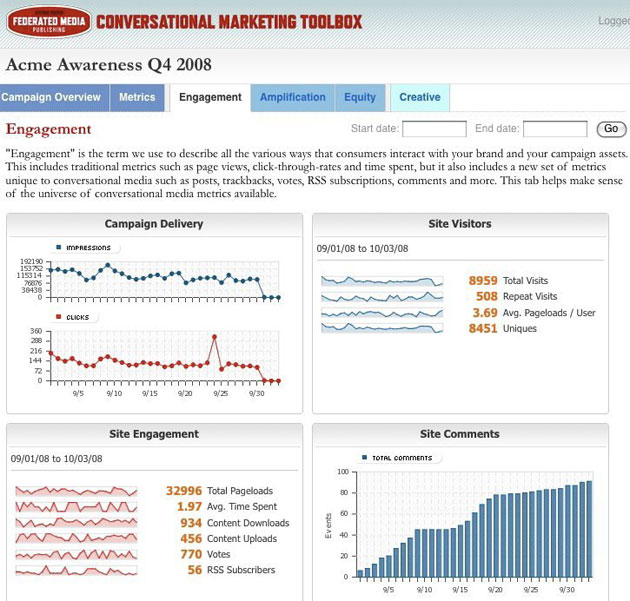
Federated Media (our advertising partner) has been experimenting with “conversational marketing” almost since their launch in 2005. Today they are launching a new marketing toolbox for advertisers which gives them tools to track all the ways users interact with these ads.

The goal, says Federated Media, isn’t just to track ad impressions and clicks, but also to look at a new set of metrics like posts, trackbacks, votes, RSS subscriptions, comments, etc, where users somehow interact with the advertisement and talk about it. Hopefully, a conversation occurs between users, the ad publisher and the advertiser, which gives the advertiser’s brand more face time. An old example of this is Hakia’s ad that asks bloggers what better search means. Other examples are here.

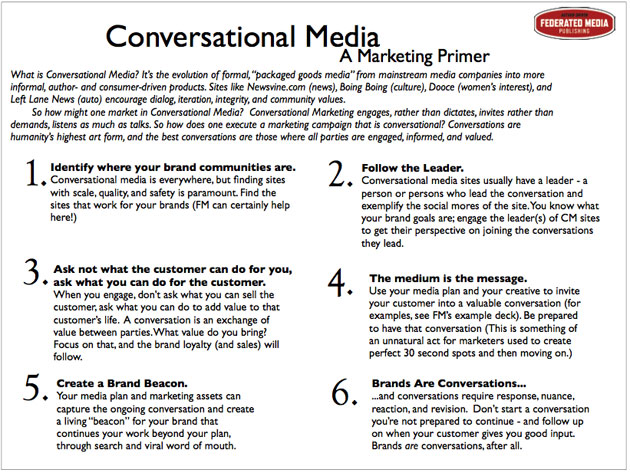
The definition of conversational marketing is a little squishy. But the general idea, which Federated Media founder John Battelle writes about in the primer below, is that you as an advertiser figure out which content sites best associate with your brand, and then you grab the leader in that space and pay them to start conversations on your behalf:
Early efforts didn’t pan out so well as authors were accused of conflicts of interest – users didn’t know where editorial stopped and advertorial began. It’s not clear those issues have been resolved, but Federated Media says a proper disclosure policy is the right place to start.

Convinced? It’s certainly controversial, but brands love it because they get a higher return on their advertising investment. That means it’s here to stay.

Advertisement

Comments rss icon

  • Ah, the C Word. The word ‘conversation’ is certainly one of the most overused in recent years. I don’t buy into the idea that “brands are conversations”. They’re clearly not.

    Nevertheless, an interesting idea from FM, especially the engagement stuff, but difficult to see how this is purely driven by advertising. What’s the charging model? Do publishers with greater engagement rates or influence generate higher fees?

  • So does this go without saying that TechCrunch is the leader in tech news? I think what makes Federated a great network for advertisers is it taps into the best of The Long Tail. Sites like AVC.com don’t get huge amounts of traffic like TechCrunch, but Fred has a ton of great content and high-quality traffic.

    Dipping into the Best of The Long Tail is more cost-effective for advertisers and spreads their message across different mediums more effectively.

  • Brands getting involved in conversations is a good thing. It makes them accountable, forces them to listen and gives the consumer context.

    Brands paying established bloggers to converse for them is weird. Why can’t the brand just speak for itself? If what they have is worth listening to, we’ll find it.

    Of course, that’s not exactly what FM has; they’re working in a squishy gray area between blog sponsorship and brands hiring freelance writers. I don’t think should be gray area there. Gray means there isn’t transparency, which isn’t a framework for quality conversation.

  • First and foremost, the askaninja.com campaign under the more examples link is absolutely hysterical. I enjoyed it so much I felt bad for listening to it in the office … no one should have so much fun at work.

    Moving on! In sales one of the first things you’re taught is to built rapport with your potential buyers. People are more likely to buy from you once they’ve gotten to know and like you. Since sales are the RIO measurement for an organization’s advertising I think this concept of conversational media is right along the lines of what people are looking for.
    Marketers could use a little more definition to the task. “Viral marketing”, “conversational media”; these concepts are vague. But I believe that people will discover the finer details of these processes only through practicing them. So hats off to Federated Media for getting the ball rolling.

  • I thought “tweets” would be part of this toolbox. Perhaps they didn’t participate. I guess they have a “conversation” of their own going on…hahaha

  • wasn’t this known as seeding up until this point?

    i still believe that there has to be an incentive for the so-called “leaders” to take action – promotional items, exclusive info, etc. just saying, “hi, would you talk about this? k thx bai” just doesnt seem to cut it yet.

    that being said, this and similar concepts are still evolving into what could be very beneficial to social communities as a whole. good to see there is progress, but i’m not sure of the return it provides to either end at this time.

  • i hanejfa fajjglajeiljgkl

  • I am happy to see that Federated Media is following our lead in the sponsored content space, though I believe “conversational marketing” may be misleading (or “squishy”) as a label. The content of the conversation would not exist without value changing hands. Advertisers are paying bloggers to start or participate in a conversation, they are not marketing within an existing conversation. It is sponsored content and needs to be treated as such.

    I see that a disclosure policy was mentioned, but I see no reference about any standard on Federated’s Site. We took a beating from TechCrunch about this in the past, but I guess Federated (your advertising partner) gets a free pass. It’s very easy to say you think disclosure is important, it’s another to do something about it.

    Is in-post disclosure require? What about sponsored comments? Are the links no-follow? Is the disclosure audit-able? Is it a condition of payment? If you want to see the disclosure requirements we have established within SocialSpark look here:

    http://socialsp.../code_of_ethics

    I commend you on adding a disclosure policy to your site Mike, though it is buried at the bottom of your About TechCrunch page.

    Sponsored Content is the future of online advertising. At IZEA we consistently deliver $20+ effective CPMs (even long-tail bloggers). Advertiser are happy to pay that because the CTRs and conversions are so high. We have come a long way since the launch of PPP, the future is very bright indeed.

    You should drop me a line Mike…. we could get you a few grand a post : )

    • Ted, the difference with anything we’ve ever done was that they were placed in ad units, not editorial. And as far as I know we haven’t run these ads since 2007, when criticism was first brought up.

      We have our conflicts noted on the about page, and again in any posts where there is a conflict (and there are very few). And we’ve certainly never entertained the notion of taking money for any post, which is the backbone of your ridiculous business.

      • Mike,
        Perhaps you haven’t been compensated directly in cash for an individual post, but surely you can admit that your posts and comments are influenced by other compensation.

        “Ted, the difference with anything we’ve ever done was that they were placed in ad units, not editorial.”

        While I believe you really wanted to see the movie “Wanted” I don’t see how it is relevant to a blog about tech and startups.

        http://urlbrief.com/92314a

        What I do see is 200+ free tickets to an early showing in a private theatre (street value of $4,000 give or take) provided to TechCrunch, in exchange for promotion of the advertiser. This post was in the editorial content of your blog. If not for the free tickets I don’t see how this post would have ever been a subject of relevance to your readers. It is sponsored content, bought and paid for with movie tickets.

        Your own quote:
        “Why are MySpace and TechCrunch doing this? Just to say thank you to our readers and encourage warm fuzzy, advertisement-clicking feelings in you all.”

        Giving things away doesn’t mitigate the fact that value changed hands in exchange for inclusion within the editorial of your blog.

        I am not saying this is wrong, to the contrary I think it is great. You disclosed that there was a relationship in the post and you provided the advertiser a great service. As an advertiser I would buy posts like this all day. I just want you to acknowledge that value is value, no matter if it is cash, movie tickets or a video camera. All of this is sponsored content and should be treated as such.

      • Mike – I am acting VP Marketing for LoudLaunch (LoudLaunch.com). I promise you that we will never – ever- ask you to join the LoudLaunch publishing network. When you write about our advertisers, it will be because of significant news – not because we paid you.

        Having said that, I think your slam on businesses (like ours) that connect advertisers with publishers who are willing to write about them for compensation is naive. It has happened in one way or the other in the traditional media world for.. well… forever. And there will always be a market for this service. Being a market maker for a valuable service is a great business – and certainly Ted (and others) have the investors to prove it.

        Should publishers disclose? Yes. Should they only write about things that will be relevant to their audience and accretive to their business? Sure. But don’t discount the potential of these kinds of businesses. Rather push for better standards, higher quality, and more transparency.

      • “Rather push for better standards, higher quality, and more transparency.”

        Great point John.

      • LOL. Great comedy here.

        All this coming from two dudes in pay per post! An industry that is re-defining spam.

        Seriously guys, wake up. You swim in VERY VERY murky water and both your company names are the antithesis of your end results.

        Please save yourself another black-eye and stop trying to pull the cashmere (i.e. well ’spun’ wool) over the advertiser, they’re not that dumb.

        Kudos MA. Job well done.

  • The way this was rushed out tells me someone else is launching something better soon. Great idea and great explanation of conversational marketing, but awful examples.

  • Mike,

    Interesting. I hadn’t heard about conversational advertising before this, although I’m pretty sure I have seen it happening.

    Now it’s not even close to being mainstream, right? So, why just tracking tools for conversational ads, and not, say for example, creation tools for conversational ads?

    Not to step into your back-n-forth with Ted M., but SocialSpark seems to be providing the tools/services for creating these ads, yes?

  • I’ll have to look into this further, but if “conversational advertising” is what it sounds like it is, then it’s the kind of thing that would be a HUGE negative for me (on many levels, from many sides). Conversation and advertising should be TOTALLY separate, IMHO. No gray area. Conversation here. And advertising WAAAY over here.

  • Hello Mike-

    Doesn’t good public relations accomplish the same goal without the stain of a money transfer? Sure, paying for a placement guarantees the message comes out exactly how the company wants, but the damage to reputation when the arrangement is revealed (and as your reference to “early efforts” shows, it always seems to be uncovered) is huge. If PR can get you to 80% accuracy in message delivery why risk the downside to get to 100% accuracy (ye old 80/20 rule)? Am I missing something here?

    If you are a company looking at this holistically, I’m not sure you need conversational advertising when other slightly more reputable avenues already exist.

    Full disclosure: I work for a PR firm. I hope that doesn’t undermine the legitimacy of these observations.

  • The new start-up Webmob-ad just came out . It is a pioneer in the automation of mobile and web advertsing by creating the only self serve and fully automated marketplace for CPC and CPM advertising . It supports all types text ads, banners and video ads. PUBLISHERS EARN THE HIGHEST SPLIT OF THE EARNINGS.
    . Register is FREE. Our matching tools offers a new approach to real effective personalized targeting. Please check it out : http://www.webmob-ad.com.

  • The value in the concept of conversational marketing sounds great, but the reality is that there is too much risk and not enough probability for reward for brands to adopt conversational marketing with this gray area approach.

    Risks:
    1. How successful of a seeding mechanism is this? What is the probability that any campaign will actually take off?
    2. How much control does a brand have over negative posts and comments?
    3. Even if there is some level of control (I doubt there is any systematic or automated approach), will brands, agencies, and advertisers be willing to devote the necessary resources to manage negative postings and comments?

    Reward:
    1. Viral Word of Mouth Campaign spreads through trusted sources and results in a 5x performance increase over standard campaigns.

    Bottom Line:
    Why would advertisers want to take significant risk if there is low probability for reward? It doesn’t seem as though placing an ad on an influential/connected/well-read blogger’s site HOPING that other bloggers write a positive post linking to the brand or readers comment is a highly probable way of seeding conversation? Why will bloggers or readers take these actions and how often will their interests align with the brand in an advertisement?

    It seems like you can’t play both sides of wanting seeding for a campaign to be highly successful while not overtly directing bloggers and users how to post and comment. Not that I am a total fan of pay per post, but it seems to make more sense for brands given that users and brands are on the same page; leaving it up to users to decide what to do is opening yourself up to too much risk and not enough reward.

    It would be great to hear a brand’s perspective on this.

  • This feature might add some transparency to less than reputable numbers reported to clients in previous conversational marketing campaigns.

  • Holy recursive advertisement/news story/”conversation” Batman.

Leave Comment

Commenting Options

Enter your personal information to the left, or sign in with your Facebook account by clicking the button below.

Alternatively, you can create an avatar that will appear whenever you leave a comment on a Gravatar-enabled blog.

Trackback URL
bugbugbug