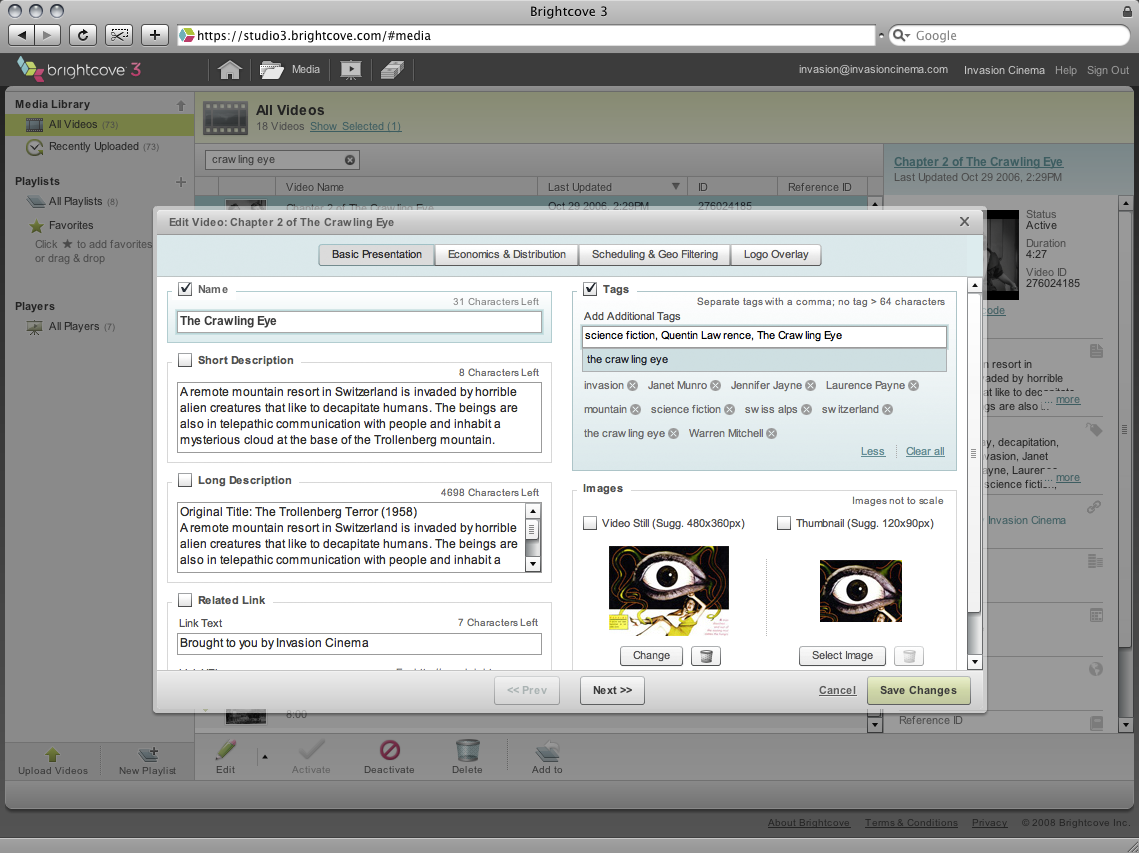
Brightcove Is Already Streaming “Several Hundred Million” Videos A Month. Now Comes Brightcove 3.
by Erick Schonfeld on October 13, 2008

A couple days ago, we posted some leaked screenshots of Brightcove 3, the completely gutted and rebuilt Web video platform from Brightcove that is launching on Tuesday. I was able to catch up with Brightcove CEO Jeremy Allaire, who gave me an update on the company and took me through all the changes in the service.

Brightcove is a Web video publishing platform that has raised $91 million and boasts hundreds of major media brands as its customers, including Dow Jones, Showtime (Dexter, The Tudors), Lifetime, AMC (Mad Men), Time magazine, and the New York Times. TV networks, magazines, newspapers, and music companies all use Brightcove to distribute and manage video on their sites and across the Web. Increasingly, so do big corporations like Sun Microsystems, universities like NYU, and political organizations like the Obama campaign.

Allaire says that, collectively, his customers are distributing Web video at the rate of “several hundred million streams per month,” which would make Brightcove one of the top ten video networks. It would still be well below No. 1 YouTube, which is streaming five billion videos a month, but perhaps within spitting distance of No. 2 Fox Interactive/MySpace (446 million streams) or No. 3 Microsoft (286 million streams).
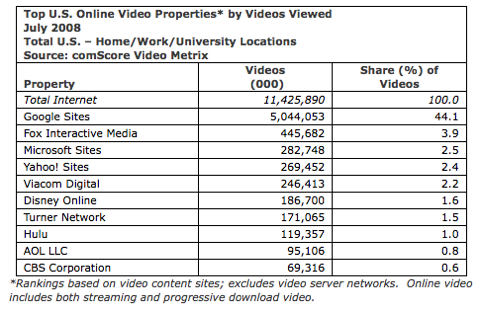
Videos viewed

As far as Brightcove’s financial situation goes, Allaire would only say:

We are not profitable, but our burn rate continues to go down. We don’t expect to have to raise additional money based on our growth.

The Boston-based company now has 160 employees, and is spreading internationally. Europe now represents 20 percent of revenues and 34 percent of bookings, up from zero twelve months ago. And Alliare launched a separately capitalized Japanese subsidiary in May.

With Brightcove 3, the company is introducing a streamlined user interface and a whole new set of capabilities. These include a new markup language for creating video players called the Brightcove Experience Markup Language (BEML), new APIs for customers and developers, and intelligent streaming technology that dynamically changes the video quality based on the viewer’s device and bandwith limitations.

Here is a summary of the new features in Brightcove 3:

  1. Custom Players. New APIs allow deeper customization of the Brightcove video players and viewing experience.  The Brightcove Experience Markup Language makes it easy for any Web developer who knows HTML to create sophisticated stylings, social tools, and video-player navigation options.
  2. Pricing.  Brightcove is going from one flat-rate pricing to three different tiers (basic, professional, and enterprise).  Subscriptions start at thousands of dollars per year and go up to hundreds of thousands for enterprise customers.
  3. Dynamic Delivery. Each video stream is optimized on the fly, based on a viewer’s bandwidth and factors such as the size of the player. Brightcove 3 automatically creates multiple renditions of each video appropriate for everything from mobile to HD viewing.
  4. More APIs.  Brightcove already has APIs that let developers customize its video player.  Now it is opening that up to developers who want to write plug-ins for social commentary tools (JS-KIT did this), contextual advertising, or analytics.  The company is also releasing syndication APIs for controlling the advertising for each video no matter where it appears. And its Brightcove Media APIs will make each video visible to search engines and make it easier to add related videos, and other contextual information. Each Brightcove video will now have its own unique URL.  The Media API will allow publishers to extact programming information from the videos so they can insert it into the HTML of each page.

On this last point, Allaire says:

YouTube has taught us all this lesson. Every video has its own page that has 20 different ways to the next video.

And in the face of the overwhelming dominance of YouTube, how do you see Brightcove videos there? Allaire’s answer:


You don’t and you don’t need to. You find it in Google. Video is a media type. It is a powerful medium for communications. Broadband internet will drive video. Traffic will flow across Websites.

Maybe some day, but right now it still looks like a winner-take-all game. Allaire thinks he can change that.

Here is an interview with Allaire about Brightcove 3 from Beet.TV:

Advertisement

Comments rss icon

  • silicon valley dropout - October 13th, 2008 at 9:16 pm PDT

    these ad/video network sure gets a ton of funding yet none has turned a dime of profits yet. only in america.

  • After holding their dicks for a couple years these guys are finally starting to move.

    Nice to see what a little competition can do.

    Companies like Delve, Edgecast, & other heel-nippers will force these guys to scramble at increased velocity.

    Thanks for the wet fart Allaire. I hope you have some double-quilted Charmin around the office.

  • Yeah,

    This release is impressive, but what took them so long. They are kinda like Joost, they haven’t done anything for 24 months.

    As for heel-nippers, don’t forget Ooyala (http://www.ooyala.com. Edgecast is a CDN and not a web publishing platform.

    I think Delve (http://www.delvenetworks.com) has the nicest UI and the semantic-speech recognition stuff is interesting.

    You can’t help but root for the heel-nippers who’ve built a competitive product with 1/10 the funding and people.

    Let’s see if it takes BC another 2 years to get to Brightcove 4.

  • Edgecast is a CDN. Brightcove, Delve, Ooyala, etc., are video publishing platforms who *use* CDNs. But these are not the same things.

    • I’ve heard Edgecast isn’t a very good CDN. If you look at their owners history they always sell their companies after a few years in business. They are only in it for a quick buck. Plus, since they have no previous CDN experience they learn on the fly.

  • Another way to distribute videos : see http://www.totalvod.com

  • I haven’t seen any Brightcove videos with captioning. Isn’t Accessibility an essential feature of any advertising venture? Millions of deaf, hard of hearing!

  • With video playing an increasingly important role in publishing, tools like this are the way forward for those who don’t have the tech resources that are often required. If you can (easily) build in ways to generate additional revenue through this technology then it can only be a winner.

    http://www.thedrum.co.uk

  • The difference between Brightcove customers and Youtube ‘customers’ is that the Brightcove ones pay for the privilege! This is an actual functioning business, unlike the fantasy economics of so much of the web streaming industry.

    And brightcove have not been ‘holding their dicks’ for the last two years. They introduced overlay advertising months before Youtube announced it, they pioneered video-editing and flash/video integrated experiences through a tool called Storymaker.

    In the end it comes down to simple tools that work consistently and easy integration of video with content and advertising, plus reliable distribution. That’s what paying customers like myself want, and that’s what they provide.

  • Many of these “new” features are already available with the Wizzard Media player. Wizzard’s player already does the dynamic delivery of the video depending on the end users connection speed and version of flash.

    http://tools.wizzard.tv

    And they also have tubemogul integration and their player is free and has been out since the summer.

    Rob W
    podCast411

  • The space is heating up, video may be one of the few areas to offer some investors growth in this recessionary period

  • You can compare all these companies all you want all day long, but the biggest issue is scale. YouTube has dealt with it and has the best company in the world behind them to handle scaling issues, but Brightcove is easily second in the video market when it comes to handling streams and load that other systems can’t even think of yet. It’s such an incredibly hard hurdle to overcome, so while the “Wizzard media player” (whatever the hell that is) has some nice features, it would likely crumble under the same systems load the Brightcove sees on a daily basis.

    • Paulson – Not accurate at all – Wizzard Media Player is backed by the Libsyn.com infrastructure. With a Billion Downloads last year – they can handle any traffic thrown at them. They are the largest podcast hosting company and have proven they can handle heavy traffic loads.

    • Brightcove is just a CMS/ Workflow tool, they scale based on CDNs. What’s the magic?

  • Delve Networks is built by the same folks who helped build Amazon’s web services like S3, EC2, SQS, etc. They also work on search engines like Inktomi and Amazon.com’s ecommerce site.

    I am guessing they can scale but you are right they don’t seem to have enough customers to prove it yet. I also suspect they are using AWS to help scale since they know that technology platform well (since they used to work there).

  • Brightcove doesn’t have scaling issues because they just rent space and bandwidth from LimeLight

  • What about community features or video discovery/searching? These guys seem to get more complicated, time consuming and expensive every 6 months. I like what Magnify.net is doing.

  • Magnify.net rocks! Delve’s platform doesn’t scale nor can their company. They’re analytics capabilities suck and the rumormill has it they are running out of cash. With their current CEO running the ship into the ground, there is no way they are going to survive. To be safe, go with the more established players in the market.

Leave Comment

Commenting Options

Enter your personal information to the left, or sign in with your Facebook account by clicking the button below.

Alternatively, you can create an avatar that will appear whenever you leave a comment on a Gravatar-enabled blog.

Trackback URL
bugbugbug