Do not panic. We accept late submissions for TechCrunch50, but please submit soon. »
Will Verizon’s New Three-Cent Hike Kill SMS Services?
by Erick Schonfeld on October 12, 2008

On Friday, word got out that come November 1 Verizon Wireless plans to tack on an extra 3-cent charge for every SMS message sent by Web information services to any of its mobile subscribers. That hike will be on top of the 20 cents per message that Verizon subscribers already pay (even those with “unlimited” plans). Thus, in one fell swoop, Verizon is attempting to boost its SMS revenues by about 15 percent.

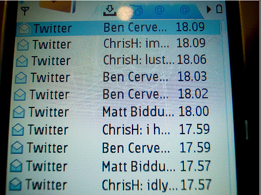
While it may be good for Verizon, the additional charge is not good for any service that sends out millions of SMS messages each month. The move caught a lot of Internet companies, SMS aggregators, and media companies by surprise. For instance, I asked Twitter co-founder Biz Stone what impact it would have on the micro-blogging service, which lets users keep up with every Tweet they follow via SMS, and he didn’t know:

We’re still investigating with Verizon so I don’t have a definite answer for you right now.

In August, Twitter suspended the SMS feature in the UK and other foreign countries because it would have cost the company as much as $1,000/year/user. In the U.S., apparently it has more of a flat-rate pricing.

But that might change now with Verizon—and other U.S. mobile carriers as well, if Verizon’s competitors match the price hike. How long are they going to stand by and watch Verizon capture a 15 percent margin advantage in the booming SMS business? If the new 3-cent charge becomes the norm, it would cost companies $30,000 for every million SMS messages they send out.

I use Twitter here as an example, but it is by no means alone. Thousands of Web services use SMS as a communication channel. For example, Google lets you search by SMS and also lets people set up automatic SMS alerts from Google calender and other services. Nearly every sports, stock, and weather Website (not to mention the political campaigns) lets you get SMS alerts as well. Those are the heavy volume users. But this new charge could end up hurting SMS startups such as 3Jam, 4Info, or TextMarks the most.

Now, of course, the price hike could backfire on Verizon. Google, ESPN, Twitter, and others could just suspend their SMS features for Verizon customers, and its competitors could use that disparity to their marketing advantage. But if AT&T, Sprint, and T-Mobile decide that they too can squeeze out an extra three cents per SMS message, they might simply pile on board.

Forget for a moment that the mobile carriers are already making a huge profit margin on the 20 cents they charge users for each message. They know they cannot charge consumers any more, but Verizon at least thinks it can turn around and charge the Web services where the SMS information is originating. If the charge spreads to other carriers, those services might die or stop using SMS as a communications channel.

(For Twitter, at least, this may not be so dire. Although Stone would not confirm, my understanding form another source is that SMS accounts for less than 10 percent of Twitter’s overall message volume. That makes sense to me. I only use Twitter’s SMS functionality to send in Tweets from my phone, not to receive the barrage of Tweets that I follow).

The other way this could backfire for Verizon is that it could raise some serious Net neutrality issues. If it does not apply this charge evenly across the board, or starts carving out exceptions to do biz dev deals (and Verizon made some indications to Silicon Valley startups it was moving in this direction prior to the rate hike announcement), then it will be giving preferential treatment to one source of information over the other.

What if Verizon were charging the Obama campaign 3 cents per SMS message right now, but cut a deal with the McCain campaign to charge one cent per SMS? That is just a stark example, but you see where this can go. What if it charges the New York Times one rate, and the Wall Street Journal another? It becomes a freedom of speech issue. That is why it is better for the mobile carriers to charge consumers directly (and consistently), rather than try to sneak around and get an extra three cents per message from the Web content companies.

(Photo by Ti.mo).

Comments rss icon

  • The answer is to kick them right back in the wallet. Drop Verizon as a service you will work with, and enable IM instead

    • Verizon is a bunch of unenlightened Bell monopoly holdover dick floggers.

      • Use Twitter boys.

      • I second that Jason…..

        I own a Patent Pending Text company call Text To Party, It’s a Event, Nightlife, On-the-Go Party Guide.

        Here’s how you’ll use TextToParty: For a small fee ($0.99), you send them an area-code specific text (”PARTY305″ or “PARTY954″ to 88089) and instantly receive a hand-selected group of the hottest special events and parties going on in your area. After deciding on the most enticing spot to make your appearance, you respond once more by text and get hooked up with guest lists, bottle connects, drink passes, VIP hosts and all the other best-kept secrets of promoters. (They’ll even shoot you directions and parking info.)

        http://www.texttoparty.com
        http://www.texttoparty.blogspot.com

        So this will affect me but not as much because people are actually texting in and we are not sending blast out, or would it affect my company too?

        please let me know…

        Thanks

    • We need a cross platform BBM killer.
      And don’t say “What about AIM, gchat, yahoo etc…”

      People want to be able to chat blackberry to iphone and more…
      People want to ping, send files and voices.
      People want to be able to know who is logged in via their mobile device
      People want to know if a message was delivered and received.
      People want free unlimited texts AND would pay for this.

      This could grow to include premium SMS features.

      The carriers don’t want this because it will impeded on SMS revenue.
      Apple doesn’t want this because they are in bed with the carriers
      Blackberry doesn’t want this because BBM is the main reason many people keep their blackberry.

      THIS WOULD BE A DISRUPTION TO THE ENTIRE MARKET, BUT IS TOTALLY FEASIBLE.

    • BBM killer {seesmic_video:{”url_thumbnail”:{”value”:”http://t.seesmic.com/thumbnail/ISQk11BBAG_th1.jpg”}”title”:{”value”:”BBM killer ”}”videoUri”:{”value”:”http://www.seesmic.com/video/Pc8nI89E0X”}}}

  • Part of the problem is that cell phones are still an oligopoly; few providers, anointed by FCC and CRTC spectrum allotments, means that even if you wish to change providers in protest, you can’t. This is not a free market.

    Why protest ? Because in the rest of the world (you know, the part that manufactures stuff and deals with hard tangible costs every time it does), as you consume more, the manufacturer produces more, and the marginal cost per item goes down. This allows prices to go down as well in a competitive market.

    The cost to send and deliver one-sixth of a kilobyte of data to a cell phone user is so negligible as to be individually unaccountable; it’d be like a sand pit accounting for every individual grain of sand. Yet as we consume more, prices magically go up.

    FCC (U.S.) / CRTC (Canada): give us a free market already. You represent taxpayers, not the moochers.

  • The freedom of speech argument is a very good point. However, Verizon Wireless has, at least partially, backed away from their position on imposing this fee on November 1. Below from ZDNet last Friday according to an unnamed source at Verizon Wireless.

    “So, as of now, Verizon Wireless will not be imposing a three-cent per-text fee on Nov. 1 on content providers who deliver news updates, horoscopes or reminders via SMS.”

    http://blogs.zdnet.com/BTL/?p=10392

  • And to think I was just in Verizon’s store yesterday discussing options. When we asked about SMS, this tidbit of trivia was never disclosed. Perhaps a total boycott of their SMS services are in order.

    What’s next? Will we be paying for email? Verizon needs to be hit with a TON of negative response to this and shut this charge down before it starts.

  • Its a ripoff, if you calculate the cost v. amount of data. think about it.

  • sounds like twitter might actually be able to create a business model by charging for device notifications to offset their new costs.

  • It could backfire: if service providers inform users that “this feature is not provided to Verizon users”, Verizon could end up losing money, rather than making.

  • NOTE TO VERIZON CUSTOMERS:

    This voids your contract - you have 30 days to dispute your contract, and leave verizon without paying the early termination fee. Just call customer support after Nov. 1st, and tell them you would like to cancel your account and not pay the early termination fee due to increased service charges. Done.

    Good luck!

    • The contract is not voided. There’s a clause in the contract that permits Verizon to change its price without voiding the contract. Please read the contract again.

      • Verizon guarantees your satisfaction when you call in. They have previously canceled contracts without early termination. If they put in a clause to prevent that, you can get into “irate” mode and probably argue your way out of a contract if you have the patience. Perhaps you are closer to that iPhone than you thought.

    • Exactly, this has nothing to do with the end consumer’s contract. It has to do with services that use SMS, like Twitter, most often with SMS shortcodes (5 digit codes rather than full phone numbers with area codes). Sorry Verizon subscribers, this isn’t your easy way out. But I definitely wouldn’t be happy about the barrier to entry being built between you and your services, such as Twitter, updates from your presidential campaign of choice, etc., for no reason but to make Verizon more money on its already highly profitable SMS services ($1300/MB on AT&T… according to techcrunch.com/2008/07/01/atts-text-messages-cost-1310-per-megabyte/ ).

      • Fun fact:

        It costs around 11€-111€ to send 1 MB of data from and to the Hubble space teleskope. But sending the same amount of data via SMS costs 4-10 times that (depending on where you are living)

  • why don’t the services that depend on SMS do what we do - use email to text by mailing to the subscribers mobile text email? It is a little more difficult as you have to figure out who the service provider is, but it works.

    • Because the email gateway is also owned by the wireless companies and is not supposed to be used for mass broadcasts. The telcos can simply shut down the interface if you violate this agreement.

  • Concerning ‘freedom of speech’: Do you recognize that in ‘old’ europe the sender covers all of the SMS cost? The receiver pays nothing at all. So, besides the rip-off happening here as well, this seems to be no issue.

    • That’s how it is in Taiwan (and I assume the rest of Asia) as well. Only the person you sends/calls pays.

      And most of the plans are “pay-what-you-use” rather than buying a block of minutes which expire every month.

  • I get unlimited SMS with Verizon for $5 per month.

    There are options beyond paying $0.20 for SMS.

    I’m fine with it.

    • Erick, do you care to tell us how the unlimited plan causes someone to pay 20 cents per text message? The link you posted is broken.

    • Todd,

      I’m sorry to be the one to tell you this but your $5 text package is *not* unlimited. It will contain either 250 messages with overage being $0.10/msg or if it is an older package, it could be unlimited Verizon to Verizon & 50 messages for the out of network texting. Check your bill on the ‘your calling plan’ column.

  • Oh Verizon, I can’t wait until I kill off your service for the iPhone or Android next year. Their lock downs are driving me nuts.

  • I think we should get everything we want for nothing. It’s so stupid that companies charge for stuff. It’s like they need money, what about what I need?? What is their problem ?????

  • I’m currently developing a mobile app, and all this does is make us less likely to invest in a short code and explore other mobile solutions (iPhone and Android). Personally, I think SMS is already on the way out as a component of applications, though in the short term, SMS-enabled phones far outnumber “rich” application platforms. I think that even the growth rate of “dumb” phones outpaces iPhone, Android and Blackberry phones, but the movement in the industry is definitely toward smart applications. All this does is decrease the quantity of mobile applications supplied through SMS, and accelerates the trend toward richer applications.

  • about time! this is a great idea, now messages will have to prove really valuable to be sent…of course the real story is that consumers will start paying $5 for unlimited sms…so in a year—this is a non-story except to the people that have no money and cant buy anything anyways. people—get over it.

  • Verizon, AT&T, Sprint, and T-mobile form an oligopoly. Similar to China Mobile, they can do anything they want. Consumers and partners have few choices.

    Whether SMS, 3G, or 4G - they still control the rates.

    The best answer is to buy dual Wi-Fi/3G services like the iPhone or the T-mobile @Home service. If these companies insist on jerking prices - consumers at least have the option to duck into a hotspot or wait for home use to avoid these per use charges.

    -Dash
    http://adEcon101.blogspot.com/

  • SMS will die out in the next 5 years anyways. I can email, use gchat, facebook chat, etc. Rarely do I ever see friends of mine using SMS.

  • Wow. 3 cents…In New Zealand it costs the sender ~20 cents to send a message with no revenue share. 50 cents (and you keep 5), or 99 cents and you get to keep 45 cents. Sending free SMS on the US from shortcodes is somewhat of an anomaly compared with other countries.

    @munge I think you are confusing the consumer SMS with ’serive’ style SMS offerings with shortcodes and large message volumes.

  • I believe this is going to hurt Verizon in both the short-run and the long-run. In the short-run, it encourages consumers to use AT&T, T-Mobile, or Sprint because more innovative SMS-based services will be available for free on those networks. SMS-based services either won’t be available on Verizon or will have to charge Verizon customers for their use. In the long-run, it will discourage SMS usage altogether which means fewer SMS received/account. Since Verizon makes $0.20/SMS (at like 99% profit margin), that obviously hurts their bottom line.

  • Freedom of speech ? C’mon … Verizon is a for-profit organization, trying to maximize the value of one of the services it provides. It’s your choice not to use them, so there’s really no freedom-of-speech infringement here.

    It sucks for those who built their business model over the current pricing and will be hugely affected by this move. Other SMS providers have a nice opportunity to promote themselves. That’s business. Consumers are the one who suffer, but it isn’t new is it ?

  • Have USA ever had freedom of speech ? Shocking.

  • To think of the origin of SMS: SMS was inserted into the GSM communication protocol as there was an empty time space available (slack defined by the engieers in the early eighties). That’s why it is 164 characters. No marketeer believed in it, but as it didn’t cost them much to support, the operators added it.

    SMS made the big revenue for the operators as it didn’t cost them additional comunication infrastructure except additional servers.
    The price/bit is very high.

  • There is a positive. This should make spamming people with marketing nonsense less viable.

    The success of SMS is founded on it’s ability to allow people to communicate. Having people broadcasting indiscriminately, ie not communicating but telling, devalues this service.

    I’m comfortable that if someone wants to send me a message it’s going to cost them. It makes them consider whether it’s really worth both our whiles sending me that information (ultimately I’ll be paying). That way when I receive an SMS i can be pretty sure it’s going to be useful/of interest to me.

    Marketers trumpet the fact the 90%+ of SMS messages are opened and acted on on receipt. Heaven help us if we get to the email situation where 50% of what we receive is junk. People will ignore the new message indicator and response rates will plummet. It’ll take years for spam filters to find themselves into operators or onto our phones. By then then customer will have moved on.

    IMHO ;)

  • Hooray! While the premise of this article has been debunked hours ago (thanks Boy Genius) and thus the hand-wringing of the article author can stop, I think it’s HIGH TIME SMS senders start getting charged. And the receiving needs to become free. Let the people who want to get SMS messages PAY for the priviledge, stop charging those of us who don’t want them and the only way we can stop SMS spam from costing us $.20/each is to have SMS disabled on our account.

    • @DavidB - Most SMS services already pay to send the message. We have to go through SMS gateways (like Mblox) as well as pay extortionate costs for short code rental. So a single SMS costs between $0.02-$0.03 per outbound SMS.

  • I run an SMS service that sends all kinds of opted-in alerts (weather, search & rescue etc.). SMS Services, like ours, will face a couple of problems: 1) Increasing SMS prices for only verizon customers means offering a confusing pricing structure to the customer 2) Determining which phone number is a Verizon number (not easy) and can actually cost more than the SMS itself to lookup through a service like NANPA. The receiver of the SMS should NEVER pay for the message, only the sender. We seem to be going backwards in the USA in regards to SMS.

  • This is the normal way of doing business in all countries (except the USA). Everybody pays to send messages and not to receive messages. I don’t have to pay when somebody calls me as well.

  • Maybe Verizon, Comcast etc. actually want to provoke new net neutrality regulation, so they can later subvert it to their advantage.

  • Erick - I don’t think this kills SMS services, but it does shoot the ad-supported model. An additional 3-cent charge translate to an additional $30 CPM above your price. That gets tough to sell when some of your potential advertisers (like restaurant/fast food chains) expect at least 20 times return on advertising.

    Last I heard on was that the Mobile Marketing Association was to have met on Friday to put the full-court press on Verizon. I don’t know how much leverage they have - Verizon accounts for at least 40% of my traffic and just I can’t just stop service to my members.

  • silicon valley dropout - October 12th, 2008 at 3:45 pm PDT

    verizon is making a killing with sms.

  • Let’s be clear here.
    1. This was a cost to the services sending text messages (MT’s), not people receiving them, or individual users sending texts (MO’s).
    2. This business model is used elsewhere in the world successfully
    3. As a recipient of the original Verizon letter on Monday October 6th, it was an aggregator contract amendment which they fully intended to implement on November 1st.
    4. The ensuing PR disater for Verizon caused them to back down about 50% of the way and say it was meant for discussion (it never was, Verizon doesn’t ‘discus’ things like this)
    5. This is a poory executed decision by Verizon, in a line of bad decisions that show they do not care about their users or the messaging business.

    Next week is going to be interesting. The easiste way to solve this is for the banks, Google, eBay and others to terminate their Verizon cell phone contracts or their Verizon data pipes. One move like that would have Verizon reversing this decision so fast…
    Personally I think a small charge (say 0.5c) will keep the spammers at bay, and mean the free SMS service providers need to rethink some otheir business models. The premium services will be fine.

  • The posters above who are supportive of Verizon’s charges to reduce SMS spam in the U.S. don’t have a clue. When was the last time you received an SMS spam message on your Verzon, T-Mobile or AT&T phone from a shortcode service? Pretty amazing, considering SMS spam is quite prevalent in Europe. Why is this? It’s because MMA guidelines are already strict, and carriers in the U.S. already enforce SMS spam policies vehemently. Compared to non-US countries where it’s free for the recipient to receive messages, US recipients pay for every message received, and carriers in the US don’t hesitate to punish SMS spammers by taking them to court (http://www.clickz.com/showPage.html?page=904901). Unlike e-mail spam, SMS spammers in the US are easily trackable and hence can’t hide behind fake IP addresses. So charging content companies that send legitimate SMS’s to “reduce spam” is a red herring.

  • How do you kill a piece of shit? The whole point of Twitter is to replace paid SMS subscriptions with something free. Verizon apparently likes to compete with free.

    I hope the present economic crisis strikes at the heart of Verizon. Maybe they could be acquired by Rostel and Putin vanquishes the entire Verizon management team to Siberia. That would be justice.

  • Anyone know of a site where one could find cost breakdowns for SMS services around the globe? Sending and Receiving. Short code and stuff.

  • Not sure what happened to this story, but I remember reading a few weeks ago that a US congressman had written to each of the telco’s regarding the increase of SMS costs from 10 cents to 20 cents. The congressman indicated in his letter that he felt that the increase had a lot to do with the decrease in competition from 6 to 4 and less to do with a rising cost of SMS. I was wondering if someone could chime in as this seems like a bold move to make after congress starts asking questions around your prices.

  • We need a cross platform BBM killer.
    And don’t say “What about AIM, gchat, yahoo etc…”

    People want to be able to chat blackberry to iphone and more…
    People want to ping, send files and voices.
    People want to be able to know who is logged in via their mobile device
    People want to know if a message was delivered and received.
    People want free unlimited texts AND would pay for this.

    The carriers don’t want this because it will impeded on SMS revenue.
    Apple doesn’t want this because they are in bed with the carriers
    Blackberry doesn’t want this because BBM is the main reason many people keep their blackberry.

    THIS WILL BE A DISRUPTION TO THE ENTIRE MARKET.

    Remember this post and toss me a kickback when you conquer the world. You’re welcome.

  • I’m surprised you didn’t mention Senator Kohl’s request for information in this article.

    http://www.senate.gov/~kohl/pr.....09B29.html

    As the chairman for the antitrust subcommittee, he’s requested quite a bit of information on why the price of text messaging has gone up so much. I imagine this won’t make things better for Verizon…

    (Fun fact 182: Text messaging was originally created as a way to monetize the extra bandwidth on the lines. Even now, it doesn’t cost a single extra cent to send text messages within networks.)

  • “Cartels” usually occur in an oligopolistic industry, where there is a small number of sellers and usually involve homogeneous products. Cartel members may agree on such matters as price fixing, total industry output, market shares, allocation of customers, allocation of territories, bid rigging, establishment of common sales agencies, and the division of profits or combination of these. The aim of such collusion is to increase individual member’s profits by reducing competition. Competition laws forbid cartels. Identifying and breaking up cartels is an important part of the competition policy in most countries, although proving the existence of a cartel is rarely easy, as firms are usually not so careless as to put agreements to collude on paper.

  • I don’t think this $ .03 is for customers. MT stands for mobile terminated. Pretty sure if you have an unlimited messaging plan on verizon you’re fine. It’s the companies that have to pay.

  • I second that Jason.

    I own a Patent Pending Text company call Text To Party, It’s a Event, Nightlife, On-the-Go Party Guide.

    Here’s how you’ll use TextToParty: For a small fee ($0.99), you send them an area-code specific text (”PARTY305″ or “PARTY954″ to 88089) and instantly receive a hand-selected group of the hottest special events and parties going on in your area. After deciding on the most enticing spot to make your appearance, you respond once more by text and get hooked up with guest lists, bottle connects, drink passes, VIP hosts and all the other best-kept secrets of promoters. (They’ll even shoot you directions and parking info.)

    http://www.texttoparty.com
    http://www.texttoparty.blogspot.com

    So this will affect me but not as much because people are actually texting in and we are not sending blast out, or would it affect my company too?

    please let me know…

    Thanks

  • Now I’m glad I use AT&T instead of Verizon. I won’t be using Verizon anytime soon. SMS is a rip-off as it is.

  • This isn’t the first time that Verizon has upset millions of people. Back in 2007, there was its shortfall fee – a $2 monthly charge that was levied to clients who didn’t use their long distance service. Now, Verizon has come up with another creative approach to revenue creation – charging 3 cents for every text message processed on its network. Of course, this charge would arrive on the eve of mobile marketing’s explosion in the US. Clearly, Verizon has seen an opportunity to capitalize on a rapidly emerging market, but its actions, however, do little to embrace the market’s growing acceptance of mobile as a very serious and relevant marketing channel.

    This new cost, albeit still in “proposal stage” according to Verizon, comes as a shock to everyone in the mobile landscape. The announcement that the imposed new fee would start on November 1st, has not allowed for any significant discussions or greater consideration for the subsequent impact to the industry, and consumers. Verizon, by acting in such a short-minded and selfish way, has marred our industry – everyone from messaging aggregators, content partners, mobile marketing providers – and has potentially set mobile marketing in the US back 5-10 years.

    If Verizon’s new messaging charge does go ahead on November 1st as threatened, thousands of providers will also be forced to increase their price structures, including ours. This will completely upset the model upon which our industry has been built. But then again, a selfish and short-sighted company wouldn’t care about that. Simply put, this move by Verizon is not conducive to the greater advancement of mobile marketing being considered and conducted by so many companies at a time when they need it more than ever.

    Scott Springer,
    Vice President, Strategic Services
    SmartReply, Inc.

Leave Comment

Commenting Options

Enter your personal information to the left, or sign in with your Facebook account by clicking the button below.

Alternatively, you can create an avatar that will appear whenever you leave a comment on a Gravatar-enabled blog.

Trackback URL
bugbugbug
The CrunchBoard
  • MediaTemple Logo
  • QuickSprout Logo
  • OpenX Logo
  • Cotendo Logo