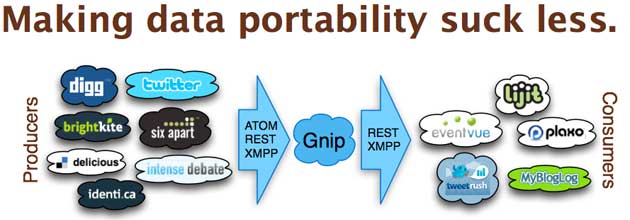
Gnip, the guys that are helping move data around from one social network to the next, launched v 2.0 of the service tonight.
The new version of the service allows data consumers (services like Plaxo that take data from other services, like Twitter, Friendfeed, Digg, Delicious, etc.) to have data from requested users pushed to them. It’s no longer “Hey, TechCrunch just tweeted. Go query the API to get the data.” Now it’s “TechCrunch just tweeted - here’s the data.” Data consumers are no longer required to build pollers for any of the publishers pushing data into Gnip, they just give Gnip an endpoint and they push the data to them in real time.
Data consumers can get complete public data streams for Twitter, Digg, Delicious, Six Apart and others without ever visiting those sites or accessing their individual APIs, subject only to the terms of service of those services. And this data can be gathered via a REST-based API or the newly launched XMPP support.
Gnip also added a number of filter options to allow data consumers the ability to create rules based queries based on tags, keywords, etc.
Gnip’s business model is freemium - lots of data for free and commercial data consumers pay when they go over certain thresholds (non commercial use is free). The model is based on the number of users and the number of filters tracked. Basically, any time a service is tracking more than 10,000 people and/or rules for a certain data provider, they’ll start paying at a rate of $0.01 per user or rule per month, with a maximum payment of $1,000 per month for each data provider tracked. For now billing is turned off and the service remains completely free. Thirty to sixty days from now, people will start to pay.


See all


Thanks for the tip.
funny how any company would take on a domain that is very geriatric.
To make matters worse, look at the logo.
Help wanted.
is it pronounced G-nip. or Ga’-nip, or nip?
MyLocator.com
It is not a consumer facing website, so no intuitive URL is required. Also, it is ‘ping’ spelled backwords.
Interesting… Notifixious is doing this kind of thing as well, but for the “end user” : you give the url of a website you like and we will notify you when something new is published there on your IM, Email or SMS and our XMPP API is coming very soon to be used outside!
That’s actually pretty sweet. Good Luck!!
Peter
http://www.thewebwar.com
At Plaxo, we’re big fans of Gnip at Plaxo. Go, team, go!
Is GNIP a common interface with push capability for multiple API’s? Since they are still sending data back to end users in REST there will need to be an integration phase which can be avoided by bypassing GNIP and just spending some time interacting with API’s directly (and write your own interface to them).
And content providers benefits is that everyone will move on to GNIP instead of polling them directly.. do they get cut of revenue GNIP is making? And if Digg (let’s say) having issues handling multiple requests why wouldn’t GNIP with Digg + Thousands of other content providers?
Can someone chime in? This does not make any sense to me.
Aleksey,
We are looking into revenue sharing with data providers.
Jud
Having read the documentation, this sounds pretty cool. I predict it will signal the death of rss feeds. Applications will essentially behave like live stock tickers rather than explicitly soliciting data feeds.
Gnip uses Atom feeds as part of the data input, and RSS and Atom are designed for very similar purposes. Is XMPP capable of carrying structured data in the same way as Atom or RSS? If so, then it’s possible that Gnip’s use of incoming Atom feeds will be merged into XMPP, if not then either Atom or RSS could stick around, simply as part of the server communication with Gnip.
this is really great idea by the way. thanks for posting this.
Big props to Boulder - some great technologies coming out of this little town!
I know this is totally gauche, but any developers interested in Boulder should post their resumes at http://boulder.me. Gnip and 19 other tech companies are flying out 100 developers all expenses paid to see the town, chat about some cool project and have some fun. Boulder’s pretty rad the last week of October.
Gnip is pretty much awesome. It honestly makes sense for both consumers and providers, which is a hard combination to get right. Rock on, dudes.
Well done GNIP. You rock!
“they just give Gnip an endpoint and they push the data to them in real time.”
This was so confusing my brain exploded.
Nitin — You, the data consumer, give Gnip a list of rules you care about on a given data publisher (people on Twitter, tags on delicious, etc) and an endpoint and then we, Gnip, push relevant data to your endpoint, in realtime, as we receive it from the data publisher.
How can the average person use the features of Gnip? If we are signed up for the services listed above, will they use Gnip automatically and if not then how can it be configured?
We’ve been using Gnip to power the status messages on retaggr for quite some time.
It’s a great service conceptually, and very well executed.
Out of interest has any company ever made a success of freemium?
Rapidshare and many image hosting sites have such a model, but I couldn’t tell you how that revenue compares with their revenue from banner ads.
gnip is awesome for those of us working on mash up like apps.
Crowdstatus is in the process of switching to gnip. It makes my life much easier.
very cool
http://gatesandjobs.blogspot.com/
gnip sounds promising for organic website traffic
Congrats Eric at team! it’s the next gen of RSS. I finally get the name too.
This company is going to be huge. So glad I got the chance to chat with Eric at TechCrunch August Capital this summer. He’s always one step ahead. By the time other people even begin realize how they’ve embedded themselves into the very framework of the entire social web, they’ll be a billion dollar company. They’re going to get as big as the social web itself. Bravo Eric. Big things for Gnip.
Even if I like Gnip’s concept a lot at this moment, I think it’s just a temporary solution of the real problem. It solves deficiencies of the vast majority of the data producers nowadays, yes, but if more implement XMPP PubSub, FriendFeed SUP and other similar technologies, there will be less incentives for data consumers to make their business rely on a single provider that supposedly aggregates and replicates all of the Web (i.e. too big to be true) and on top of it - charges them. Right now, only a few people know about Gnip and are using it, but once it become ultra popular and hammered by web & desktop apps, I think the relatively low $1,000 cap will be increased or even removed.
I think what we really need is a non-profit organization that promotes and eventually creates standards and open-source frameworks for our space. This is the real solution of the problem! If we can query Digg, Delicious, Flickr, etc., in a uniform way and get event notifications in a uniform way, then Gnip becomes irrelevant.
I can’t believe Gnip plans to offer a revenue sharing program! In general, it sounds great, but it is ridiculous that providers will monetizing their lack of decent APIs!
Nikolay — The day that all the web companies agree on a standard protocol and metadata markup, the Gnip team will gladly go get other jobs (ignoring all the value add word we are currently builind into the system) However, the trend is for standards to proliferate, not centralize. As a result, while I applaud your call for a single standard, I think the truth is that Gnip is a pragmatic solution to a permanent problem in computing.
Maybe it would be useful to promote Gnip server software and its APIs as an open source platform and standard, which can be implemented by any host? Then systems that use Gnip would benefit from a robust standard, and Gnip would increase its user base.
thanks for this subject
I want to ask Michael Arrington (Whom I always enjoy reading and hearing his opinion) if he still thinks web 2.0 is dead as he published in an article not too long ago?