VCs (And Startups) Won’t Be Immune To The Credit Crunch
by Erick Schonfeld on September 29, 2008

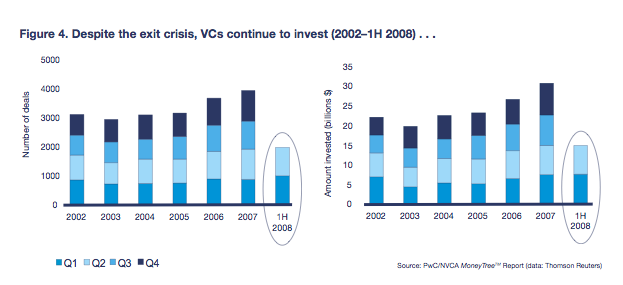
So far the downward spiral of credit and financial markets seems to have left venture capital firms and startups relatively unharmed. Even though the IPO market closed completely in the second quarter (and opened again only slightly in the third), venture capital firms continue to raise money and invest in startups at a healthy pace. During the first half of the year, venture capital firms raised about $16 billion in 141 funds and invested about $15 billion in nearly 2,000 deals.

But it is not clear how much of those funds already raised can be counted on. Generally, the investors in a venture fund (the limited partners) commit a certain amount of cash to each fund, but only pony up the cash when the VC fund needs it to make an investment. With wealthy individuals taking losses in the stock, credit, and real estate markets (the stock market is sharply down this morning, and even hedge funds are not safe), VC funds are already beginning to feel the trickle-down effects.

As investors suffer large losses elsewhere, they are not able to fulfill their commitments to the venture funds. This will hurt small funds first, which may already be scrounging for new limited partners to replace the money from existing investors who are beginning to come up empty-handed. Less money for VCs would mean less money for startups. Are any VCs or LPs out there seeing this trend? (Do tell in comments).

On top of that, the exit environment for existing startups is not looking any better. A new MoneyTree report by PricewaterhouseCoopers that is out today notes that both the number of IPOs and M&A exits for startups declined precipitously:

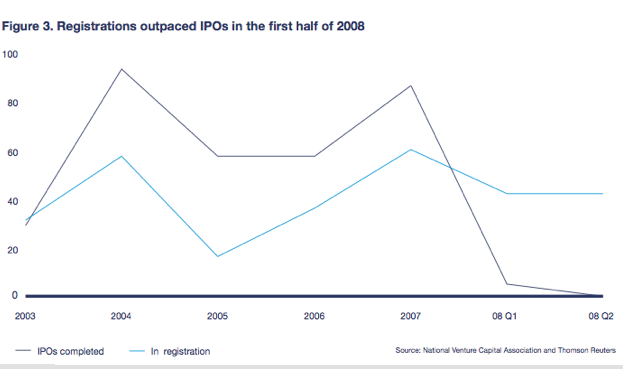
Resulting in the number of IPO registrations far exceeding the number of actual IPOs (in a healthy market it is usually the other way around):
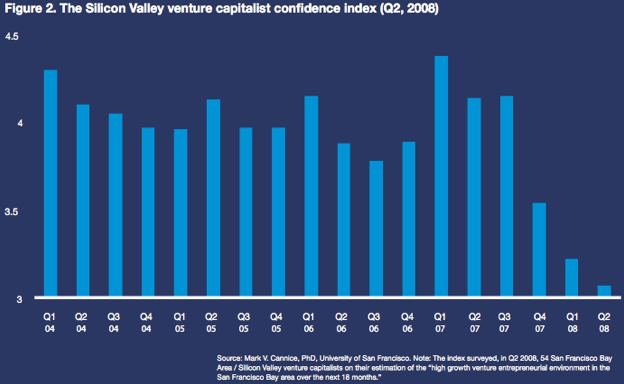
And, not surprisingly, Silicon Valley VC confidence is at the lowest point in seven years:
Responses

Comments rss icon

  • With this level of credit crunch I don’t believe anyone would be un-affected. I recommend even moving your money to multiple banks..

  • Let’s see: Investment banking doesn’t exist anymore. Wachovia, a huge player in the banking industry, is getting bought out. WaMu croaked. If you all think somehow we are flying on a magic carpet which excludes all tech related companies/startups, please keep smoking that good stuff.

  • Agreed, risk tolerance is decreasing. Everyone has to tighten their belts. Only really good proven ideas will get funding and people have to plan to generate revs a lot earlier than before. Business plans should be dynamic

  • Clearly the credit crunch affects the entire economy. Venture financing does not exist outside of this. The better deals will get done with less capital than before and the marginal deals won’t get done. Naturally, the deals built around a revenue model will be these “better deals”. The days of managing burn and funding burn through successive rounds, while an attempt is made to capture sufficient eyeballs to segue to ad revenue, is over. VC’s will want an actual business to invest in now. They’ll immediately strive to reduce the ratio of “big winners to dead-poolers” by half what it is now.

  • Any big swing in the economy favors someone over another. So who is the winner (if we can call it that) here?

    With less money on the table, small startups will have a chance to really work on their projects (assuming they can afford to do so) instead of racing to be first. Essentially, if you are small and can manage to squeak by financially you will see a huge drop off in incompetition. That would make you a winner.

    The other winner might be in-house innovation from the big guys. I would expect google, facebook, myspace, microsoft, and even yahoo, to try to fill the void left by credit starved independents with their own in-house work.

  • The first and last graphs are very, um, interestingly structured.

  • With the current economic downturns there is a severe lack of confidence and VC are no exception. Companies with proven tracks records are closing down overnight… VC will get more stringent and more diligent in the way the money is spread but I think the best of the companies will come out of it.

  • I think it is a good moment to increase efficiency in both:

    a) VC investment: trying to invest the really needed, too many start-up are over-funded. If the investment is lower, perhaps the results could be the same and more exit via merge or adquisition possible.

    b) VC shoul be linked to M&A activities, in order to increase the number of operations, even the average amount of $

    now times bring new ways to do, in my opinion, more profitable operations and not all or nothing bets.

  • Certainly second round financing has been affected, check out uber.com

  • Seems like this kind of post would be bolstered by some sentiment from the VC guys themselves. What are they seeing? What are they expecting to see? Would be helpful to your loyal readers.

  • When there is a recession not only VCs but almost every sector will be hit. With the current financial crisis circulating in an infinite loop, just waiting when will it drag down VCs and start-up…just a matter of time indeed.

  • The fundamentals of the economy are strong.

    • for now… but if you look @ what’s happen over the last decade, and by extension last quarter century, you’ll see that the economy shifted away from production to consumption. The American consumer has been spending, using debt borrowed from foreign savings.

      What’s alarming about this behaviour is that the Fire Industry (finance, insurance, real estate) distorted the market, because assets and economic growth were based on bubbles, and not actual productivity. So financial engineering was seen as more lucrative than physical engineering, and investments poured in. The consequence is this: for the last decade, capital and investments have flooded into unproductive parts of the economy (FIRE industry), thereby starving off the actual productive areas, leading to an inefficient market. The credit crunch has unmasked this problem. Now, even the remaining productive areas are choked for funding.

      The fundamentals were propped up by phantom productivity., they’ll fall preciptiously, soon.

      • Probably the best as well as the most succinct analysis of the Mess I have seen.
        Thanks.

      • I concur. This analysis is spot on!

      • This is the next scary thing:

        Interest rates need to go up to stop our Dollar debasement.

        … but people can’t even make mortgage payments with the low interest we have now. And credit card debt.

        If the government tried to keep this up artificially, it will crash.

      • “What’s alarming about this behaviour is that the Fire Industry (finance, insurance, real estate) distorted the market, because assets and economic growth were based on bubbles, and not actual productivity. So financial engineering was seen as more lucrative than physical engineering, and investments poured in. The consequence is this: for the last decade, capital and investments have flooded into unproductive parts of the economy (FIRE industry), thereby starving off the actual productive areas, leading to an inefficient market. ”

        Isn’t this why it’s a good idea to transfer assets to the productive markets? Despite the credit crisis online advertising is still going to go through the roof, is it not?

  • Fully agree. The liquidity crisis should trickle down to VCs fundraising and hence VCs should be much more cautious in their investments. In addition, unlike in 2001, US VCs can rely on a relatively small USD ~7bn “treasury coffer” (i.e., cumulated fundraising minus cumulated investments over 10 years) that represents roughly 1 quarter of investments. For more details, I wrote a post on that yesterday: http://tinyurl.com/488uh6

  • I know of two small amounts going to 2 start-ups that has been a ‘check is in the mail’ situation going on weeks now….

  • what, if anything, is surprising about this? vc’s can’t move to the capital markets, so they won’t pass hurlde 1 - and then they can’t really consider a merger or sale of assets since nobody is well capitalized enough to return what they want or need (with a few exceptions, namely large tech cash reserves at apple, google, msft, etc), that’s hurdle 2 (failed) -and lastly, the opportunity for ‘further financing’ is gone, because there’s no path back to hurdle 1 or 2 in sight…a vicious cycle…makes investing in companies like seesmic look rather silly now, doesn’t it?

  • I agree directionally that a complete financial meltdown hurts everyone. In particular, it will hurt overfunded web companies that don’t have an actual business model. But I disagree with the magnitude of the conclusion in the above article, insofar as while the credit crunch will cause an economic contraction, and that effects everyone, this is a very different time than 2001. The bubble burst after the 90s was centered on technology and tech companies, hence the ensuing “nuclear winter”. This credit crisis is of much greater overall severity, but the technology industry is on the periphery this time.

    We think companies (and venture firms) who have been successful will continue to be, by and large, even against the backdrop of all of this. But definitely agree that those companies that were funded largely by froth are going to have a rough time.

    We’ve written about elements of this dynamic: http://bit.ly/1BxWmw, http://bit.ly/4hTXVd and http://bit.ly/1qT91j.

    • I agree with my friend Eric… The bar should have always been high for companies to get venture funding. In times like these, companies funded with questionable business models with meaningless web 2 ish metrics will likely not make it through this down turn.

      It’s hard to deny the bottom is coming out of the economy and there will be carnage on all sides. It is severe and will be a category crippler in most other sectors. In terms of venture, I believe we will see a contraction in both less than stellar companies as well as their counterpart less than stellar investors.

      That said, the US economy is based on innovation and the engine behind that is a successful partnership between startups and funding sources. I am hopeful, optimistic, and like Eric, active in keeping that engine alive.

  • vc’s will want to invest in something “tangible” not just a single channel crumby domain name website or widget application. A 1200+natural language domain empire has day one startup value. a natural language location based digital-ecoshpere presence that will never change. Forever Pillars of online and mobile natural language location. Valuation? Priceless.

    StartupLocator.com

  • something about who you are:

    http://neoviky.blogspot.com/20.....e-you.html

    …….and the most disruptive idea in the world…that can take on Microsoft and Google….

    http://neoviky.blogspot.com/2008/09/inet.html

  • What the fuck are you talking about? They printed $1,000,000,000,000 last week alone:

    http://www.247wallst.com/2008/.....188-b.html

    This is a credit expansion not a credit crunch. It’s only a credit crunch for anyone who isn’t a Federal Reserve member.

    • @Nonsense

      No, they didn’t print $1T last week. Watch M3 if you want to know if the Fed is inflating. They are not; GDP doesn’t support it at this time. They -must- deflate (”deleverage”) a good chunk of the last 20 yrs of credit expansion. Remember the Fed is a private organization (i.e., not an arm of the Gov’t as most think); they are in this for profit, and profit they will, by whipsawing avg American’s back and forth with credit inflation and deflation.

      • What the fuck are you talking about? The fed created $188 billion dollars in new loans every day last week. 5*188,000,000,000 equals what? Oh that’s right. 1 Trillion dollars. So they created a trillion dollars didn’t they?

        By the way, your suggestion that “Watch M3 if you want to know if the Fed is inflating.” shows that you don’t have a clue. They stopped publishing the M3 some time ago, as a preparation for everything they are doing now.

        http://en.wikinews.org/wiki/US.....h_M3_index

        This is a total blowout of the American economy, but no one is going to notice it until the smoke clears.

      • They stopped publishing M3 earlier this year, and a variety of extremely accurate public market reproductions have been available for sometime, eg

        http://www.nowandfutures.com/key_stats.html

        Don’t get me wrong; I absolutely agree that the Fed -will- inflate again. But that’s not what’s happening now.

      • Sure there are is a lot of speculation on what the M3 is but only the bankers know for sure, and they aren’t telling. Heres another one:

        http://www.shadowstats.com/alt.....ney-supply

        Credit is tight, but only for everyone who isn’t a major financial institution. This is a fire sale. They are driving the economy into the ground so they can take it over. The discount rate is still at record lows meanwhile, it is impossible to get a loan. They are printing money, hyper-inflating the economy and then denying credit to everyone, making it impossible for companies and individuals to get out of this hole.

      • Forgot to add, according to most calculations, the M3 has increased 50% in the last two years, so how can you not call that inflationary?

      • @Nonsense

        A couple of thoughts for ya (FWIW)

        - I’m not aware of a single gov’t that has attempted to use hyperinflation (high inflation) on a highly leveraged economy (Debt/GDP > 200%) for the past few thousand years. Closest might be Weimar (Germany, 1920s), but that was <200%, externally denominated, and forced on Germany as a result of WWI. Not a sound approach.

        - There are a couple of reasons for the point above. One is that the USG, despite being fortunate to be the reserve currency for the world (thank goodness), is deeply concerned about its borrowing/funding cost. Remember in the 70s that we had interest at ~20% of fed budgets vs ~10% today. No one wants a return to the 70s

        - Rules are set by creditors, not debtors. Creditors want to milk every bit of productive wealth (ie labor) they can

        Once enough leverage has been taken out of the system (defaults, voluntary workouts, some repayment, transfer to USG, etc), the Fed will start inflating.

        Given the status (ie lack of “true” data) of M3, another way of watching this is to look at compund annual growth rate of the narrow money supply (ie M0) [and yes, I know that some think you can't tell about a central banks intent wrt inflation by watching a country's M0]; if you see it in the 6-7% range (or greater, obviously) for 6+ months, you can be assured they are inflating (vs the typical 1-2% CAGE in a non-inflationary environment). If you look at the St Louis series…

        http://research.stlouisfed.org...../page3.pdf

        … you’ll see only one month of data that supports this view.

        Again, I absolutely agree that we will see some price inflation near term. But it will be quite small compared to the massive deflation/deleveraging of assets. Now once THAT’S done, as above, the Fed will inflate again. $0.02, FWIW.

  • Look for dot-bomb style combinations (mergers, amalgamations, acquisitions) of struggling Web 2.0 companies.

    It will delay death of non-biz model companies and lead to plenty of layoffs. That AdSense “cool app” model is looking so good anymore.

    The TC Deadpool is going to be busy.

    Regards,
    George

  • As the others have all stated, there was no way that tech companies would not be affected by this crisis. I also foresee a lot of mergers, bankruptcies and acquisitions.

  • I foresee a lot of these “widgets” and “apps” and “features”, which passed for actual companies over the last few years, jumping into the deadpool…

  • It is easy to be negative in this environment, and the graph int his article is confusing. Venture investments have remained strong DESPITE terrible market conditions because these investments have (1) comparatively lower risk than they once did and (2) longer time horizons to generate returns. These are good attributes in this market climate.

    See more:

    http://afp.google.com/article/.....QhVTBXbqmA

    • Lot of truth in your comment. Some of the best investments from a VC standpoint were made in market downturns or troughs. Valuations are the cheapest then and good talent is plentiful. Game on for the real entrepreneurs!

  • Financial Services start-ups are in a bad way. I don’t think people realize just how many smaller companies were dependent these investment banks for their revenue.

    Having been a part of that space for several years, I can assure you the domino effect is just beginning.

  • i think VCs are isolated, unless they are fundraising. My understanding is that once the LP has committed, if they don’t come up with the cash when the VC calls for it - they lose all prior investments. That would suggest that most LPs make sure they have the cash. If they are making a decision on meeting their VC commitment or a new investment in something else which results in wiping out the prior VC investment then it would seem a pretty simple decision. With that mind, it would seem like a good situation for VCs.

  • and the surprise is where…?

  • I think some of the VC money will dry up. I don’t see VCs funding niche ideas or competitors to existing ideas (other social network, twitter competitor etc). I do think there will always be a market for new ideas and the pool of money will be there.

    Taking this futher, if you believe the Obama hype and him creating a “green economy” that is the answer to “America producing something”. We still have the advantage in science/high-end engineering. This is where we can have a “Green Deal” if you will and have a combination of private companies with government incentives create a ton of opportunity for investment.

    It cannot be like the last 2 decades where we lose mfg jobs and the only thing we “made” was wooden houses.

  • Wall Street professionals are paid “good” if they give 10% portfolio returns to their clients. VCs with good track record give way better returns than simple 10%, think Google, Akamai, YouTube et. al.
    All biggies should collaborate and have fund that allows small companies to make it big. It need not be in finance, take a look at the businesses run by people who own gas-stations and motels, they have transformed the business in its entirety.
    Small amounts of capital invested in “people” and not “businesses” always yields enormous returns. There is ample opportunity to make it big in every turmoil, either by short-selling or by investing low amounts in people who can make it big..

  • I think this financial crisis is only going to get worst. How many of these black Mondays are we going to have till we realize that the market has to rest back to when the market was stable and work its way up. Im no economist but i see a very obvious trend with the market. If this bail out doesn’t improve the market dramatically by the end of the week we will be expecting a drop below 10000.

  • I think in the last quarter of 2007 we started to see VC money drying up and/or the fists holding onto the money significantly tighten. I would think that venture capitalists, sophisticated investors and local angels are all watching the market and would prefer to keep their cash under their mattresses or overseas to ride out the storm.

    Although, as we saw last week from one of the most successful investors of our time, Warren Buffet seized the opportunity to capitalize (or exploit) underpriced assets.

    There is plenty of money still out there, but I believe the folks with the money have significantly more strength and power than the folks wanting or needing the money.

  • As someone who started a company in 2001 in the worst sector of them all, telecom I can tell you that this is the best time to start a company.
    Only those companies that have a “solid” idea defined by revenue within 12 months will get funding. There’s a crap load of money out there to invest. Companies with management teams that started and built companies during 2001 will be getting funding much easier.
    This is the time to invest so you build a solid foundation for the expansion stage of the economy!

  • Interestingly, I’m waiting to see how long it takes for this trickle effect to reach Canada as we remain unaffected so far, but we’re so economically tied to the US, it’s bound to reach us sooner or later.

  • It will depend on the length of the crisis. VCs have the advantage of not being effected by day-to-day swings as much as others, and also have a built-in incentive to invest (if they don’t, they don’t make $$$). However, fear will affect all investors so if the crisis lasts and the markets don’t regain confidence, it likely will become 2002/2003 again and VCs simply will stop investing for (with hindsight, always ungrounded) fear of not knowing any valid place to deploy capital.

  • The same is happening in Europe, the whole IPO market and Seed, Growth finance market is like shut down. Bad times coming up or already there

  • uber.com … See the effect !!!

  • Hope our economy picks up soon!

  • the ONLY thing this fear and panic on these posts does is create more pageviews and stupid comments like this one for TC. After all if they are true to their predictions, TC should disappear (after all who are they going to cover if 85% of startups go belly up)?

    in reality early stage startups are in good shape. they need less money and can go to angels. the bar is higher as well for new entrants so the funny business model ones will never get to the fundraising stage.

    so yes we are isolated and this is a great time to start one. at least some of the high horse employees can realize programming in PHP (ruby on rails guys are worse) doesnt mean you get a bentley just for showing up to a gig.

    remember that brands like Google and Apple were started in the worst times.

    • Google did not start in “worst” times. It started in very good times, i.e., 1998. It did manage to grow rapidly through the “worst” times, i.e., 2000-02.

  • Banks aren’t taking on anymore risk. End of story.

  • With the US economy sinking under the credit crisis, it is difficult to sustain the Web 2.0 Bubble. I wrote recently about Web 2.0 Bubble when it was reported that many internet companies were doing the same thing. How many social networking sites, mobile location sites, etc. do we need? The bubble burst wave is coming. Stay tuned……….

    • @ web 2.0 bubble: As to your point on how may social networking site, etc we need: don’t forget that web 2.0 is just another media format just like TV or print is. So we can have numerous similar web 2.0 sites… unless you infer that we should have only 2-3 TV channels?
      I’m not saying however that all web 2.0 products will survive but that’s the natural cycle of innovation.

  • TechCrunch after the CreditCrunch? http://bit.ly/2KYKVW
    Doom or innovation drive?

  • I believe there will be better startups during times like these. Nothing like struggle to be more efficient, frugal, and an assertion that the idea startups pursue will in fact, help the world. With more time, and more powerful web frameworks, it is possible to implement such ideas and see the proof of it’s necessity with just 1 or 2 ambitious people.

  • Registrations don’t tell you anything. Registering is a favorite way for the investment bankers to try to get private purchasers to feel pressure to act and buy at a high price. Most of those registered had no real prospect of IPO’ing.

    What the lack of exit opportunities will do is drive down valuations and reduce activity on new deals. If the exit is going to take longer, cost more cash and be at a lower price, the VC has to have a valuation on a round that can generate a decent return in the expect time-frame. if the time-frame is longer, valuation has to go down. If more cash is needed because time-frame is longer, valuation has to go down. If final exit expectations are lower, valuation has to go down. If you need to put more money into your existing investments, you can make fewer new investments.

    The big purchasers with cash or liquid stock know all of this. They are going to come in with lower valuations and play hardball on price, terms, hold back, earn outs and the like. Going for money today is like going for money in 2001. it will be tough because we won’t see the exit opportunities looking good for 18-28 months.

  • Start sending in your lessons learned, steps for bouncing back and deadpool rumors…2.0 style.

  • I think Sarbanes Oxley also has impacted the number of IPO’s. With the number of regulations and costs associated with compliance has deterred others from entering the SEC world. I have no data other then talking to other technology CEO’s who caution S-O.

  • Did not the LP’s throw more money at VCs after other investment options such as real-estate in their alternative investment portfolios tanked? Wouldn’t this mean that VCs that raised funds recently (and typically would have a 5-year investment horizon) be ok at least in the short term? I’m just wondering if the central argument that ‘capital drawdown commitments will be dishonored’, is a little tenuous? Aren’t these binding contracts?
    Sure, this is a bad time to be anywhere in financial services, but if the PE guys salivating over under-priced assets can be smug because of all the ginormous funds they raised recently (though the LBO rocket-fuel, i.e. cheap debt is poof gone), shouldn’t the VC industry be actaully a bit better off, at least in comparison?
    What am I missing?

  • Pang Wang Yang- Jerry's gone away - September 29th, 2008 at 10:13 pm PDT

    Hank,
    Can we just call it “the web” for fuck sake. It doesn’t need a version number, you sheep.
    Couldn’t agree with you more! Too many ‘tuggers’ in this industry. But then, if they didn’t have their hands firmly down their pants they’d probably be more productive and be inventing more useful functions rather most of the pathetic window candy around at the moment!

  • With Web 2.0 companies that have no clearly defined monetisation strategies, the road ahead may prove to be a lot more difficult. The size and reach of the financial crisis will dictate that even web-based companies must revert to the old school model of defining revenue streams upfront. Old school phrases such as “economically viable” and “commercially feasible” (remember them?) will come into vogue again - regardless of how “viral” a website may be or its level of “ambient intimacy”.

  • there will be some effect, but I don’t see a repeat of a 2001-style nuclear winter for startup fundraising. back then, even the best VC funds had big chunks of their portfolios caught up in the irrational dotcom exuberance - so that in 2001 no investors had time for anything but triage.

    things are so different this time….

    1) there are dogs out there, but its not like the overhang of the dot-bomb era

    2) with equities and bonds doing nothing, there will still be a substantial number of dollars looking for better returns - even if they have to be held for a longer term (like in a venture fund). This may be a force keeping money flowing into new venture funds.

    3) in a down economy, it’s a lot easier to build return on an early investment in a business that needs to gain $10M in new revenue to show 100% year on year growth, versus an established public company that has to find $200 million in “new IT spending” (for example) to show 10% growth. this gives emerging markets and innovative startups a huge advantage in these times.

    4) hard to remember sometimes now what 2000-2001 was like, but the ad model had not remotely come alive yet. and now, thanks to Google and a few others, its more like a pumping cardiovascular system that can be tapped into all around the web for any well-profiled audience.

Leave Comment

Commenting Options

Enter your personal information to the left, or sign in with your Facebook account by clicking the button below.

Alternatively, you can create an avatar that will appear whenever you leave a comment on a Gravatar-enabled blog.

Trackback URL
bugbug
The CrunchBoard
  • MediaTemple Logo
  • QuickSprout Logo
  • OpenX Logo
  • Cotendo Logo