In a recently published patent, Google describes a vision for an open wireless world, one in which mobile devices (and smartphones in particular) are no longer married to particular cellular service providers.
When you buy a phone in the United States today, you typical have to sign a contract that prevents you from using that phone with more than one provider for a predetermined amount of time. You’ll encounter no such requirement when purchasing a laptop, which can be used to connect to the internet through any service provider at any time.
The Google patent for “Flexible Communication Systems and Methods” contends that cellphone users should also have the freedom to connect through various networks and methods, and that the communication service they choose at any particular time and location should be determined by competitive market forces.
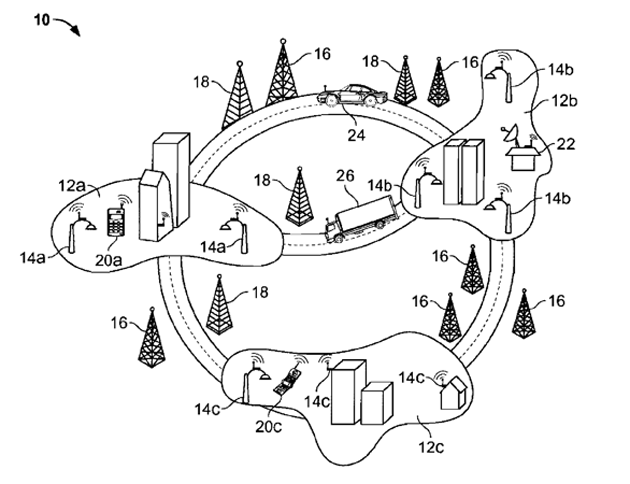
The idea is that you could, for example, make phone calls and browse the internet on your smartphone via WiFi when at home, Verizon when downtown, and perhaps AT&T when out in the countryside. You’d base your decision on both pricing and quality of service, with the quality of coverage in your current location playing a major role.
In a way, the iPhone has already given us a taste of what this would be like. When near a WiFi hotspot, you can decide on the fly whether to surf the internet using 3G/EDGE or WiFi. Most people choose WiFi because it’s faster (and probably free, unless you’re at an airport or cafe). But you may go with 3G/EDGE instead because it’s more secure (no worrying about the traffic sniffing that occurs on open WiFi networks). With VoIP applications now available for the iPhone, you can make this decision for your phone calls as well.
Now imagine that this choice was available when on-the-go, and that you had five service providers to choose from instead of just two. It’s not hard to imagine that the competition would lead to lower costs and better service. Not to mention, you wouldn’t get stuck with a crummy carrier after moving or traveling to a place that has poor coverage.
As Unwired View emphasizes, and the patent outlines explicitly, such a system would require “a transparent auction marketplace with wireless providers bidding in real time to provide the communication services to users.” Google may be well-suited to establish such a marketplace because of its experience with AdWords and AdSense. The carriers themselves would resist such a scenario with tooth and nail because they’d become dumb pipe providers that couldn’t lock users into contracts any longer.
The patent is part of Google’s broader agenda to get as many people online as possible with as many devices as possible. Hence the gPhone, its pressure on the FCC, and Larry Page’s bristling in support of open white spaces. The opening of white spaces in particular could lead to more connection points for mobile devices, ones that form an attractive alternative to those provided by wireless carriers. And Android-powered phones could be among the first to take advantage of a flexible connections system.


Neat stuff.
so goog wants a patent for “adsense for cellular.” carriers will do everything in there power to stop this from ever happening. maybe in 5-10 years after they buy att.
This Diagram looks strangely familiar. Watch the vator.tv video.
http://professi...ofile/mylocator
The diagrams are nothing alike. They are talking about wireless access, you are talking about “search”.
FYI, what you are doing in the comments is called “thread jacking”, where you reply to the first comment with another comment that is in no way related to the first.
@Analled-im sorry you dont see a correalation.
Mobile+MyLocation= G (1 locator channel)
Mobile+MyLocator= Me (1200 locator channels)
“who knew adding location to search was the key for mobile”
http://www.yout...h?v=KMT7Deky9iY
MyLocator.com is deep into anything regarding mobile and truly having the capacity and potential to compete or beat G at anything it does.
when you have any relevant substance, share it with the community and a link to your site. guys like you that hide and babble before you or wtf your talking about.
when your ready to come out of the closet take it to seesmic. you guys are like a “Comment Crank Call”. what your doing is called “piece mealing.”
like i said none of the phone companies are gonna allow googleoogle adsense to set there prices. Appears G is gonna have to buy some cell towers.
@mylocator.ning.com- Please give it a rest. You don’t compete with google and you sure as shit won’t beat google, at anything. You are on a ning network and own lots of domains. Good job.
I don’t believe many of us would have a problem if you were to comment inline normally, reserving ‘reply’ when it is actually appropriate. On top of that, you do not need to continually self-promote and turn the conversation into something about you.
@CrustyP- Closet Case #2-http://seesmic.com/video/QTr4Qavbu5
everything was fine and settled till your closet case sidebustin’ azz came in.
Read a 3rd Party Critique
http://www.kill...locator-network
when you want to share your lifes work or have a comment of substance share it with the community and add a link to the site. take it to seesmic clowns. one click to your right. put your lips where your comments are. Share who you really are, your internet presence and experience and then maybe we can take you seriously.
YouLocator.com- Be Yourself!
A wiseman once said you cant teach a Jackass new tricks.
is this free for the other people?
“when purchasing a laptop, which can be used to connect to the internet through any service provider at any time.”
That is correct only for WiFi. Any laptop user that has a mobile cellular card is tied to a specific carrier such as Verizon/ATT/etc . WiMax is not here so its moot.
“With VoIP applications now available for the iPhone, you can make this decision for your phone calls as well.”
Are these officially available from the App Store or just used on jailbroken phones?
Lets get the facts straight….
“when purchasing a laptop, which can be used to connect to the internet through any service provider at any time.”
I think what the author was saying here is that when you buy a personal computer in general, laptop or desktop, you aren’t tied to a specific ISP for internet service. However when you buy a phone they are quite often locked to the provider so even after the contract is up you wouldn’t be able to take the phone else where.
Yep, they’re available from the App Store. Can only use them over WiFi, though.
yeah but lets be honest. you could set that up on any wm6 phone and possibly a blackberry.
unfortunately they are iphone biased users. I am typically neutral and think that iphones, wm6, blackberrys, and android are all cool pieces of technology each having their own strength. however I like to point out when people make biased comments so others are aware
Any particular one you use Mark?
Sounds like a good idea to me. I hate being tied to my cell phone carrier.
“Are these officially available from the App Store or just used on jailbroken phones?”
Truphone is available officially from the iTunes Store (http://www.trup...one.com/iphone/). Straight enough fact?
-Erik
Erik,
Actually, your wrong. From the truphone website:
“If you’re connected to a Wi-Fi network and want to make a low-cost call over the internet, simply open the Truphone application and call as normal.”
VoIP over WiFi is not the same as VoIP over 3G. When your on WiFi, theres no data usage on the carriers behalf. That is a primary reason it is not allowed. Might want to read their website before posting your pseudo facts.
notAuser
I think this is a phenomenal idea. I hate how the cell phone providers lock you into using only their devices. My service is provided by T-Mobile and I bought an unlocked phone not sold in the United States off Ebay. I needed a new SIM card, and the T-Mobile rep on the phone was about to send me a new one until she found out I did not have a “T-Mobile phone.” I think an open wireless world of phone usage would foster the cell phone providers to up their game, so to speak. There would be a greater emphasis on service, which could result in its continual improvement.
i have just gone into the store before with a cheap $20 phone and said that i needed a new sim card and they gave it to me for free.
great vision. most phones have this capability now – wifi, 3g/edge, and 2.5g, etc. most phones can support VOIP mobile telephony. all that the mobile operators have to do is to allow for “seamless price” roaming. but would they? I can therefore see what Google is doing – grabbing those “white spaces” to encourage the entry of “mom and pop” operators if not Google itself. then there is the issue of the “mobile” currency. who bills? (true Google can push for ad supported calling, texting and mobile surfing.) but that will not be enough. what if the mobile subscriber wishes to buy “content” for her phone like a ringtone? what if she wants to buy “songs” and “tunes” from a virtual music store like iTunes? what if she wants to send money to relatives and friends or share airtime credits. Someone must own the currency. Here i can see the likes of Google Checkout, eBay’s Paypal, and maybe some other “third force” that will proactively promote a “prepaid” mobile currency. this all sounds great. i can sense so much entrepreneurial activity happening in this space sooner rather than later.
It would also be nice if Google dropped a massive wireless mesh network on the Bay Area … and gave every resident free IPTV, free Internet, AND free phone service. Then i could sever ties w/ the a-holes at AT&T and DirecTV. While they’re at it, Google should figure out free power over wireless network so I don’t have to pay PGE anymore. And make sure this ‘everything free over wireless’ network doesn’t have any downtime, b/c that would piss me off.
How many ads are you will to see for all of the free service?
Willing to see an ad when you plug in your hair dryer? What if Google sees that you haven’t seen enough ads this week and your house goes brown until you log some ad time on the Net or your TV?
No doubt, was trying to poke fun. Nothing is free. Always a price to pay. I’d rather pay richly for my Verizon wireless account and be nailed to the wall with the contract than make a single call where some stupid voice ad or text ad confronts me. Some things do not parlay well into advertising. For me, my cell phone is one of them.
Verizon costs me $200 per month but I’d rather pay that than see or hear google ads. I hate google ads. Every web site that displays such looks ridiculous.
Sounds a lot like William Gibson’s latest novel, Spook Country.
I think this is going to be a really tough nut for Google to crack. I think Android is a good step in the right direction toward providing some openness with devices. However, I think Google is going to face considerable opposition from wireless carriers (as they did with the FCC auction).
Is there not a mobile Skype phone that has no network but runs only if there’s an available wi-fi signal? Because this needs to happen. eBay, are you listening?
nothing new here… everyone has been proposing this for years
proposing is different that action. google is finally trying to act, especially with android
This is an inevitable outcome to the closed, Cold War like situation we have now between the carriers. One day soon I would like to see my mobile phone chirp, letting me know I have entered a region with multiple providers and let it show me the rates.
Prices would come down, offerings would come up and we might even see wireless COOPs spring forth. Community owned wireless providers based around the neighborhood or borough where you live.
The closest you can get is to buy whatever phone you want unlocked (from the internet) and then use T-Mobile to go, i.e. minutes you can buy from ebay for less than retail. If you buy 1000 minutes (normally under $100) those minutes last for one year and can be rolled over by buying any amount of additional minutes prior to the year expiring.
No contract and you only pay for the minutes you use.
If somebody read the patent, I need to ask: how can they handle switching between operators in the same call? that depends on carriers and it’s not easy.
Well. I read the patent. Actually I wrote an original article in the source.
And Google does not give any concrete way of how to do switching from network to network.
All that they say is that it’s being done today with UMA.
And tomorrow (maybe 5 to 10 years down the road) it might become as easy as switching between wireless towers today
this is why we love google {seesmic_video:{”url_thumbnail”:{”value”:”http://t.seesmic.com/thumbnail/BI7uEI2Szz_th1.jpg”}”title”:{”value”:”this is why we love google ”}”videoUri”:{”value”:”http://www.seesmic.com/video/LbmNTaxajn”}}}
they had the opportunity to buy the 700 spectrum at auction recently and did not buy it. i think verizon got it.
google does not want to help people who really need it. the starving, homeless and malnourished.
Wealth Squatters-http://www.techcrunch.com/2008/09/25/youtube-fights-global-poverty-with-in-my-name/#comments
i dont love google.
Google is not UNO. It’s a company. Stop wanting it to “help” people. (what does this mean anyway…)
They didn’t buy the 700 spectrum because they never wanted to. They just made the auction rise upon the minimum amount that would force the buyer to open the network.
Hi Oliva,
Hopefully i can open a few eyes about the “reality” of gaggl and to have people consider who they say they “Love”, before they say it.
Gaggl does not have have soul, nor does it care about people on a humanity level. They are billionaires running a “awareness” campaign about poverty. Its like Microsoft running a campaign about poverty saying “look at all the poor people, poor things”. Its disgraceful when you think about it.
Billionaires that care about poor people “GIVE”. We dont need to look at poverty, we need to attack it with the only thing that will cure it, “MONEY” and a “sincere committment” to end it.
Billionaires need to put there Money where the Mouth is.
Wealth Squating AKA Greed, is the root cause for all poverty and problems in the world.
I believe billionaires have a “moral” obligation to help those who are in need.
HomelessLocator.com
“google does not want to help people who really need it. the starving, homeless and malnourished.”
Are you for real???
Clint Boulton, of Google Watch, on his “Did Google Sabotage Ringside Networks?” tried to convince people that Google is a philanthropic-seeming social software player.
Google is A COMPANY… (an amazing in my opinion)
http://the-anti...s-sabotage.html
GO GOOGLE {seesmic_video:{”url_thumbnail”:{”value”:”http://t.seesmic.com/thumbnail/T0SSgqX6Co_th1.jpg”}”title”:{”value”:”GO GOOGLE ”}”videoUri”:{”value”:”http://www.seesmic.com/video/scbZDBaaof”}}}
This kind of technology is already there in many countries including china and India. I fail to understand how it is a “patentable”. Also as somebody indicated that free access means ads, it doesn’t, it only means that market forces determine your price.
Today even if I purchase the “device” separately or even when it is paid off after 2 years of contract, I get no price break. This doesn’t happen in China and India.
Well, this technology does NOT exist in China, if you are referring to the roaming between different cities within China, it’s not free OP switching
well if other countries have it then it is a patent through the U.S. Patent Office not the China Patent Office (I dont know if they have that there because of the communism but you get the point)
The concept is pretty interesting. Questions to be put on the table:
1) SIM card producers are ready?
2) Do end-users like choices each time when they need to connect to OP network?
3) All the deals signed between operators for international roaming shall all be trashed
4) a huge technical challenge to allow users to connect in one minute, switch to another OP, and reconnect again …
“SIM card producers are ready?”
No, they are not…. Yet
“Do end-users like choices each time when they need to connect to OP network?”
No. But they don’t have to. They (if they want to) can change the settings in the phone. Or go with defaults provided by Google or their operator.
“All the deals signed between operators foar internatisonal roaming shall all be trasehed”
Not necessarily, especially if Google creates it’s own MVNO or something like it and gets in the middle
“a huge technical challenge to allow users to connect in one minute, switch to another OP, and reconnect again …”
Yep. But that’s why we’ve got Moore’s and Metcalfe’s law, and common business sense on our side
The commerical lock-down seems to be unique to the USA (and Canada?). Europe and Asia the commercial contract is most commonly separated from the handset purchase (although bundling is an option).
If you roam with a GSM phone internationally, your handset will connect to different networks (selected from the ones which have a roaming agreement with your home network provider).
So not sure what the patentable part is – other than the desirable user ability to determine the policies for connecting to the network you want (based upon various parameters I suppose). This technology (least cost routing) has been around in the fixed line world for ages so it shouldn’t be too hard to replicate for mobile.
The idea is pretty interesting. But it’s inevitable that Google will face opposition from many sides. Still, it would be interesting to get a glimpse of what the world would be like if this were implemented.
Its about time somebody patented freedom.
Being able to switch from one carrier to another and then to wifi or home internet will really put downward pressure on per minute charges.
Next we need to be able to legally sell or home connectivity to others.
The biggest reason the wireless carriers hate this is that no matter what happens 2 of the big 4 will loose big time. Wireless in the US runs off of two different, competing standards: CDMA (Sprint/Verizon) and GSM (AT&T/T-Mobile). If we move to one standard, then someone will loose big. Europe (if I remember right) runs on essentially one standard (GSM) which would make this sort of deal easy to work out.
There is a lot at stake if this goes through.
Webmob-ad, is a new start-up that just came out . It is a pioneer in the automation of mobile and web advertsing by creating the only self serve and fully automated marketplace for CPC and CPM advertising . It supports all types text ads, banners and video ads.For publishers , it offers the highest split of earnings you can find out there and much more. It caters to web and mobile Publishers and Advertisers . Web and Mobile Publishers can earn money easier than ever and registering is FREE. Please check it out : http://www.webmob-ad.com. We would like to hear your comments , please drop us a line .
Google will focus on the loocation based advertising stuff like the Sykai camera before they move into this. I think this is the 10 year plan to own the telecom industry.
Only in America
I think there is quite a bit to be worked out here yet:
1) how will the user accept or reject the cost of the next network on the fly?
2) what incentive will networks have to maintain their towers etc once this happens in remote locations?
google is starting to rub too many people the wrong way. their days as an admired company (like their stock price) peaked some time ago.
Here are my thoughts:
1) User will set up a default to look for the cheapest network, but set a maximum per minute price. the phone will ask if you want to use a network that is more than your threshhold
2) I think there will be greater incentive to maintain remote towers. Imagine using your phone as your GPS with location aware search available all the time. not many people using this now, but when it starts becoming mainstream (along with currently unthought of uses) the tower that is working will get the revenue.
I love what Google is doing, but can’t agree more that they have made their fair share of enemies along the way.
a wise man once told me not to mess with phone company money
you can screw over anyone but phone company
there could be nothing worse that getting you phone cut off.
Wow… what a good idea. So you can use Wifi for telephone calls basically…
If you step back just a tad… and if you follow the comment thread and where it went, then I think this patent explains why Google built their own phone and phone software.
Love it!!! Even if it would put me out of business.
I don’t think google would take a “enemy creation” kind of stance as we are reading the content of patent today. .. My reading is that over next few years, google will try to establish an operator market of its own for cell telephoney. And they will do it competitively against any other service provider. Their strategy seems to offer an open-source G-Phone along with an open-ended accessibility to any service provider instead of contractual-locking of users … and it seems a fair idea if a company decides to work on such a strategy.
It may upset the existing industry practices, but then that’s the game
Happens in the fixed line business already, why not in mobile?
IN the fixed line business – when routing calls internationally (for example) the carrier (YOUR CARRIER) will select a route on the fly, based on cost and quality. Telcos are quite familiar with this structure and it pays for the upkeep of their equipment.
there is no reason why this can’t happen in mobile, the only obstacle is that there needs to be a company that manages the auction (Google?) and manages the billing (Google too?) and one that provides the correct SIM (Google again?).
Lets face it – if you can 1) keep your number 2) have 30% lower bills then who in their right mind wouldn’t use this system?
OK, when i travel abroad, my cell phone selects a carrier. So for example, when i’m in India, i get Airtel the one time, and Hutch or Vodafone the other. So how is this different?
google.com covers more each day…
Nice start for a mission, maybe. But has the google boardroom thought a step beyond this. What if a user likes a Nokia phone but with Windows mobile on it; a Motorola with Symbian on it. I know there are roundabouts to do this; but unless we don’t give users the flexibility we will have businesses complain about illegality. That’s a truly free world.
For more comments/views on this topic visit http://ddas4.blogspot.com
When the prices for unlimited mobile and data access are in the neighborhood of $99/mo and declining, as a power user I am unlikely to want to make choices every time I want to make a call. Perhaps the software can do this for the user automatically, but for a certain segment of the user population, arguably both at the low end or the high end where the volumes and dollars are – this is unlikely to change user behavior.
It could be interesting in global roaming environments, where the billing is metered and the costs atrocious.
I would love such an open mobile environment. I can’t wait to get rid of the chain and shackles of today’s wireless providers!
While an interesting idea it could have many unintended consequences like:
a) more expensive devices for consumers – as carriers cannot recover the full cost of handsets over the life of their mobile contract.
b) less coverage and choice of carriers – as investment moves away from infrastructure like towers/new cables for which their is no return. No one likes their industry “commoditised”.
Time will tell.