Evri Unleashes An Open Beta, But Falls Short On Results
by Don Reisinger on September 24, 2008

Evri

Evri, a site that uses semantic searching to help users discover more Web content in the shortest amount of time, has added a number of new product features today to mark its open beta.

The site now features a content recommendation engine that publishers can add to their sites to let visitors browse Evri’s listings and profile pages where Evri will collect all the related content on a particular topic. In addition to videos, Evri also added an image carousel to its results pages, which it collects from across the Web.

Evri

The idea sounds fine — Evri wants to collect some of the best news, videos, photos, and important information from news sources, Wikipedia, and Google (to name a few) to create a more informative experience — but it falls flat on its face on too many levels.

Sure, it’s nice to have videos at my disposal on Evri’s page instead of searching for them on YouTube and it collects basic content from Wikipedia so I don’t have to surf my way around the Web, but most of the general information and news can be found on Wikipedia anyway. And while the images and videos are a plus, they are not enough to make me want to use Evri.

Not only that.  The site is missing a slew of simple topics and on a major topic like Android, it only has seven “top” relevant news articles. If I did a simple search on Google News, I’d be able to find thousands.

I took Evri for a spin to make sure my initial distaste for the service wasn’t made in haste. Unfortunately, it wasn’t.

Evri

I first started out with something simple by searching for “Android.” The site returned an informative page on Google’s software and included information it collected from Wikipedia, YouTube, and elsewhere. I was surprised that the site’s image results displayed just two screenshots of Android’s interface. The rest were images having nothing to do with the software—some stills from a 1960s movie, a man rock climbing, a random drawing, and some shots of the iPhone and Blackberry. I then surfed over to Wikipedia and searched for Android and gleaned much more information about it. And considering the videos and images were a bit off, I didn’t miss much at all.

What about a person search? Many of the same problems persisted. I tried something a bit more obscure than “Bill Gates” and searched for “Dean Martin.” Finally, the site returned relevant images and a bunch of videos that proved extremely relevant. Only this time, the news results were crazy: the top result mentioned Lehman Brothers and its financial woes.

What amazed me most about Evri was the sheer number of sites, people, and companies that it doesn’t support. Granted, it’s still in beta and its public launch was just today, but it’s missing startups like Yammer and FriendFeed and relatively well-known dog breeds like golden retriever or airedale terrier.

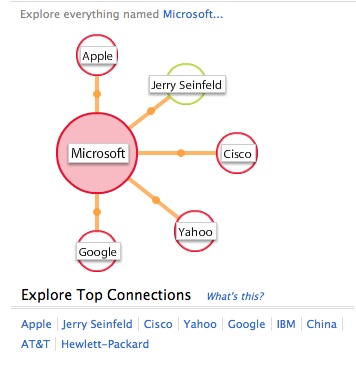
Finally, Evri’s “Top Connections” functionality is a bit suspect. Once you find the result you’re looking for, you can click on the connections it formulates for the term. In other words, if you’re searching for Microsoft, the site will show a diagram with Microsoft in the middle and a series of circles with company names in them connected to it. If you click on one of those circles (Yahoo, for one), it’ll display news articles pertaining to both Microsoft and Yahoo. Amazingly, those two companies only returned 10 top results — a ridiculously low number given their history.
Evri

Here’s what that looks like for “TechCrunch”:

Evri is trying to make the Web simpler for its users, which is probably why it doesn’t list so many news results and keeps the descriptions it collects from Wikipedia to a minimum. But because it chooses to do that, Evri quickly becomes a source for those who want quick access to videos and not much more. If you’re looking for in-depth knowledge about a given subject, Evri simply falls short of its aspirations.

And perhaps that’s why it was lost on me.  I can get all that information elsewhere and chances are, I’ll be able to find better information much faster.  If this is the best the Semantic Web has to offer, it still has along way to go.

Comments rss icon

  • Might try the search first, for android, this would give you:
    http://tinyurl.com/4e344c

    Or more interesting, articles on android where tmobile or google is mentioned
    http://tinyurl.com/3h2ebq

  • “help users discover more Web content in the shortest amount of time”?

    Maybe it’s just me, but these days I try to discover as little new content as possible. Recall is not a problem any more, so to speak.

  • I think you’re missing the vision here Michael. This is about structuring the data not just aggregating the data. Gnip is trying to be the best tool for aggregation and companies like Metaweb (www.freebase.com) and Evry are trying to structure that data. However, both Freebase and Evry need figure out good ways to get data into their systems — freebase with UGC and Evry with APIs and an aggregation engine.

  • I don’t know, I think there’s a very large universe of entities. What they are trying to do is prety tough. Sure you can find cases where it isn’t yet perfect, but I think this is pretty cool:

    http://www.evri.com/product/bo.....f4f02.html

    and click on Company and then click on the different airlines. All the pictures are coming back with airplanes from the correct airline. That’s not bad. Also click on “explode” in the left: they show you all the places for crashes. Maybe I can find it by searching around a bunch, but not bad to have it all in one place so I don’t have to.

  • looks interesting…we need to give it a chance

  • Don makes a few good points, but seems unnecessarily harsh. The number of topics Evri covers is quite impressive based on my experiments though some domains (like politics) are better than others (like Web 20 startups)… I find it amusing that in the TechCrunch Vortex one believes that coverage of Yammer and FriendFeed are indicative of likely success (I don’t think Yammer even existed beyond several weeks ago…). And the point of the current coverage seems to target newsworthy items, not generic topics like golden retrievers.

    A closer look suggests there is some serious semantic horsepower going on under the hood here - it seems more impressive than anything the much-hyped Powerset ever demo’d.

  • so… it’s kartoo with pictures?

  • if this is the future of web.. ill stick with version 1.0

  • I don’t see how EVRI can help Boost SEO or inbound linking. Can you please comment me back and fill me in more? :-)

    Thanks

  • These guys have burned through about 18 million in investment and this is all they have to show for it. Unimpressive for that kind of money. The VC’s should pull the plug on this one.

  • Well… I usually tend to like semantic search engines (no. not powerset), but they have done a bad job. Looking for “Harry Potter” selecting the “film” I get images of book covers. Looking for “the deathly hallows” gets nothing - wouldn’t you expect a semantic engine to understand parts of names? That is not what I would call a ample “data structuring” solution, and yup, $18M is a huge sum of money to produce … that

  • The reason Evri’s data is a bit minimal could be that their main product are small embeddable “related content” widgets (where less is more) and not some kind of portal site. Regardless of whether such widgets are useful, there’s no doubt a market for this. But I’m not sure where you get the idea that Evri is a “Semantic Web” company? Most of their data appears to be scraped off web pages, and they don’t seem to publish structured data, either.

  • i think the article here is missing point as well - though $18 M is a heck of a lot for what is now not so clear a business model.

    I think most search is not so great - its a giant group think engine - google for lemmings? - for me the interesting thing here is to provide results that expand the thinking - Evri looks to reveal relationships beyound the obveious and maybe in long run also curtail search spam - i mean do i really need 10000 results ? and do i really need to search in 3 pages or 4 to get to a somewhat relevant site?

    Also, lets stop applying mature company expectations to a startup - I mean sometimes beta really is - beta

  • There is a very detailed post on their blog about the underlying search technology that I recommend people check out. I’m not an expert, but this looks like the deepest semantic technology I have seen out there. There are many specific examples in the post:

    http://blog.evri.com/index.php.....me-search/

    Here is another one that discusses the underlying search approach: http://blog.evri.com/index.php.....radiohead/

Leave Comment

Commenting Options

Enter your personal information to the left, or sign in with your Facebook account by clicking the button below.

Alternatively, you can create an avatar that will appear whenever you leave a comment on a Gravatar-enabled blog.

Trackback URL
bugbug
The CrunchBoard
  • MediaTemple Logo
  • QuickSprout Logo
  • OpenX Logo
  • Cotendo Logo