
At the Web 2.0 Expo in New York City this week, a new service called Present.ly launched, which takes aim at Yammer by allowing businesses to quickly create a microblog tool that lets employees send short updates to each other in a manner that’s practically identical to Twitter.
Yammer, the TechCrunch50 victor, performs the same basic functions as Present.ly, but the latter adds a few extras that may entice some companies to switch.
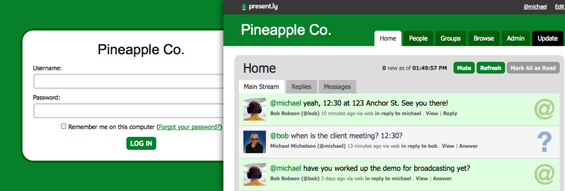
According to the company, Present.ly supports file attachments so employees can send important documents back and forth without using email, and it lets companies segment groups so management can have its own portion of the site and others can have their section.
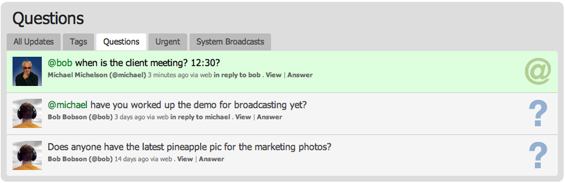
Present.ly doesn’t require all users to have the same email domain, which is one of the major issues users are complaining about in Yammer.
Present.ly also lets companies deploy the service on existing IT infrastructure if the organization is concerned with security. That said, it’s not available in all versions of Present.ly, which could prove troublesome to the company if its users are only looking for a free solution. And unfortunately, that free solution isn’t too useful for major companies.
Present.ly has five basic offerings that the company claims, will appeal to any size organization, but I’m not so sure that’s true.
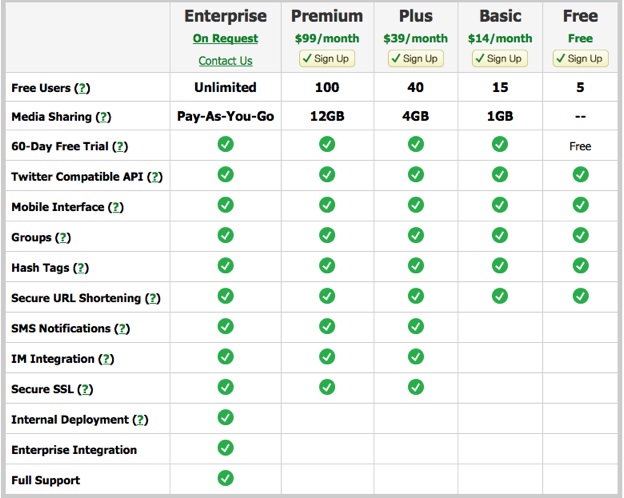
Present.ly is free for up to five users. In order to increase the number of users to 15, companies will need to pay $14 per month and 100 users will cost $99 per month. Additional users on lower plans will cost $1 per user per month if companies don’t need to jump to the next plan.
Only the top plan, Enterprise, will offer all the features Present.ly has to offer. Aside from a mobile interface, Twitter API, and group integration, which is available on all plans, the Enterprise level adds internal deployment, enterprise integration, and full support. The price for the Enterprise plan is currently listed as “on request” and the media sharing capacity is set to “pay-as-you-go.” Present.ly is offering a 60-day free trial for those companies that are interested though.
From a feature perspective, Present.ly is more capable than Yammer on paper and offers some of the elements that Yammer users have been asking for since its launch. But companies will have to pay for those extra features. All in all, Yammer still offers a more painless way for employees to get started on their own and will be adding new, requested features over time. Since Yammer’s launch last week, 50,000 people have signed up. The new competition should mean better features for both services as they race to outshine each other. Which one would you rather use?


I don’t think both services are safe, if it would be on my internal network working as app , yes I can see good pontential of communication. But if it’s outside of my network my employees better not say soemthing like
“@JoeDoe Sh** I just screwed up iPhone app little bit” or
“@SteveJobs Hey Guys We Are Going To Release Iphone Gen 3 on July 2nd 2009!, make sure you don’t tell anyone”
You still think thats good idea?
As these gain traction I think Laconica’s open source solution will as well. It doesn’t have as many features but they’ll come soon. It’s perfect for those who want control over the app.
http://laconi.ca
Example: http://army.twit.tv
Btw Shawn, that army twit tv can be hacked in matter of seconds
all you really need to do is use open id and not place any password
Would advise Admin to update if he/she did not do it yet.
“Fix 
A fix has been applied to the darcs repository. All sites should update their Laconica software to prevent abuse of this security bug.
Additionally, site owners should run the following SQL to eliminate the blank passwords:
update user set password = NULL where password = md5(concat(”, id));
“
I think you helped show the value of a hosted service and their responsibility for a security role? Also, running inside your network seems as though it would be a lot more work than a Yammer or Present.ly approach.
I’d comment on your specific scenario (i.e. via duplication) more but the screens where I could try your scenario all present me with an upsell request:
“You cannot access this feature on your current plan. At the very least, you need to subscribe to the ‘Plus’ plan to access it.”
Livecrunch, present.ly is available to be installed within your current IT infrastructure so you can apply whatever security you see fit. It was built with security in mind.
clone 1 vs clone 2.
I am on the good side… still deciding which
No thanks! I’d rather stick to my good old e-mail inbox.
Seriously? You’d rather have one monolithic heap that contains:
-Urgent Calls
-Formal Communications
-Policy Messages from Executives
-Newsletters (internal)
-News (external)
-Work product
-Contracts and Vendor Agreements
-Status Updates
-Informal conversations
One of emails biggest drawbacks is everyone uses it for everything. The growth in interest in Twitter (for the last two items on the list) is a parallel to the growth in Document Management systems to remove work product from email. And good Intranets replace policy messages and newsletters.
If email could be whittled down to formal and external communications, it would be a lot more useful.
This is great for everyone, including Twitter; other companies are exploring business model possibilities for them.
1. I don’t see what pain point is being solved.
2. Building businesses with little barrier to entry (and no, network effects are not significant here) seems like a jolly old time.
Will Google sue over name violation?
Remember when GoogleDocs was Writely / Presently?
For the life of me I don’t get this stupid, ridiculous obsession with text messages!
What happened to fully featured data transmissions?! Why in the world would I want to update my “blog” with such short messages when most phones do and will be able to do 3G from now on?! Why not a full pipe between mobile users and their blogs? People, please stop with the text craze! Do some real innovation.
The phone companies make a lot of money from SMS. Yes, its garbage and has soooo many limitations and costs. How can you innovate and get MASS ADOPTION without their consent? Most phones have no data plan any way…
lol if twitter guys were bad dudes they would offer their own enterprise edition and instantly knock both of these clones out of business . come on evan do it knock these clones out of business.
this is soo cloned.
I’m signed up and doing a side by side comparison. I’m sticking with Yammer for now.
The “Group” function is neat but their demo video seems a lot faster and smoother than the actual experience. The multimedia attachment support is neat but not terribly relevant for how we’d use it day to day.
Unfortunately, the features are restricted on the “Free” account whereas Yammer gives all the features except overall company Admin.
If Present.ly copies the access controls of Yammer, they would hard to distinguish.
Let’s hear it for sub-month me too competition!
All plans are free for 60 days, so you don’t have to sign up for the Free version. Try the highest plan to see all the features and then decide whether you’d like to pay for it.
In regards to being too cloned. I’m obviously biased but yammer looks like an exact clone of twitter. Present.ly was built from the ground up and differentiates itself from Twitter with the added features like groups, media sharing, an API from day one, and loads of other things.
Additionally Present.ly has a Twitter compatible API so any applications that use the Twitter API can be easily modified to work with Present.ly.
I have a better idea.
Enable all your features for “Free” accounts then let those features expire in 60 days from account creation.
I am biased that providing you with payment information before I kick the tires is a bit of a stretch.
http://weblog.m...-hours-for-699/ refers to the group status app I built in about 18 hours, http://speakhq.com , for simple groups and the like.
this was pretty cool when it was called IRC
Yeah, and NNTP comes to mind too — but not even Netscape’s server products division could make it palatable to the Enterprise markets once IM and other discrete peer communication tools emerged.
Technically, the only value I can remember from that was Netscape -> iPlanet -> AOL -> Red Hat and specifically for the LDAP service side. But, it’s not like end users ever saw the underbelly or cared.
IRC is great for IRC people. Otherwise, it looks like the Matrix screen saver to a regular user that just wants to communicate.
“Yammer still offers a more painless way for employees to get started on their own ” Present.ly takes a different approach. Security is more important to us and having employees create ad-hoc networks to discuss what’s supposed to be private company information with companies only able to secure that content if they pay is tantamount to holding them hostage or placing a ransom on their data. We thought of the same model but decided it would be too unethical.
Regarding the 50K users since signup. Sigh – maybe Present.ly would have that many users now too if we were given a chance to compete in TC50. As it were, we were rejected without even an initial interview, which is supposed to be a guarantee according to the rules of the contest. I’m still waiting for someone to explain why we were left out.
present.ly would be much more welcome here if not for the huge amount of comment spamming coming from your IP address.
Looks to me like everyone is bagging both companies, except the obvious employee (naffis) and ‘Dave’.
We use private twitter profiles, works fine. We’re only 7 people though.
I spoke with the present.ly management team last week. Here’s my review:
http://startupc...-presently.html
Competition is always welcome.
Personally though, this is a perfect example of not having a defensible business with a “wide economic moat” as Warren Buffett would say.
These two are going to battle it out while Twitter sits, watches, learns and implements because Twitter is the one with the most brand recognition and that is what is going to matter unless somebody really differentiates.
I switched from Hotmail to Gmail because the organization was better, but it’s still email and the basics can be accomplished by all.
Each will make money no doubt and the pie is going to be big enough for all to co-exist but the big success story is always #1, not 2 or 3.
My money is on Twitter to bust out with all these features and rake in the dough.
Socialcast.com should not be overlooked. It has a much better user interface than either Presently or Yammer and is much more functional as a long term knowledge base. It has no character limit (Presently limits posts to 140 characters) and allows multiple domains (Yammer limits users to a single domain).
Socialcast also has a bookmarklet which makes it great for accumulating knowledge online without having to be logged in to the site. You can also use the bookmarkelt to update your status right from the browser (again without being forced to login).
I spoke with the founder by phone earlier this week and it sounds like some exciting new features are on the way that will allow Socialcast to quickly bypass the early entrants. I’d really look forward to TechCrunch arranging an early preview and review of Socialcast’s new features.
It looks like these will be the 3 big players in this exciting new area of Enterprise 2.0 and based on our research I wouldn’t be surprised if Socialcast winds up on top over the long term.
http://www.socialcast.com
You don’t seem to realize SMS integration is key to the function of micro messaging platforms. Otherwise, an AIR app is the best way to use these tools, not going to some destination website (unless for some infrequent config).
Great another Twitter clone – This one will probably win Techcrunch60 next yeat.