
Academia.edu: A Geni For Researchers
by Jason Kincaid on September 16, 2008

Collaboration has long been one of the most fundamental components of science. From handwritten letters and essays to professional publications like Science and Nature, scientists rely on each other to test their theories and to help formulate new ones. Given this inherently social nature of science, it’s surprising that no website has emerged as the de facto meeting place for academics online.

Academia.edu, a San Francisco-based startup that launches today to the public, is looking to fill this role.

At first glance the site bears a strong resemblance to Geni, the genealogical site that visually maps relationships between people. Professors, post docs, and graduate students are displayed according to their department and the professors they work under, as well as their specific fields of study. In the future, the site will also map which members have worked with each other on past research projects.

While this map may prove useful once in a while, Academia.edu’s real draw is its news feed, which allows users to stay up to date on current events in their field. News items include recently published papers, conferences, and project news. Users are asked to build profiles describing their academic backgrounds and current projects, and can choose to upload their journal articles or abstracts, depending on what their publishers allow. All content on the site is meant to be geared towards academics – this isn’t a place for scientists to socialize.
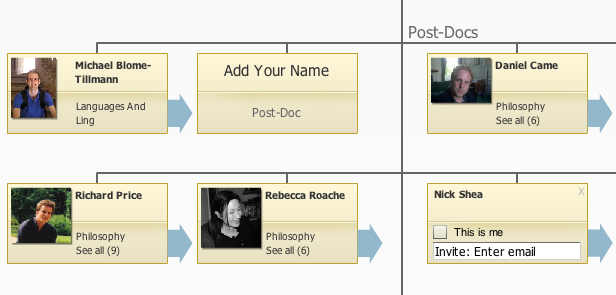
Whenever a new member joins the site, they are asked to identify themselves by both their department (for example, Computer Science), and then a more narrow field (example: Search Engine Algorithms). From then on, all activity submitted by this user will be added to the feeds of the fields they participate in. The site also allows users to specify certain members using a Twitter-like “Follow” system.

Academia’s success will lie in its ability to build a useful news feed revolving around its professional network – most professors simply don’t have to time to read every publication related to their field, and the feed could easily be a boon for them. The relationship map is a nice touch, but it isn’t practical for day-to-day use.

Another startup in this space is Lab Meeting, which aspires to be a social network for scientists.

Advertisement

Responses

Comments rss icon

  • Sounds like a good idea that has some interesting monetization potential related to partnerships with publishers of academic papers and publications.

  • The guys over at Academia are a smart bunch and they have a really useful product – something you don’t see enough of these days. Glad to see them get some coverage!

  • looking forward to seeing this develop – great use of a socnet in a more “serious” environment

  • haha yet another social network. DUMB. seems like i am the first non-employee to post here, given how glibly positive the other three are

    • If everyone in business had your attitude, innovation would truly be stifled.

      “Yawn… yet another operating system… who needs anything more than DOS or OS/2?”

      “Yawn… yet another search engine… who needs anything more than Yahoo or Alta Vista”

      “Yawn… yet another personal journal site… who needs blogs when you have Geocities?”

      I could go on, but I think I’ve done my job at making you look like a dumbass.

  • Hmm seems interesting… will check it out..

  • How did they get and .edu address? Isn’t one supposed to be an educational related institution of some kind? Maybe I am mistaken about the whole edu tld.

  • Yet another stupid attempt to “socialize” academia… it is not giving any useful tools to help researchers… it will never succeed.

  • Researchers already have their own sites for their papers. For example, SSRN (Social Science Research Network) is a fairly well known and used network.

  • It is stated that is a study, experiment, nothing is concrete here. Let the guys over at Academia do their job, SSRN is totally different.

  • The Academia.edu website shows a 500 Internal Server Error, maybe due to the TechCrunch traffic?

  • 500 Internal Server Error

  • hehehehe TechCrunch Effect, we may call….

  • Academia.edu’s back up now.

  • Over at http://www.AcademiaConnect.org we are trying to connect academics, researchers, and graduate students of all disciplines by providing a forum-focused social-network and easy to use Scholar Directory and Scholar Search engine. Scholars really do need a central location where they can find, communicate, and collaborate with everyone in their field as well as publish, promote, and share their knowledge, data, and expertise with the world. This is why I created AcademiaConnect.

    Marcos Salazar
    http://www.AcademiaConnect.org

  • If this really works it will change the nature of background reading. When I did the literature review for my dissertation it took me weeks to track down appropriate literature. Now, it could take minutes. Of course, the literature will still have to be read.

  • I’d like to see something like this for the corporate world.

  • I thought .edu domains were regulated and restricted to US-based academic institutions. It’s surprising to see this domain name in use then.

    The user interface is horrible. I tried to find my university, it said it didn’t exist. Then when I tried to create it, it told me that it already existed. However, it didn’t point me to it. I kept having to guess how I might find it (there is no simple arrow to go through a list). When I did a search for the univ name, it came up, but promptly disappeared from the line. Wow.

  • Seems like a useful idea to me. I don’t think the “yet another facebook” comments above make any sense — if academia.edu can focus on connecting researchers and helping them keep up to date on each others work than that will be a valuable service.

    About the *.edu domain — I didn’t think this was legal either, but aparently all domain names registered prior to 2001 were allowed to keep their names. Looks like the name was first registered in 1999, so they are “grandfathered in”.

  • SciLink has already done this, with their “Tree of Science.” And they already have significant uptake and traffic.

  • For a discussion of additional sites and services, see the NewsLink Spotlight article posted on Sept 4, 2008: “Research Sharing Gets New Tools and Goes Trendy,” http://newsbrea...ArticleId=50584.

  • Is there some open source software for building trees such as this? Any info is appreciated. Thank you.

  • I’ve done a ton of work in this area. I believe that simple social networks tailored for academia make sense. Faculty have a drastically different set of requirements and concerns than users of Facebook or LinkedIn, and not all of these can be addressed by apps/gadgets or creative use of the existing platforms. These can also be very serious, show-stopper issues: consider the researcher who uses animal subjects, and how you can integrate these lightning rods for controversy into such a system.

    So Academia.edu isn’t on the wrong track. But, that said, I think they’ve missed the mark. Frankly, I wonder if they haven’t launched too wide, too soon. The implementation and design strike me as alpha-quality. It’s unpolished, and can be very, very clunky in places. And the functionality just isn’t what I would expect: it looks like a standard social network with a few unimportant concessions to academics. As it stands, I would be (happily) surprised to see faculty (in particular) adopt it in any significant numbers. But, I’ll keep my eye on it, and I sincerely wish them the best.

  • Richard Price is the man – and academia.edu looks sharp as hell. Congratulations Richard.

  • Neat idea, pity about the implementation

    1) Clunky interface
    2) Won’t actually let me sign up, I go through the process and then it tells me there is an error and they will do something about it. Very informative.

  • A graph database containing all major institutions, researchers, publications, events and all the connections (positions, collaborations, citations, …) between them would be a true game-changer for academia. I’m afraid we won’t see anything like that anytime soon.

  • sell your domains at http://www.zoomwam.com for free stop wassting your money

Leave Comment

Commenting Options

Enter your personal information to the left, or sign in with your Facebook account by clicking the button below.

Alternatively, you can create an avatar that will appear whenever you leave a comment on a Gravatar-enabled blog.

Trackback URL
bugbugbug
Techcrunch on Facebook