
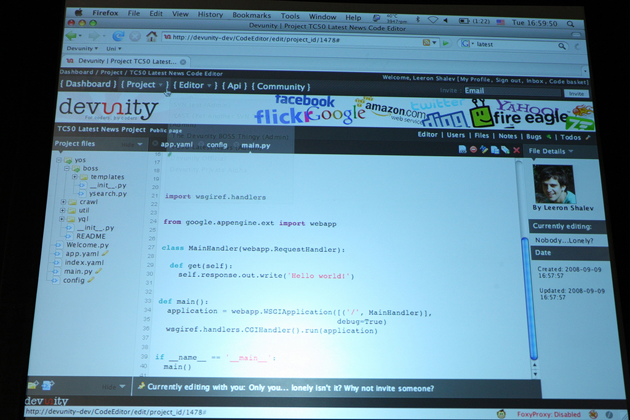
Devunity is a collaborative coding platform that allows developers to simultaneous view and modify code on their browser without having to download a client. The service has built-in support for a number of popular APIs, allowing users to simply click on one of the options to generate the relevant framework in their code.
After developing a program on Devunity, the platform will suggest a number of cloud-based services like Google’s App Engine for deployment (though users will be free to use their own servers). Devunity will be free for open source projects, but plans to charge for private programs (the company hopes to lure developers in this way).
Users can use a built-in commenting system to annotate their projects, and the site plans to introduce chat rooms for real time conversation. There’s no immediate need to keep track of versioning, but users can choose to use SVN if they’d like.
During its TechCrunch50 presentation (watch here), Devunity used its software to demonstrate how simple it was to generate a TC50 latest news aggregator.
Expert Panelists
Josh Kopelman – What do you guys do?
Tim O’Reilly – I have to say I had a hard time following.. I get it’s an online dev tool using APIs. How do you turn this into a company?
Devunity – It’s a collaborative coding environment, don’t have to download anything done online using cloud services. It’s not just for cloud, we encourage to deploy to cloud, but we support ftp servers…
Can be called a “google docs for developers”
Tim O’Reilly – Do you imagine a 37signals business model?
Devunity – Yes, we’re also going to white label platform, if they want to offer it using their API, like mobile companies can have this tailor made dev environment to write applications deployed to their services.
Tim O’Reilly – Back to 37signals.. they obviously have this PR win with Ruby On Rails.. got them press, how do you get this visibility to get developers in the door?
Devunity – You can go in the service, it is free for open source community. Free for open source gets them hooked.
Jason Calacanis – What’s the #1 problem that you solve? What sucks about being a developer?
Devunity – You aren’t in contact with other devs.. you can ask what the guy nextdoor is doing.. they don’t have any collaboration around their code
Evan Williams – I have questions but they’re complicated. You said you don’t have to deal with versioning, but there’s a reason for it.. do you have branching? are you just writing code and producing to production?
Devunity – We’re using svn, there is version tracking, you don’t have to check code in.
Evan Williams – is there developer environment you’re running on before you deploy to server
Devunity – we upload to Google App Engine, that’s our dev server. We’re looking at doing google gears..
Om Malik – Would you use something like this?
Evan Williams – i doubt it. It would be hard to change. the benefits are probably for more dispersed teams


Tim O’Reilly, and Om Malik on the panel?
Can’t find them here http://www.tech...ence/panels.php
it looks to be gud ..lets seee it after release.
Looks like crap
Call me cynical, but this seems to be an answer to a question nobody asked. Why do I need to edit my code using a web app, where my code is being sent over the wire? I understand the advantages of a web app for non-techies who can’t be bothered with installation programs, but for the tech crowd installing a desktop dev environment like Eclipse is a no-brainer. What are the advantages of “real time” collaboration on a piece of code, and what does Devunity do that Subethaedit doesn’t do? Finally, why should I give up FTP passwords, etc., to a third party, and how will their security be guaranteed? These passwords hold the keys to my core IP, and putting that at undue risk is unacceptable.
I think this rocks.
I am a coder, not an IT guy. One of the things I *absolutely hate* about products like Eclipse is that I have to spend all this time figuring out how to install and maintain the development environment. I watch myself and others waste tons of time on this problem. If I could jsut sit down
Now what would be really make this compelling is if they had an iPhone version that I could use for “lite” work like adding one more line of code to a javascript file when I’m not at my desk. There are frequently times when I’ve been thinking about a design or problem while I wait in line or am bored in a meeting. I want to try out a one line change right then rather than scribbling it down and trying to remember for later.
And, of course, the number of new dev frameworks that they actually support will be a determining factor for acceptance. I find myself often having to change development environments as I move to a new framework that is only supported on one. (This is how I, like many developers, end up with 3 different copies of eclipse-dervived editors installed on the PC. Plus XCode, plus TextMate. Plus… ick. Maintenance nightmare.) That is the window of opportunity for these guys to drive adoption.
I have to say…I love what Eclipse COULD be, but right now I find it clunky and confusing. I typically code in PHP on a Linux desktop. I’ve played with pretty much every editor available in Synaptic (and a few that aren’t in there) and I keep ending back up in VI or gedit (plus a few plugins). For me, the collaboration piece is cool but what I want most is an IDE that I don’t have to update, that is constantly aware of the different APIs out there and makes it simple to harness them.
I also want consistency if I’m working on my Windows laptop at home or my Ubuntu laptop at work (and yes they have Eclipse for Windows, but again…I’m not satisfied with Eclipse). In the long run, I want to be doing everything in the cloud so I can have access to everything regardless of what computer I’m using in whatever location.
It’s the revenge of the diskless workstation and the cloud is my server.
Subethaedit only works on Macs, for one. I suspect that if it wasn’t limited to just macs, then this app might not have been written.
Not everyone has the same IDE, and not everyone can configure their app for realtime collaboration, but everyone can use a helping hand to work through a code problem.
I would like to see this sort of service geared more towards casual use – like a real-time collaborative pastebin. If the goal is having people build full scale apps (even small ones) across a team, I suspect it won’t have as much success as they’re hoping for. There’s a far larger need to part-time development help on small bits of code than there is for full-time collaboration on largers apps, But that’s (obviously) just my opinion.
Good luck guys!
can you say code hack
Awesome idea. I think there will be more and more services like this (for one see http://www.apri...com/amy/amy.php). This type of thing makes pair and team programming possible in remote scenarios. Software development can really gain a lot from realtime environments even for local teams because it means you can have multiple minds in the same realtime space with technology-enabled interactions. And framework/platform/IDE installation and configuration IS a significant barrier and waste of time so instant-join project environments on the web are a big improvement.
re: Kimsal’s comment I have been working on a live pastebin off and on for months.
This is exactly the opposite direction that many coders are going in. Distributed version control seems a better fit for how many developers are working. The challenges of writing all the editor-like functionality would be immense and most people get the most out of their editor by configuring the hell out of it. I have not used Devunity so I’m not trying to say anything negative about it directly, I just think that the concept that it revolves around has been passed by.
Perhaps this is a great idea for people who don’t ever need to debug or test their code. :\
My guess is that groups move towards distributed version control because Subversion is slow, doesn’t provide adequate status during updates, and developers can’t agree when their abstractions/paradigms are inadequate or there are just many problems being worked on in the same space. These types of problems shouldn’t lead us to abandon the proposition of working together directly and integrating ideas in realtime. Debugging and testing for web applications can be part of a web-based development environment.