
Mobile payments startup Zong, which is one of our DemoPit exhibitors at TechCrunch50, thinks it has the answer to micro-payments on the Web for social apps like gaming, dating and classifieds. It uses your mobile phone as a way to pay for things such as virtual goods in Facebook apps.
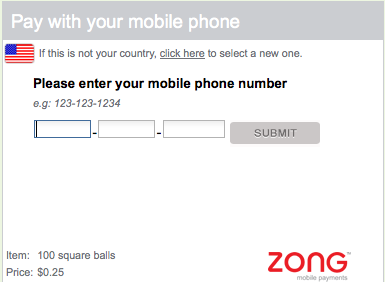
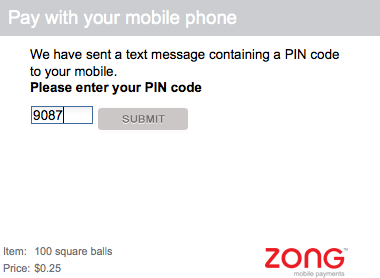
The way it works is that you enter your mobile phone number to pay for something on the Web, maybe a virtual cowboy hat for 5 cents. Then you get a test message on your phone with a pin number. If you enter that pin number in a widget on the Web, the charge will be reflected in your cell phone bill.
Using mobile phones to bypas the issues that micro-payments still have on the Web is a smart move. Nobody wants to use a credit card for small purchases of a few penies or dimes, because the finance charges are too high. Whether anyone wants to pay even a few pennies for a Facebook app is a whole different matter.


See all


That is an interesting idea for mobile phones. I think there’s a real opportunity for companies to get incremental revenue on the Web through some kind of phone and payment integration. It’ll be interesting to see how zong does.
Nice to see coverage on DemoPit startups… Many ppl would thought they would be sidelined by organizers … Thumbs up for TC50!!
–
We’d also launched our startup today, check us out at http://www.adexcel.com
AdExcel is “The Ning for Advertising Networks with more juice in Socialized Ads”..
Let us know what u think
Best,
Darren
Cofounder of AdExcel
Very interesting and innovative but what about the security aspect, what if the phone the lost. Since in most sn apps they have an option to provide phone numbers, why not take the phone number from the app itself.
Rahul: If you lose your phone, you’re likely to call your carrier to have your account suspended as you would with a credit card. Also, you can use Zong’s API to integrate the solution tighter to your app and pull the number from it if you want to.
Finally, small precision: With Zong you can bill up $9.99 across carriers and even more than that in some European countries we cover.
What is the rev share…don’t the carriers take between 20% and 50% based on the carrier.
If I want to use this to charge 10 cents for something on my site, how does the split work between content provider, Zong and carrier
Great concept - good luck with it.
I made a social network site that attracted about 25k users about 5 years back, and had this business model.
The site is already down, due to our commitments with our existing jobs.
You can see the example here: http://web.archive.org/web/200.....angau.com/
In the lower right hand corner you can purchase virtual currency using the mobile phone, and use the virtual currency to purchase things on the site (badges, etc.)
We found out quite soon that the mobile carrier charges were very high so we weren’t making much, you almost always have to charge twice as much on anything, and we were only charging pennies and cents.
Maybe on million user scale this might be worthwhile.
Great idea- I had it 3 years ago.
Here’s why its not going to work / nor get mass adoption.
Carriers (sprint/att/tmobile/etc..) typically take 30-50% of any “carrier billing addon” such as a ringtone, wallpaper, (or a zong payment) etc..
Then, if zong is using a “aggregator*” for the billing part (likely) that is an additional 5-10% of every purchase gone.
(*a aggregator is a third party service that makes integrating with carrier billing more easy)
What does all that mean?
Lets say I am a publisher, selling my warez for 5$
If I use paypal for the payment, I get almost all of that (minus PP fees)
If I use zong, I will only get 2.50$ - Not counting the fees zong will obviously want. So do I have to sell my warez at twice the cost, or accept the lower payment for more adoption? Will it hurt me or help me in the end?
Now, don’t get me wrong- Zong could decide to pay the publishers out of pocket for the half they don’t get from the carriers, but there leaves LITTLE room for profit. They better hope the carriers have decided to be more friendly since when I looked at this.
I literally spent 3 months of my life on this exact idea / project in 2005 only to come to terms with the fact that although it was a good idea that would get mass adoption, there was not only zero profit to be made, it was a losing business model.
Disclaimer- I haven’t looked at this technology or idea in years, and things may have changed in regards to carrier shares and other aspects.
In reiteration of the above- I have been just doing some reading, and it seems like carrier billing features are going to be all but phazed out within the next 3 years due to chronic abuse from ringtone companys. Where will this leave zong? A paypal competitor for mobile?
Dan, ideas are a dime-a-dozen. Execution matters. Digital goods can be sold profitably at 50%+ txn costs.
Well, if you can process the same transaction with credit card or paypal why would you take that 50% hit?
Brilliant analysis captain planet.
Digital goods can be profitable at 1% - There is no additional cost in selling 1 unit or 100000 units. that does not mean that you wont lose money on what you could charge.
And just to reiterate- Most US carriers will be dropping this archaic billing system due to intense pressures from local AG’s stemming from fraud in the ringtone/horoscope space.
And I agree with your comment on the execution of a idea- Its a shame they didn’t do more due diligence to save the VC firm some cash.
And wow, 3 years to build this? (they took a A round in 2005) -
Holy. Shit. Back when I was looking at doing this with a team of 5 people, we estimated we could have this entire system built out within 6 months. Either the coders on this project are lazy, or they seriously lack management / skill.
ZOMG KITTENS!!
I thought this was a great idea until I saw the Payout Table! Sell something for $1 and keep like 44-cents!!! Too crazy. Not worth the “convenience” of billing it to their mobile bill.
Freddie: true, carriers take a substantial cut. But also true: Zong converts users about 10x better than credit cards. It will never be used for physical goods, but for virtual currency on Facebook apps, or for gaming, dating and classifieds websites for which conversion from visitor to buyer is more important than absolute revenue per user.
Would you use a credit card to buy virtual currency online? Most probably not…
Also, about 70% of the world’s population don’t have credit cards, but most of them have cell phones.
can you even get a phone without a credit card these days?
David, how do I know that your “cool” phone processing is not cannibalizing my current cheap credit card and paypal processing? I don’t want to pay a 50%-3% fee to do marketing for you. I was shock how much the Telco charges and all the add on fees (eg. SMS fee etc) you charge. What kid of rip off is this?
Great idea. If the payment schedule wasn’t so restrictive and if it was available in Canada i would be all over this.
Congrats to Zong!
$12.5 Million for this! You have to be kidding me, where are all these venture guys who are biting on this crap? I can pull 3 ideas for mobile out of my butt with better business models. This is basically a widget and a tie in with an aggregator. Nothing unique here…
I hate the carriers and the last thing I want is to give them more power or money in my life.
Great idea! I think this can work, if you position yourself the right way (virtual goods). Wondering though: In Germany we’ve been using this for some time already. There are many companies over here offering this and the payout is about 10% better than Zongs.
We have had systems like these for some years already in Europe. I have a hard time understanding how this is any different from these.
They are especially popular among tweens, who use them to buy virtual goods and membership updates for social networking sites.
This is a great idea but they are taking about 60% of the original charge. Are they doing this because they control the market or are the carriers really charging them that much?
Roy, the carriers are really charging that much. There’s no way around it right now. Mobile phones are the most convenient payment method for kids and teenagers who don’t have credit cards. One of these days someone will figure out a way to bypass the carrier stronghold on these payments and will make cellphones a convenient way to pay for anything.
Nerve: the reason it’s different is because it’s a hosted payment application that allows you to bill multiple price points to 500+ million mobile subscribers across Europe and the US without the unbearable hassle of configuring every carrier in each of the countries you want to cover. Zong is the mobile payment platform of Echovox that has been around for nearly 8 years and has connectivity with most carriers in Europe and the US.
Roy: Zong takes as low as 3% from what we get from the carriers. Both our share and the carrier’s share improves as volumes of transaction for a given service grows.
Credit card companies charge about 1-3% per transaction - Carriers - 30-50%
Isn’t it obvious that carriers are loosing big money here? Instead of becoming the next credit card companies - and take the market by storm - they continue to muscle us up like they were the RIAA
Loosers (literally)
This is a standard way to purchase virtual currency in Asia with one major difference. In Asia, the fee structure actually makes sense - you only pay 10% of the retail price as a fee and keep the remaining 90%. Taking 60% as a fee just underlines the wrong-headed approach that Western carriers continue to take toward content businesses on mobile.
zong launch in germany? i say: “you always are welcome here!”
Ron: we’re live in Germany, 12 other countries (Western EU + US) and expanding.
The main domain for Zong seems to have been hijacked.
Zong is a big telecom company in Pakistan. Right now, the website zong dot com takes you to a wikipedia entry on Pakistan!
More on this on my blog
blog.momekh.com
Yeah I am from Pakistan and ZONG is a great telecom company here. Goto http://www.zong.com.pk and you will know.
Btw how come both companies using same name and logo font seems to be same too !
I wonder what the ‘chargeback’ rate is. I imagine its astronomical due to the majority of the userbase using this system would be tweens doing unauthorized charges. The parents must be thrilled.
Dan: chargebacks are pretty low for these types of services as prices are clearly communicated to the end-users. They run below 5% across services. In Europe most carrier don’t even apply chargebacks.
David, can you substantiate the “Zong converts users about 10x better than credit cards”? Also, how does it compare to paypal conversion? If conversion is even only 3x better Zong is a win in my book, but I want to know where the data comes from.
Denis: sure thing. When we say mobile payments converts up to 10x compared to credit card payment for subscription or virtual currency based services, we base that on live traffic we have running across both payment mechanisms on existing services. We witness that in age group 15-25, over 80% of the transactions happen on mobile if given an equal chance to choose between credit card or mobile. The main reasons are:
1) Adequacy of payment method: not all of the users of the target group have credit cards;
2) Fully integrated user experience: users don’t have to leave the website to go to a Paypal or credit card processor page where most publishers lose a good portion of their customers-to-be;
3) It’s simply faster and easier: everyone know their cell number off the top of their heads, they type it, receive a PIN code in a text message, type it back and it’s done -> back to the game/experience.
We have been using it for a few years already in Korea. I think it was first started in Korea as well.
It is a pretty good model, but even in Korea I think there is potential for still quicker and easier micro payment. I would like to be able to pay on the spot, like we do with cash.
I fully agree with Tal’s comments - the carriers are shooting themselves in the foot for continuing to charge such high rates. Their potential to compete with Visa, Mastercard, Amex, etc. is completely within their control, but they lack the vision to see the potential & harness this opportunity. Even if they only reduced their share of the transaction price down to the 10% or 15% range (nowhere near credit cards 3% - 5% ranges) the carriers would see a massive uplift in transactions processed and would get a huge uplift in revenues. But that will most likely take quite a bit of time.
Also, from what I can see, Zong is very competitive commercially relative to any other option in the cell/mobile billing space. And they definitely have the easiest system to integrate with.
This is the same model as Paymo, mGive, PayforIt/SimPay.
Merchants won’t accept the HUGE rents that the provider + wireless carriers will extract, along with the 60-90 day redemption period, and it will always be constrained in transaction size and volume by the carriers’ willingness to take the credit risk.
Full reaction and discussion at link.
Nice work… live in Germany, but i think not really offen used, or? May you give me an example. Thx
Nice