Negative Momentum: Newspaper Ad Revenues Gaining Downhill Speed (Even Online Is Declining)
by Erick Schonfeld on September 5, 2008

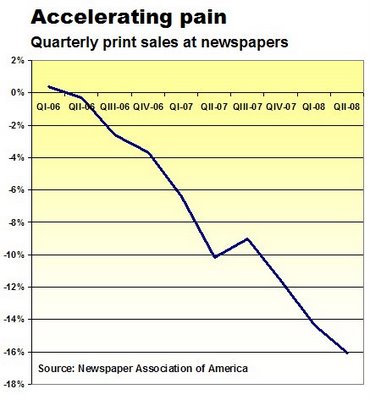
Can it get any worse for the newspaper industry? The steep decline in print advertising just keeps getting steeper and, for the first time, even online ad sales have gone down. Total print ads in the U.S. were down 16 percent in the second quarter to $8.8 billion. That makes nine consecutive quarters in which “print revenues have declined at an almost continuously accelerating rate,” notes Alan Mutter at Reflections of a Newsosaur. He put together the chart at left, which starkly illustrates the newspaper industry’s death dive.

The newspaper industry took in $1.7 billion less in print ads during the second quarter than the year before For the first half of the year, the industry is down $3.1 billion. At this rate, there won’t be an industry left by the end of next year. Of course, revenues have to stabilize at a lower level before that happens. Don’t they? Right now, we’re at 1995 revenue levels.

Don’t look to online ad sales to save the industry. Online ads came to only $777 million in the second quarter, which was down 2.4 percent from the year before. That’s marks the first decline ever in digital revenues. The practice if bundling print and online ad sales isn’t helping in this case, either. Advertisers trained to buy bundled ads are more likely to drop the entire bundle when making budget cuts.

The advertising recession is in full swing, and no segment is safe any longer.

Responses

Trackback URL

Comments

Pretty much explains GOOG’s downward spiral in the market.

Hopefully it’s all temporary.

a persons or business online strategic location (domain channel) will forever be a the holy grail to there online marketing success. there is only so many premium places to be found on the internet. if you have a premium location your never out of work.

online ad recession? I dont think so.

ad networks are a dime a dozen!

premium strategic location based niche market ad inventory platforms are the future of internet search. and i can count those on 1 hand. now thats a online recession.


With Online Ventures increasing and everyone inclining towards the latest technology obviously newspapers are becoming a formality rather than something which you would really read everyday.


Well in emerging markets like india this isnt the case. India print revenues look good.

Rajiv,

“Gutenberg never envisioned the chainsaw”

The insight (in the article) is about the now obvious trend here in the US. The trend is a convergence of just-in-time-distribution, combined with the near-zero cost-of-goods and negligible infrastructure afforded by working with bits vs. atoms, across digital networks.

It becomes clearer how everything “print” will be inexorably replaced by far superior conduits developed by new businesses, at far lower cost to everyone involved in the chain.

I would predict this same creative destruction will occur faster in India, where you have fewer trees to waste on newsprint, regardless of the disruptions in labor.

Suggests one might concentrate on all things relevant to digital information, going forward. Geoff


It is possible that many companies are focusing on SEO instead of traditional news advertising and online advertising.

We have gotten feedback from colleagues that this is the most cost effective way and the effects last longer with lower maintenance - if done right

But recession or not, it is highly unlikely that they firms are doing nothing and passively atrophying - they are just looking for the best ROI for their ad dollars


typo:Don’t they? Rght now,


Same as every recession: ad budgets get slashed early and often, especially brand vs. direct response. Lot of of layoffs coming, many magazines will go bust, secured lenders will become owners. Been there, done that!

is that the reason or is it the move to online content consumption?


Down she goes!


News papers need to move to an electronic form and be readily accessible like the kindle. In a year or two when we have electronic newspapers and electronic magaszines viewable on an iphone like tablet (larger form factor) then we’ll see advertising pickup again.

It will happen, were just waiting for technology to catch up to what people want..


With outlets such as CNN covering “discoveries” of bigfoot as “newsworthy”, it should come as no surprise that those looking for relevant info will go elsewhere. Precisely at the historical moment when elsewhere became everywhere, with the explosion of high quality blogs with top-notch writers.


I’m noticing a trend of newspaper reporters trying to improve their efficiency just a touch by following citizens in their cities on Twitter. It’s a good way to catch the buzz and reduce their legwork


Really this is not a fall, it is a refocusing of our attention. Focus is moving to different modes of doing business and becoming de-centralized. The premise of print ads and ads in general is that you need to be attracted to a point “away” from your previous focus. Total-Scope systems transform that premise to a Universe focus. That is the real “cause” for the changes taking place, the internet being a symptom and catalyst of that. What meaning does “country” have in the context of the internet? Less and less meaning. Especially when archaic governments hinder the survival of many societies, we will continue digging under walls and overcoming limitations brought on by centralized thinking. Bit-torrent is a great operational metaphor for where we’re headed.

de,

Precisely. However, demassivication is the culpret. IE, personal computing circa 1980 predicted this exact scenario, many times, in many ways. Scinece fiction writers explored the effects in the future pluperfect tense - as if it were happening to you.

Drudge needs no trucks. “Gutenberg never envisioned the chainsaw.” The difference in the cost of operations is becoming apparent to everyone, inside and outside the print industries.

Do you go to the local newspaper to look for a new house? 95% of new home buyers use the Web to look for a new residence (home or rent). Newspapers used to be the only way for realtors to achieve reach, so newspapers owned the real-estate ad segment; that along with new and used car ads and classifieds made up 50% of the paper’s revenues. Who goes to the paper for those today. Now, online, the realtor can sort his inventory by feature (never to be available from print) and display according to viewers needs and tastes.


Given the generational shifts in media consumption habits (migrating online and to non-traditional sources) and the infinite choice that the proliferation of media and fragmentation has provided - it’s no wonder that newspaper readership has declined so precipitously. And, that decline only hastens the falling ad revenues.


You’d think this being an election year would help the newspapers, but many people I speak to would rather read blogs like dailykos to get their election news fix.


I think there also has been a change in our reading habits over a period of time that because of many different reasons. We are spending more time online and prefer reading online - My reading are more related to areas that I am interested in… I still visit the same news paper I used to read as a printed edition, but now in the electronic edition - the news paper made me stick to their website by keeping their format and layouts exactly the same as the printed media. I may read a max of 2 articles but I visit everyday

Hey, do you know the software required for the online printed edition? Who are the best players and most economical for this?

How long is a string?
The major players: Olive Software, NXTMedia Books, ALfa out of Germany and on and on….


The entire advertising landscape is changing dramatically. Its a product that is always moving online, I think when everything is said and done. The space will be totally different from what we currently know.

Jippidy.com - Video Yellow Pages


Given that customized news is the future, (smart algorithms, digg, etc) the best newspapers can hope to do is embrace the online world so their stuff can be picked up and used. They don’t have to *be* the intelligence, they just have to be properly accessible so the conversation can include their content.


Yep, ad spend cuts being one of the main indicators on the recession barometer - we’ve been there before!

Publishers should be looking at alternative revenue streams online, dependence on ad revenue should be reduced.

We published a piece on the subject recently in In Circulation mag, more orientated around magazines but relevant nonetheless, if people are interested in monetizing content online http://tinyurl.com/5ksp9n

It is quite common that publishers do not want to push online, as they feel online will cannibalise print circulation, and print ad revenue which is often the primary revenue stream, they also feel advertisers understand the print advertising medium (ABC certification etc). This precipitous fall in print ad spend may help convince otherwise….

Certainly reinforces the commentary that says the Philadelphia Inquirer decision to cut editorial from the web and focus only on breaking news is not such a good one (Paidcontent.org - http://tinyurl.com/6opbqa , Aug 2008; Sarah Lacy - http://tinyurl.com/6feyhp)

angus


sorry - something weird just happened at the TC server end - tried re-posting on a different PC and all the attempts went through together.

angus


Eric, can I get permission from you and TechCrunch to reuse and reprint this article? It is of great importance.


Like you said, the industry is in for a long correction. More companies will be in trouble.


I think that you all are missing a bigger point here - it’s the content, not the medium, that is becoming the downfall of traditional print media.

Who better to transition to a different medium than an organization already staffed with content creators and advertising sales? Then why haven’t they been able to leverage that existing infrastructure? Not because they don’t understand it - after all, this is 2008.

Take the blue pill and remain in an ignorant bliss that blames the external for the decline in subscription and subsequent advertising dollars. Take the red pill and embrace the harsh reality that the public isn’t buying biased opinions as news anymore.

In the online world where ink isn’t purchased by the gallon and those with views different from the NY Times can generate a larger subscription base with a blog it all comes down to those with the most eyes on the page wins the advertising dollars.


Anecdotally, we offer a free news website service and the online ads that we display on our clients’ sites do not bring in as much as we expected.

Although, we do not employ them, there are techniques to display ads more intrusively and that may be the way to go to maximize revenue. I’m starting to see intrusive ads more and more.


This is very interested!


The most natural thing is to sell your content, if its really good. If you are not able to sell it, and hope to compensate with advertising, you are already on the looser side - thats what traditional media did not get.

Sell your content on Klatcher


Sounds good . Webmob-ad, is the a new start-up that just came out . It is a pioneer in mobile and web advertsing by creating the only self serve and fully automated marketplace for CPC and CPM advertising . It supports all types text ads, banners and video ads.For publishers , it offers the highest split of earnings you can find out there and much more. It caters to web and mobile Publishers and Advertisers . Web and Mobile Publishers can earn money easier than ever and registering is FREE. Please check it out : http://www.webmob-ad.com


The decline started long before the advertising slump. Decline in readership = decline in advertising. Traditional, corporate owned media has been in a long decline due to the public’s perception that these are no longer trustworthy outlets for real information but have become outlets for corporate and government PR operations.

A steady rise in the subscriber base to alternative news outlets matches the decline curve. First they blamed the internet, then the old media outlets went online yet the decline continued. The largest sector of media consumers is approaching retirement age, not exactly the prime audience for internet based media if the explanations and excuses are real.

When the press returns to being truly free and performing real news gathering and un biased reporting the decline will soften. For many it’s too little, too late. I’d like to see more investors work on launching unbiased news outlets - I predict those would succeed. If they are allowed to do business in the first place.


Two things:

Craigslist - fast, easy, cheap. And good photographs. Well, ok. Sometimes

The liberal bias and slant inherent in the printed media is finally coming back to haunt. In the words of a famous (infamous) preacher: “The chickens have come home to roost.”

Craigslist have killed the newspapers!


Leave a Reply

« Back to text comment