Cake Financial Pushes A New Social Stock Index: The Cakedex. Can It Beat The S&P 500?
by Erick Schonfeld on September 4, 2008

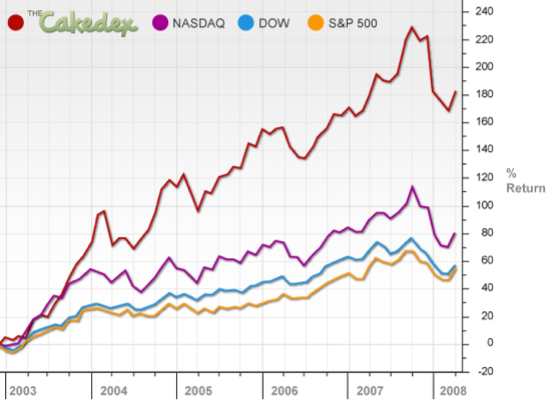
One year after it launched at TechCrunch40, Cake Financial is rolling out a new design today with a load of new features. One of the most interesting is a new stock index called the Cakedex that is based on the top 100 holdings of the top performing investors on the social investing site. Over the past five and half years, the Cakedex would have outperformed the S&P 500, the Dow Jones, and the Nasdaq. Although, over the past 90 days, it has been underperforming the major stock indexes. Next year, the company plans to launch an exchange-traded fund based on the Cakedex so that people can actually invest in it. Can the top investors on Cake do better than the market?

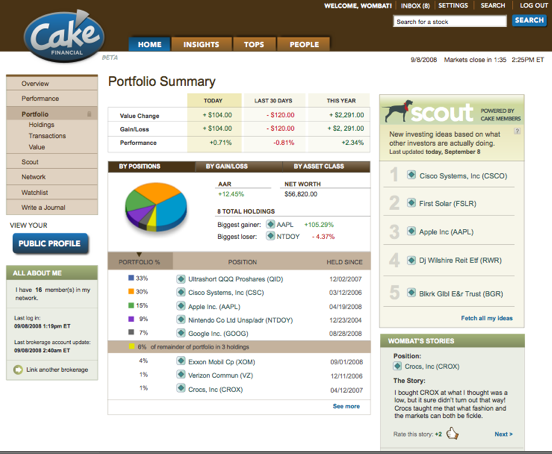
The Cakedex was actually introduced in May, but is now integrated into Cake’s new design timed with its first birthday. Cake members track the performance of their actual brokerage accounts and share that data with each other. Cake can now tap into 60 different brokerage services, up from a dozen or so. And has now tracked over one million transactions.

In addition to Cakedex, other new features include:

Cake Take: A stock rating system updated several times a day, based on the real-time buying and selling of stocks by Cake’s members. Cake has ratings for 2,033 stocks, mutual funds and ETfs (versus 3,069 for Schwab and 4,074 for Morningtsar).

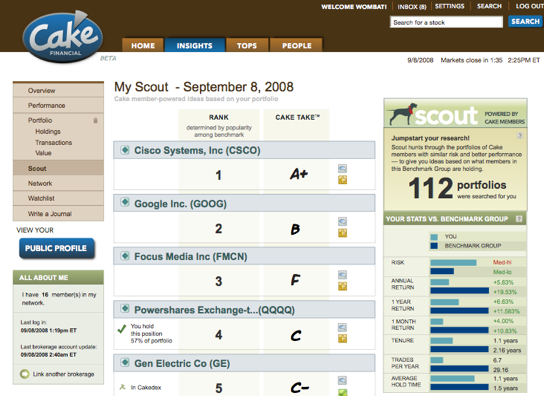
Cake Scout: A stock recommendation system that uses collaborative filtering to show you what other Cake members with similar holdings and risk profiles are buying and selling. Each recommendation includes the Cake Take stock rating.

By adding these social recommendation features, Cake is becoming more like the Last.fm of investing. But it adds a ranking element so you know which members are worth following. Other social investing startups creating similar ranking systems include Covestor and Vestopia, and the race is on to create real financial products based on the social investing data that these startups are collecting.

Cake now has “tens of thousands of members,” according to CEO Steve Carpenter and is collectively tracking about $1 billion worth of assets. But the Cakedex is based only on the holdings of the top 10 percent of members. The biggest equities that make up the Cakedex are:

Apple
Visa
Google
Berkshire Hathaway
Oracle
Amazon
Washington Mutual
Intel
Research In Motion
General Electric

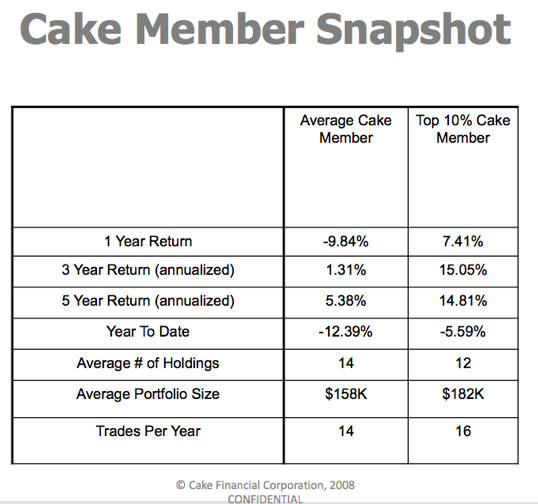
But how good are Cake’s top 10 percent beyond what is goes into the Cakedex? The average Cake member’s portfolio is down 9.84 percent over the past 12 months, while that of the average top-ten-percenter is up 7.41 percent. (YTD it is -12.39 percent versus -5.59 percent, respectively). So not bad. Maybe there is some wisdom in this crowd. Here are comparisons for other time periods:
Advertisement

Comments rss icon

  • It’s the oldest trick in the game .. take 10,000 investors and probability says 5,000 of them will beat the market. If each investor was a random number generator, the top 100 would fare quite well …

  • Is it similar to Mint… if yes then I am sorry I am happy with Mint.

  • …and similar to marketocracy. Even though the index has outperformed the S&P and other other indices, I wonder how it’s Sharpe ratio and tax efficiency would compare…

    • It’s actually different (in a good way) than marketocracy. Cake directly links in to your brokerage account (like Mint does) to track actual performance. It’s tracking real performance of real money. Marketocracy let’s you create portfoilios of fake money and track performance. I’m sure they have plenty of people on there with multiple accounts.

      There is absolutely no comparison with Mint.com; two different (both very good) products.

      • Harshal,

        I’m fairly sure that Marketocracy does have multiple accounts for some of its users. I run a creative agency (Traction) and they were our first client. We helped them build their community and launch their first fund (we started working with them in 2000 and if memory serves me, launched the m100 Fund in 2001).

        The idea of using the wisdom of crowds to power a fund was a bit ahead of its time back then, but the premise is solid. Back when we launched Marketocracy, we latched onto the fact that 85% of professional fund managers weren’t beating the S&P500. If you read Fast Company last month (fastcompany.com/magazine/128/made-to-stick-the-myth-of-mutual-funds.html) you’d see that’s still not too far off today. IMHO, social mutual funds are going to be a major new investment vehicle in the coming year or so.

        (Full disclosure: Traction just started working with a new start-up in the space called Inner8 that’s launching a private beta in a couple of weeks. They’re similar to Cake in that you’ll actually be able to invest and leverage a community to improve your investment performance and get new ideas, but are combining that with cool analytics tools—i.e. if you like Apple, you can see what stocks trend most closely with Apple. If anyone’s interested in checking out the beta, email me at adam-at-tractionco.com and I’ll get you a password when it goes live).

        Anyhow, I think it’ll be interesting to see if real investment accounts (Cake) vs. monopoly money investment accounts (Marketocracy) perform better in the context of a social fund. In both cases it looks like the fund is based on the portfolios of the top 100 investors. But I’m sure people are willing to take more risks with fake money. Is that good or bad on an aggregate scale? Don’t know, but it’ll be interesting to find out. (BTW, Inner8’s model will be one where you use the community to get investment advice without tracking actual holdings).

        Certainly can’t be worse than my Vanguard fund has done for the last 8 years.

        Adam

  • Well, I can put together an index that will outperform the market by 500%, if I created it today, and would cover the last 10 years, and say “my index would have outperformed the market…”. In hindsight, everything’s clear, so there is absolutely no value in their index at this time… If they created it now and in 5 years the graph will look like the one above – then these guys will deserve lots of respect.

    Also, any finance professional will tell you that indexes are updated from time to time: some companies are dropped and others are added, and therefore these indexes do not reflect the true situation of the overall market, because only the best performers are added to the index, which inflates it artificially. The same will happen to Cakedex and it is almost guaranteed that it will “beat the market”.
    The true numbers on its performance will come up only when a real person invests real money in this index (which will probably be a basket of stocks until the ETF is created), and update this basket as companies get dropped and added to it – what that person will have in his/her account in 5 years will reflect the true performance of this index.

    But, as I always wrote about this kind of sites, amateur investing is a nice pastime if you don’t try to make a killing with betting on stocks. It’s addictive – thus Cake will have a good bunch of devoted followers.
    Good luck!

  • Cake is a nice way to keep track of how poorly everyone is fairing in the stock market. Does this system track when you short a stock? That’s where I make the majority of my money on the side, and it doesn’t seem to be working. That could be a big reason why the top 10% return looks so awful.

  • hey jason, product guy for Cake here. funny you should mention shorts, it’s on our product plan, and we’ve got a team of PhDs figuring out how to accurately calculate performance for those trades. thanks for the feedback!

    • What never fails to amaze me.. is why companies claim to make you more money.. why don’t they take their secret formula if they are so sure, and massively leverage their bet and make a killing, become gazillionaires…. but for some odd reason they never do… they always need suckers….

      I guess there’s a new sucker born every minute…

  • Cake (tracks all brokerage accounts) is like a hybrid between Zecco and Mint. But why are Cake’s top users underperforming the market? Because Cake needs to get some hedge fundies or at least some other professional stock investors to use the site. If you want top users, take a lesson from Zecco: it’s an official brokerage, not a composite with a Mint-like interface…

    I used to work at a stock brokerage in SF (haha) and I’m way happy with finance 2.0, though – some of the functionality augments the standard Web 1.0 financial tools on Bloomberg, Yahoo Finance, CNN, Ameritrade, etc.

  • There is indeed an opportunity for a social network specifically for individual investors. Right now, there are a few of them online. But none stands out as in other types of social network. Hopefully, we can add a social network module to our own site soon.

  • I replied above and said that Cake Financial is different than Mint. I thought it was. Now I’m second guessing myself. Also, how does Cake compare to Covestor?

  • I think they are similar to covestor.com more than mint.

  • Hi Jon, this is Erica from the Cake team – chiming in to answer your question about how Cake compares to Covestor.

    One of the biggest differences between our two sites is that Cake builds all of our data aggregation systems in-house (rather than using Yodlee) which means that Cake members can get access to their portfolio information as far back as 10 years (instead of 3 months). With this data, Cake calculates performance metrics like AAR, gains/loss on specific holdings, etc.

    All of the information you see in your Cake account is verified by a direct link to your brokerage; no information is manually entered… which means that, when you look at your performance or other people’s, you know that it’s accurate/verified. On Covestor, members can manually change their data.

  • “Next year, the company plans to launch an exchange-traded fund based on the Cakedex so that people can actually invest in it”

    How would this work? Would there be a management fee? How would this be structured? I take it if the Cakedex is based on the top 100 users, their positions would not be visible on the site if a fee is charged for management.

  • It sure takes a long time for data to get from Schwab to Cake.
    I know this is not profound comment.
    I am anxious but it just keeps running.
    Maybe in am

    • Hi Bob,

      Due to a minor website issue over the weekend, some new members to Cake may not have seen their portfolio information instantly upon linking. This issue is now resolved and the portfolio information did indeed successfully and securely link to Cake. To see your portfolio insights, log in to Cake.

      Please let us know if you have any other issues or questions – email service@cakefinancial.com.

      Best,
      Erica

  • Vestopia no longer exsists…
    I like MarketGuru.com in that field.

Leave Comment

Commenting Options

Enter your personal information to the left, or sign in with your Facebook account by clicking the button below.

Alternatively, you can create an avatar that will appear whenever you leave a comment on a Gravatar-enabled blog.

Trackback URL
bugbugbug