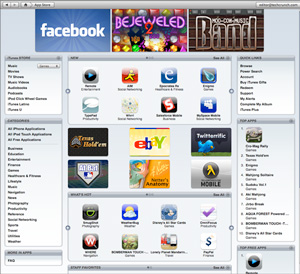
Now that Apple has enjoyed some success with its App Store, smartphone manufacturers are starting to realize that having such a service is a worthwhile endeavor. An App Store with the right ingredients for success not only makes people want to buy the smartphone more than others, but it offers a new revenue-sharing opportunity that could become extremely lucrative.
Perhaps that’s why Microsoft’s new store for Windows Mobile 7, called Skymarket, leaked today. And it’s also why Google announced late last week that it was planning on launching the Android Market to compete with Apple’s store. Each and every company going after the mobile Web is trying to do what Apple has done with its own App Store.
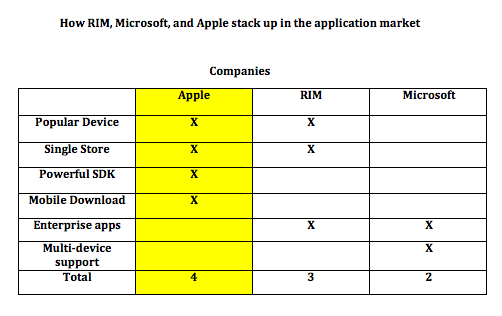
If nothing else, the App Store has shown that there really is a recipe for success in this space. What is that recipe? At this point, success in the Mobile App Store market requires:
1. A popular device.
2. A single marketplace where users can find any application they want in one location.
3. A developer platform that’s both easy to use and powerful enough to create fantastic apps.
4. A dose of enterprise applications.
5. The ability to deploy the same applications on multiple devices.
6. The ability for users to download applications wirelessly to their device from a Wi-Fi or 3G connection.
Apple has most of these ingredients and is performing extremely well in the app market, but its competitors — RIM and Microsoft — seem lost. Both companies have applications that can be downloaded from countless places on the Web, the applications simply aren’t as usable as iPhone apps, and there’s no simple way to add applications to the phone without connecting it to your computer. (Update: To clarify and echo what some commenters have noted, BlackBerry owners can download apps over-the-air and do so on a daily basis.)
While Apple wins out in most of those categories, Microsoft and RIM can still stand up in a few where Apple isn’t quite so strong. For example, Apple’s applications appeal mainly to the consumer, but RIM offers the enterprise solutions that have been left out of Apple’s store so far. But in the end, it’s Apple that reigns supreme in the app store market and will continue to force the others to modify their offerings and catch up.


I think Apple is very good at managing Mobile Apps Stores as they are creative and have Steve Jobs!
http://www.KidT...ru.blogspot.com
Anytime you have a marketplace where software developers are guaranteed a payday, you will see a lot of action.
No risk of web dotBOMB development, and no risk of desktop warez.
If Windows or OSX could promise a nice clean environment where people could sell software, they would see a lot more desktop development. Same for the web. If you could be guaranteed a fair and clean portal for people to use paid services on the web, you would see a lot more investment.
The web is too sparse, and the desktop is full of piracy. So mobile apps will flurish, even with Android, as it’s guaranteed monetization. If you invest in mobile apps, you are almost sure not to lose money.
This bounce back should occur in Q2 of 2009
You should take a look and see why “Applications Stores True Game Changers”
@ http://is.gd/26zS .
And the interview with getjar @ http://is.gd/26XN
7. The Brewery. They aged the phone for one year to build a large enough base to have immediate success to the millions rather than trickle users in. As a developer it’s more attractive to see immediate mass appeal than a cross-your-fingers-and-see-what-happens approach
RIM doesn’t have a Powerful SDK? What exactly does the development environment and sdk downloadable from their site count as then?
http://na.black...eng/developers/
I don’t think RIM’s SDK is powerful at all. Take a look at the apps and what you can do with it. Apple’s SDK is, at the very least, more capable of letting developers get the most out of their apps. I think RIM might be able to improve upon that eventually though.
I’m sorry Don, I don’t know who you are, but it seems you aren’t a very technical person and are completely clueless when it comes to development.
RIM’s SDK is indeed far more powerful than Apple’s as it does things Apple won’t – allow background processes, allow system modules, allow deep integration into system settings and config and allow listening and responding to system events. Were you to ever actually try programming something for mobile devices (as I am doing right now) you’d learn how terribly wrong you are.
Onto your other grave error: “Mobile Download”. You say “and there’s no simple way to add applications to the phone without connecting it to your computer”
Which is simply put, a lie. You can click a link and install a Blackberry app over the air. I can understand a non-developer having trouble understanding SDKs, but how can you sprout these outright lies?
“I don’t think RIM’s SDK is powerful at all” – Obviously you’re not a technical guy and you say it as you see or hear it. Unfortunately you’ve never heard of Java and what it can do.
Indeed.. I would echo the sibling comments. You really gave away a lot with that statement.
What exactly does the development environment and sdk downloadable from their site count as then?
A piece of junk? Their IDE is a complete joke and their Eclipse “plugin” isn’t a plugin at all but a port of their junky IDE into Eclipse. It is probably the worst IDE out on the market
I agree with Thomas E’s sentiments – a good article apart from the needlessly controversial table on SDK and popularity.
ok arrington we know you love your IPHONE but thats not the reason every second post should be about the appstore or the phone….
Why does Windows Mobile not have a Powerful SDK or Mobile Download? I think you’re confusing this with the quality of the device. Those sound pretty arbitrary and subjective to me. I think building for .NET or Win32 is easier and known by more far more developers than Objective-C and Mac development.
So, what’s defines a powerfull sdk? why is Apple’s SDK so much better than Microsoft’s?
They wanted to get somewhere and just needed some arguments
Basically a cheap shot…
iPhone has superior web-browser compared to any other cell phone. The convergence between mobile web and desktop web experience is happening and users want the same experience between the two. Granted, the iPhone may not have Flash support, but it allows me to view every site the way it’s intended to. While Opera and IE for Mobile are trying to converge the web, the reality is far from happening. The new mobile web-browser players like Skyfire, may level the playing field but lets hold our breath on that
Due credit to RIM, even after using the iPhone for over 1 year, I can type emails faster on RIM than on iPhone. For me, RIM is an utility device while iPhone is a fancy one…. I hope that changes when/if iPhone gets a sliding keyboard
Anyone wanting to compete in this space should just market themselves as the other app store and get whatever is left of the market!
Handango has been around longer than any of them
Arrington you’re facts on mobile are way off. I’ve developed a lot of RIM apps and I’m not sure where you’re getting your info.
RIM devices can download and install OTA. http://mobile.blackberry.com/
RIM doesn’t have an app store. They have an alliance partnership program which basically means they help distribute apps from those developers that become alliance partners. It’s not an app store – they don’t take a cut.
What criteria are you using to establish the ‘power level’ of the respective SDKs?
RIM generally does have multi device support. You might have some issues around icon sizes but a 32×32 icon generally works on all RIM devices.
Certainly not all apps can be downloaded OTA and you’ll notice that I said “it’s not easy”. I didn’t say it was impossible, but said that the easiest way to do that is by connecting it to a computer, which is quite true. The experience is much easier on an iPhone 3G.
Don,
Can all iPhone apps be downloaded OTA?
How do you quantify easy? I downloaded MLB Game Day on my Blackberry a few weeks ago and it took 3 clicks and entering my user/pass. That included paying for the application service fee and linking it to my MLB.com account.
I also just downloaded Google Talk on my BB in two clicks, and it took all of 30 seconds. That’s pretty easy.
Finally, I’m no Microsoft fanboy, but Windows Mobile isn’t popular? By one measure, Windows Mobile is 3 times as popular as RIM and Apple combined! (http://wmpoweruser.com/?p=538) Now, true, Windows Mobile doesn’t have one killer device (neither does RIM/Blackberry — or Apple anymore for that matter) but at best, Windows Mobile should be NA, because they don’t create any hardware that I know of, only software.
RIM doesn’t have an app store. They have an alliance partnership program which basically means they help distribute apps from those developers that become alliance partners.
They don’t have an app store but are working on it internally. Why does RIM insist on doing work themselves is beyong me. For example they are writing their own bug tracking software when there are dozens of free and commercial ones. Their own home grown “app store” will likely be a dud.
RIM should figure out what it is doing and just stick to that, and that is making phones. And they should fire whomever is in charge of OS upgrades for them — have you ever upgraded the OS on a BB? Can you? Contact your carrier? Your what? Apple is making all these problems go away.
In Japan NTT DoCoMo’s i-appli succeeded with all checked except “Single Store”. It was not important to have single entry point. All sites could sell their Java-ME based application on their site in easy steps.
I hate to keep pointing this out, but this is another extremely short-sighted article from TechCrunch on the state of the mobile industry. How can you guys continually leave Nokia, the world’s largest smartphone vendor, out of the equation? What about the various Symbian app stores like Handango that have been around since LONG before the iPhone even existed? Come on guys, this should be a no brainer by now.
I, too, would contest the “power” of Apple’s SDK. The iPhone doesn’t even support J2ME or background tasks. And I would seriously question the benefits of having a single store.. competing app stores for J2ME/Symbian phones has helped to keep prices low.
One difference is Handango takes 50-75% of profits from the developer and doesn’t list all the apps in it’s OTA store.
i agree that this is a rather poorly-written article. come on, don, at least update your little table to reflect that RIM would now be 4 with Apple.
still, i think “guys continually leave Nokia out of the equation” because they do not claim a significant share in the US smartphone market, however dominant they are globally. RIM first, apple coming second, according to the latest research.
Handango has been around for ages, as has apps for Windows Mobile, but so what? They obviously didn’t know the best way to optimize their application markets.
Finally, you are flat out wrong in saying that the competing app stores for J2ME/Symbian phones has helped keep prices low. The average price points for apps on Handango is around $20. For the App Store it is below $10, with at least 20% of the apps available being offered for free.
Regarding Apple’s “powerful” SDK try programming anything that has to do with bluetooth…. oh you can’t! So that just leaves a ton of accessories out of the equation.
What about Symbian? You have left it out? Surely Nokia and Sony Ericsson have a majority market that could benefit from an “App Store”?
Handango, the longest running app store, heads to the deadpool.
“powerful sdk”? Don’t get me wrong I love my iphone but from a devoloper stand point window moblie and rim have much better sdks that you take advantage of all the features of the phone.
This article is worse factually than the tech articles I find in my local newspaper, right next to the church bulletin.
Don – I worked on the developer experience for Windows Mobile some time ago. You’re way off here. I would suggest playing with Visual Studio to see what the experience is like or downloading just the SDKs alone and seeing the samples.
Is there really room for more than one here? Isn’t MS (and goog for that matter) getting Gatesd here? iPhone and AppStore is more than a singular product–it’s the new de facto platform.
I think Dan must be fired from TechCrunch!
iPhone is cool, but saying Mobile Windows doesn’t have a “powerful sdk” seems very stupid! and Dan forgot that Visual Studio is much more powerful than Xcode.
Give only one more oportunity for Dan
I guess RIM really wins… the SDK is indeed powerful, and you can do mobile downloads, giving RIM a 5 and Apple a 4.
Non technical people seem to often make the mistake that great UI = powerful SDK. Just because a window can slide across the screen, or an alert box has nice gradients doesn’t mean it’s powerful.
I’m not saying Apple’s SDK is weak by any means, but there are some limitations they place on it, that imo, make the RIM SDK more powerful.
The key here is the device. None of the RIM/MS phones come close to the overall form factor and ease-of-use of the iphone. Until that happens and more phones offer similar screen real estate and non-painful brwser experience, iPhone will continue to attract more developers.
One main item that attracts developers to the iPhone platform is that they make the user experience seamless, so more apps are viewed/downloaded/sold. It has its flaws, but from EVERY iPhone, you can browse, download, install, and purchase. And users know this.
One WM and Palm devices, who have had mobile software since the turn of the century, there has been no uniform way to do any of these tasks. Except for power-users, users did not know that you could add software (no store on device), could not download OTA (a recent possibility and user knowledge on how-to is spotty), installation was a nightmare (from internet to desktop to device), the purchase experience was varied (Palm/Pocket Gear, Handango, Mobihand, Dev sites, etc), and also delivery of the “unlock” registration code for shareware was also varied by site (via email (spam issues), automatic, or otherwise).
The AppStore solves all those distribution issues for the developer, which with the other advantages noted in this article, makes it very attractive for everyone.
A few side comments, with RIM and Symbian, you only can browse certain titles (it’s not easy to get approved or get onto “the stores”), and with the other Electronic Software Distributors (ESD’s), like Handango, they can take upwards of 40-75% of the sale prices.
I recently covered some of this in more detail on our blog “Mobile Evolution”…
Salesforce is there. Medical applications, both from a consumer and physician viewpoint, are there.
Surely more “Enterprise” applications will come to the iPhone.
What’s wrong with handango? They’ve been an “App Store” for years
Surprised you didn’t reference your own (TechCrunch) story ( http://bit.ly/43iERo ) on Mpowerplayer, the Launchbox Digital company. They have the best (only?) try-before-you-buy system for non-iPhone games and apps, and came out of Launchbox with a killer Facebook version. http://www.mpowerplayer.com
One question that I can’t find an answer for…
Can you sell an app that you made in Dashcode in the store, or does it have to be an Xcoded app?
I must be missing something, since I know you can download and install Windows Mobile apps over the air. I’ve downloaded and installed Tiny Twitter, Google Maps, and Opera mobile to name a few.
I’ve written up some tips on how to one up the App Store by harnessing the power of good design: http://jordankanarek.com/?p=30
I think this article missed one criterion that will become increasingly important as mobile applications become more common:
7. a marketplace presentation that understands users’ requirements/expectations and presents them with _relevant_ applications.
There are simply so many apps available through the appstore – or through Handango, or other store-of-choice- that it is becoming very hard for users to find the ‘right’ or the ‘best’ app of any given type, or to become aware of unique/unusual applications that are particularly relevant. I think it will become more and more valuable for the store/distribution system to incorporate user understanding into prioritizing the presentation of the applications. None of the currently popular platforms or stores have this capability, although there are some startups and small players that do. It requires a fundamentally different approach to designing and positioning the store.
IPHONE SDK IS the most powerful.
I’ve developed several paid apps for the iphone. I’ve also programed in .NET for the past 10 years.
What makes the SDK huge is not the programming language (Objective-C) it is the SDK itself. The ability to do complex animations, play audio, respond to touches, react to phone movement. All with a FEW LINES OF CODE!!!
Please…How powerfull a language is means mothing unless you can get great stuff done quickly!
I love .NET, like Java, and really don’t like much Objective-C, but who cares?
Interesting article, I’ve tried writing apps for myself but they’re exceedingly difficult to make popular in any form. I saw jitterbug advertising a seminar on making a successful iphone app but I haven’t worked up the nerve to go.