Movie Labels To Launch New “Open Market” Play Anywhere Scheme As Last Ditch Effort To Save DRM
by Michael Arrington on August 26, 2008

Most of the big movie studios and many online movie retailers are preparing to launch a new initiative tentatively called Open Market, first proposed last year by Sony Pictures, we’ve learned. All of the major studios besides those associated with Walt Disney are already on board and will be part of the announcements made next month.

Sony Pictures CTO Mitch Singer’s presentation to industry participants supporting Open Market is available here.

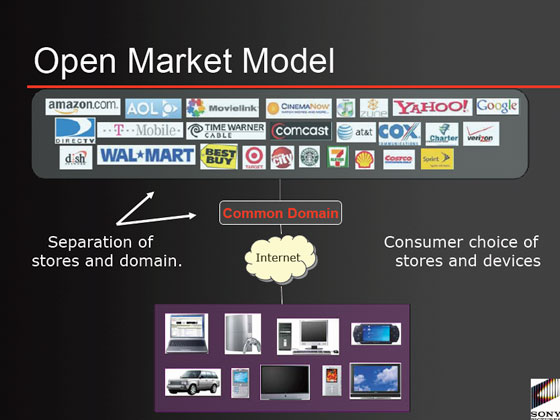
Open Market is a set of policy decisions and a software and services framework that will allow interoperability of various formats and DRM schemes that are currently splintering the market. That splintering locks users into a single store and format, and is putting a stranglehold on widespread adoption of movie sales online. Multiple sources have indicated that the studios are putting their weight behind the initiative to avoid the fate of the music industry and as a last ditch effort to stop or slow non-DRM movie sales.

The industry has been flat out unable to agree on DRM interoperability (the Coral Consortium was the primary hope in this area and has largely stalled). Instead, Sony Pictures proposed Open Market, which will allow play anywhere functionality more from a policy perspective and less from any technical fix to make DRM schemes interoperable.

A key part of Open Market will be a neutral third party to manage device registrations and movie purchases/rentals to ensure interoperability. This “domain” provider will manage services that let users register devices (PCs, televisions, mobile devices, etc.). Any movie purchased from any service provider can then be watched on a registered device.

Supposedly a whole slew of companies are supporting the effort. Fox, Paramount, Sony, Universal and Time Warner are on board. Retailers like Amazon, Target, WalMart, Comcast, MovieLink and CinemaNow are also said to be participating.

Notably absent is Apple and the various Walt Disney studios (Pixar, Touchstone, Miramax, etc.), which are strongly backing the iTunes/Fairplay scheme.

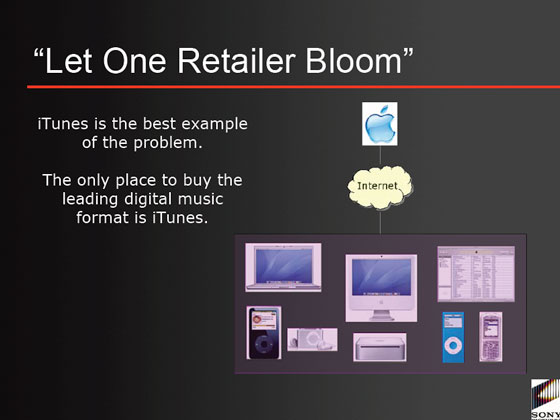
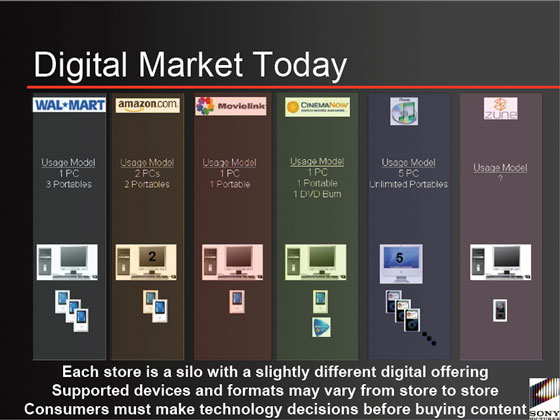
Screen shots from the PDF linked above:


Advertisement

Responses

Comments rss icon

  • If there could have been a common “iTunes store” like domain for several movie retailers it would have happened a long time ago.

    Guess what? They don’t want to.

    Amazon went with TiVo, Netflix put out their own $99 TV playback device, and XBox 360 integration, ect…

    BTW, Netflix isn’t even in the Sony PDF presentation.

    Why don’t they sell movies or Netflix through the Playstation 3 store?

    At any rate, this “everybody share a domain store” concept is a pipe dream, probably conceived after a pipe was involved at some level.

    • The problem is that the domain, most likely controlled by Sony under this model will have it’s own brand and trademark and will make the vendors look generic, and will have them cut throat competing with little to no leverage based on the rest of their business.

    • “Why don’t they sell movies or Netflix through the Playstation 3 store?”

      A great question and one that Sony could not give a straight response. If you remember, Stringer launched the ‘Sony United’ initiative several years ago to integrate the closed formats and notorious silo’s that dominate the corporation. How much progress have we seen since then?…and this is the company that’s leading a major interoperability initiative?

    • sorry, accidentally hit submit…. Here is a better of article; but looks like the cable networks, studios, game consules are going to battle it out and Xbox has a huge advantage with its ability to replace the standard set top boxes we use for cable, etc… today

      http://www.enga...ce-partnership/

  • 70-80% of all the digital music devices are controlled by Apple, if they are not involved then they just locked out 70-80% of the music market, if they went DRM-free they have access to 100% of the market.

    They are too late to the game to try and copy Apple, the music industry needs to open it’s eyes and actually do something that makes sense, either it will save them in the long run or they will die messing around with these half-baked ideas

  • [Movie "labels"? I think you mean studios, Mike.]

    • Jargon schmargon. “Studios” are just as responsible for making movies as grocery stores are responsible for making maple syrup. MPAA=RIAA and Studio=Label. Same damned thing, same suits, same industries going belly up, just eight years later.

  • It’s about time to provide a single point of distribution but supported by multiple businesses. Great for the business and excellent results for the users.

    • It will take a helluva marketing campaign for movie studios and 2nd class retailers (read: not iTunes) to convince leery consumers. They’ve been fooled before…

  • does this mean the internet is shrinking.

    what is gonna be the domain name of this openmarket exchange site?

    i think this means the internet is about to get more compact.

    this proves my theory that we dont need another website or domain name, we have enouth to work with.

  • I don’t understand why Apple gets the blame here. They built their own empire around their hardware.

    The companies who own the content are the only ones mandating that iTunes continue with DRM.

    • The labels/studios hate and fear Apple because Apple has already locked music distribution in to iTunes, and there is no viable alternative. The movie studios don’t want to be trapped the same way, so they’re trying to band together against iTunes and drag a bunch of half-wit frightened retailers along with them. This is PlaysForSure 2.0 and just as likely to succeed.

  • This is dumb. If there’s a middleman, what do I need the store for? Why is Target necessary if all the licensing is handled by the content equivalent of Verisign? Why not just let them sell-through to consumers?

    • Why do you need Target retail stores when you can easily shop at their wholesaler? Oh right, you can’t, they won’t let you. Same reason – a race to zero margin is bad for everybody involved.

      If Target can drive through sales (with gift cards or whatever) in their stores then they deserve some small cut even if it’s only a few percent. Same applies to any other retailer. If you try to kill all the current retailers and make one new monopoly online retailer, they’ll protest by refusing to sell physical CD/DVDs in their stores out of protest. We are not at the stage yet where physical retailers are completely superfluous. And anyway the goal is to enable competition amongst digital retailers which keeps their cut small – unlike Apple which has at least some pricing power. A monolithic retailer for all digital media would surely draw antitrust attention also.

    • Because the whole point of a retailer is to offload customer service from the product producer and wholesaler. This thing is just a big authentication server, it doesn’t care about creating a good purchase experience or taking phone calls from unhappy customers. Dealing with humans is difficult and expensive and the content owners don’t really want to be in that business. Retailers only need like 3% net margin which is cheap enough.

      • Well they don’t technically *need* a 3% margin, if there was ever an end game to a given sector with perfect competition and market saturation, with little or no room for improvement for the given segment, the profit margin will even get lower.

    • Movie studios are banding together with their current distribution channel (retailers) against their common enemy, the Internet. You don’t need Target to get your movies now, and you never will. This is the cycads allying themselves with the dinosaurs against the deciduous trees and vertebrates.

  • Shucks though, we already have a ‘common device which can manage all registrations and purchases’ and can play content ‘from any service provider or retailer’.

    It’s called a “computer”.

    Soon as somebody makes a decent wireless HDMI adapter and software combo product, ALL of the solutions proposed here by this “open market” initiative will be totally resolved. People will plug it in, find a movie from WHEREVER, then hit play, then go sit on the couch with their RF remote.

    • “Soon as somebody makes a decent wireless HDMI adapter and software combo product, ALL of the solutions proposed here by this “open market” initiative will be totally resolved.”

      Firstly, not even an N class wireless stream can stream HDMI 1080 content.

      “People will plug it in, find a movie from WHEREVER”

      Where is the where in WHEREVER?
      The new highdef H.264 Flash codec doesn’t even come close, so don’t say Vimeo or YouTube.

      Currently the only sites that have started to stream and provide downloads for true high def are porn sites http://www.goog...earch?q=HD+porn

      I am not aware of any legitimate genuine indy film sites that provide HD.

      So if there is content, it will have to come from newsgroups, IRC, or p2p. That will congest the internet a LOT. Even now with people trading Dr Who episodes that take up an entire DVD at 5 Gigs a piece compressed is bad. Imagine 30GB blurays being traded. I think there are already groups that do, but they’re not popular.

      If wireless HDMI ever does happen it will explode.

      Netflix, Unbox, ect.. will be years behind as usual. That’s just the way it works.

    • If you own a PS3, you can download and view HighDef right now, though your selection is likely to be limited to porn. That’s ok though, the PS3 will not discriminate. It has decoders for high def mpeg. There may be a few obscure indy films that you can download in high def too.
      http://www.goog...lms+HD+download

  • Will this work for music, games, ebooks, etc. or just movies?

  • how about the studios engage their illegally downloaded content and offer users ad-supported flicks and the option to do the right thing?

    Obviously not referring to films in theaters. But go on pirate bay and look at all that shit.

    Why dont they try and monetize at least a little of this rather than DRM’ing content, waiting like idiots for a DRM solution that works out.

    DRM DOES NOT WORK

  • Here’s another option.

    Content creators can sell directly to their fans. When they release a new piece of media they can post it on their own blog using a microformat.

    Third party niche websites can be developed to scour the web for these media microformats that contain specific information.

    For example, one site might be dedicated to finding the latest hip hop songs from the bay area and linking directly to the artists. So they would find media microformats that contain genre info, location info, and release info and return only the hip hop songs in the bay area from this month and give you the link to download or purchase the song directly from the artist.

    Instead of having a few destinations to view all types of songs, you’ll have a long tail of niche destinations for specific kinds of music. And the artist doesn’t have to register with any of them. They just have to use the microformat.

    • Also the artists can encode their media any way they want to.

    • Nice idea to enable a Long Tail in retailers and not just content creators. What do you mean by purchasing “directly from the artist” though? Every musician or indie director has to set up a server? They’re going to want somebody else to aggregate the hard technical work. Right now that’s Myspace for hosting the web site and iTunes/Amazon for hosting/selling the media files. For instance Pandora helps you find music, but links out to iTunes if you want to buy it; presumably they get a commission.

      • The artists can choose whatever services they want for fullfillment and list them in the microformat.

        Personally, I would release my work for free under a creative commons license that would allow third parties to resell my work. The microformat could include a download link.

        That way, essentially any retailer big or small that can detect the microformat can automatically add my media to their database without me manually uploading it to them. My media would have the potential to be in every single retailer that exists with just me posting a media microformat to my blog.

        The goal for me as an artist is to gain fans. People may not pay for a piece of my work they can get for free digitally, but the more people who have access to my work, the more fans I would get.

        And fans are more than willingly to pay for non digital goods such as merchandise, to see that person live, or to collaborate.

        Also, for fans willing to pay for media, given a choice to buy from iTunes or download and donate directly from the artist, I think a true fan would rather download the media for free and donate the amount they were going to buy it from iTunes.

    • That’s not what consumers want. They do not want cheesy videos from YouTube.

      They want the multimillion dollar budget Hollywood films. That’s what they’re trading on p2p, newsgroups, and IRC

      They’re not trading some B film made by drunken Canadians in Nova Scotia.

      The answer to this is SO SIMPLE. It’s SO SIMPLE.

      All they need to do is to offer MORE than a simple bluray disc in stores. Offer more than a Homer Simpson shaped box. Offer something you can’t print out on a printer from a PDF. Something undigital in the store version of the product.

      People will make the trip to the store to buy again. It’s that simple.
      Give people something they can proudly display, and say they own instead of 2 bit printed crap and a plastic laser disc.

      They have to ramp it up. It’s time. They’re lazy.

  • The only way I’m likely to stomach drm is if it was industry wide. There no way in hell I’d touch whilst it I can’t play the same file on all the devices I own.

    Of course even them international licensing agreements mean the whole thing is pretty useless and so I’ll happily stick with discs.

  • Oh no, the big bad iTunes store is locking everyone out.

    WHAT’S THAT?

    You say Steve Jobs already wrote an open letter to the industry, asking them to drop DRM entirely? You say Apple already has made “iTunes Plus” available, which offers DRM free music service to any label that will agree to use it? You say AAC is a standard format that can already play on many non-Apple devices, including Windows computers?

    Give me a break. If you want to find who’s driving this, look at Apple’s competitors. That’s all…

  • Fail! This will be hacked in a week.

  • What’s a movie label?

    In any event, this effort will fail just as surely as the previous ones. People, people, time to move into the opportunities of a post-DRM world.

  • “Notably absent is Apple and the various Walt Disney studios (Pixar, Touchstone, Miramax, etc.), which are strongly backing the iTunes/Fairplay scheme.”

    Hmmm…let me see, what do these two organizations have in common…oh yeah, Steve Jobs is significant shareholder in both ;) It’s good to be the King :)

  • the hearts & minds of storytellers, from various countries, unveiled
    at the open film festival presented by Culture Unplugged Studios

    http://www.cult....com/index2.php

    Asia & Middle East’s first online film festival, wishing to focus on
    not just films, nor just film-makers, but the consciousness transplanted thru cinema.
    Be the jury and Enjoy! Film Festival 08 : East Speaks, Here.

    watch, vote and spread the buzz in your community, on your social networks, in your blogs.
    promote films. promote consciousness.

  • Xbox beat them to the punch. Fantastic deal with netflix. Where is blockbuster in all of this mess? Great things.. http://www.goth...te.blogspot.com

  • Okay so now TC is two-thirds ads with half of the remaining third white space.

    I’m not impressed.

  • A step in the right direction, towards interoperable, portable DRM.

    If it is truly managed by a neutral third party whose only interest is in creating a universally available service, open to all customers, it will be a a good thing for all of us. The minute it gets caught up in shortsighted, vendor-specific attempts to lock up markets, it will have troubles.

    All this assumes it has strong technical underpinnings. We’ll see.

  • Hi Michael,

    I know this thing out here is completely irrelevant ..but ….anyway…

    Have been a regular reader of your blog for quite a long time now.

    The thing I liked about TechCrunch was that I was able to read all the posts on the main page itself, instead of traversing to the inner pages to read the full content.

    But unfortunately I see that this has changed with the new design.

    Don’t you think that its not how your audiences would like your site to be?

    Would like to know your take on this and hopefully would like you to do something about it.

    Thanks.

  • I know this is out of point, but I have to say nice layout Mike! It looks cleaner!

  • This new lay out is awful! The main reason I read techcrunch is to avoid having to click around to the different stories. This is just a kick in the face!

    Way to just blend into the crowd!

  • “iTunes is best example of the problem”…

    GIVE ME A BRAKE!

    Sony, do you think we’re that stupid to swallow your whole “consumer choice” BS? iTunes is the “best example” of a business model that WORKS and it pisses you off because you’re not the one who came up with it. Unless you’ve got some serious memory loss issues, you’ll remember that before iTunes no one could manage to figure out a way to sell digital content online… mostly because of the limitless greed and complete lack of forward thinking from the antiquated music industry, and its inbred cousin: the movie industry.

    The reason why there’s DRM on iTunes stuff is not Apple, it’s the music industry, it’s YOU sony.

    “The only place to buy the leading digital music format is iTunes” You mean MP3 right? Right??

    “Consumer must make technology decisions before buying content” Not really… They buy an iPod that’s not attached to any kind of registration scheme and load it up with their own music collection and DRM free music like iTunes + and Amazon. The only thing that’s “wrong” in that picture is that you’re not getting a slice of the pie…

    So I suggest you rename you “Open Market” thing the “Me Want Money Too”

    That’ll reflect better what this is ALL about

  • It would help this industry if there was a central authority for clearing just as there is for certificate authentication. it is interesting that bank accounts and the like have a certificate issuance authority yet the deployment of digital born goods is trying to lock the content instead of the wrapper around the content.

    As for sony they just want to have another custom codec for the hardware. The only reason apple is successful in this 15 year endeavor is because they pulled off the proverbial ‘jukebox in the sky’ deployment albeit at 1 Infinite Loop and it works good enough. It works although it could be much much better then again why try harder when you own 85-90% of the industry.

    For the movie studios they continually try to put out new protections that ride along with the content instead of entrusting a more wrapper based funds transfer model. People care more about the user experience now (read search,matching,personalization and on demand) way more than “owning” a movie.

  • Guess what? There’s already a device-led ‘OPEN SYSTEM’ using an as yet un-hacked DRM… The DivX certified VOD platform. AND the word is that the PS3 is about to be DivX certified!
    So you get the ‘Open System’ unlike the Apple ‘Closed System’, with proven technology and devices from most major hardware manufacturers already certified and out there!

  • another DRM, rebranded/renamed? No thanks.

    Until DRM is abolished, all my donations will go to torrent seeders.

Leave Comment

Commenting Options

Enter your personal information to the left, or sign in with your Facebook account by clicking the button below.

Alternatively, you can create an avatar that will appear whenever you leave a comment on a Gravatar-enabled blog.

Trackback URL
bugbugbug