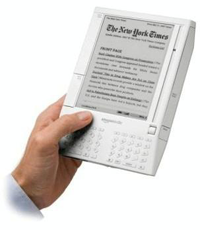
More rumors about the new Kindle are emerging, which we first wrote about on July 15. The first device will have a similar sized screen as the existing model but will have a much enhanced form factor. The second will be a large screen device aimed at students and will come later.
Somewhere around a quarter of a million Kindles have been sold to date and Amazon is clearly pushing out the last of the current units via a credit card promotion on their site that drops $100 off the $359 device.
Kindle is currently tracking the iPhone/iTunes model – Amazon sells the Kindle for a profit and then makes more revenue on content purchases from the Kindle site that they run. I don’t know how much margin Amazon makes on each Kindle sale or how much they make on average from content purchases. But if they really want to push ebook adoption by the masses and stay at the center of that universe, I’d recommend a dramatic shift in business model.
Imagine if Amazon launched a licensing program that gave hardware manufacturers the ability to build Kindle clones, along with an incentive to sell them at near-zero margins. Amazon would give those manufacturers access to the core Kindle hardware specs (there’s no real magic there anyway) and the right to call it a Kindle device so long as they also put the core Kindle software on the device. That software links the device to Amazon’s store, meaning downloads revenue flows through Amazon.
Amazon would then share a percentage of net margin generated from downloads with the hardware manufacturers.
Very quickly we’d see a wide variety of Kindle devices, all competing on price, features (large and small screens would just be the start) and form factor. Hardware manufacturers, who are all constantly trying to squeeze a tiny bit of margin out of their products, would suddenly have another revenue stream to tap.
Amazon would continue to control the signature device and would likely be able to sell them at a premium since a lot of consumers would prefer the Amazon brand. But a whole ecosystem could emerge around the device, including multi-function versions that do other things. And each of those devices would be linked to Amazon and making money for the company.


Still waiting for a UK release, otherwise understandably uninterested!
And what would you do with a CDMA radio for the whispernet? That wouldn’t make any sense. Quit whining. Why even bother commenting on this post?
He was clearly registering an opinion that the rest of the world would like to use this technology, but until it becomes available we can’t even really enjoy talking about the new version.
I say: Ditto.
Maybe because there is demand for this product outside of the US and he wants it to be known?
Amazon has to really get serious about international releases now, Kindle is a success in the states and it will be a success internationally.
I live in the UK about 2/3 of the time, and the Kindle is great. The wireless feature, while neat, isn’t the main selling point for me. The ability to carry multiple books in a small form factor, and to actually enjoy reading them (unlike trying to do so on a laptop) is what makes it for me. I bought a book on my laptop in the Dublin airport, then downloaded it to my Kindle, and the whole process took less than 2 minutes. Slick!
Don’t drop your Kindle. It will be toast and you will be buying another one again, OR not.
Right now the Kindle has a department for technical support and customer assistance:
Your idea wouldn’t work for different software/hardware versions and the associates wouldn’t be able to effectively troubleshoot knock off brands/versions of the core kindle.
Nice concept, however in theory it wouldn’t work from a Customer Service side of things and trust me, I take more than enough calls in regards to core unit right now, for things as simple as registering to troubleshooting issues.
This would set an interesting precendent for certain other companies…
It might work. But I’d see a world like PC vs Mac: The kindle brand would become bigger, but also less stable, because of all the various hardware configurations that would have to be supported.
So, on one hand the PC world is a lot bigger than the Mac world. On the other hand Mac has a higher profit, more expensive hardware, but often also seen as more stable, since apple has full control over all parts.
the multiple hardware configurations are a serious issue, and the Kindle software is clearly not set up to handle it. But that still leaves room for a different form factor, and multiple hardware support could come later.
PC (MS Dos) vs. Mac’s OS. VHS vs Beta. PCL vs every other “Printer Control language”.
This strategy is a tried and true strategy. It works. On the other hand, Amazon may not be “forced” to do this until some other manufacturer (Apple, HP, Lenovo?) comes along with a better distribution channel and a competitive product. Then they MUST do it, or they will be confined to be the “Palm Pilot” of the industry (proprietary niche small-time player).
And how are these other manufacturers going to swing free EVDO (a recurring subscription cost and the only true significant differention of Kindle from other eReaders) on a tiny slice of eBook profit margins?
They aren’t. Besides figuring out the number of units sold “analysts” and bloggers should also try to figure out how much Amazon is losing on the free data network. And by “figure out” I mean “guess.” It may be low cost now because it’s hundreds of thousands with very limited functionality. Add more features, several million users, and start to transform the book industry, and I doubt Sprint is willing to give away a chunk of its bandwidth on the cheap.
I think Wifi is actually the killer feature. I don’t use the EVDO much because surfing the web on the device is sort of useless.
There’s also the possibility that the EVDO deal could be extended to the clones. But given the cost of the radio, some consumers may be happy to take a cheaper device that doesn’t have the radio included.
Agree–WiFi would be ultimately more useful and less limiting than EVDO. I am not sure I’ve actually used the EVDO anyplace besides my home, and I’d rather use WiFi there anyway.
I’d like a platform independent reader for their DRM. Annoying that I can’t read on my PC.
they could just open an API to the whole kindle system (DRM+store).
windows client
AIR app for the kindle?
mac client?
just to be clear, an air client for os x or windows, not air on kindle
why not? security issues?
I like the idea of the Kindle but I can’t help thinking this device seems awfully anachronistic in its feature set… I know epaper is pretty new I guess but does the UI have to look like Mac OS 7? I guess I’m not the target market because most of the books I buy are either huge Design/Photography books or or reference books I use while at the computer… What I would DIE for though would be a large (A4 or so) color screen where I could read full color comic books
I have about 5,000 of those (hard cover “European” style) back home and it used to be my #1 drawing reference material… I hope someday…
Got a little sidetracked here. Sorry!
“What I would DIE for though would be a large (A4 or so) color screen where I could read full color comic books”
I also would LOVE something like this, perhaps similar to Comicbooklover – a Mac app, for e-comics.
Recently signed up for a trial months subscription to Marvel Comics Unlimited, a web based services whereby I have access to 4000 marvel comics, ok it’s web based so it’s not ideal, but for the price it’s pretty good.
Sorry for going off topic
Your suggesting Amazon go with a more Microsoft-like PlaysForSure and drop the iTunes model?
Because that totally didn’t help Apple gain it’s massive market share in digital music downloads!
It worked for Apple because Apple have a decades-long track record of making consumer products that people salivate over and want to buy. Amazon do not.
Mike’s idea makes sense, in that respect. Let consumer electronics manufacturers do what they are best at and let Amazon be the backbone of it all.
To your point, Amazon licensing out the Kindle back end thus allowing iPhone developers to create Kindle apps for the iPhone would immediately increase Amazon’s reach into the ebook market by an order of magnitude.
hmm, sounds like an idea iterated on a comment from above, just changing AIR, windows, or OS X to the iphone. how original!
Kindle vs. Zune (Google Trends)
http://trends.g...=all&sort=0
Yeah, that whole licensing thing worked out well with PalmOS PDAs.
Next!
Very valid points Mike.
Why does anyone want to sell at near zero margin?
Michael’s idea, at first glance, makes sense since it’s obvious that the Kindle could use many obvious features. In essence, he’s asking Amazon to create the Windows O/S for the publishing industry while sacrificing profits on the hardware (during it’s growth phase) and a percentage of the book sales. In return Amazon would get better hardware features, form factors, and pricing.
This seems highly unlikely since Amazon is really only one hardware release away from addressing these concerns. Apple has clearly shown that controlling the hardware platform (while outsourcing the hardware design) can work and I wouldn’t be surprised if Amazon isn’t following this model.
There are also many other factors such as Amazon’s agreements with the publishing companies and bandwidth providers. Who knows how tightly these agreements are tied to Amazon being the hardware distributor. For people looking for eBooks on the PC/Mac, Adobe has been doing this already for years so there’s no barrier for the publishers to adopt this approach. Why haven’t they? Most likely it’s about control, piracy and a belief that a purchased document should only be available on one platform. They may actually want users to feel that the documents are more tightly tied to the hardware, but I’m speculating here. Still, the fact that publishers haven’t adopted Adobe’s eBook capabilities is telling.
–Jim
Author, go embrace your CRAPTASTIC, LOCKED ITUNES LIBRARY.
Yeah, just what we need, ANOTHER CLOSED, PROPRIETARY, DRM-RIDDEN JUNKBOX.
**************************************************
Portable doc viewers should be AS OPEN AS TV sets: PLUG IN WHATEVER YOU WANT AND WATCH IT.
**************************************************
Author, STOP KISSING GREEDY CORPORATE A$$, BROWN-NOSER!
Actually, crying about DRM and closed, proprietary tech, is usually attributed to the “hippie-like” characteristics listed as your name.
Greedy Corporate? Or, just good capitalism? Are you a commie?
Sony Reader is by far the better product. Why are we still talking about this POS?
If Sony Reader is by far the better product, why have I not even heard of it given that I fit the exact buying demographic for that kind of device? I’m going to buy my own Kindle as soon as the new one comes out but I’ve given one as a gift before. They’re great.
…and what company would want to sell a device for a near-zero margin without any ongoing revenue?
Hasnt somebody cracked Kindle yet?
Yet another reason why publishers would prefer a closed architecture.
I disagree. I think Amazon needs ownership over the device as well, otherwise the quality of content display will be standard-less and at the mercy of cost structures and strategic decision making of these manufacturers. The iPod drove initial adoption of iTunes and then of course the content quality and ease took over. Amazon should not let go of control over the device just yet, BUT it must consider selling the device @ cost (assuming that they are not already doing it) and charge just for content. Apple is able to charge so much for hardware, software and content because people believe that they have great design style and they definitely do so. When you think of Amazon, observe the images that are conjured up – Amazon reminds me of Walmart – variety and low cost. Plus the kindle is NOT the best looking device in town.
Summary: Amazon must continue selling the hardware (at cost if possible) and charge for content only. I would also suggest storing all ebooks downloaded online like .MAC and using the device to access that content thru Wi-Fi as an alternative.
I especially agree with your comments about styling. No doubt I’ve been ruined by Apple, but I really want my gadgets to look good and I’m an older guy. I read that younger people are even more demanding when it comes to design. Come on Amazon, hire one of those fancy design boutiques to give the Kindle a makeover.
The problem here is that the kindle is yet another device to carry around. And a pretty bulky and expensive device at that. The author of the article is correct in saying that Amazon needs to reduce the upfront costs of this unit. Especially considering that it can not cost more than about 50-100 dollars U.S. to produce.
Get the cost down and make money on the downloads. They’d have a real business model there.
But how does Amazon in that business model make sure the new devices won’t support other networks/online stores besides Amazon?
i believe Amazon has enough resources to spend on market research that they don’t need some Bloger’s advice. Mike, your Ego problem is getting out of controll, seek some help.
Mike, I disagree. I think you’re just being a Silicon Valley idealist. There are very good reasons to close hardware platforms that do a specialized task: nobody expects Nintendo to allow third-parties to make Gameboy DS clones.
Like the iPhone, the Kindle is a product that has a close relation to the telecom companies — they’re going to insist on some control. The business model of selling value-added services over cellular data networks makes it possible to sell compelling services, escaping the trap of the super-expensive data plan that gives you very little.
The iPhone has a small, free prg called: Stanza.
It allows you to read 1,000s of books… all for free.
http://www.ipho...hone-114151.php
No need to buy, (or carry) a separate (huge/heavy) device with you.
This is the device I am most interested in:
http://www.readius.com/
“Amazon would give those manufacturers access to the core Kindle hardware specs (there’s no real magic there anyway)”
Darn right there isn’t. An E-ink screen, a basic low power processor, some flash-type storage, and some software features.
The principal reason e-readers haven’t taken off in the consumer marketplace is price. The principal reason the price is (still) so high is that the best option for e-reader screens comes from a monopoly supplier.
There will be no mass market for e-readers until the monopoly supply problem on optimal e-reader screens is fixed.
this is simply mike blathering again… much like the guy in the shower who’s smoked a bowl… the guy gets out and say’s damn, i’ve got a great idea.. and he runs to tell others about it. when he wakes up, he realizes that his idea was that the soap should be attached to the towel for easy access!!!
the diff with mike, he blathers this half baked syuff on his blog, and people say “ohhhh it’s from mike, let’s discuss/take it seriously!”
there are a host of reasons why you wouldn’t deviate from the model that mike espouses, and to be honest, there are some reasons why you’d employ that strategy as well. depends on which side of the fence you’re on regarding the software/hardware application you’re trying to implement, and the level of control over your part of the process.
if you’re just shoving software/bits, and you can “maintain” some level of control over the hardware built by the manufacturers to support your software, then it’s an easy decision.. but if you’re looking at other factors, then the decision really isn’t that cut/dry.
this sounds like mike spouting as usual..
yo, mike, how’s that cheap (we’re gonna rock the world with it) tablet device you were going to build a month or so ago!!!
mike mike be a good reporter/journalist/biz owner.. but i would say the jury is still out as to his ability to really build a tech biz (hardware/software, not a blog).
peace
“I don’t know how much margin Amazon makes on each Kindle sale or how much they make on average from content purchases.”
I sell a Kindle version of the book at Amazon.com, they take 65% of the costs and give 35% back to the book seller.
Amazon charges a higher percentage compared to Apple’s iPhone Applications.
i think the kindle looks great. the problem with it isn’t the device. people don’t read books anymore.
I really would embrace the Kindle if I didn’t feel like I was being ripped off by book-pricing. I find it hard to conceive that margins remain the same between the 5+ dollar charge for a Kindle book, and the 7.99 for a paperback. I’d rather pay the two bucks extra for a hard copy.
When Kindle books get to 2.99 – and I can save them for reading a year later – I’ll become an enthusiastic buyer….
Looks like Amazon is rushing to get the new version out before their fiscal third quarter’s end.
It’ll give the CEO, Bezos, something fun to talk about
Given the state of the US economy, the slowing European economy, the rising dollar, I can’t imagine the rest of their quarter is going all that well…
Publishers estimate 10000 Kindles have been sold – now that’s probably too low, but 250k – give me a break, were Amazon to sell that many they would trumpet it high. I think maybe 50k is reasonable, I doubt 100k Kindles sold to date
I had a Sony but it was slow so I use my iPhone now and am reasonable happy. I would buy a Kindle at a lower price (150$ say, maybe 200 if it gets way better) since for me its wireless is useless – I do not buy drm books that I cannot convert to read wherever I want
Just Do It {seesmic_video:{”url_thumbnail”:{”value”:”http://t.seesmic.com/thumbnail/BLZR5S4oTh_th1.jpg”}”title”:{”value”:”Just Do It ”}”videoUri”:{”value”:”http://www.seesmic.com/video/IKxzuFj5CC”}}}
Living in the Silicon Valley I have seen a Tesla 4-5 times ‘in the wild.’ I have yet to see a Kindle.
It’s not really an “in the wild” device, though, is it? Mine’s on my bedstand or desk more often than not. Also, even though I’m wildly enthusiastic about the product, there’s not a lot of “wow-factor” for me to show off to, say, anyone that’s seen an iPhone or PS3 in action (and how could any device with a slow-refreshing, B&W screen compare in that way?). Like the Blackberry and TIVO, I’d argue that the Kindle will spread more by word of mouth than through the power of gadget lust.
What keeps me from the Kindle is that to justify its cost, I would have to buy about 30 books on it, and the 9.99 books that would recoup the cost are usually best selling fiction that I only occasionally have interest in.
Mag and paper subs are too expensive recurring costs, so I am likely to instead go for free web content
What would push me towards the Kindle, would be if amazon simply had a simple delimited text file of such as Title Author Cost of the 100,000 or so titles available; or even a web version a complete Kindle Catalog that is not such a pain to navigate
The premise of this model – that Amazon will need to fight to stay at the center of digital publishing – seems flawed. The first company to rope, say, half a million users into their ecosystem will probably be the go-to eBook seller for the forseeable future (especially if they build in a few more social features). If, as the Citibank guy prognosticated, the Kindle becomes kind of a go-to curiousity Christmas gift (since the iPhone and iTouch have sated the gadget lovers every other need for relatively little cash), they could reach that half a million mark sooner than you think.
I’ve barely had my Kindle a week and it’s a great product! Too bad I’ll return it soon and wait for 2.0…
I’ve been saying all along, Amazon.com should offer a free digital copy of any dead tree book you purchase. If I started collecting a bunch of digital copies, I’d proly buy a Kindle sooner rather than later.
Arrington thinks Amazon should license the Kindle technology to hardware manufacturers to help deploy the device and rev share on the content. I think this is a dumb idea, but poll against me at tinycrunch.
There a more macro-level problems with Kindle IMO.
http://usedbook...start-the-fire/
Books have always been portable and most readers a) don’t need more than one book at a time and b) don’t reread the same book again and again and again.
The iPod works because you want to listen to the Arctic Monkeys again and again so the cost per use is obscenely low. But, in a normal commute, you also want to listen to the Arctic Monkeys, some Green Day then some Beck, maybe Radiohead etc. etc.
Very few will read the same book twice, let alone hundreds of times. Again, very few will read more than one book on a commute or even a vacation.
That’s why textbooks DO make sense.
Yet, that’s where price and DRM continue to be a problem and publishers rear their ugly heads. Publishers aren’t jumping up and down to hand digital books over to Amazon. They’re already a bit grumpy about their stranglehold on eCommerce.
This is a fine hardware/technology suggestion but I’m not convinced this product actually fills a large enough gap in the marketplace.
Try moving several hundred books when you change apartments once a year. Paper is a nuisance.
That said, I bought an ebook from Amazon (ironically, The Innovator’s Dilemma) maybe 7 years ago and it’s already dead because Amazon won’t authenticate it anymore. They stopped selling Adobe Acrobat files after Elcomsoft cracked them and I guess they let the auth server fall into disrepair. So I’ll get interested in ebooks again when I can buy them without DRM, or strip it myself after purchasing.
Great thought. Reminds me of the way VHS (developed by JVC) became popular a couple of decades back.
Amazon simply needs to go cross-platform with their reader, much like Apple with iTunes. Make a reader for the PC, the Mac, the iPhone. And then sell books. Lots and lots and lots of books.
Best guess is that there have been 150 thousand Kindles out in the wild. There are twelve MILLION iPhones.
Which audience would you rather reach?
Michael Arrington,
Why do you always rail about music DRM but give Amazon a free ride? I paid $60 for a pdf book on Amazon a few years ago. It will no longer work with Adobe Digital Editions and Amazon told me it was not their problem when I wrote them.
I would LOVE to buy a a good book reader (and happily pay for content) but the Kindle is a joke because of DRM. Read the fine print.
YES! And then I could read all my Kindle content on my iPhone!
I wish they would expand the product to other countries, specifically, Canada
Being able to read my monthly book purchases on a compact device would be great.
Bring Kindle to Canada!
I had some similar thoughts.