Do not panic. We accept late submissions for TechCrunch50, but please submit soon. »
Google Will Now Manage Your Website’s Ads
by Mark Hendrickson on August 26, 2008

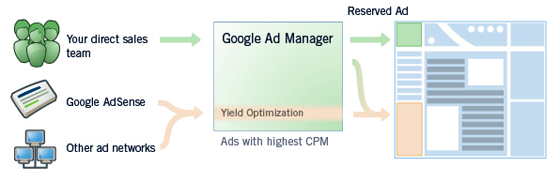
Last March, Google began inviting a select number of publishers within its AdSense network to test a new hosted advertisement management tool called Google Ad Manager. The search company has now announced that the tool is out of beta and available to all publishers with AdSense accounts.

Since its unveiling, Google Ad Manager has been seen as a direct threat to OpenX, an on-premise software solution (known previously as OpenAds and phpAdsNew) for managing the advertising campaigns on websites. Both solutions serve and track the performance of ad units sold either directly or introduced by third party networks like Federated Media or Google AdSense (which we use here at TechCrunch). But only Google can “use AdSense to fill unsold inventory or compete on price against other ad networks,” optimizing returns for publishers by serving up the most profitable ads from campaigns vying for the same space on a page.

As a hosted solution, Google Ad Manager also has the advantage of an easier setup and administration process since it doesn’t require any server-side installation or code maintenance. A hosted version of OpenX - which would necessarily depart from the company’s open source roots - has been anticipated for awhile now but has yet to be released.

Some will say the public release of Google Ad Manager spells serious trouble for OpenX. But seen in a different light, the release also enhances OpenX’s standing as acquisition bait for the likes of Microsoft, who wishes to compete more effectively against Google in the online advertising space.

Since its acquisition of DoubleClick, Google has also run the DoubleClick Revenue Center for publishers with large in-house ad sales teams.

Responses

Comments rss icon

  • Google, will you be allowing iframes in these ads?

    (We need this in order to serve ads that have content specific to our users - ie their daily words - in the language they elect to learn).

    • To answer your question, YES — Google allows you to insert any code snippet you want, including iframes.

      Now, on another note:

      As a user of GAM for several months now, I can report that it is a BEAUTIFUL product. Google, you are brilliant. Unlike OpenX, GAM is easy to use, easy to share with people with average intellects, and works flawlessly all the while.

      But where OpenX beats Google, ironically, is in its ability to deliver ads based on keywords and context. Google only allows a very limited extent of custom keyword targeting. GAM’s keyword targeting is so limited, in fact, that a die hard keyword-targeter almost certainly must fall back to continuing to use OpenX, as a vehicle for delivering targeted GAM-mananged ads.

      But jeez louise, as far as accommodating keyword targeting, generally both stink. Neither Google nor OpenX have this down yet, nor even appear to even acknowledge the VITAL importance of keyword targeting.

    • Yes, I’ve used iframes and they work well, haven’t noticed any bugs.

  • Hopefully they worked the bugs out of it as of the announcement ;-)

  • Why did Google buy Doubleclick?!?

  • This is really interesting. We currently use OpenX and we’re pretty happy with it. The free/hosted thing vs our own servers and bandwidth isn’t that big of a deal… the biggest thing being the capabilities of the server and software for us. If Google can do this right, then that’s great/amazing. If not, then the hosted aspect isn’t that much of a selling point to us at least.

    One thing that’s nice about OpenX is since its Open Source PHP-based software, modification and extension is fairly easy, but I’ll leave it as a possibility that Google will roll all of the features that we need into that. We’re more than happy with Google Analytics for example.

  • It wouldn’t make sense for MS to acquire OpenX to compete with Ad Manager. MS got the Atlas ad server as part of the aQuantive acquisition, it would make more sense for them to create a scaled down version of Atlas to compete with Ad Manager (or just go balls out and really stick it to DoubleClick Revenue Center/ Google Ad Manager by making the full suite of Atlas’s functionality free.)

    • Completely agree. Microsoft would pretty up Atlas long before they’d bother with OpenX. The only value of OpenX is that it’s FREE and PHP. Since the game here is hosted ad management, the PHP thing is moot. Regardless, Microsoft doesn’t even use PHP.

      As a matter of fact, the ability to call ads from OpenX via a PHP XML-RPC method was actually DOWNFALL of OpenX for me! I had to fall back to using Javascript to build a Shitty Wall around my ads to keep out robots and keep them from clkcing on my banners!

  • Does anyone know whether Google will offer Geo-located (geo-targeted) ads in their API? I know that they currently have GeoAd network, but that only works in their mapping API. Something like lat49 would be nice.

    Cheers,
    Andrei

    UMapper - http://www.umapper.com

  • @Andrei,

    I haven’t played with Ad Manager myself, but I would bet that more advanced features like geo-targeting and remarketing would remain with the non free version, DoubleClick Revenue Center / DART, if they do offer that in Ad Manager then OpenX really will need to worry.

  • Does this use the existing adsense javascript already placed on your pages - or do you have to replace all your existing adsense code?

  • a competitor or not, my vote is for Pubmatic. These guys are awesome and have tremendously made ad management easier for me.

  • @Mark

    > As a hosted solution, Google Ad Manager also has the advantage of an easier setup and administration process since it doesn’t require any server-side installation or code maintenance.

    But as a hosted solution, Google Ad Manager has the disadvantage of exposing all the data and information to a single ad provider (Google). And for most of the sites using OpenX, it is free, open-source, best-in-class ad server software for a non-hosted ad server which allows them to customize their ad server implementation to an extent that is hard without having a local copy.

    Many of our publishers use OpenX today and I can say that hosted solution or no, OpenX is working for thousands of web sites already that operate as viable online businesses. Google really has its work cut out for getting independent publishers to move their ad serving operations to a closed platform.

    Arguably, OpenX will have the same challenge, but at least they have a somewhat captive audience. And OpenX offers an *alternative* to Google Ad Manager… many publishers wish to run their ad operations without being beholden (or locked-into) to a single entity with no ability to switch. That alone is valuable without further consideration of who’s buying.

    The one contention I have with your post is that Google is not alone to “use AdSense to fill unsold inventory or compete on price against other ad networks.” There are 2-3 businesses that are changing the economics of the ad network industry, working with publishers directly to make sure they make more money without risk. Adroll.com (my company) is one of them.

    http://www.adroll.com/about/products

    And there are others…

    Amar, jump in if you’re feeling like t’rolling with me today. :)

    • Ugh, conspiracy theorists.

      Google already knows you love 3-nippled acrobatic monkey porn at 1145pm each Wednesday so who cares if they see your ad serving stats.

      • Hey Rick, it’s not that google knows that you dig 3 nippled simians, hell, who doesn’t? But if you are a small to medium size publisher, especially one that makes use of AdSense you better realize what kind of info you are giving up. I think an example may illustrate it best…

        Let’s say you have a site that has a few thousand daily followers, so many that you have decided it is worth your time to proactively sell ads. Let’s then assume that any inventory you cannot sell (i.e. if you get 30000 impressions a week and you only sell 20000 impressions worth of ads you have a surplus of 10k) you backfill with google’s AdSense. Okay let’s now assume that your eCPM for your google AdSense invetory is $0.75 (AdSense pays per click but it is effectively $0.75 per thousand impressions of ads). Now let’s say your in house sales guy can sell ads at only a $1.00 eCMP, if you were to sell your remnant inventory through someplace other than AdSense you would be getting say $0.50 or worse you aren’t selling it at all and getting nothing.

        So the stage is set. You decide to use google’s Ad Manager and run your in house sold campaigns through there, thus letting google know that you are getting a $1.00 eCPM for 2/3 of your inventory, and if they manage the rest you are expecting $0.75 per 1000 impressions, but if you were to ditch them the best you could get would be $0.50 per 1000 impressions. Google never let’s on what the publisher percent of AdSense clicks is, and that is the important part. Through Ad Manager (and mind you this is all fear and speculation of what could happen at this point) google now knows that they don’t have to pay out a $0.75 eCPM, instead they only have to pay out a $0.51 eCPM for them to remain the preferred choice of other alternatives for your remnant inventory. They would then (again this is pure theory right now) increase their percentage of the click revenue from AdSense, and thus decreasing the publisher revenue, while still making sure that the publisher sees that AdSense is the most profitable monetization method for unsold inventory.

        Maybe another example would be more helpful. Say the government takes a 10% tax on income you bring in. You let them look at the sources of revenue and expenses in your household and the government decided you could comfortably pay 15% instead. Sound appealing?

      • Thanks for the thorough post. I agree the data *can* be used for evil, however I think market forces will lead to the same end result. Google just cuts the crap and makes getting to the ends much quicker.

        “Google never let’s on what the publisher percent of AdSense clicks is, and that is the important part.”

        Try running an Adwords campaign targeting your own site. I suggest trying to target by site & KW using various bids. You should get an idea of the advertiser/publisher split. It isn’t the same for every click but might help you sleep easier.

  • I’m running OpenX now… I would definitely Google Ad Manager if they had a more streamlined interface.

  • seriously - why would anyone choose to compete with OpenX - that awesome….what do they do again? what does the ‘X’ stand for?

    oh! advertising. i get it.

    huh?

  • A few months ago google started penalizing people for using things like text link ads, and now they’re offering an ad brokering tool? this is starting to reek of anti-competitive behavior.

    • Text link ads are primarily intended to capture and pass on some Google PageRank to the advertiser. As such, it (deliberately) degrades Google’s search result rankings.

      Google selling and managing ads doesn’t do that, as their ad units are delivered via JavaScript - spiders never see the links. If TLA buyers just wanted advertising, they’d be fine with that (or a rel=nofollow link), but they’re not - they want Google ranking.

  • I’ve played around with Google Ad Manager for about a month. I personally find it a more easy to use tool than OpenX.

  • Goodbye pubmatic and RubiconProject. :(

  • Now the style of these comments fit!

  • I’m unclear of the advantages Google offers over Pubmatic, RubiconProject or OpenX. I would think in some ways you wouldn’t want Google to manage the account if they were one of your ad providers.

  • Google AdSense continues to enjoy. Perhaps the increase in earnings.

  • Hopefully the bugs of the announced

  • Do they offer this in different language regions, e.g Germany ?

    Martin Winkler

  • I notice nobody discusses that GAM is contradicting AdSense on certain topics and some of the AdSense T&Cs are made obsolete now that GAM is freely available.

    As I discussed in a bit more detail on my blog (check my latest post if you wish), AdSense prohibited publishers to have the ads open in a new window, and to display more than 3 ad units per page. However, GAM offers the ‘ads in new window feature’, and can display Google ads in as many slots a publisher wishes to (through AdSense, only the first 3 ad units would display ads and subsequent ones would be empty). So far, no answer from AdSense as to how these aspects will be conciliated.

  • i love to pick on elgoog, but this is fucking perfect - they really nailed it. seriously.

  • As long as some people will want to keep the data and not share with Google (or anyone else) OpenX has a future.

    And OpenX hosted version is in beta test (I was invited to test it and i will write about it soon).

  • Does anyone know if it supports https? Adsense doesn’t support https and is a pain for many web application to do advertising because browser would warn about security risk.

  • Hello,

    Any help will do. I have been trying to promote my website. Where do I start? Thanks for your time and help.

  • What about integrating GAM with e-mail campaigns? Especially with ExactTarget? I heard they offer “Live data” this sounds like a perfect pairing. Any news on this front?

  • Big ;) hanks for the tips - will help me ..

Leave Comment

Commenting Options

Enter your personal information to the left, or sign in with your Facebook account by clicking the button below.

Alternatively, you can create an avatar that will appear whenever you leave a comment on a Gravatar-enabled blog.

Trackback URL
bugbugbug
The CrunchBoard
  • MediaTemple Logo
  • QuickSprout Logo
  • OpenX Logo
  • Cotendo Logo