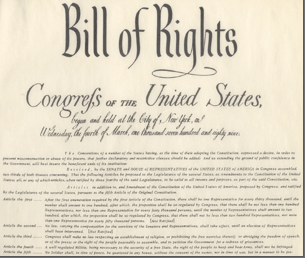
As the Democrats and Republicans gather at their national conventions, it is time to really think about a comprehensive national technology policy for the Internet Age. Many laws and policies governing the Internet and digital property are inadequate attempts to transplant rules from a different era.
The problems that arise are not just about Net Neutrality (see Comcast) or copyright infringement or digital privacy. They are about all of these things. What we need is a Digital Bill of Rights that spells out what freedoms and rights consumers can expect from Internet service providers, content companies, device manufacturers, and the government itself.
Both Presidential candidates have already outlined their technology platforms. (Obama did so last year; McCain only got around to unveiling a formal tech policy earlier this month. Both Obama and McCain also spoke to TechCrunch about their thoughts on tech policy during the primaries). But McCain’s technology platform is a bit vague, and Obama’s choice of tech-challenged Joe Biden as his running mate is not exactly a confidence builder. The fact is that nobody in either party has pulled together a focused set of principles that can truly guide both lawmakers and policymakers.
It’s a tall order, but it is important to have a consistent policy governing everything from Internet Protocol regulations to intellectual property on the Web. With suggestions from serial tech entrepreneur Austin Hill, I’ve come up with a first stab at such a bill of rights. Help me to further refine them in comments below, or add your own suggestions.
The Digital Bill of Rights
The Right to Use and Reuse Content: Consumers know that digital copies of songs, words, and videos are qualitatively different than physical copies, yet copyright law treats them the same way. When the economics of scarcity no longer apply, consumers start to behave differently. They copy and reuse content in unforeseen ways. The pendulum has swung so far that normal consumer behavior has now been criminalized. The concept of fair use needs to be updated and clarified, while still balancing the fundamental right of copyright holders to profit from their creations.
The Right To Control Digital Property On Your Own Device: Possession may be nine tenths of the law, but digital devices don’t follow that rule. When it comes to digital property, who owns what is ill-defined. This can become especially complicated when content is tied to a specific device. If I download a digital book to my Kindle or an app to my iPhone, Amazon or Apple (to pick on them again) have the ability to pull any content from my device without notice or permission. Even if I’ve paid for the content in question. Copyright law and DRM technologies are so intertwined and confused that both consumers and companies could benefit from clearer rules of the road.
The Right To The Free Flow Of Information: Internet service providers, especially those who benefit from public rights of way, should not be allowed to discriminate against information by data type. Debates about Net Neutrality can get bogged down in discussions about content filtering, packet prioritization, and backbone peering rules. But the issue here is basic access to the Internet and all the data that it contains. Data is information and artificial limits on what kinds of data can flow through the Internet’s pipes can amount to a form of censorship.
The Right To (Some) Privacy: For the most part, the expectation of privacy is dead on the Web. But the privacy of certain types of information (health, financial) will always need to be protected. Federal guidelines for how to protect consumer data is preferable to a hodgepodge of industry and state regulations that are currently failing us. (Who wants to book a room at the Best Western?) Privacy laws are also inconsistent in the physical and digital worlds. The Bork law, for instance, makes it illegal for physical video stores to share my rental records, but iTunes or Amazon could sell my digital video or music purchases without running afoul of the law.
The Right to Control Your Digital Identity: And what happens when the “content” in question is your own digital identity. Who owns that? The answer should be that you do. Congress is certainly interested in this issue, and wants to make sure that online advertising networks don’t abuse their possession of your identity data to bombard you with ads. In fact, Google and Yahoo, have been making preemptive moves in an attempt to stave off regulation. But politicians may want to take a closer look at the EU’s privacy directive, which has been in effect for more than decade. Citizens should be able certify that the digital identity associated with their name in a given database is in fact theirs and to revoke access to that identity information on a case-by-case basis.


See all


No offense, Erick, and this may be slightly off topic but seeing this on CrunchNotes:
http://www.crunchnotes.com/2008/03/19/ridiculous/
(publishing the private email of an intern by a major blogger)
Is not exactly pro-privacy. I get the fact he is a journalist, but “privacy” is all about catering to your readers. Maybe I’m just pissed it went down that way, but it relates IMO.
You are right, that is off-topic.
Erick saves and takes half damage.
Wrongo– you already have those rights, if you take responsibility for yourself. If you don’t, then well, you don’t deserve your rights really.
Beyond that, those rules limit my ability to buy what I want to buy, they limit the ability of people to innovate– Limelight’s direct-to-ISP data distribution is the anti-net-neutrality but allows great streaming, Rhapsody allows me to rent music cheaply by giving them control of how I listen.
Thanks, but I’ll decide for myself what I want.
Here Here!! Kudos and I second that, an internet bill of rights will only open the door up wide for full-on gov’t regulation of the internet and this is not China!
@Morgan & Brian
No we do NOT have these rights. Read Comcast, AT&T and NeBaud ToSes:
http://www.nebuad.com/privacy/sitePrivacy.php
Net Neutrality died on the floor of Congress. We couldn’t get the carriers to be targets of class action suits for selling our phone call logs to the spooks because of rampant corruption and corporate/government “inbreeding”.
“from Internet service providers, content companies, device manufacturers, and the government”
In which category would you place google?
I would like to see the right to own your own social graph as well as your data including contacts, photos, videos, etc.
http://www.destructuring.net/a.....wns_m.html
Erick, you forgot that the internet has no borders. There should be provisions for data coming and leaving regional boundaries as well.
It was a year ago next week that the “Bill of Rights for Users of the Social Web” was co-authored by Joseph Smarr, Marc Canter, Michael Arrington, and Robert Scoble.
It is at: http://opensocialweb.org/
Worth checking out, IMHO.
You are right, this is definitely a tall order. When the government gets involved, we all know that the outcome of such a project would much different — this would quickly become a document full of limiting policies, contrary to your intensions. So, how do we ensure that the government does not take a bad direction?
Here is the same good old discovery… It’s years that there are those proposal… but trust me (I have a project http://www.internetconstitutionalact.com) to make it come true is slow… anyway I have to say that nothing is impossible.
Lots of people talk about it and they have no clue at all… Let do the speech to experts like the ones of the Berkman Center at Harvard that they are light years in front of everyone in the world about this problem.
We all know that there is the need of something like that… but there isn’t the culture or better the global culture about it… a tie will come for sure…
first of all apple can’t pull apps from your phone if they could they would have done it already the can just disable apps so they can’t use your GPS. But if your that worried just jailbreak your phone and you’ll be far outside apples playground.
One has to ask whom would be looking after these rights? The same people that are doing such a bang up job that lead to most of these issues in the first place? I can’t see that working out well. You can have your bill of rights 2.0 but the real power lies in the in the interpretation of such. How many violations of amendment 1 can you think of just by referencing the FCC alone , paper doesn’t protect us it’s sadly not, as Morgans says” something you can be given. This is just trying to treat a symptom of a far larger issue.
“The pendulum has swung so far that normal consumer behavior has now been criminalized.”
Actually, I’d go the other way and say that criminal behavior is now taken for granted, much as governmental graft and corruption (payola) is taken for granted in many African and South American countries.
Just because “everyone” is doing it doesn’t make it right…
I’d be satisfied to pass the NET NEUTRALITY legislation.
Congress has 2 =bills they are voting on. Please vote (all votes sent to Congress reps).
http://www.govit.com/S_215/A_b.....nsure_net/
http://www.govit.com/HR_5353/T.....l_Communi/
I wouldn’t trust McCain’s tech policy, he himself said that he is clueless about internet, and that he needs help to check his email. His policy was mostly likely drawn by someone else and McCain himself is not going to do anything about it. + with the 300+ lobbyists working on his campaign there is bound to be one or two who represent RIAA
Most of these are good principles and good ideas (net neutrality regulation, alas, is not), but I want to emphasize that talking about a “digital bill of rights” is a bit demeaning to the actual Bill of Rights, which desperately needs attention.
The actual Bill of Rights is being poorly applied to the digital world, such as in the area of search and seizure. I hope people recognize that we need renewed attention to the actual Bill of Rights in the digital era, as opposed to a “digital bill of rights.”
I’m hoping that this “net neutrality” jazz will right itself as more and more lawmakers and agencies, outside this guy who’s been thrown by Lessig et. al. at the FCC, come to see that the real problem is *net congestion* and who must pay (big users, BitTorrenters, WoW kiddies and script kiddies etc). Yeah, that’s not a restriction of their freedom of speech, it’s an ensurance of ours.
I’m all for wresting more rights and freedoms from service providers, to make them accountable public spaces. There are far too many services that swing the banhammer over politically incorrect speech. The tenor is set by ppl like Dave Winer or Shel Israel banning or blocking me, or the Lindens permabanning me from their forums for criticizing the tech elite, or Gillmor literally cutting me off the air just when I begin to critically explore some of Lessig’s socialist ideas around CC (and yes, they are indeed socialist; CC doesn’t promote commerce and capitalism, now does it? It promotes the free spread of your content to other people with the shill that you get credit — did you make a living off that?).
We have a perfectly good thing called the First Amendment. The concept goes like this “the best press law is no press law” — truly. It’s about “Congress shall make no law such as to restrict the freedom fo speech”. Full stop. You don’t spell out laws, as that only involves a restriction of rights then, a defining of situations that don’t need defining as we already have the perfectly good precedents sent on many of these areas.
Trying to pass a silly thing like Arrington’s lobbying agenda disguised as a “Bill of Rights” undermines every Constitutional and legal principle in America and those universal principles of common law.
o The Right to Use and Reuse Content: this is a given in property law, and existing property and contracts and copyright law should be able to handle it fine. Economics of scarcity DO apply (the new scarcities aren’t pulp or gas or broadcasting equipment but *attention* and *broadband*). The problem isn’t somebody copying for their own use, but reselling for many copies and uses when it’s not theirs. Normal consumer behaviour isn’t being criminalized; this is a silly exaggeration.
o The existing legal/Constitutional system works fine. A lawsuit against the woman with the dancing toddler failed, and her right of fair use of the song on YouTube was withheld. No *new* law is required. This is what you have in a system where the rule of law works by precedent, not by Silicon Valley executives drafting heavy texts to proscribe what they like or don’t like, inciting popular hysteria around “rights” as merely a cover to start a lobbying operation in Washington (why not just register one and pay for 501-c-4 status the normal way?)
o Digital property is created and has a design and intellectual property contained within it, even if I get a copy to use. It’s a balance, not 9/10ths mine except as a user to consume, but not to do anything else with it.
o Apple’s ability to pull content has to do with protecting the integrity of the system as a whole to be able to function, i.e. to remove malware. We haven’t seen yet that this harms individual rights. Nobody is “confused” about this except for copyleftists who think they should be able to hack and grab everything.
o Data flow and the fake “net neutrality” masking net congestion isn’t about access to download your big movies, it’s about access for everybody and calling curbing of your abuse and greediness on the public commons isn’t about “censorship” but about your need for self restraint, or a public need to make big users pay, full stop. Trying to cast this as censorship demeans the very idea of what censorship really is, but of course…that’s the idea, to skew meaning and recast it.
Sorry, not persuasive.
o The right to privacy isn’t dead except to whiny widgeteers who demand all access all the time to sell their widgets. Most services in fact still pretty much maintain privacy. The problems related to privacy and services are solved by lawsuits and precedent rulings coming out of them, not promotion of an ineffectual and actually more restrictive “bill of rights”.
o Come up with better revenue models (when you get over your opensource infatuation) for social media and you won’t have to be as troubled by what ad pushing does to consumers and privacy.
o Er, you fail to see where the EU is going with this: they’re now demanding the registering of blogs, and demanding that bloggers yield their real identities to be able to blog. This is like the Romanian government registering every typewriter to control samizdat in the 1980s. It’s to curb speech, not protect identity. You shouldn’t be for this. A single unified data base like this in one government hands creates more problems of privacy and freedom than it solves.
Please, Arrington, cut the crap and come clean here. Make an internal private lobbying menu for your agenda. Hire a PAC or make a PAC. Use the existing lobbying process to lobby for your interests to sell tech and social media to an affluent elite with i-Phone and widgets etc. without eroding the rights of everyone else.
If a digital bill of rights reduces legal fees, I’m in favor. Unfortunately the debating, writing, and enforcing of rights require more lawyers, not less. The common consensus that there is no good lawyer except a **** lawyer applies - present company and personal friends excluded.
*her right of fair use of the song on YouTube was *upheld, not withheld
Ok, if there is a bill of rights … i have a few questions.
1) when will copyright expire?
2) will the copyright for digital identity expire?
3) how do you define digital identity?
4) is it necessary for everyone to have digital identity?
5) how is money be governed?
At O’Reilly’s Emerging Telephony conference in January 2006, David Isen ran a session on just this topic, formulating a digital bill of rights detailed at http://isen.com/blog/2006/01/m.....-talk.html
Amen. The trick is to write it the way our forefathers did; to be intentionally vague to allow for flexibility in a fast changing world.
When is the law or anything written by lawyers, congressmen, or the likes ever clear? They always use “may” and never use number to describe anything. That’s why judge has so much power over people.
regardless of whether or not you have a bill of rights, freedom is dependent upon a free and responsible media as well as an informed and vigilant public. note how the united states does not have either, and thus its bill of rights has been completely thrown out the window without the public understanding the consequences of this.
along those lines, let us note the irony of this call for freedom being posted on techcrunch, a site that endorses john mccain — a guy who admits he is computer illiterate — when 73% of its readers endorsed ron paul. let us further note the irony of mikey calling himself a “hardcore libertarian” (his words) while supporting big government candidates like obama and mccain. if ya’ll want freedom, step up to the plate and prove it. otherwise, techcrunch is just another media outlet that sells the truth for a lousy advertising dollar — precisely the kind of media outlet that helped the USA lose the bill of rights in the first place.
the general idea is good but the first item makes the whole thing stupid. In life, all over the planet, not matter what language you speak, no matter how much money you have - one rule applies: if its not yours, its not yours. You do not get to judge the value or necessity of something that belongs to someone else. The whole problem with piracy is most of the people who pirate have enough money to buy it. They are just unethical and lazy. I can’t believe techCrunch is advocating this nonsense.
More governmental control and regulation? What could go wrong!
In the 60’s idealists talked about ending wars, free love and doing drugs.
Now idealists talk about net neutrality, free downloads and digital rights.
The 60s sound like they were more fun.
“What we need is a Digital Bill of Rights that spells out what freedoms and rights consumers can expect from Internet service providers, content companies, device manufacturers, and the government itself.”
It sounds cool, but is misleading. You are treating apples and oranges, the companies and the government, equally. Your relationship with companies depends on mutual agreement. You can walk away, if you don’t like the deal. On the other hand, your relationship with the government is determined through politics (primarily majority vote). You cannot resist paying taxes and following their rules, whether you like your government or not.
The consequence of turning business into politics is that you are more likely to have either A or B (through voting), not A and B. I prefer A and B.
After two hundred odd years, the one thing we can say for certain is that “rights” are an unsuitable foundation on which to build legislation. In most developed countries here is no “right” that I can assert without infringing someone else’s. The concept of “rights” is only of use to rabble rousers - and to give Tom Payne and his friends the benefit of the doubt, that’s probably all they were initially intended for.
Hmmm - sounds totally unworkable to me. I live in Australia and am subject to Australian law (not US law) - so your Digital Bill of Rights would probably be totally worthless to me as it would be to most of the people online - ie those not residing in your country. I can appreciate that you could argue tha t’most’ countries would adopt such a document but what about those who don’t.
Nice idea - but who would police or uphold it?
i hate it when someone “loses” a laptop filled with millions of people’s private info … we should be able to expect to not to have to worry when that happens and that people who don’t care for our info are punished. why can’t all my data be like my credit score and allow me to monitor who uses it and when and, when necessary, block access to it?
Eric
Re: your digital bill of rights idea, the current one does the job just fine, thanks.
I’m sorry to see such European Union communalism (http://seekingalpha.com/article/77337-google-ibm-red-hat-sun-and-the-digistan-connection) infecting SV. So much for starting a company in your garage and waking up one morning with a 12-meter ocean racer in the Bay.
Specifically you say,
“When the economics of scarcity no longer apply, consumers start to behave differently. They copy and reuse content in unforeseen ways. The pendulum has swung so far that normal consumer behavior has now been criminalized.”
That’s typical EU blogobull. Taking some one else’s digitized intellectual property is no different than sneaking into the movie theater through the fire escape or shoplifting in the video store. I agree it’s no big deal. But it’s wrong.
As for what Amazon and Apple you affirmatively chose to abide by the Ts&Cs of their service. You can’t screw up regular utilities either with some appliance you purchase.
As for net neutrality, I may be wrong on my understanding of the issue but I can’t think of Verizon or Comcast could do that is a bigger risk than the one that you’re proposing: letting the government get too involved.
Finally nothing is better protected by the current Bill of Rights than privacy. Got an issue; make a federal case out of it. You don’t need a new law to do that.
Praise the Lord, but it will never happen as long as Congress is more beholden to business than the people, not to mention the desire of government to control the people through Total Information Awareness, which is a reality. Fifty so-called fusion centers aggregate everything there is to know about you from public and private databases for your dossier.
Hi Eric
I like most of your suggestions and commend you for actually proposing a list! I am chairing the dynamic coalition for an Internet Bill of Rights an initiative that works in the context of the Internet Governance Forum
check out the original appeal http://internet-bill-of-rights.org/en/appeal.php
and our mission statement http://tinyurl.com/5urtul
max
The Right to Use and Reuse Content “The concept of fair use needs to be updated and clarified, while still balancing the fundamental right of copyright holders to profit from their creations.” That is so easy for you to say. But until technology can recognize intent - your intent to use the content for personal use versus your intent to globally distribute someone else’s work - all this talk only serves to screw the artist out of both their technical control and their legal rights. If you don’t want to put a really low ceiling on the funds to create new creative works, then you have to put some sincere - some really sincere - efforts into developing tools that protect the artists’ digital rights before you start taking away their nearly unenforceable - thanks to intentionally channeled innovation - legal rights.
What about patents? Patents are a tremendous issue - especially on the internet. How can we continue to function with litigious patents such as the “one-click” patent Amazon used to kick around Barnes & Noble? We need a better method for handling patents relating to digital goods/products. With the digital age and the shortening of products effective lifespans, at the least we need to massively shorten the period for which a patent is effective - and perhaps we should consider removing patents altogether.
Agreed - software patents, for one, should be abolished entirely (IMHO)!
Connie Book and I just completed a survey report for Pew Internet that will be released Wednesday Aug. 27 - you can read the full report at http://www.imaginingtheinternet.org, but the news release intro reads:
Whither the Internet?
A survey at the second global Internet Governance Forum shows activists want an online Bill of Rights, more competition among service providers, a multi-stakeholder effort to connect more people, and less American power exercised over the Internet
By Constance Ledoux Book & Janna Quitney Anderson, Elon University
August 25, 2008
Last November, hundreds of government, industry leaders and Internet activists from around the planet gathered in Rio de Janeiro for the second Internet Governance Forum. It was the second in a series of five annual meetings aimed at creating a global conversation about the future of the Internet and perhaps recommendations to the United Nations and the World Summit on the Information Society about policies that might be developed to promote widespread public access to the Internet and how the Internet might be configured.
We invited attendees to complete an online survey about their views of the role of the Internet around the world and how about how governments and other regulators should structure policy about the Internet. Some 206 IGF attendees (15% of Forum participants) from 65 countries responded to the survey. The results of this convenience sample are not representative of all Forum participants or Internet activists. Still, the diverse sample provides some interesting perspective on policy preferences from around the world. Here are some of the most striking findings:
There should be an Internet Bill of Rights.
Respondents indicated strong support for the establishment of a global Internet users’ Bill of Rights. Some 66% of those participating in this survey agreed with the statement: “A global Internet users’ Bill of Rights should be adopted.” Only 6% disagreed.
Some key planks of the Bill of Rights would be: freedom of information, freedom of expression, and the right of people to have affordable access. Some 76% of respondents supported freedom of information as a core ethic of online life and 75% agreed that such a policy ensuring freedom of expression on the Internet should be adopted….
I read the Pew report and while the executive summary mentions freedom of information, this phrase is not used elsewhere in the report. I suspect what you mean by “freedom of information” is “free flow of information”. Can you confirm this is correct and if not, please explain what you mean by the phrase?
The Costa Rican Congress is already processing such a Bill. It protects:
1. Existence.
2. Presence.
3. Content.
4. Projection.
Let me know if you want more info: skorpio at-ad gmail