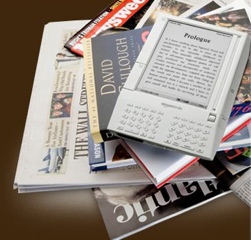
Amazon confirmed our speculation that they are planning to target colleges and universities with a new version of the Kindle, reports the Seattle PI. Textbooks are a $5.5 billion annual market, and most publishers now offer electronic versions of their textbooks. McGraw-Hill Education, for example, publishes 95% of their books electronically as well as in print. But there is no compelling device to read them on. The new Kindle will likely be a large screen version of the original, which is much better suited for textbooks.
Amazon also downplayed our estimates that 240,000 Kindles have been shipped since launching last November. Citi analyst Mark Mahaney later increased his sales estimates as well.
Amazon officials gave McAdams Wright Ragen analysts the impression that high-end estimates on Kindle sales reported by TechCrunch and a Citigroup analyst are not reasonable. (See a previous blog post on the topic here and here.)
Amazon managers “told us that the Kindle is definitely selling very well, but they also said the analysts and reporters giving out these extremely high estimates ‘did not run them by company,’” Bueneman wrote.
We’re sticking by our sources on the estimates of units shipped from the factories in China. Amazon is correct that we didn’t “run them by company” prior to publishing, but since they don’t comment on non-public sales figures, it wouldn’t have been a useful exercise anyway.


What are they going to do about issues like what happens when you’re done with a book? What happens to selling your used textbook?
This blog covered the topics well: http://diveinto...ture-of-reading
While someone else may have a better theory, I think many students would trade the ability to sell them in exchange for not having to carry them around for four years. Also, there will be less demand for used books if a portion of the campus isn’t interested in having physical copies anymore.
You had to pay $200 for a new edition textbook that you’ll use maybe 2 semesters. Selling it is a smart plan- make some money back, always a good thing. And college is expensive enough without the books.
Enter Kindle. No manufacturing cost. No shipping cost. And if there’s an new edition, you download an update instead of buy a new copy. I’m not saying text books will go for $9.99, but a 50% to 70% reduction in cost doesn’t seem far out to me. When that book costs you $40 instead and you didnt’ have to lug it around campus, reselling it doesn’t seem like a huge deal. Add that to the back pain prevented and the trees you get to help save, not to mention the power saved and polution prevented from the manufacturing and shipping… sounds like a good deal to me.
OK, I’m confused.
In your earlier article, you state, “We Know How Many Kindles Amazon Has Sold.” Now, you are calling that same data, “estimates of units shipped from the factories in China.” Two wildly different things. Who is downplaying what?
For that matter, from the below data point as written by a small publisher, it appears Kindle sales have slowed dramatically as of late, so no telling how many of the 240,000 Kindles shipped to Amazon, remain in Amazon’s inventory:
“I have been tracking the sales of Kindle editions of our books against sales of the printed versions for the past almost eight months. Kindle sales have declined noticeably over the past few weeks, while print editions continue to sell at a steady pace.
I am beginning to think that Amazon has hit a marketing wall, due to a combination of factors…”
http://publishi...peaked-already/
“We’re sticking by our sources on the estimates of units shipped from the factories in China.”
You complain that you don’t have enough money to get surveys done, yet you some how got a hold of the factory manager at some Chinese electronics factory, got him to break his NDA and possible cause his family to starve for the next year after he gets fired, and rub it in their faces?
Like woah.
Agreed
Great scoop, I can’t wait for the new Kindle. I’ll likely buy one if there is a price drop that accompanies the larger screen.
To Amazon. Think Ti-85 Calculator. Best of Luck. -Dominic, Pazap
It would really make more sense to have this technology included as an embedded option in a laptop
I don’t think it would. The Kindle uses a screen that is better-suited for reading and it also allows you to have your “textbook” open while you are working on your laptop without having to jump back and forth between windows.
Laptops need to have good screens for reading also. And why would a student spend a lot of money for yet another device, with the hassle of carrying it around, recharging it, etc. when they have a perfectly good laptop?
IMHO, textbooks on laptops is where the future is headed. Textbooks benefit way more than novels, etc. over paper when it comes to search, hyperlinking, interoperability, and accessibility.
I would want my ebook reader on my laptop so I can cut and paste text for quoting in my papers. I want to copy equations into applications that let me calculate with them. If I’m blind, I want my favorite screen reader or braille display to work with them. None of these things is going to work on a Kindle, at least not any time soon.
Paul
You’re assuming all teachers and professors will allow laptops in their classrooms, which I can tell you is not the case. Putting that aside a laptop involves carrying an AC adapter and worrying about battery life. Most ebook readers will easily last an entire day on, they’re lighter, and most importantly, the screen is significantly easier on the eyes. As someone who works 7 to 9 hours a day on the computer, I can tell you it’s much easier to read on my Kindle or Sony 505.
First thing I thought when I saw the article headline was http://www.gnu....ht-to-read.html
Nice link to Stallman drivel. It’s like listening to an ape describe the concept of intellectual property…wait, that’s exactly that article was.
“exactly what that” rather than “exactly that”
ok guys…
some somewhat shoddy writing here.. the actual article states that amazon is working on a new version…
“…Amazon is working on a new version of the Kindle, and sees a big opportunity to market its e-book reader to college students, McAdams Wright Ragen analyst Tim Bueneman said Friday in an e-mailed note based on meetings with management…”
Article doesn’t state that it will have any particular hardware/focus regarding textbooks…. However, to get wide usage, faculty will have to pretty much mandate that students use the electronic version of the book. Otherwise kids are still going to want to buy the book if possible, in order to resell it. of course the publisher is going to try like hell to get rid of the used textbook market as much as possible…
gotta keep looking at the kid/student as a walking ATM machine!!!
the road to making this whole approach work, and to really give the student a damn break, is to print/publish textbooks in an electronic form, and make them free (or damn close) for the kids.. supplement the books with a revenue model based on ads, and/or sponsorships…
do this successfully, and you pretty much change the current textbook/publishing monopoly structure.
however, to really accomplish this, you’re going to have to implement systems, and an infrastructure that’s radically different from what exists today…
peace..
Well, I’m glad sanity has returned to the Kindle sales numbers, though I kick myself for not trusting my gut.
If sales were THAT good Amazon would be talking about it – to everyone and anyone.
http://usedbook...-amazon-doesnt/
This news, along with the ’small amount’ of NYT subscriptions via Kindle should put a more realistic perspective on the numbers. The NYT subscriptions are an important factor IMO since they’re practically poster children for Kindle.
The focus on the Textbook market is smart, but in some ways is an indication that the mainstream market hasn’t taken to Kindle.
And there are plenty of obstacles (like recalcitrant publishers as well as Follett and Barnes and Noble who run hundreds of University Bookstores across the country) to getting Textbooks to work too.
From a few weeks ago. A “real” Kindle data point from a “real” source, and not one trumped up by an overzealous writer:
“New York Times Co. executives said today during the company’s second-quarter earnings call that the newspaper has sold a “small amount” of subscriptions on the Kindle.”
http://www.bloo...&refer=home
Doesn’t exactly sound like NY Times subs are red-hot…
Amazon’s Bezos touts Kindle’s ability to supply newspapers as a primary justification for the device.
Bezos: “The convenience of having your newspapers pushed to you full text—newspapers and blogs—is fantastic.”
And form looking at Amazon’s website, we see that the NY Times ranks as the #1 Amazon “Bestselling” Kindle Newspaper (beating even the WSJ):
http://www.amaz...;sort=salesrank
So, if the NY Times, the #1 “Bestselling” Amazon Kindle Newspaper subs suck, as the NY Times executives say so themselves, well then this reinforces the view of overall weak Kindle unit sales.
The idea of an amazon kindle for textbooks makes absolutely no sense to me. Call me old fashioned but have you ever tried marking up a PDF or anything on a digital reader. A big benefit of physical books for learning is that you can easily take high-lighter, pencil and pen to them. I have not yet seen a reader than can do this as well as good old paper.
Now don’t get me wrong digital books as a concept are a great step forward for casual reader. It’s so much easier to carry around a series of documents in a 6 ounce device than a stack of books, but that point seems to be seriously missing in Amazon’s market studies.
I wish the college kindle much luck, but I don’t see it revolutionizing the textbook market.
Check the A4 sized Irex Illiad. It has a wacom touch-screen, you can mark anything you want and share your annotations instantly over the Internet with other students. You can save your annotations in the PDF file, you can use handwriting recognition on your annotations, you can basically highlight text, rearrange it, and send it directly over to your Laptop to finish the editing of your document.
It’s much better then using paper based textbooks.
Amazon PR guys playing poker again. Have fun if you must.
I recently rented a Kindle from the library at my school. They have 6 Kindle’s which they have for rent as a pilot program. I really enjoyed using the device and as soon as I got it, I realized that putting textbooks and such on the device would be an incredible market – especially if it cut down on the hugely exorbitant pries of such books (I had a $170 textbook this semester). The only potential downside I see is that the Kindle doesn’t make it particularly easy to flip around in the book – something I do quite often for engineering textbooks – but I’m sure that could be fixed in later models.
It’d be probably quite easy enough to pirate the digital versions of the text books as well. As long as the device supports open document standards and doesn’t scan your content for copyright infringement before letting you display it on the device.
“I recently rented a Kindle from the library at my school. They have 6 Kindle’s which they have for rent as a pilot program.”
Now that’s an interesting idea. I know that libraries are providing ebooks (most, unfortunately, not in a Kindle format). I never thought of them renting out actual Kindles. How long a period can you rent it for, and how much is the rental fee?
Sorry, me again…
I’m assuming that these Kindle come preloaded with books the school supplies?
None of these devices display color, a significant limitation when needing to examine illustrations. Advertising wont support the cost of creating a textbook, particularly when the number of users at a university are in the 100 student range each year…and textbooks are created by the professor teaching the course. Used books have destroyed the print run of popular books without remuneration to the creators/publishers. Creating books on the web with subscription access allows for all the advantages of handling a printed book without adding the “weight” to one’s backpack. Emory University, Atlanta, has just started a french language grammar program online for their students at http://learnfrenchwithjt.com. which employs 40 weeks of lessons with audio/manual/visual illustrations through a subscription at less than half the cost of a textbook. It’s “green” and it supports the university financially at the same time.
Advertising would easily cover the cost. Do you have any idea how many free samples and ads are sent to dorms at universities? Companies literally call university housing offices asking to give this stuff away, what do you think they’d pay for some sort of advertising space? Students are notorious for terrible spending habits and being easy to sway, a huge market that companies are always trying to get into.
THERESE POLETTI’S TECH TALES
Amazon’s Unseen Bestseller Raises Questions
Commentary: Kindle e-reader draws hype, but actual sightings are rare
SAN FRANCISCO (MarketWatch) — There was a certain irony Monday when Citigroup analyst Mark Mahaney jacked up his sales forecast for the Kindle, the electronic book reader developed by Amazon.com Inc.
Ironic because in Silicon Valley — the capital of early-technology adopters and the bleeding-edge users of all things geek — actual sightings of the device are quite rare.
http://www.mark...tory.aspx?guid={0D9A9B01-7AB1-4B1C-BC0B-DC8DEF7878DE}&siteid=yhoof
Interesting, that even if eTextbooks do catch on and their publishers embrace the technology, that many her seen to think that Amazon will have the market to themselves. Think about it, Amazon really owns little in the way of the underlying technology, and there are so many “real” consumer technology companies with more compelling products within months (or less) of introduction:
http://www.comp...mp;pageNumber=1
For myself, I think that if eTextbooks do become more mainstream, the “eTextbook” reader will need only be a usb accessory, or even an additional display embedded (but removable) on the laptop’s cover, just like cell-phones now have two displays. Either way, I don’t see Amazon’s role in this market being important.
As others have said, the ability to copy and paste text, citations, and to do further research from said text, perhaps email it to a research partner/classmate, etc, are are going to important components to any shift in study habits.
Digital Daily by John Paczkowski
“Citigroup Analyst Eligible for Remedial Kindlegarten?”
http://digitald...5/kindlegarten/
*Kindle*garten—haha!