Yahoo’s stake in Yahoo Japan is often cited as one of its most valuable assets, and indeed Yahoo is considering selling it as a quick fix to appease angry shareholders in the U.S. While Yahoo seems to be treading water in the US, Yahoo Japan is sitting on top of the Japanese web industry. In fact, Yahoo Japan’s market cap at the Tokyo stock exchange is hovering at around $22 billion, compared to Yahoo’s current $27 billion. Fiscal 2007 marked the 11th consecutive year of profitability and record revenues: Yahoo Japan’s sales grew 23.3% to $2.4 billion (Yahoo in the US: $7 billion) on a year-to-year basis, with a net income of $570 million (US: $660 million).
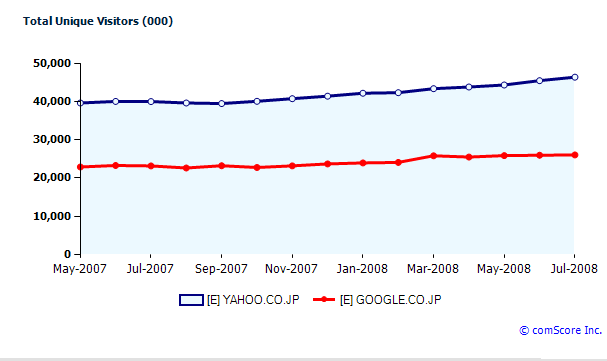
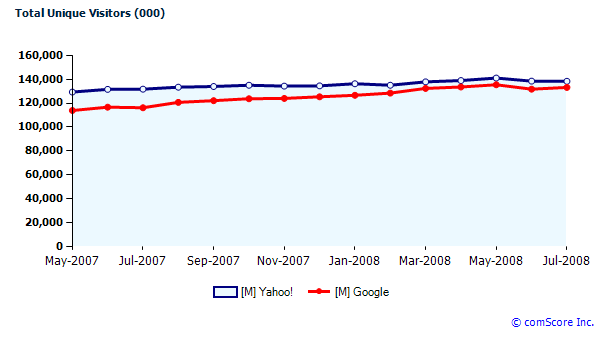
With 46 million monthly unique visitors, according to comScore, Yahoo Japan reaches 82 percent of all Internet users in the country. That compares to 26 million monthly uniques (or a 46 percent reach) for Google in Japan. (In the U.S., the two are neck and neck, with Yahoo drawing 138 million monthly uniques, and Google 133 million). Alexa also has been ranking Yahoo Japan at No. 1 for years now.
It’s no exaggeration to say that for millions of light users in Japan, the Yahoo portal site is almost synonymous with the web itself. Here are three major reasons (and possible hints for other web companies wanting to expand internationally) for this dominance:
1. Get a Headstart and Help From a Local Powerhouse
Yahoo Japan incorporated in January 1996, just 11 months after its parent company did (Google waited 3 years to open a Tokyo office in 2001).
Currently, Yahoo Japan is owned 40% by local telecommunications powerhouse SoftBank and 33% by Yahoo in the US, demonstrating a textbook perfect Japanese-foreign joint venture structure.
SoftBank’s founder Masayoshi Son, Japan’s richest man (who says his company one day will rule the global web), doubles as Yahoo Japan’s chairman. The site is also the default starting page for SoftBank’s 15 million mobile web (“Yahoo Keitai”) subscribers.
2. Super-Localization Is the Key
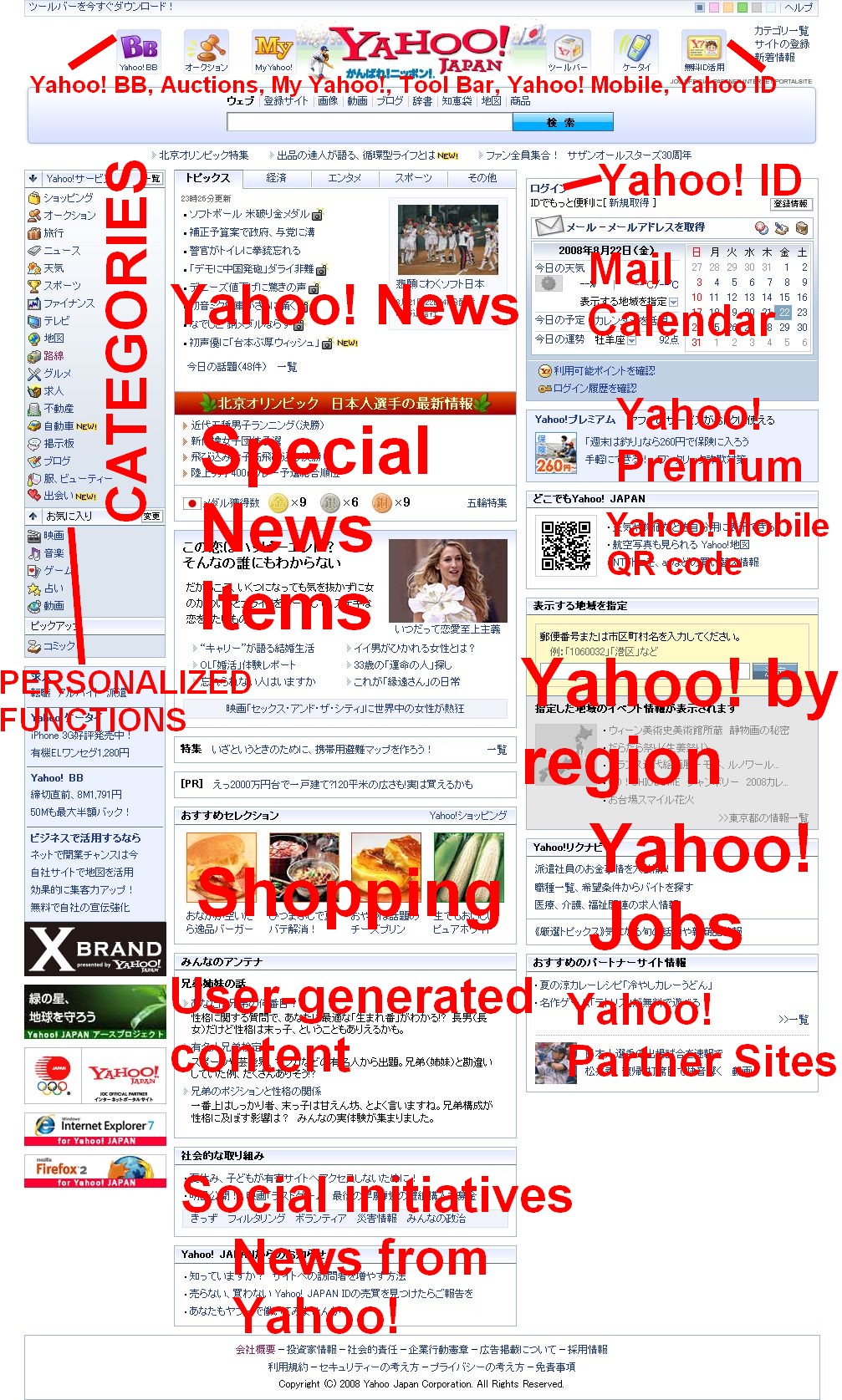
In terms of structure, design and scope, Yahoo Japan is significantly different from the US site (see screenshot). The site may look cluttered to Non-Japanese eyes, but users in Nippon prefer (if not even expect) these crammed starting pages.
Yahoo Japan is split into 11 differentiated business units, i.e. search, auctions, member and regional services, media, mobile, lifestyle etc.
What’s particularly interesting from an American perspective is that almost nobody in auction-crazy Japan knows Ebay although the company opened a Tokyo office as early as October 1999 (Yahoo Japan Auctions started just one month earlier). Ebay finally gave up in 2001 but came back in late 2007 with Sekaimon, an intermediary enabling Japanese users to access Ebay with their Yahoo Japan IDs and through translated menus.
Yahoo Japan Auctions boasted a transaction volume of $6.5 billion in fiscal 2007 (mobile and fixed Internet), whereas American users can’t sell off stuff on Yahoo anymore since June 2007.
Additional services exclusive to Yahoo Japan include Yahoo Videocast (a video portal for cell phones and PCs), the Digg clone Minna no Topikkusu (Everybody’s Topics), Yahoo Days (a social network) and Netallica (an entertainment news sub-site).
The company offers a number of mobile- and Japan-only applications and is also involved in the Internet banking business.
3. Do Business The Japanese Way: A Finger In Every Pie
Over the years, Yahoo Japan diversified into an influential web, telecommunications and media conglomerate, now encompassing dozens of consolidated subdiaries and affiliates: It merged with and acquired advertising firms, information processing companies, marketing research providers, map software makers etc.
The company has managed to build up a Japanese identity by
- employing 3,500 people in one of Japan’s most prestigious office complexes
- foraying into Japan’s multi-billion dollar TV business with the development of widgets for digital TV programs and “Yahoo Japan for Aquos”, a Sharp TV-optimized version of the site with future plans for video distribution
- establishing Yahoo BB, one of Japan’s first ISPs to offer low-cost, fixed-charge price plans for broadband connections
- launching a sponsored service, which enables users to read a number of print magazines online and free of charge (stirring up the notoriously conservative local publishing business)
- buying the naming rights for the Fukuoka Dome (now Fukuoka Yahoo Japan Dome), a major baseball stadium in Southern Japan
- partnering up with other local web companies such as video portal Nico Nico Douga, Myspace Japan (i.e. for the distribution of Japanese music news) and mobile application provider jig
The strategy of total Japanization paid off for the company (which is even an official sponsor of the country’s Beijing Olympic Team). There are few serious competitors on the horizon which could endanger Yahoo Japan’s premier position, at least not in the foreseeable future. Is Yahoo Japan an anomaly, or is it a model of how to go international on the Web?


Who cares!
http://www.FliteRecord.com
@Eric:
Obviously people care, and if you don’t, shut up or GTFO.
@Eric Williams
Typical response from an ignorant closeminded American living in California with his head up his rear.
Please tell us of your successes in Japan that causes such fervent interest. Didn’t think so.
Thank you, Come again.
How is babby formed?
http://howisbabbyformed.com/
If you don’t care about such info,you better find another website to spam coz fliterecord is already worthless and you r making it even worst
If there’s not enough competition to drive companies out of business, the stock market is like picking the right winning team in any competitive sport. The money you bet on the company is more than how much the company make. Until, of course, the company decided to leverage against the market capitalization. That’s when shareholders may get the f*
Fascinating article. Please do more like this one.
I have to agree with Some guy. Very interesting piece after of dozens of similar posts covering incubator launches.
Also seems to be researched thoroughly.
Serkan’s journalistic eye has improved hugely since that weird fish post.
There is another point that this article missed, and it’s that Japanese are very loyal to brands. Japanese people will pick a brand for grocery stores, cars, a news sources, or yes, even websites, and stick with it for ever. Historically, the Japanese are fiercely loyal the their daimyo, maybe that has something to do with it. The country has one of the lowest piracy rates in the world, and this is just for software. (see reference below).
My fiance is Japanese. She, and all her friends use yahoo japan, not just for e-mail, but as a hub for the entire internet. When we travel to Japan, she and her mother will go out of their way to shop at the rice cracker store across town, and this is Tokyo, so that’s about 30 miles across town. We always go to the same Karaoke shop, even if the prices fall at another shop.
Google is going to have to do something really spectacular to win over the Japanese. This was an interesting article though. The bit about liking the “complicated” interface is really true. For some reason, Japanese people like to be bombarded with data in everyday life. Contrast that with the very simple style of their art.
Reference
http://www.cbc....y-20070517.html
Great post
Super Post
Yahoo Japan, does business as the Japanese would do business. Regardless of what company you run, or where you run it, you have to follow the culture of the country your in, or your just a dooming yourself to uselessness.
Also paying employees less helps keep business costs down. I believe the average salary at Yahoo! Japan is more than half that of what it is at Yahoo!. And Yahoo! Japan, like most Japanese companies, does not offer free food/drinks/games/etc… which helps save some more money.
Follow up:
Also makes big numbers in news article and mail.
also interesting to check out: rakuten, japan’s #2 portal, with roughly the same number of employees: http://www.rakuten.co.jp. This is a pure shopping play, basically amazon + ebay combined for japan. most japanese households have an account there.
Disclaimer: this will be a slight rant!
One thing on Yahoo Japan’s side is the willingness of Japanese users to accept downgrades in service/pay pointless surcharges without batting an eyelid.
For example, for years Yahoo Auctions was free for buyers (Yahoo make money from sellers and adverts), but recently they changed the pricing scheme. Now if you want to bid more than 5000yen on any item, you have to become a premium member and pay a monthly fee. When they made this change I was very angry, but all my Japanese friends just shrugged it off with, “meh, it’s only 300yen[$3]/month, what’s the big deal?”
I see many examples of this “there must be a reason for the fee, so let’s just pay it” mindset amongst Japanese consumers, and it allows Japanese companies to charge for things that western consumers would never pay for.
@Chris
Buyer cost was “not free for years”. Yahoo! Japan Auction memberships required monthly payment in 2001 and had been there for years.
Your saying “free” was begun as a 2006 campaign celebrating its 10th anniversary. The 5,000 yen limit was introduced after the 1 year campaign period, but instead of resuming all, they keep buyers buying less than 5,000 yen for free. You misunderstood the situation.
During the complete-payless buyers year, they observed increased frauds and other troubles (well, as Y!J claimed so. I do not know).
Ok, my mistake. I arrived in Japan in 2006 so I didn’t know that it was not free before then. Thanks for setting me straight.
Excellent article! I’d love to hear more about Japan.
cool . might be a good idea to dig deeper into this analysis with case studies from India , china and Brazil and put some comparing the strategies of Yahoo , ebay and google and then coming out with a pattern for success in culturally different markets then the US
Great post Serkan.
I agree, excellent article Serkan.
Good post. Add the Alibaba stake (crudely, 40% of $23 bln), and the rest of Yahoo then looks pretty cheap…
Biased… based on Location of the writer. Evidently Yahoo! itself didn’t even think this about themselves. They wanted $37 per share to close the deal. Yahoo! can have Japan and with it’s $19 stock price it’s best days are behind them. I can’t wait until Yang misses numbers again this quarter.
Very informative post…I have been in Japan for four months now.Just like most students, I went for a Softbank cellphone because Softbank to Softbank phone calls are free for 12 hours per day. I was surprised to see that they have a Yahoo page as default starting page. Your post has really helped me to understand the connection between the two.
Some cool statistics.
http://tekno-wo...ld.blogapot.com
Another content-free piece about Japan from Serkan Toto.
To succeed in Japan, a company has to Japan-ize? Sure. To succeed in the U.S., a foreign company would have to Americanize.
Buying the naming rights to a stadium in Fukuoka is a key success factor? Please … Prove the causation.
Something like this is in Czech republic with local portal Seznam.cz with ~60% in search and Google.cz with ~30%.
And everyone in Czech SEO market watch Seznam-dance
Personally, I find myself more of Google-type and yet I am surprised by the function of Yahoo! Japan site. It’s well designed and less overwhelming for people who are not accustomed to the net. The design itself is to maximize the effect of segment marketing with clear targeting: Each article is assorted in a way to introduce the consumers to new services, with which Yahoo! Japan is working. I feel it is mainly designed for young girls to mature women, who makes an important part of Japanese consumer market, which is clever, since Japanese PC makers are tying television with PC. The software or service sectors only need to redirect the interest of TV audiences to their services, whether they are new or old, through computers and Yahoo! Japan is working as an agent in the process. Also, they are well aware of the role of cell phones in consumer market. The key which differentiate Yahoo! Japan from Google is probably the assortment of the potential services. Each piece of information may not attract consumers but if it is assorted in a way which makes the meaning for consumers, it makes a different story. Google requires more positive actions form the users’ side but Yahoo! Japan allows more passive users to access their services just like escorting ladies. Google is designed for the users to seek for personal interests but Yahoo! Japan is designed to tie hot topics and/or trends with services. Tying topics with services are well-suited to more social minded users such as ladies, too.
I’m one of the oddball Nipponese who finds the “cluttered” Y!J starting page really cluttered. So your mention of its design was intriguing enough for me to make a similar markup to the US version of the Y! starting page. I think the US ver. is a little cleaner but they both share the same Yahoo-ish meme.
Oops. I forgot to include the URL of the screenshot ; here it is
http://www.flic...013316/sizes/m/
You gonna see alot of these oversea posts until the end of summer vacation. Live with it.
I just saw a new Google campaign in the train today: http://google.jp/dekiru/
Google is deeply lagging on the mobile side here, so they’re plastering whole trains with this ad campaign stating 「Google で、できること。」 or “What can you do with Google?”
Its purely softbank driving Yahoo Japanns success. You are better off investing directly in Softbank (code 9984) as you not only get a major stake in Yahoo Japan (also 21% of Yahoo US) but also Softbanks sleeper – Alibaba. Alibaba is like another Yahoo Japan in the making in China.. Investing in Yahoo Japan may give you solid returns but investing in Softbanks Asia strategy directly in where the smart money is!! (BTW docomo kicking themsleves over missing the iphone boat in Japan here.. Son San kicked docomo’s butt – now have greatest mobile phone subscribers for 15th month in a row – thats unprecendented !!!!)
Loving these articles on the Japanese web industry. Keep it up!
I loved the post.
It’s really a dose of surprise to me that Y! Japan is heading parallel to Y! as a whole entity.
So,there’s is atleast one Super Hi-tech nation where Y! takes a lead over Google in web market
Yahoo Japan is interesting, but this post should better be titled “Softbank rules Japan’s Internet”. In effect, Yahoo US has very little to do with the local success, it is rather Masayoshi Son’s vision of the Internet that served its success.
How come Softbank dominates broadband users despite NTT being the incumbent operator? How come they dominate auctions? How come they bought a mobile operator after Vodafone failed to leverage their acquisition of J-phone? All three has been totally disruptive in the local market, kicking out eBay, then beating NTT on broadband and now underpricing NTT DoCoMo. None of this is due to Yahoo US and is due to Son’s strong grip on shareholders and long-term vision, as all three were financially quite risky and operated at a loss for years.
For the “finger in every pie” being the “Japanese way”, I am not sure the very peculiar case of Softbank can serve as a general rule. One thing for sure, they do way better than Yahoo US. In effect, Softbank = Yahoo (#1 portal) + Google (#1 search) + eBay (#1 auctions). Their broadband and mobile business surely don’t hurt either. The hundreds of startups gravitating in Sofbank’s universe are also bringing value to their main assets.
As a side note for keep: in Japan, you get a blocking majority with 33.34% of shares (and total control with 66.67%). Softbank owns 40.16%, while Yahoo Inc has 33.41%, which means Yahoo Inc has normally the ability to veto decisions from Softbank. Hence: not sure it will play out with a possible Yahoo Inc sale…
I didn’t know Yahoo was so big over there. Changes my perception of the Yahoo brand completely.
good articles
http://www.cityquery.com
Extremely interesting and well constructed post. It pays to be a global brand, and obviously Yahoo figured out how to hit paydirt in Japan. Too bad it hasn’t replicated that level of success on its home turf.
Yahoo ? Cutting off your left arm ? But who is gonna stop the bleeding ?
Great article.
SchoolShift would be proud.
__________________________________
http://www.schoolshift.com
Great article! One subtitle for this article is “How an international company can succeed localization in foreign markets.” It’s a great case study on how to penetrate different markets and international companies should learn from this, that it’s not enough to just say “we’re a ‘country’-centric company” but establish the right connections and put above all else the user’s needs.
I am in Japan and i know, Yahoo! is GOD here.
My GF has Yahoo Taiwan as the home page on her laptop and my eyes hurt every time I open up Firefox. Cluttered is to mild of a word to use.
Great post, can we have more Serkan Toto & long analyses articles on Techcrunch ?
This is pretty crazy, but google can’t win everywhere
Yahoo! Japan is a giant company whether you like it or not.
I wish if Google could outstrip Yahoo since I’m a SEO and rankings at Y is always fluctuating as opposed to stability of G.
Yahoo! Japan is a giant company whether you like it or not.
I wish if Google would outstrip Yahoo since I’m a SEO and rankings at Y is always fluctuating as opposed to stability of G.
Good work!!
Keep it up!!!
goooooooooooooooooooooooooooooooooooooooooood
“The site may look cluttered to Non-Japanese eyes, but users in Nippon prefer (if not even expect) these crammed starting pages.”
No. I have Japanese eyes so Yahoo Japan looks the same as Yahoo.com.
And Yahoo BB has 25% or more share of market. I think it is the reason of Yahoo Japan success.
Good post. But I’ve gotta agree with Hisato above… Yahoo Japan is no more “cluttered” than Yahoo. It beats Google here in Japan because it’s a portal… not just a search box.
Everyone (Japanese) I know here uses Yahoo… not a single one uses Google.
And despite what the first commenter (Eric Williams) said… more posts on Japan (and China, India, etc.) would be sweet.
more on yahoo international.
it is also HUGE in France. don’t know the statistics but 2-3 years ago all my my friends at the University used to go to yahoo.fr to check their news, sports, weather, mail etc..
it’s not as huge as in Japan though (no BB, mobile..)
Yahoo Japan is huge, bigger than I ever remember Yahoo being. Its the default start page pretty much everywhere and seems to be the defacto standard for webmail as well. Something just worked for Yahoo where many others have failed.