Portland based Iterasi launched in early 2008 to allow users to create on the fly bookmarking of entire web pages (not just the URL, the entire web page with images). Instead of the Delicious approach of simply bookmarking a URL and some descriptive data, Iterasi let users create a Wayback Machine like copy of the webpage, including with dynamic alterations from being signed in, cookies, etc.
Here’s an example save of the TechCrunch site I created earlier this evening. Saved pages can also be embedded via an iFrame.
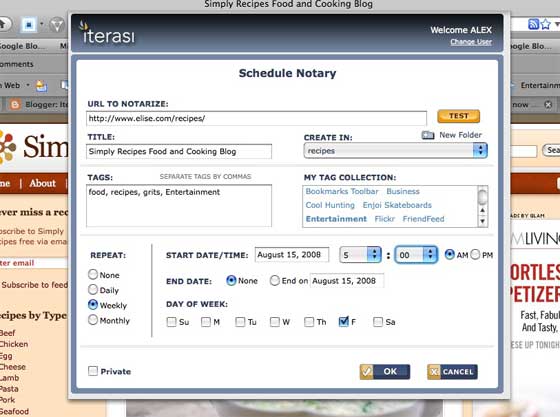
The page save is done via a browser plugin. Until today Iterasi only worked on Windows machines via IE or Firefox. Today the site expanded to Mac machines (Firefox only), opening up the service to new non-Windows users. More importantly, they also added scheduling.
Prior to today users had to manually bookmark a site. Great for a one-off, but if you want to scroll back and view how a site changed over time you had to remember to go there periodically to set a save.
Not any more. Users can now schedule automatic saves of sites as often as daily and add them to folders, tag them, sort by date, etc. Also, all pages are fully indexed and searchable.
Iterasi is completely free, although founder Pete Grillo says they may add a premium option down the road.
On the downside: There is no way to auto-set all saved pages associated with an account to private, although each save has a privacy setting. Since the default is public and the page saved is dynamically generated via sign on and cookies, some private data can be exposed (hit save when you are on an open Gmail page and all your email headlines are public if you forget to set it private).
Also, for a number of reasons Iterasi does all the bookmarking on the user computer, meaning scheduled saves only occur if your computer is on. If not, Iterasi takes the bookmark when you next turn your computer on. Users who don’t leave their computer on regularly won’t fully appreciate the service.
Overall Iterasi is an excellent service, and the schedule feature makes it a must have research tool.






See all


What a good find!
We have been using Freezepage for the past year.
Will give this a try - these services really come in handy at times.
Please continue to do more SAAS posts
http://vishtecho.blogspot.com/.....e-app.html
Well I wish that this research tool is incorporated by Apple to fix the App crash in the iPhone! (seriously)
Steve Jobs does acknowledge app crash
http://vishtecho.blogspot.com/.....e-app.html
Thanks for the spam, asshole.
Roll your own waybackmachine, pretty interesting. Would be nice to run over a long period of time to watch your own sites change as well.
Thanks for the interesting and (mostly) well-informed piece. You did, however, get one important fact completely wrong. Iterasi (according to their site and other sources) is headquartered in Vancouver, Washington. Not to be snide, but note that Vancouver, WA is not only a different city than Portland, but is in an entirely different state. We Vancouverites past and present really hate it when people attribute our few positive traits to our northerly neighbor.
Word around the campfire is that they’re moving into Portland office space on September 1.
This is true. We are in the process of moving right now. BTW it’s loads of fun to move an office while doing a major product release. You would think we could plan this better…
I stand corrected then.
isn’t the only reason for Vancouver WA (not to be confused with Vancouver WA) is that it is right across the border from Portland in income-tax-free Washington? Or is there some fascinating cultural reason for it to have an independent personality?
We picked Vancouver Wa in the early days as it was close to some of the founders homes and rents are lower than Portland. But now we are all grown up so its time to move to the big city.
I noticed an embed feature that allows you to embed captured pages on other sites. While kinda neat, I’m sure this will spell legal trouble.
Perhaps. Modern thinking seems to favor a more open model where content, once on the Web, will travel for the benefit of all. If someone, somewhere complains, we can pull their content and follow the fair-use model that is generally well accepted. But more and more, these old-school models of hording and hiding information are coming crumbling down. As they should, IMHO.
Flash embeds and javascripts do not appear to be saved. I can live with that.
Horray for web standards and graceful (noscript) degradation.
What a crap took…it kills my browser every time I load your example page.
If you send email to support@iterasi.com we’ll work on fixing what’s wrong.
I’ve been waiting for the mac version to be released for ages - so glad it has & yes, it’s a magnificent tool…BUT, unless i’m missing something, the heck I’m waiting 2 minutes everytime I want to ‘notarize’ a webpage. It doesn’t even let you move away from the page to browse other sites while it gets on with it. It should definitely definitely definitely do that in the background and simply notify you once the page is ready in your account.
Yes, some pages can be slow. We do a lot of digging to gather up the page prior to the user loading another. So we can’t run completely in the background. Some browsers internally are very single threaded. But we have some ideas and we’re working on making it faster.
@ gman yeah same problem here. whenever i open it, my browser get hang.
Apologies for being dumb, but I don’t get it. Why should I use iterasi? Why is this a “must have research tool”? Neither this post nor the iterasi site tell me a single benefit I would gain from using the service, both are 100% focused on the features. This makes it come across as a solution looking for a problem. Why is this better than delicious? Websites don’t just disappear overnight. Is it good for sites in which the same URL contains very different content all the time? Like the homepage of amazon.com or something? Why would I want to bookmark that page instead of the sub-page for the product I am interested in?
In short, please sell me on benefits, not features.
Web pages do, in fact, disappear. Note the recent turmoil at the Olympics where the Website telling the history, and therefore the age, of a potentially underage Chinese gymnast was ‘misplaced’. But closer to home, just going thru one’s own browser bookmarks, how many of them point to an error 404 (or the landing page equivalent) or point to something, but not what it did when the bookmark was made? Over time, bookmarks age and they age poorly. They are dependant on the policies of each Website and rarely are any two alike. So certainly a link is good for a while, but how long? It varies widely. Its election year, if you want to track a politician’s message over time, I assure you their site will not lay out their ‘evolving’ message over time for all to see the inconsistencies. If you want to save a special retail or travel offer, you better print it as the site just may have a new one tomorrow. etc, etc.
My point is that the Web is very dynamic. Bookmarks have their place, but they don’t age well.
Ok, fair enough. I haven’t experienced this pain much before, but I can see how some people might have. I suggest you add those same examples to your site’s home page, and “Bookmarks have their place, but they don’t age well.” sounds like a good tag-line for your service.
Peldi
Being able to search the text of all your pages is also a killer feature. Delicious doesn’t do that.
Another use case that I’m aware of is with regards to images. Getty, Reuters and others offer licensing rates based on how long you are going to use an image on your site. For many sites (especially news sites), they typically only license images for a month or so. While this makes sense from a business perspective it also makes bookmarks of these images useless. Return to the page after a month and the image and caption are simply gone.
Many of the most compelling ‘current events’ images you will ever see are distributed across the web in this fashion.
On that note, I guess that’s also a good example of a group of companies that do aggressively pursue any unauthorized ’sharing’ of their content.
Interesting tool! For research, I can highly recommend Zotero (zotero.org). The free Plug-In for Firefox (all platforms) handles web sites as well as books, papers and all kinds of sources. Has a powerful citation manager with search, tagging and linking of sources. No scheduler though,
Can the saved pages be stored locally? With google gears maybe?
How is this different from Diigo?
Someone want to compare the two? Come on you attention whoring bloggers, do it!
I agree with Peldi: can’t see much use for this for vast majority of folks, especially for tracking the changes on a site over time, especially since it sounds like you’d have to set it up from the time you wanted to track. How many real use cases are there for someone who wants to see how a site changes over time, goes and sets up a process to do so, and actually tracks that info over time? Seems like it would be more useful if the captured historical data was already out there somehow.
And as to bookmarks dying, I would say that less than 5% of my bookmarks point to 404 pages, and those that do can usually be found again with a quick Google search. I would also say that I probably only go back and look at 5% of my bookmarks, and that 5% rarely overlaps.
Sweet tech, but not sure there’s a real user pain point to apply it to. Hope I’m wrong
the name sucks
uh, this is some seriously OLD shit - furl was doing this nearly 4 years ago…clearly, unlike me, you do not do any research for a living…
I’m curious as to how this is more compelling than, say, the Firefox Scrapbook add-on. Seems like one of the strengths is that you can share the pages online with others, but what else is there?
Personally, I see a lot of potential for this service. I love the ability to search text across my bookmarks, and knowing that exactly what I saved will be there.
Also, for research, I remember planning my wedding with my wife, and sharing content/ideas/information was a real pain. However, if we had this tool, we could share exactly what we wanted the other to see, knowing they’ll get what we bookmarked. Then you can also create a tag set that makes it very easy to share all content around a certain topic.
Obviously, Delicious can do some of this, but to quickly find the hotel that mentioned “free dolphin swim” amongst 8 or 9 bookmarked hotels just creates a lot of value to me.
I use Evernote (read about it here many moons back). It does not save the full fidelity of a page but gets the job done. Of course, it does not do the “wayback machine” job.
I am going to save this article to Evernote. May be I’ll get around to checking this service out.
Sean
Will check it out. Are there any copyright issues? When will Iterasi be out of beta?
re: copyright, see response above to @Markus.
re: beta, no firm date in mind. The term seems to mean ‘developers can test new ideas and see how well users like them’. In this sense, I hope to be in beta forever. Seriously, we put as much testing in our beta releases as we would in any release. (And I hope this last comment doesn’t come back to haunt me…)
What a fantastic implementation. But in my experience, people won’t necessarily save pages. They’ll just use search.
I don’t see this as an either/or decision. Everyone searches all the time and that won’t change for the forseeable future. iterasi and other tools in this bookmarking world allow you to save something once you’ve found it. So the two complement each other.