Swapping sites are nothing new (see Dig N’ Swap), but in Japan we like to trade our junk via our mobile phones. That is what the Japanese social sharing service Sharemo is all about. The site’s ambitious idea is to contribute to overcoming Japan’s throwaway society.
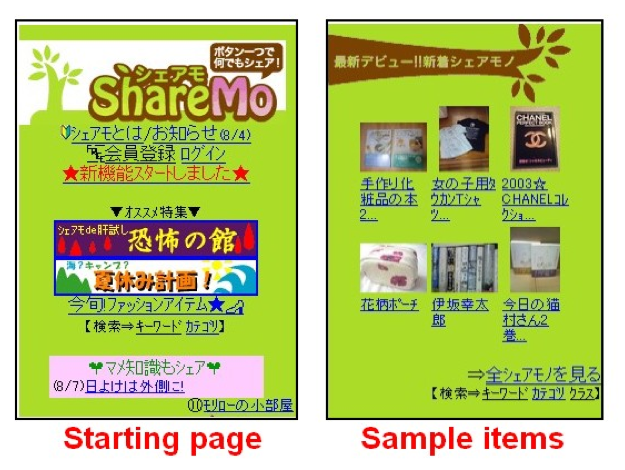
This is how it works: Users can offer any item they don’t need anymore (DVDs, comics and clothes are especially popular) on Sharemo. If the item is useful to another member, it can be rented, used and then relisted. This procedure is repeated until one Sharemo user decides to keep the item. The system keeps track of all actions and allocates points to active members, which can be donated or redeemed to rent items.
Sharemo’s crucial point is the complete absence of money and the reliance on trust among the members. In Japan at least, the concept pans out as expected: Although the mobile site isn’’t actively being promoted yet, Sharemo it already racks up 400,000 page views monthly.
Sharemo is operated by Enigmo, a company setting itself apart from other Japanese web companies by an international mindset. Their promotion networks rollmio and pressblog are successful outside Japan already, and Sharemo is set to follow suit in the mobile space. Will this concept work outside of Japan?


See all


That is an interesting concept that could only thrive in a nation where there is valid trust among strangers.
Perhaps the homeless problem is not so severe in Japan.
Here in NY, many of us donate used quality clothes to charity -if they have not been worn that much.
In terms of DVDs and Comics, many donate them to the local public library, if there is no intent to sell them. Since libraries are often cash strapped, they resell them.
actually, pretty genius.
genius, but dialectics applied when implemented in other cultures.
I love the concept but have just one question: how does Sharemo make money?
I think they might be taking 1% of all transactions between users. Could be !
Unless I’m mistaken, the whole service is based on sharing. No money switches hands. So they’re taking 1% of what?
great idea but would never work in usa
serkan,
are you new TC guy. anyway havent dont remember seeing your name before here.
Thanks for covering JP startups(mobage-town was a good discovery to me). We have ways to hear about the valley or even EU/Israel/India startups but not in JP(maybe there are local japanese blogs). Looking forward to your coverage on JP mobile and web startups.
Thanks.
This is not much different than BookMooch, but applied to any type of “junk”. The other difference is in the terms - “mooch” vs “rent”.
For the U.S. it would need to be more targeted. Freeshare is a free service in the south.
ya I Like the concept
I think it would work in the US. I’d wager that there’s someone already working on it.
Interesting concept…
Sounds like a derivative of Craigslist. Very interesting.
I have a red paper-clip I’d like to swap for a BMW.
But isn’t getting a BMW kinda of negating the whole ’sustainability’ angle?
what about Swap Tree? I think it is pretty good, a friend of a friends company. http://www.swaptree.com
Japanese people never came out of their den ever since 1990. We dont wish to hear much about services that will never will become available outside japan.
Enought is enough, Arrington, please stop this Toto..
On another note, one reason why this is more likely to be successful in Japan (although that’s not to say it wouldn’t be elsewhere) is that the Japanese take extremely good care of their possessions! When I was living there and bought 2nd hand DVDs or Playstation games they were always in mint condition. Rarely a single scratch on them!
that’s great but in Germany that concept wouldn’t work, that’s for sure. And I’m german, just for the record.
400,000 pageviews monthly? That’s nothing. Typo?
The concept is definitely working in the state, this is a nice twist on things but again, the monetization of the service is not clear. Please visit Dig N Swap to learn more about our service and join our community!
There is certainly a lack of garage sales in Japan (no space to keep junk around); people do take care of their possessions; there is no local dumpster a-la Salvation Army Depots so this might hit home in Japan. I would be interested in the back-end fulfillment functionality, and if ShareMo actually helped people without the financial resources to purchase certain essential day-to-day personal items like food and clothes.
Has no one heard of Freecycle? Freecycle.org is the American version of this, but it is split up into smaller community-based groups through yahoo groups. For example, there is a site for York county, PA as opposed to the entire state of PA or the entire US. I’m sure you could visit other locale’s sites and have something such as a CD or DVD mailed to you.
However, from what DK commented…It may work better in Japan because they take better care of their stuff. There’s too many people in the US that just beat their stuff up then try to pass on stuff that really should be thrown away or clothes that should be put in the rag bag, but the person is trying to pass them off as still good items.