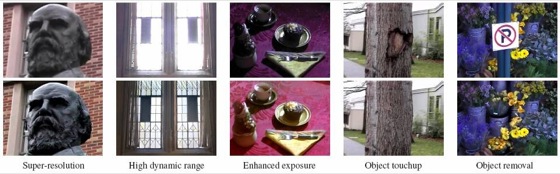
This system, by students at the University of Washington, uses still photographs or one single frame of a video scene to automatically improve video. The improvements are amazing. Video might contain artifacts like overexposure and low-resolution imagery and this system takes cues from still images of the scene to bring almost the entire video up to photographic quality. Can’t wait for this to hit our local point and shoot - in maybe five years.
Click through for sample video.


See all


i like to automatically improve things automatically as well.
“Video might contain artifacts like overexposure and low-resolution imagery”
Overexposure and low-resolution are not artifacts.
this is the coolest thing i’ve seen since photosynth
They are artifacts of a poor videographer just as pixelation et al are artifacts of poor compression.
I enjoy things that are automatically automatic, I find it joyful.
John,
low resolution has nothing to do with the person behind the camera, but is rather a function of the camera. Over exposure on the other hand is simply that… it can lead to artifacts, but it doesn’t necessarily have to!
- mp
Impressive - but when can I get my hands on a FCP plugin?
The sample with the flower looks like a fake. How do they recreate the background behind the parking sign ? I’m a little suspicious on that one. Hard to believe for me.
Have you ever heard of lightfields? If not you might want to read the wikipedia article… In the most basic sense… they fill in pixels that are occluded with information created from a light field. This light field is generated by computing the camera position based on the estimated scene geometry.
This will only work well if the background is not really moving relative to the camera… if those flowers were swaying it wouldn’t be able to fill in the missing pixels as most of the information in the light field would be very noisy and inaccurate (since the depth map is really really low res i doubt the generated light field would be accurate at all)
While this looks amazing, you have to keep in mind that they must have had a grad student spending hours or weeks tweaking the results. There are components in their algorithms that would be considered major breakthroughs if they could be automated effectively. For example, there is a point where they “automatically” get a depth map from a static image.
On the other hand, if these cameras become mainstream, it could work: http://www.crunchgear.com/2008.....-pictures/
artifacts are things like noise, flares, sensor dust.
artifacts is NOT overexposure nor low resolution.
Most of the time I see stuff on TechCrunch which is not commonly known in the industry, mostly insider news.
This work was done in early 2007 and it is available on Youtube since that time. The paper was also published in 2007. Very late on TC.
There must be intellectual property ownership issues because co-authors are from Microsfot Research, Adobe, Berkeley and Washingtom.. Microsoft and Adobe already have too much to fight for… Silverlight vs Flash…
hehe - like Silverlight will ever really take off!
it sure has! The whole world is watching Olympics online LIVE using NBC-Microsoft partnership of using SilverLight.
No. American viewers are watching the Olympics via NBC using Silverlight.
America is *not* the whole world.
At least not yet :-/
I can’t imagine going back to shoot photos of some static object just to fix up old video. If it worked with Photosynth so you could autoscan Flickr for helpful photos that would be awesome. Otherwise you might as well just reshoot the video with a better camera.
I think (but I’m not positive) that the photos must be taken at the same time as the video.
If you think about it, a scene at a different time of day/year would have entirely different lighting and shadows (not to mention all the other things in the photo that could change over time).
On the other hand, since Photosynth can piece together photos from different times and angles maybe it is indeed possible. It would be very cool.
These people have created the need for a Nobel Prize in Pure Magic. This stuff is awesome!
how about exposing the damn shot properly and shooting in hi def?
technology is search of a problem and motion match has been around for years!
I wonder if it’s automated. I don’t see how they could remove an artifact like a street sign from the middle of the photo with automation ??
It doesn’t seem to solve world peace. Still waiting for that.
Isn’t something like that most video compression algorithms do to reduce the size of a movie? Put a keyframe and then “guess” the upcoming part of the video using only that for some of the changes on the image?
Does it use Fuzzy Logic, ha-har-har
http://www.acomputerportal.com.....shing.html