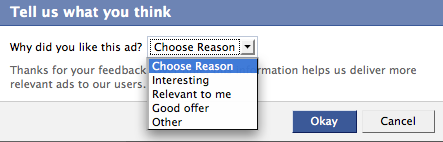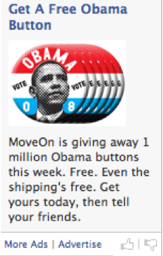
If you’ve bothered to look at the ads on Facebook lately (don’t worry, nobody else looks at them either), you might have noticed little thumbs-up and thumbs-down icons at the bottom of each ad. If you click on one of these, a box pops up asking why you liked or didn’t like the ad. This presumably will help Facebook target ads at you more effectively in the future.
The ad-rating feature was quietly rolled at least two months ago. But it seems a bit redundant. After all, ads already come with a natural, built-in rating system. If an ad resonates with me, then I will click on it. If it doesn’t, I won’t.
But ads on social networks in general perform so poorly that perhaps Facebook is hoping to get some feedback from the 90-percent-plus of members who never click on a particular ad. In effect, Facebook is throwing up its arms and asking consumers diercty: why do our ads suck so much?
You’d think that Facebook members would have better things to do with their time than instruct Facebook on how to d a better job targeting ads. But then again, we are talking about Facebook.

![]()


One more thing NOT to click on besides the ads there. lol
There is a reason for this – Facebook has no way of knowing if you are INDIFFERENT to an Ad verses DISLIKING an ad.
In other words, you may not be in the market for a product or service – not because of the quality of the ad vs Not liking an ad itself – thereby decreasing the liklihood that you might have been curious enough to get details on a product or service.
Most people will not bother with giving feeback – unless they are having an relatively extreme reaction to an ad
But if there are a number of users complaining about the same ad – then where there is smoke there is fire
I’ve seen some ads on facebook that I agree are targeted at me but I feel reluctant to click to avoid “agreeing” with the ad delivery system to bombard me with other ads. Most people are also using ad blockers, so it’s a continuing battle between online advertisers and ad-blockers… but who will win?
I am not so much giggling at the thumbs up and the thumbs down, as I am the fact that they have a link available if the member wants “more ads”
I suppose if someone paid me, I wouldn’t mind wasting my time on evaluating Facebook ads instead of connecting with my friends
I think they need to change the Ad Format… People are used to the list of Ads down the side of Google and I feel facebook should adopt that proven format…
With a basic text based list, they could show more ads per page impression, get more paid clicks and do away with the crappy images people use in their ads.
Zuckerberg… Give me a call if you need any further consultation… Lol!
The problem with social network ads is very simple. They are over-used and abused. Facebook and MySpace have billions of impressions and they think those impressions are worth as much as impressions anywhere else on the web. That isn’t true. Users on social networks are performing specific tasks at the time they’re shown an ad. For example, if I’m writing a message to another Facebook user on the Compose page, there are ads there. Why in the world would I stop writing my message to look at the ad? I know what I want to do and I’m gonna get the job done.
They should stop abusing ads by showing them on every pageview, and then MAYBE they can drive their eCPM up. Ads should only be on pages where people are exploring, not performing specific activities.
That’s their answer. Same goes to MySpace. A lot of pageviews doesn’t always mean a lot of money. Choose which pages you want to place ads on very wisely.
good idea !
I agree with My Guy – and I’m one of Those People who actually would bother giving feedback.
There are ads I see (not particularly on Facebook, but generally) that I like, or at least notice and think “hmmm… must look into that someday,” and others (LowerMyBills.com stupid dancing, and Netflix endless pop-up ads) that I really, really would never, ever like to see again. I wouldn’t mind letting them know, if I have a sec’.
Or of course it could be one of those things where they are just trying to reduce our stress and annoyance my making us feel as if we have some control over what we are seeing.
I’m always pushing (in my work on Web sites) for more opportunities for customer feedback – instead of guessing, let them *tell* us what they think. A few insightful comments can be very enlightening.
at least they’ve moved beyond advertising their own ad network…http://racetalkblog.com/2008/07/10/dear-facebook-stop-advertising-your-ad-network-to-me/
i’ve got an even better idea: how about taking it a step further, and if i hate an ad, i click a little red thumbs down, like for those annoying smiley face ads that would make noises, or the ones that throw people into epileptic seizures from their flashes. not only will that ad never be displayed to me again, but if enough people thumbs-down it, the ad gets banned.
and, if i think an ad is really cool, i can click the thumbs up, and then it gets displayed more often to people on my friends list.
then, instead of basing revenue on cpm, base it on the increase in rotation due to the ad’s popularity. more rotation = higher cost. if advertisers don’t want to pay for an ad that’s receiving increased rotation, they’re insane. because let’s face it: click-throughs are a farce. nobody *actually* clicks on ads, and then buys something. okay, maybe some people do, but they’re weirdos.
but if you’re trying to increase impressions, what better way than through a (somewhat) democratic process where better ads naturally get displayed more often? and why would anyone actually watch ads?
know the words to the free credit report song? i know a couple girls that do. and that’s a completely craptastic product that people will forever remember. granted, it’s not really an online ad, but still. people DO like to watch and look at cool ads.
I would kind of disagree with your opinion. The fact is that ads suck for those people who know that they are ads. So, experienced users might feel that Facebook ads are trash, but many “not-tech-savvy” users might not feel the same way. (You would notice that such experienced users would not click on any ads for that matter. I personally do not remember the last time I clicked on a Google/YPN ad! )
This is called “ad-blindedness” and facebook is trying to overcome this by blending its ads with the content as best as it can. And I think that voting mechanism is just to bring some sort of a interactivity with the users because Facebook’s main target audience is not “tech-savvy” people like us, but teenagers who have hours to spend on the comp screen designing and maintaining their Facebook profiles. Therefore, in my opinion for such a user this is a good move by Facebook.
hmmm, what if everyone just clicked thumbs up? do they really think people will give honest opin ions anyway?
i bet some 19 year old that works at facebook came up with this idea to justify their job for a few more months. i mean really, what do the 600 employees really do there all day besides eat free lunch anyway?
@losers – Ya, those employees are really smart-MBAs who dont know anything about Internet Marketing or coding etc. Mostly, the main work that they do is to approve/reject the ads that are submitted by their advertisers. And on most forums I visit, every facebook advertiser is unhappy with them because they are notoriously random in their approval process. They would sometime approve “lewd-explicit” ads and sometimes dissaprove normal ads.
I’ve actually noticed the voting system for Facebook’s ads, and have on occasion used them. I thumb down all ads asking me to find the right guy or get money cheap (Facebook wisely presents this ads as it knows I am an English major) but I thumb up ads I enjoyed, and have searched for more. Facebooks ads alerted me to a Relient K concert that would be in town and has even linked me to products I intend to use like TuneUp.
Another valuable post that keeps me coming back to techcrunch.
I just noticed the sponsors for the first time (I think) on this blog with varying degree of recognition – never to I’ve seen them before.
It will occur to me next time I see one of the sponsors I recognize and if I or one of my valued contacts has a need…I will click. Just like sponsors of my favorite talk radio shows.
Maybe Facebook will adopt some sort of focus group like all other media sponsorships.
Facebook stole that from Adpinion.com. They have that rating system.
But voting on ads is stupid and: you like the ad, you’ll click on it! No need to vote.
Highly specific small ads work to put alongside highly specific Google search results
In Facebook, you’re not looking for anything and the ads are (still) poor and not relevant
One scenario might be the “Adsense for Facebook users”: pick ads that you think are “cool” to put on your profile and you would like to be associated with (and you think your friends might click on), and get a cut… But then a new race opens: how to get as much traffic to your profile as possible, unleashing another wave of creativity (and potentially spam)
That is a very sensible comment. I actually never thought about it, but I do click on some google ads from time to time, while I almost never even watch to ads on others websites.
The fact is when I am searching for something on google, there’s a good chance the displayed link will actually bring me the information I’m looking for.
On any other kind of website, the ads are somewhat linked with the site themes, but as I am not searching for anything specific while browsing them, the displayed ads are much less likely to get my attention.
My first question would be, how many of your commenting on the effectiveness of Facebook ad’s actually use their advertising system?
The facebook ad platform is not as good as google, i’ll admit. But that is only because google captures a user at their most impressionable moment, just before purchase or when searching for specific information.
Facebook doesnt have that advantage but their ad system is second ONLY to google adwords and I dont know anyone who uses both that wouldn’t agree with that. The facebook ad system allows you to target people based on EXACT interests, not based on their searching habbits, but based on who they are, demographics.
This is incredibly powerful for other forms of advertising. For instance, I hire linux system administrators so I target anyone within 50 miles of my office that lists “linux” as an interest. That allows my AD to be extremely targeted and thereby, extremely effective.
The rating system is important for a completely different reason than if it was used on google. For 1 example, if you are getting spam/junk/misleading ad’s on a social network, there is a cognitive frustration that somehow FACEBOOK is lying to you. Google doesn’t have this same problem because its not a social network and when searching you have numerous options rather than the 2 advertising options you have on facebook.
This post is just way off in my opinion.
Oh please. YPN and MSN AdCenter convert way better than Facebook. Not saying you can’t make decent coin on FB, but you gotta run the right offers and then start jammin on it an getting freaky and start turning those conversions out. Hahaha… yes this is the attitude of Affiliate Marketers on FaceBook.
wow. Someone needs to take a marketing research class.
Most successful internet marketers barely make it out of high school, much less take a marketing class. You would be surprised to see who dominates in online marketing technique.
They are really really struggling to monetize their site and things just aren’t working.
I think this debuted about 4 months ago. And about this quote, “You’d think that Facebook members would have better things to do with their time than instruct Facebook on how to do a better job targeting ads.” I agree that it is a little bit pointless to rate the adds, but I think Facebook had p*rnographic ads–which I always rate down–in mind.
You’d think that Facebook members would have better things to do with their time than use Facebook.
I agree with Brian – I’ve seen a fair few ads that I consider inappropriate, including some that are outright pornographic.
But in that case, why is there an option to rate up an ad? Why not just have a link that allows users to report the content is inappropriate?
Erick has a good point… the thumbs up / thumbs down is reminiscent of when they allowed rating News Feed stories – and I definitely don’t care about ads anywhere near the same level as News Feed stories…
personnally ive got a ad-blocker add in installed so i dont even see them, just the text of them which is fine, clears up the pages nicely.
About 3 days ago a Facebook ad informed me of a concert that I wanted to see in a couple weeks. It is a relatively new locally operated charity concert (Carolina HopeFest) that has little advertising but many artists I really like.I can almost guarantee I would have missed the concert if it were not for the ad. I’ve definitely never been glad to be served an ad on the internet.
Question: Do people listed as “conservative” receive ads for Obama (and vice-versa for liberals)?
Your catching the drift…
As some who is familiar with affiliate marketing, I can say there are a lot of small fry aff marketers making a decent living running these ads on facebook, but here is the problem. Even a small fry aff marketer can quickly saturate and exhaust an offer on FB. This is why FB as a company will never make money. It’s profitable for a PPC aff marketer, but the problem with FB is the astonomical amount of page views it takes to get a conversion. But that’s not the aff marketer’s problem, they just move on to a new offer once the old ones stop converting. The aff marketer doesn’t care how many people get pissed at an ad, and they would never know… Not even this type of survey will produce the data a marketer would find usable.
I once read that an untuned motor scooter that is noisy can wake up to 250,000 people if it driven across Paris at 3 in the morning. I think FaceBook ads are very much like that. Make countless people aware of your presence with very little to show for it.
I actually think the ads on Facebook work quite well. They’re both locally targeted (have you tried X restaurant in your area) and interest / business targeted. I’ve clicked on a few that I’ve been interested in, as well as using them for advertising, with great results.
So I’m a little confused as to all the bad press here. The only problem I see is the swath of really crap ads aimed at anyone below X age, with images of random items (ie iPhone) wanting people to do surveys. Makes the other ads less useful, for both advertisers and adversities.
I personally support the idea of improving one’s ad clickthrough, so the concept of this rating system is right. However, as no one pays attention whatsoever to ever click the ads, there will certainly be very few users who would rate the ads.
Maybe the alternative is to announce the users that there will be some sort of incentives for rating their ads.
Social networks are Web 2.0 elements – Web 2.0 does not give users pointless ads.
Web 2.0 ads should be useful info for the end user created by another user, or business.
There is a place for ads and place for no ads. But useful ads are always welcome.
Social networks aren’t Web 2.0 – not without business.
the issue is the mindset of the user. FB is very much part of the daily routine for users and while they are using it they are focused on specific tasks, not peripheral ads. Its the wrong time to serve them ads.
I think this makes a lot of sense; it allows Fb to gather information about ad engagement for the people who don’t click on ads, and they can push that back through their feedback loop in terms of relevancy. They know that n people clicked on ad X; now they also know that n people were engaged enough with ad X to provide feedback on it.
Maybe fb should look at getting feedback on the placement and timing of the ad, rather than if the users liked the ad or thought it relevant. I think that would actually be of some value to fb, helping them know where users are open to being presented with ads and where they are not.
-Robb
I couldn’t agree more
wow. Thanks Posting
Ok, maybe it’s because I’m in the biz, but I use the rating system a fair bit. I don’t think it’s going to be the end all, be all for making Facebook profitiable, but it’s an interesting piece of the puzzle. I’ve always wanted the choie to say “I have this already” – a la Netflix. Netflix may still want to ad me, but maybe it could be more targeted.
Geo seems to work well, and occasionally I’ll vote on an ad, less occassionally I’ll even click. If this is a tool that one day leads to better targeting and to me being more likely to click, great. BTW, don’t forget the branding/impression value of an add, not necessarily all about clicks.
Before you make universal statements like “ads on social networks behave so poorly” you should try advertising on a social network for yourself. I have advertised heavily on my space, and ads on my space do *extremely well*. Ads on facebook perform ok too but not nearly as well as my space. This is not a problem inherent to social networks – its a problem with how facebook was designed.
Secondly, as many other ppl pointed out – feedback links on ads are extremely commonplace, yahoo, aol, and every other major online media network has them. Where have you been and how is this even a published article worthy of Techcrunch?
Who do you work for? Have you seen the amount of comments this generated?!!
Most people don’t go to a social network site like Facebook to look at Ads. Just like most people don’t watch TV for the commercials (except for the Superbowl maybe). Since they are online, if they want brand or product information they google search or go to amazon
The valuation of the social networks seems to be based on impressions, which is a metric anyone spending ad money dislikes and why google has been deftly cautious in this area…
What can it hurt? If Facebook gets people to interact with the ads, even if they are clicking on the content, it can only result in more notice of the ads in the future. This is a really smart move by Facebook and a very social way to handle a big problem on the network – lack of ad revenue!
It’s actually not redundant at all. A click-through is an investment, not a vote. Getting feedback on ads in the way they’re doing it is very smart in general, even without getting more targeting.
If the ad creative is so bad that it’s driving people away from the site, that’s different messaging than simply not clicking. If they’re getting targeting value as well, even better.
It is a good ad rating system for facebook. now I can block some ads I dislike. it will make facebook users like this community better.
One other reason for explicit (as opposed to implicit) ratings, is that most tracking systems can’t track across disconnected sites, or past a certain time frame. I see a lot of ads which I might act on much later once I’ve finished what I’m doing. The more Facebook knows what ads I am interested in rather than just clicking on, the better from that POV.
You’d think TC would have a small clue about how online ad consumption works though. Maybe that’s why they’re not rich?
Facebook is facing the problem that other ad networks face – too much competition for ad dollars, not enough users to absorb ad inventory, challenges monetizing content, and changes in ad space pricing models (CPM, CPA, CPE, etc.). Facebook may be trying to use this feedback mechanism like other companies that are using social media: to track how people feel about the product/brand, which in turn informs product direction, or in this case, how the ad/offer should change in order to best engage with (i.e. convert) the member.
The key for Facebook here is to up the value for both advertisers and for members. That means providing high value content (i.e. content that users want to see) and removing low value content (e.g. porn, racism, etc.). UGC moderation is a big help here. Content that adheres to terms of service = high value content. High value content = happy users, happy advertisers, and happy ad networks/publishers. Everybody wins.
Thumbs up, thumbs down rating system is worth a try.
Seems like all the comments here ignore the success of social networks like FB and MySpace to generate so many loyal users, to target users through demographics and social preferences, in a young market that they have moulded.
They may be struggling to monetize in comparison to their page views but Scott Rafer explains it is high volume low cost. Beyond this it is surely worth noting that they continue to grow, that the market is young, so the learning curve has yet to take off.
Giga Om hits a couple of nails on the head:
http://gigaom.c...social-network/
The above link to Alistair Croll’s article is not entirely relevant but interesting, very interesting.
The embedded Sponsored Story ads are working well for us. The display banner results, however, were so poor we haven’t touched them since our initial trial approx 2 years ago.
well Erick… facebook doesn’t make the ads, so maybe that’s why there is a rating system in place. It’s great to have feedback from people who dislike advertisements. that’s good feedback for the people creating the ads as well as for facebook.
furthermore, the ads are created and displayed by the people who pay for them, it has very little to do with facebook itself.
try becoming more informed before you spew your ignorance over the internet next time.