Japan’s super-advanced mobile web: Too unique to serve as a global blueprint?
by Serkan Toto on August 9, 2008

Over one billion cell phones have been sold worldwide in the last year, but in the US or Europe, the mobile Internet is still catching on relatively slowly. There even was a heated debate in the blogosphere just recently whether the mobile web has a future at all.

However, this has never been a question in one specific region of the world: In Japan, since 2006 more people have been accessing the web through cell phones than through PCs. Is this a picture of things to come in other countries?

Not necessarily. The interplay of five specific factors paved the way for the success of the mobile web in Japan (where I live) and largely explains why it hasn’t taken off yet elsewhere:

  • the ubiquity of advanced cell phones combined with a vast selection of tailor-made services
  • tech-savvy customers who often had their first web experience on a cell phone
  • a reliable technical infrastructure
  • symbiotic business relations between carriers and content providers
  • relatively sound regulatory policy

Three catalysts for growth: superior phones, a lot of content and demanding customers
Japan’s image as a high-speed testbed for the world’s most advanced mobile technology is well-deserved. A staggering 90 million 3G handsets are currently in circulation. Over 70% of people in this nation of 127 million are subscribed to mobile web data plans. By way of comparison: The 3G penetration rate stands at 23.8% in the US (where 52 million 3G handsets are on the market) and at 11.1% in Europe. 15.6% of American mobile subscribers use the mobile web.

The country’s three main carriers (SoftBank, KDDI au and market leader NTT Docomo) are churning out around 100 different Internet-enabled 3G handsets per year, each equipped with a whole array of flashy functions (the iPhone made its debut in this country only last month). Japanese people use their “Keitai” for over-the-counter payments (e-wallet), as a commuter pass in public transportation, 2D barcode reader, health control terminal, dictionary, karaoke player, digital TV, music player, e-book, and much more.

Some handsets
even feature video transfer from Blu-ray recorders, alarm buzzers with direct connection to the nearest police station or voice-to-text translation. In June, Docomo introduced a home service for owners of Wi-Fi-enabled cell phones to access mobile web sites at a maximum of 54 Mbps.

The availability of cutting-edge phones is one reason why many Japanese people don’t own a PC but would rather browse the web exclusively on mobile devices. And it’s not just for short bursts. They never write SMS either but rather thumb-text push-mails, often containing little icons, emoticons and coded youth slang acronyms. Booking flights online, ordering clothes, auctioning off used stuff, gaming, paying for movie tickets via direct debit: all of this has been possible on Japanese mobile phones for years now.

Semi-walled gardens in a flawless technical environment
Japanese companies never tried to duplicate the wired Internet experience but rather developed unique mobile ecosystems specifically for deployment on cell phones. Docomo’s i-mode kicked off the boom when it launched in early 1999 and was quickly followed by proprietary web systems established by competitors.

Today, the mobile web in Japan is fast, sophisticated, technically stable, and easy-to-use. Users press one dedicated button on the phone and are online within seconds, usually starting to navigate via menus predetermined in the carrier’s landing page. Alternatively users can type in URLs directly to get to mobile web sites, which can then be conveniently browsed by using one-key shortcuts.

Accessing the fixed Internet is also possible. Docomo, for example, uses a mix between a modified version of HTML and several i-mode-only protocols. This means that au’s EZweb subscribers are fenced out of Docomo’s web system (and vice versa). By the way: WAP never gained a foothold in this country.

But even in Japan’s mobile industry all is not well: Developers frequently deplore insufficient CSS, a lack of cookie and scripting support and restrictions imposed by operators and the Japanese government, i.e. especially with content regarded as harmful to children.

Powerful trio: Forward-looking politicians, carriers and content providers
Next to charging end consumers for their services, Japan’s mobile web operators generate revenue by making sites and content providers pay considerable fees for prominent positions in their default menus. Carriers also double as centralized billing institutions, significantly facilitating transactions conducted on cell phones. If a user downloads a game from an i-mode site, for example, Docomo keeps about 10% of the fee for itself. The content provider gets the rest, while the user conveniently pays the total via the monthly phone bill.

This means the business of operators and content providers alike is based on a 3-pillar kiosk model.

Carriers provide:

  • stable connectivity and technical infrastructure
  • system of timely and correct payment flows (for subscribers and content providers)
  • willingness to share revenues

This framework motivates content providers to ensure:

  • development of compelling content
  • advertising of their services
  • willingness to pay billing fees to carriers

This development was spurred by the Japanese government: To politically boost 3G adoption, carriers never had to pay a single Yen for mobile phone bandwidth. By way of comparison: In 2000 and 2001, the 3G licences in the UK and Germany were given out for $58 billion and $78 billion, respectively. In Japan, government policy was aimed at kick-starting a market, not to filling its own coffers. And it worked.

The country’s Ministry of Internal Affairs and Communications says business carried out through cell phones in Japan was worth $106 billion in 2007 (up 23% from 2006), with m-commerce accounting for $67 billion and the mobile content market for $39 billion. Just one example: Cell phone owners downloaded music worth $10.2 billion, 42% more than in 2006.

Japan quickly managed to transform into a super-mobile society and this development might be hard to replicate, at least in the same way. What will be interesting to see is whether the mobile web emerging in the U.S. and elsewhere can leapfrog Japan by embracing more open standards and doing away with walled gardens. The jury is still out on that one.

In the meantime, Japan wouldn’t be Japan if it wasn’t thinking even further ahead. Think next-generation mobile networks: In March already, Docomo successfully transmitted 250Mbps packets in an experimental Super 3G system, planning to end preparations for the eventual launch by 2009.

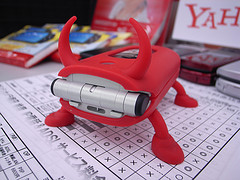
(Photo by Matsuyuki).

Advertisement

Responses

Comments rss icon

  • ///The availability of cutting-edge phones is one reason why many Japanese people don’t own a PC but would rather browse the web exclusively on mobile devices.

    Regardless of the impressive speed and the abundance of mobiles – you can not get the full effect of Pictures and videos without having a decent sized LCD.

    So in essence, a lot of quality video entertainment and image aesthetics and audio quality are being traded off for mobility.

    • Half of 2008 models of Japanese cellularphone have over 480×800 pixels resolution. (FYI, iPhone 3G is 480×320) I agree that absolute size of display will not satisfy some use-cases though.

    • Who do you explain that large LCD suppliers (10″+) post strongest results in 2007 than ever?

      In US, we eat with forks and love our couch more than our women. Yeah, we’re dumb lazy fat asses. That’s also life expectancy is much better in Japan.

      In US, I see more future in the long run for internet on large plasma (3D?) screens than on mobile, despite the relative success of theiPhone.

      Mobile internet is doomed to be limited to few applications but will never replace a desktop. How do you expect me to work on photoshop while stealing picture on the net on even a 480×800 pixels screen. Now way!

      What you describe is a nomadic way of life, in a society where people mostly live for their job and have to stay away from home much longer than here. In US, our job comes second after… fun & entertainment! There’s a reason why we have hollywood movies and the largest theme parks, don’t you think?

      Anyway, mobile internet is and will always be a gadget. A useful one, maybe, but serving different purposes than actual web surfing, on devices definitely unable to offer work comfort.

    • well fidelity is only part of what is called quality, the other is relevance, and mobile devices excells at this.

  • “The interplay of five specific factors paved the way for the success of the mobile web in Japan”

    There are other factors such as the fact that Japanese people typically spend a lot less time at home than Americans do so mobile phones end up being the most geographically convenient way to access the internet. (There are far fewer internet cafes than in neighboring Korea, perhaps due to high real estate costs.)

    • Add to that, the fact that the post office is the largest bank in Japan with over 500 million accounts (as of March 2007).

      Obviously too unique to serve as a blueprint. I guess the Japanese don’t understand how odd it is to have a privatized post office, and that it also serves as a bank is mind boggling.

      • … [post office] also serves as a bank is mind boggling.

        It’s the same in most of continental Europe. Not so mind boggling at all.

      • It’s no more odd than a coffee shop selling CDs.

      • Haha, you folks don’t get it. The ’snail-mail’ network is private in Europe? Really? And they have a large number of consumer bank accounts?

        Stick to your scripts, kiddies. Leave the business to the grown-ups.

      • Frank:
        My point was mentioning another factor promoting the widespread use of the mobile internet in Japan. You comment “added” that the post office is the largest bank in Japan. Please explain how that has affected the adoption of internet on mobile phones.

        Maybe you meant your comment as a reply to the main article. So the 3G network has been (in a sense) publicly subsidized and the post office was privatized last year. What is your point? Or do you even have one?

      • Frank, you seem to be close to retirement: update your knowledge.

        Example: Germany — DHL (aka “Deutsche Post”) is private, its bank “Postbank” has the largest number of accounts in Germany. All larger post offices include a small bank.

        The days when snail-mail in Europe was state-owned are gone since about 10 years. (Germany: 13, UK longer than that).

      • @Mommy- I wouldn’t waste your time…or would I :)
        My point was that Japan is a very different place, with business structures that a) don’t make sense elsewhere and b) allow for synergies that dont exist elsewhere. Using the phone as a payment device is a very large difference only allowed because of the odd structures in business; it changes the mobile game when the mobile is a payment device. There is a ‘battle’ going on in the US over this topic between the heavy-weights.

        @Boggler- 11.5M accounts is cute and all, but it ain’t no 500M. We aren’t talking about *a* bank in a post office, we’re talking all post offices with *one* bank, meaning 4000 locations [ I didn't know about germany's specific situation, thanks. We have UPS, FedEx, DHL, and USPS, all you have is DHL?]

        Check out this article
        http://www.usat...-colossus_N.htm

      • @Frank:

        Germany: Postbank has 14.2M customers (19% of the 80M Germans) and 850 offices, ALL OF WHICH are in a DHL owned and operated post office. However, DHL “points of sales” exist in copy and book shops, etc., which don’t offer Postbank services. (Before privatization, every post office was owned and operated by DHL, and *every* post office did offer banking). Postbank is the German bank with the most customers, but not with the highest deposits. Customer to customer postal services are pretty much dominated by DHL, whereas Fedex, UPS, TNT (previous Dutch Post) and others focus on the more lucrative B2B segment (without many offices).

        Japan: the 500M number stated about is 4 times the number of people living in Japan…

        Elsewhere in EU: I have used postbanks in Austria, Netherlands, Spain, Italy and Ireland, when I was still a student and everyone of their post offices offered bank services as well.

        Conclusion: the concept of offering bank services in every post office by a bank owned and operated by the national postal service is not as unusual as you made it sound.

        @Everybody else: sorry for the longwinded discussion, but I’m one of those people who get mad when others assume that the rest of the world is like their home country. It’s not and that’s good.

      • @Frank: I thought that might be what you were getting at but simply stating that Japan is “too unique” and providing a peripheral example (which happens to be common in other parts of the world, thus undermining your point) is both superficial and rather unhelpful. Besides the fact that using a mobile phone as a payment device is only a small part of the mobile web which this article addresses, it too is already being used in many countries. As you suggest, it is eventually going to come to the US, but don’t think there are no ‘battles’ over these things in Japan.

        I happen to think that this article is missing a key factor: the social reality of Japan. As Mat said below, there is widespread use of public transport. Combined with long commutes and most of a person’s day spent outside the home, it makes sense that a mobile way to access the internet would be popular.

      • @Boggler
        Getting mad on the interwebs eh? Good strategy.
        Thanks for that info on European post office/ banks, I found it quite interesting.

        I can’t’ comment on the accuracy of USA Today’s reporting, but I’d guess it was spot on, and must mean that many people have multiple accounts, but practically everyone has one (with the same bank).

        Sorry, I was wrong that it was odd to have the two entities entwined, but no other country has such a dominant player in consumer banking, meaning the market is very unified.

        @Loren’s Mom
        … the social reality of Japan. As Mat said below, there is widespread use of public transport. Combined with long commutes and most of a person’s day spent outside the home, it makes sense that a mobile way to access the internet would be popular.

        So, Japan is unique?

      • Japan is not as unique as people (including Japanese) would have you believe.

    • Another factor – Japan is much more densly populated than the US so less wireless infrastructure is needed.

      • DHL doesn’t own the German post offices. The German post office bought DHL years back and merged it with their parcel business, making DHL their parcel service.

  • The Japanese government has a history of subsidizing these connectivity infrastructure. Even for ISDN (broadband 1.0), the majority of the population was getting >100kpbs while the US was still fighting over a 56k standard.

    That subsidy is expensive. Maybe insight on how their ministry of technology justified it would be insightful for the government here. And I would bet it’s more than someone saying “it’s strategic”.

  • Let’s not forget an important foe to an advance telecom infrastructure in the US: geographic barrier = high cost.

    http://www.mong...ics_by_area.htm

    japan ranks #61. lol

  • Nothing can be ‘too unique’ – it’s either unique or it isn’t.

  • One other factor is the widespread use of public transport in Japan. Take a train and everyone is using their phone.

    In the US, public transport is largely restricted to those on the wrong side of the digital divide. The rest of us use single occupancy cars – making cell phone surfing next to impossible.

    • But not for talking. You would never see a loud-mouth talking on their phone in Japan. In my experience, a Japanese person does one of theree things on the train:

      - Sleep
      - Read comics
      - Buried heads down into their cell phone

  • When I went to Japan last year, we stayed at a relative’s house. He had recently bought a laptop, which sat in the main room. One evening, I asked one of his two teenage daughters whether it would be OK if I looked up some flight times on the laptop. She said she didn’t know if you could do that. I asked if she meant it wasn’t on broadband. In fact she meant she literally *didn’t know* whether I could do that on a PC. She knew she could on her phone of course, and offered me the information on that. It was clear that she had never actually used a PC to access the net and I was somewhat blown away by that.

  • The Japanese may as well be in another universe.

    Have a nice day fiddling around in the Japanese market — uh, I mean the original and world championship walled garden.

  • Wow. What an eye opening and informative article. Nice job Serkan.

  • Techcrunch is in some kind of Japan frenzy!!! :)

  • Good post, Serkan. I’m enjoying your weekend articles here.

    I am, however, quite sceptical about the whole political aspect. You give high figures for m-commerce, which probably serve as political justification for Japanese politics giving away the scarce resource frequency for free (unlike in Europe, where it was *auctioned* off — which means that the telecoms decided the price).

    What do those m-commerce figures include? It can’t all be ringtones. My guess it that most of it is brick and mortar business (e.g. payments) shifted to m-commerce. In other words: the Japanese GNP hasn’t been increased due to m-commerce. (?) [In that case, I'd rather have my governments debt reduced from auctioning off frequencies...]

    Clearly, and very different from the 1970s and 80s, the Japanese electronics and telecoms industries have been unable to succeed internationally. Why? All of their phone “standards” are not a standard elsewhere. This policy has protected their home market, but has made it impossible to penetrate other markets, such as Europe, India or China. For example, NTT tried i-mode in Europe, but failed miserably.

    • i-mode failing to be a success outside japan, has actually nothing to do with standards (as wrt Europe …. itz kinda successfull in france though –with Bytel)….
      the standards problem came ..because at the start of this mobile internet thing…there were mainly 3 regional standards …the networks in Europe were GSM, Amercia–CDMA, and Japan with Ariba/PDN … the evolutionary path for the mobile world was not same and no standards were in place …. gradually we came to 3G and then we ITU made 3 different ways to move to a common standard ….

      as for Policy protection …. i also wonder sometimes why Japan always failed to sway the international community to accept the japanese telecom standards …say it be i-mode (before WAP2.0 was released i-mode was already a big success and the eminent Japanese telecom players were part of WAP forum !!!) …. then came this “mobile wallet” –NFC technology (again the standard in Japan’s osaify keitai and those outside are not matching) …terrestrial one segment TV ….. !!!…

  • If there was a good and easy way to charge for content, mobile web and apps would be a lot more advanced than now. Carriers take most of the revenue, makes many stay away from mobile dev.

  • With the kind of speeds mentioned here ie 56mbps and recently tested 250mbps that too for for cellphone connectivity, i can only wonder if iam living in internet stoneage( In India Broadband officially means 256kbps – yes 256 kbps!!!)

    -Anita CM
    (http://www.vantrix.net)

    • i guess compared to japan yeah(internet stoneage, that too given indian economy is boomin and whatever …although infrastructure still stays at a caveman’s world…. wonder when this IT cost of labor booms in india and then what would indian economy do!!!)
      … i have a 100mbps download at home in japan now … :) …(was 20mbps ..5 yrs bac)

  • Japan’s mobile internet, although well developed in terms of content, remains a decade-old antiquated technology with a user experience that is limited at best and shows no signs of improvement. The majority of sites look like those from the Internet in 1995.

    Businesses have openly embraced the mobile internet, but this will become a severe handicap for future innovation. The carriers are so tied to the current mobile internet eco-system that they will be unable to introduce new standards and move to a richer user experiences for years to come.

    Japan’s dominance in mobile peaked with the release of the iPhone.

    • Yup. Pages are limited to 100KB per page (images and all), with very limited HTML and CSS which are as powerful as FONT tags. (in fact, the “i-CSS” style sheet added to i-mode phones were nothing but syntactic alternatives for the font tags that already existed – inline only, no regard for reusability or separation of presentation from content at all.)
      I quite envy the web dev environment of the iPhone and other upcoming WebKit mobile browsers, where you can use the same technologies as those used in PC development.

      • That is not correct, most mobile sites in Japan use flash and are very easy to visualize and navigate. Top models have 3Mb limit on flash content.

        http://www.scot...play_mobile.jpg
        http://farm1.st...fa38841.jpg?v=0

      • Look, do you live in Japan and develop Flash sites for a living? No? Then stop spreading BS, because I DO and curse at the limitations every single day.

        While Flash Lite does exist and is used, “Most” mobile sites do not use Flash. The first pic you linked to is a mere mockup of a 800×480 screen which isn’t even Flash. And sure the second pic is NTT DoCoMo’s frontmost i-mode menu, and it uses Flash, but the majority of sites use them partially at most. Like PC sites, full Flash makes it harder to update and maintain sites. AND you cannot use the left/right keys while in fullscreen Flash. AND you cannot receive input at all for inline Flash. How frigging “easy to navigate” is that supposed to be? Answer: It’s not!

        And look at the technical specification documents for NTT DoCoMo (http://www.nttd.../index.html#p04), KDDI au (http://www.au.k...mm/flash01.html) and Softbank Mobile (http://creation.../web/index.html) and you will very plainly see that the upper limit for DoCoMo/au are 100KB, no more. Only Softbank supports 300KB, and with Softbank being the smallest of the 3 major carriers, if you want to develop for an audience worth anything you’re stuck with 100KB which is the lowest common denominator. Got it?

      • Look, do you live in Japan and develop Flash sites for a living? No? Then stop spreading BS, because I DO and curse at the limitations every single day.

        While Flash Lite does exist and is used, “Most” mobile sites do not use Flash. The first pic you linked to is a mere mockup of a 800×480 screen which isn’t even Flash. And sure the second pic is NTT DoCoMo’s frontmost i-mode menu, and it uses Flash, but the majority of sites use them partially at most. Like PC sites, full Flash makes it harder to update and maintain sites. AND you cannot use the left/right keys while in fullscreen Flash. AND you cannot receive input at all for inline Flash. How “easy to navigate” is that supposed to be? Answer: It’s not.

        And look at the technical specification documents for NTT DoCoMo (http://www.nttd.../index.html#p04), KDDI au (http://www.au.k...mm/flash01.html) and Softbank Mobile (http://creation.../web/index.html) and you will very plainly see that the upper limit for DoCoMo/au are 100KB, no more. Only Softbank supports 300KB, and with Softbank being the smallest of the 3 major carriers, if you want to develop for an audience worth anything you’re stuck with 100KB which is the lowest common denominator. Got it?

    • yeah ..thtz true … but the point is that mobile internet was first introduced here with a small footprint … ( even now it costs you to receive mails …whereas receiving SMS is free anywhere else) … so in-order to make the customers comfortable with their monthy bills heavy webpages were not introduced as well as a full browser (the flat rate data packet fees are also a recent addition) … most of the data generated in japan while using mobile email :) … and downloading entertainment content ….. and in that arena … think of the mega appli games …guess they are way ahead of the rest … ((( browsing is not so popular ..i guess but sending mails, playing games … reading manga/e-books, watching downloaded TV clips …paying your train commuter ticket .. are more popular here in japan ))

  • Mobile web is BIG in Japan. Does the rest of the world perhaps take rest?

    Interesting

    http://www.slid...rowsing-the-web

  • …the Japanese are so far ahead, aside from the Koreans, in mobile technology it makes US/Europe look like theyre still carrying around clubs. my bet is Japan will be the first to introduce a communication device directly embedded in the skull…

  • “relatively sound regulatory policy”

    You socialist pig – don;t let this hear M Arlington – he will kick you good time…

  • uuuh my snark brackets fell off.

  • As part of networkchallenge#3 I clicked on your ads.

  • Mobile internet at 54mbps. Wholly cow. I am using 1.5mbps via PC.

  • The web on my iPhone, for instance, isn’t what its cracked up to be. On more than one occasion, I have cursed myself for not bringing a laptop when it takes me three minutes to browse on my phone for something that would typically take 30 seconds on my laptop

  • Over a billion cell phones! holly molly! lets just say that phones and computers are the number one celling products in the world.
    http://www.littlebabyguide.com

  • I spent a year in a japanese university in 2004/2005… and I was amazed to see that the supposedly tech-savvy undergrad students (20-24, physics) never heard about MP3 and mp3-players. 2004! They believed the only way to listen to music back then was to buy sony’s minidiscs and rent CD’s from tsutaya stores. Few months later, the ipod was introduced and destroyed that walled-garden in weeks.

    • I’m a Japanese in early thirties. Mp3 and mp3 players had been very popular around me from late 90’s. I don’t know which of your and my experience was the rare case.

      Some junior high school students in Japan I know use closed FTP site to share mp3 files with friends, because they know they can be tapped if they use P2P network. Not everybody is using cellphone without knowing about PC.

  • Great to hear about the 3G services in JAPAN and here in india we are waiting for them.

  • I think this article misses the most important point about japan. 80% of hte working population sits on a train for 1+ hours a day. that’s a lot of down time to play around with your phone.

    • Interestingly enough, another thing to think about is, most of the mobile internet usage in Japan is reported to be in the bedroom (right before they go to sleep). I believe this is the same in other countries.

      It is true that the heavy train commute situation drove the growth of mobile internet in Japan, but once people get used to the convenience, it’s at home that people use mobile internet the most.

  • I really think Japan is a special case of culture, geography, etc.

    I don’t care how advanced the phone is. If I’m out and about, I want to use my phone as little as possible. As far as using anything like a mobile web, you can forget it. I spend my entire day online. The last thing I want is to be spending time peering into a phone screen. If I’m out making purchases or going to events or anything else. I will be navigating the real built environment for what catches my interest. I will not be looking at geotargeted advertising on my phone for a coffee coupon I can use around the corner.

    I think the mobile net will be good for other things like changing your VoIP carrier, but will never match sitting in front of a laptop. The concept will never make it really big because it’s culturally incompatible with the US.

    • “I really think Japan is a special case of culture, geography, etc.”
      “The concept will never make it really big because it’s culturally incompatible with the US.”

      There is more to the world than Japan and the US. :-) Anyway, iPhone and Blackberry users prove that *you* are the “special case”.

  • I wander if the ideograms are not an additional factor here. I imagine you can push a lot of more information on the small mobile screen with ideograms than you’d do with alphabet.

  • Another non-technical aspect which is grossly ignored is the metro-driven lifestyle of the general populus. There are only 3 alternatives to kill time in a subway: sleep, read books aka manga and surf on your cellphone. The article describes the supply side (technology and regulatory push) but ignores the demand side of the equation (consumer need).

  • One of the most important factors to building the Japanese mobile ecosystem has been the low % commissions (around 10%) taken by Japanese mobile network providers (carriers) in the sales and promotion of mobile content. Content producers are therefore able to gain substantial financial benefits from selling their content through the mobile channel. In mirror image, European and the U.S. carriers take a huge % commissions (between 70 ~ 90%), perhaps to pay off those massive auction prices paid for their 3G infrastructure. Global carriers need to give content copyright owners better financial incentives in the licensing of their content in order to increase carrier ARPU.

  • SureShot Serkan !
    but, Too Individuality ><

  • Back in 2000, 2001 + I headed a loosenit think tank called 3Gv2 – the idea was to look in a different direction than everyone else when thinking baout the future of wireless in America. What we determined was that the time frame for adoption of even a basic 3G service was WAY in the future here and therefore there was a lot of opportunity in the meantime – and especially as storage capacity got smaller, and cheaper – more mobile.

    Anyhow, a lot of duscussion was based on the success of the i-mode and NTT, which used their own servers, and a small language c-HTML rather than some other complex language like WAP or J2me or whatever… that could’ve worked here, however, just like how this gov’t can’t make a move to drilling for oil for the environmental lobby and would be sued into oblivion should they try – the ‘open’ cry of those not wanting a closed system would cause a tremendous amount of trouble for companies who even attempted to try.

    Open systems are great for all but those that want innovation to thrive and succeed. In SOME cases it actually has the opposite effect of squelching progress. For fear, or for all the different consordiums who take years to establish a ’standard’ (how long have we been talking about 2.5G, 3G, GPRS, WAP, bluetooth, et.al?. yeah.)

    No where is that more evident in the adoption of 3G in America. truly pathetic, a lost opportunity and a ton of squandered wealth.

    oh well.

  • Eduardo: Look, do you live in Japan and develop Flash sites for a living? No? Then stop spreading outright false information, because I DO and curse at the limitations every single day.

    While Flash Lite does exist and is used, “Most” mobile sites do not use Flash. The first pic you linked to is a mere mockup of a 800×480 screen which isn’t even Flash. And sure the second pic is NTT DoCoMo’s frontmost i-mode menu, and it uses Flash, but the majority of sites use them partially at most. Like PC sites, full Flash makes it harder to update and maintain sites. AND you cannot use the left/right keys while in fullscreen Flash. AND you cannot receive input at all for inline Flash. How “easy to navigate” is that supposed to be? Answer: It’s not.

    And look at the technical specification documents for NTT DoCoMo (http://www.nttd...ture/index.html), KDDI au (http://www.au.k...mm/flash01.html) and Softbank Mobile (http://creation.../web/index.html) and you will very plainly see that the upper limit for DoCoMo/au are 100KB, no more. Only Softbank supports 300KB, and with Softbank being the smallest of the 3 major carriers, if you want to develop for an audience worth anything you’re stuck with 100KB which is the lowest common denominator. Got it?

  • Japan has a lot of technology under it’s belt. …its a nice growth of technology

    http://compedia...us.blogspot.com
    http://mobilesp...ia.blogspot.com

  • Serkan — that was a very good writeup. I was surprised to note that you did not indicate Japanese script(s) as contributing to the success of the mobile web. I believe it is much easier to use a smaller set of symbols to communicate in Japanese compared to (say) English. Which maybe an important differentiator if one is to replicate the success in Japan elsewhere.

  • “Anyway, mobile internet is and will always be a gadget’”

    Typical American- always gotta be right.

    well it appears that in Japan it is not a gadget

  • Consider a hand raised in Queensland, Australia

  • Serkan,

    While I agree with many things you wrote, I think one factor is crucially missing (surprised none of the comments mention it either): Handset manufacturers and their relationship with the carriers, which is very different than elsewhere. In Japan, the carriers fully spec the phones, procure directly from the manufacturers (who don’t do retail) and pay them up front. This allows them tight control over the capabilities of the handset base in total and thus a very solid base to build services (or service platforms, rather) on. Your average EU or US carrier (even less so for content providers) generally has only a vague idea of what percentage of its users have, say, GPS, video, or whatever else capability on their handsets, which makes it extremely hard for them to develop content and services that people actually can/will use. In the Japanese market, it was, for example, relatively easy for the carriers to say, “If we start equipping handsets with NFC chips for payment etc. around 2005, then by 2008 we will have enough critical mass out there to actually launch services utilizing that feature on a major scale.” Put more simply, in Japan, carriers, handset manufacturers and content providers have been able to act in concert and develop the industry taking a long-term view.

    I certainly don’t think Japan can act as a direct blueprint for other markets, but what I do know is that every single person working in mobile somewhere in the World who has seen what is happening in Japan with their own eyes and has developed an understanding of how things are structured here (which is something some of the comments are unfortunately lacking) went back to there own market with lots of ideas that could be applied there, although the general paradigm is different.

  • great writeup… enjoyed it.

  • I believe that as much as anything, the growth of Japan’s mobile web is a combination of down time on trains (= nothing to do but text friends and surf the net for the duration of the ride) + a lack of space at home for big computers and the fact that Japanese tend to spend less time at home than Americans.

  • Consider a hand raised in Queensland, Australia

  • Srilankans Would like To Use Your Mobile network.

    Coming Soon On Srilanka..
    We Are Waiting For You !
    Dilruklasantha@yahoo.com
    +94771135518

Leave Comment

Commenting Options

Enter your personal information to the left, or sign in with your Facebook account by clicking the button below.

Alternatively, you can create an avatar that will appear whenever you leave a comment on a Gravatar-enabled blog.

Trackback URL

RealTime CrunchUp Sponsors:

bugbugbugbug
Techcrunch on Facebook