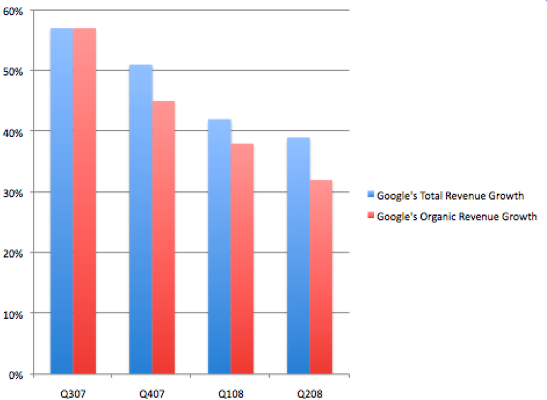


Google pulled in $5.37 billion in revenues last quarter, and $1.25 billion in net profits (nearly ten times what Yahoo made last quarter). Yet behind the consistently amazing financial performance, a few chinks are beginning to appear in Google’s armor. The biggest one may be the increasing gap between its organic revenue growth and its total revenue growth.
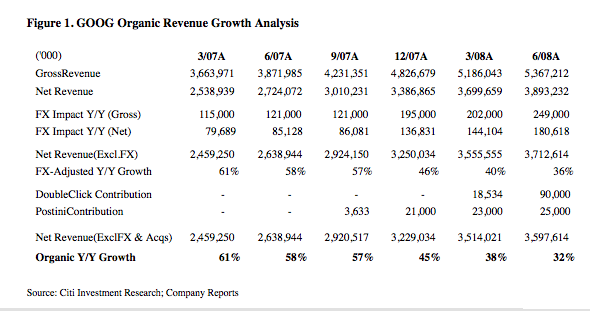
Google does not break out its organic revenue numbers (the revenue from its core businesses, not including contributions from recent acquisitions, investments, interest, or foreign exchange fluctuations). But in a note put out on Friday, Citi analyst Mark Mahaney gave his estimates of Google’s organic revenue growth. He warns, “We have seen steady and material deceleration in GOOG’s organic revenue growth,” and he expects that trend to continue in the third quarter as well. (Even so, he still reiterates his buy rating on the stock).
I’ve put his organic growth rate estimates together with Google’s reported total revenue growth rates for the past four quarters in the chart and table above. In the third quarter of last year, both growth rates were the same: 57 percent. By the second quarter of 2008, Google’s total revenue growth rate had settled down to 39 percent, but its estimated organic growth rate was significantly lower, at 32 percent.
What this suggests is that Google’s core search advertising business may be decelerating faster than a glance at Google’s quarterly income statements would indicate. It also highlights how important it is for its biggest acquisition, DoubelClick, to make up for the slack. And, of course, it would be nice if Google could start making money from its underperforming businesses such as YouTube, Postini, and Google Checkout (some of which, themselves, were acquisitions). Mahaney estimates that DoubleClick contributed $90 million in revenues last quarter, and Postini contributed $25 million.
Update: Here is Mahaney’s detailed analysis.


It is possible for Google for fill the holes created by their core search business decelerating, but they are going to have to concentrate on bringing all of their acquisitions together. Some of it just doesn’t make sense at all.
about the acquisitions… that’s mostly what they have been up to lately, it seems like. Some acquisitions don’t make sense though…I mean they have the knowledge to create something of their own… but it might end up like Knol..not such a hype. http://blabtech.blogspot.com
one trick pony, ad widget? what is google? google adsense and search results are barbaric. adsense equals spamsense. the experience and innovation they dont have nor posess they will buy. some people at google are defintely not doing there job. darn lazy billionaires.
If the numbers are correct its an emergency. .
“Google is Shrinking.” .
Some ol’ man’s advice: 90% of all statistics can be made to say anything… 50% of the time
But Google definitely has some disappointments, here’s a list of the top-10 disappointments. It’s 10% longer than the previous one, with 50% more information.
It’s a strange world indeed when youtube is considered an under performing business. Make me look very very small
Yes, and once they start putting ads, everyone will be complaining about it then also. You can’t satisfy anybody.
I really dont see why every one complains. To tell you the truth I never even notice ads. Ive been to youtube thousands of times and if you asked me if they have ads, i wouldnt be able to tell you.
Well, part of the reason YouTube isn’t a business with an extraordinary outlook is because they paid so much for it. If the price was lower, expectations would be lower.
‘And’ ?
I think one simple thing Google can do is get more creative with their ad units. They’ve stuck with the same format for way too long and most people are blind to them.
What if they adopted some ad units that combine images with text similar to BlogAds.com? How about put up ads on all of the embedded YouTube videos and share part of the revenue with those that embed the videos? I think this problem is as simple as having a brainstorming session… maybe they should hire Roger Von Oech?
Best suggestion (the image/text units) I’ve seen on here. They made it against the TOS when they saw the clickthroughs AdSense publishers were getting, but image next to text works.
They’d have too many legal issues to do the embed thing with YouTube though
I knew those pesticides were bad for you.
Companies are no longer falling for the “SEO” garbage they were all tricked into buying back in ‘05/’06. The sad truth is that Google’s best positions are reserved for Wikipedia entries and the huge sites on the internet that were big before and after Google came around and companies are no longer seeing a decent ROI from them.
Search engines like Google need to be reworked from scratch every 2-3 years to ensure new content has a chance to be seen or else the small guys (who Google makes most of their money from) won’t even bother anymore. Especially with all the click-fraud and non-control of ad placement that is common knowledge.
@Scott C. – The wikipedia positions you referred to are the organic search results which google doesn’t make any money from. Wikipedia and the other sites you mentioned don’t turn up in the paid-for search results so I don’t follow how re-working the search engine as you suggest would actually benefit anyone.
Because even though Wikipedia doesn’t charge $$$ to get their position on Google, Google puts them in the #1 spot simply because Wikipedia entries are usually extremely informative. If someone is doing a search and the first entry is from Wikipedia, they’ll believe Google is responsible for them finding such informative results. After they’re done with Wikipedia they’ll move on to other results only to find they usually lead to businesses and/or sites that aren’t as relevant but paid a ton to Google.
Theyare giving Wikipedia a free ride in results while every other site needs to pay — and I think this had had a larger negative effect on people’s opinion of Google than tech journalists realize.
A lot of people simply do not appreciate how many backlinks Wikipedia has got – http://www.maje...q=wikipedia.org – you can see that Wikipedia has got 670 mln external backlinks from 1.3 mln domains. Nothing suprising that they rank well.
You just became a Trending Topic on Twitter
http://search.t...+Google+Have+An
I’d guess that Google Apps sales will become increasingly aggressive as well as create a real channel. I’d expect that to be across the SMB space as well as into service providers as the back office services that Google Apps provides become increasingly commodity.
i don’t know, but tonite is saturday nite and i’m having an orgasmic growth problem.
QoQ growth 3%
Good observations. Like Explorer share of browsers, Google has almost a global monopoly on search. Focus on high-growth, third-world Internet access helps sustain organic growth, but the key problem is that ad click rates have hit a wall.
Running image ads in AdSense is a desperate effort to increase accidental clicks. (http://adecon10...-of-backup.html)
Well , The problem may be because it is all ready at the top and saturation.
The managers has to think now quite differently to improve its performance further.
Maybe it’s strategic buys and acquisitions should be considered (or not count against them) as true growth, as long as they can keep them profitable. I expect some very interesting new products debuting soon that will continue to fuel the company for a long time to come.
Here’s a question for ya – when was the last time you clicked on one of their ads? how often do you click?
I’m telling you man… they gotta get more creative.
I think a good idea would be if Steve Jobs could do to advertising what he has done to computers, mp3 players, cell phones, etc. Make ads cool, simple and fun.
In particular when I’m shopping for something, I click on the AdSense links quite a lot actually.
If you count the first two pages of results on any given topic as “ads” then quite often. Sites only get to those spots by paying Google a lot of $$$.
I for one avoid Google adwords and the ONLY time I might click on one is if I’m trying to track down a specific site and they aren’t showing up in normal results (like in the first 5-10 pages)…but that’s only out of frustration and it had never left o a sale of any kind.
What do you mean sites pay $$$ to Google to get on the first two pages? Except for the obvious ads on top and on the right, the search-results aren’t paid-for.
Economic recession!
Advertising frankly doesn’t work. I sell adverts on my site and buy them for customer acquisition and they don’t work. ECPm is pitiful even with being a google ad partner.
I’d also say 99% of people write their own ad copy too, because they can, but that doesnt mean they are advertisers. No-one readling this would imagine they could script a 30 second superbowl ad, but they still believe they can write copy. Perhaps it just takes time for people to realise that and google are going to run out of new people willing to chance it.
Also seeing more traffic now from MS and yahoo, perhaps all those new people buying PC’s don’t bother changing their default search engine anymore.
Why is Google a buy at the price of 500 dollars a share? You buy something like that if you are not tryig to grow you rmoney but rather keep it at a specific small growth rate.
How much higher can Google go anyway? What happens once it hits the cieling and most people who can possibly use it are? When MS owned +90% of the internet browser and OS market, did people buy MS and expect it to go up?
My opinion is that Gogle is too expensive and its P/E (price to earnings – actual earnings) ratio is too high. Its price will go down etheir today or 2 years from now. It can not sustain its 40+ ratio. It is over valued.
Deal with it.
Google’s share price depends on expectations of their execution. The global ad market is over $1.5 trillion – even after the economic slow-down. Google is 1% of the total. Sustaining growth requires Google to expand beyond AdWord. They have the global platform, but efforts with Youtube video; marketplace for radio, TV, and magazine ads; and local ad sales have failed to scale.
What your saying is that it will grow and grow and grow. This is assumption is no different thant people who though the housing market will just keep going or the airline business (back in the 60-70’s) can only go up.
If Warren Buffet’s company can have a P/E ratio of 20 with its shares costing 100,000+ a share, why is Google worth it when its P/E Ratio is almost at 30?
P/E Ratio
http://en.wikip...ia.org/wiki/P/E
Google Stock Info:
http://moneycen...ote?Symbol=goog
It could go up, but I would still not consider it a buy. If I wanted to buy it right now, at best I would earn 5 times what I earned IF the stock goes to 2500. What is more plausable: stck going to 2500 or tock going down to 250 or only go up to 750? Even if I wanted it to go up to 1000 (and double my investment), I would probably have to wait a while.
That is alot of risk for such a gain. Not many stocks go to 1000+ but many stocks go down after their P/E ratios remain at a high level.
I would rather try to find the next Google for $10 a share and let that go up to $100. I earn more and risk less.
Google is not a buy as far as I am conserned until its P/E goes back down to what Warren Buffet calls a good p/e share price
Oh yeah…. and the resession might not help either LOL
Google the best
Bing is better!
Google is too commercial project
Google is banking Android to deliver the much needed growth. But apart from the possibility of a big hit with Android, what else has Google got up its sleeve.
It amazes me that the Big Three Web Titans such as Google, Microsoft and Yahoo, have no ideal as to what will be the next big thing on the Web.
They are all just firmly fixed on making their Search and Ads Platform deliver their only goods.
But from all of the other great services that they offer, they do not know that they all hold on their hands, key services that can make the next big thing happen, right here right now.
I wish I could be on the board of the above Three Titans and show them that they have the smart services that can be packaged as the next big thing?
Mobile would deliver huge growth. Google has hedged it’s bets via it’s exclusive relationship with Apple iPhone.
Google has proved to be a one-trick pony so far in commercial terms, albeit a hugely successful one-trick pony. However, their dependence on online advertising has a natural limit in that not everything in the world is suited to being advertised on the internet (eg goods and services that don’t lend themselves to being sold online). For such items it is hard for advertisers to connect click-throughs to sales, and therefore they can’t easily measure the ROI of their marketing spend.
Is TC now a site just for analysts? I’m a programmer not a fucking stock analyst. WTF is ‘organic growth’? Does Google need to buy more fertilizer?
But most of these comments *are* related to programming – or at least indirectly.
You see, when/if Google goes down, there won’t be anything for PROGRAMMERS to create things that might utilise its very presence.
But Google is the most provider for web publisher to get earning. Hope google grow and grow.
Yes, they do, which is why they are launching JUNK like Knol.
What is the news in this? EVERY business goes through a maturation process and Google is no exception. I remember in the early 80s I worked for IBM and during that high grown period people used to extrapolate IBM’s growth rate and say that by the year 2000 IBM’s revenue would be bigger than the GNP of significant countries and greater than 1% of the US GNP. Fundamentally, it can’t be.
No company can grow faster than the GNP forever whether it is Google, IBM or Microsoft (or Starbucks or McDonald’s for that matter) or it becomes a country’s GNP.
Not only this, their ad sense revenue is also on decline, but i am sure google Apps will take care of future growth.
Inorganic growth is always a challenge, especially when it comes to integrating technology and people.
As the web moves towards convergence of apps it will be a challenge for leading players to integrate their web apps without compromising on usability. What they need is Business Technology Re-engineering (BTR), for more on BTR, read my blog http://www.kree...com/blog/sumeet
Thats why for kreeo.com we choose to develop our own content management platform and framework using open technologies
Many people dont know that most of google’s revenue growth in the last 2 years came from eCPM revenue optimization (via quality score) than organic traffic growth. IMO, there is not much left to extract in this area.
Since the total search pie is not growing that fast and google has >90% marketshare in most countries and nearing that in US, i wonder how they can grow beyond 20% from 2009??
To change anything at Google will disrupt the CAN DO NO WRONG image; after all these people are the smart of the smart, how can they not be earning?
This premium exists in their stock price, Google is trapped in that it must out preform all the time, they have no excuse.
Yeah , its of course that Google facing stiff challenge to increase its revenue with the same growth rate , as previously Google had monopoly over Ads on internet but as in the market many ppl had started using other services due to Google’s non sense policy to ban any account at any point of time, advertisers also checking that their money paying them in terms of return or not .
Michael is correct. And its not Search- seems to me at as the Internet gets larger, Google has created the belief that web ads are click based — that leads to the belief that ALL ads should be measured on response right away. The reality is that brand advertisers have a small % of their budget on response based ads, as that usually occurs when a buyer is ready — not when they don’t know and not sure what they want.
Bottom line, at 62% of Internet Revenue, Google has maxed out the direct marketing budgets of most marketeers. Typically these are 20% of advertising and a bulk is spent on brand engagement. If you read any agency white papers they are all talking about engagement. Google provides no engagement and bypasses the agencies so they don’t trust Google.
If you read the other analyst reports- DoubleClick is helping Google- but only in ad serving. Google has failed in display and in video- a shock as they own YouTube! Too bad Yahoo and AOL are stumbling, as they were good at these, but not anymore. And Microsoft is no focused on catching up with Google in Search (the same mistake Yahoo made) that they ar missing the new game.
Like most analysts, I believe that Google has strategic markets under heavy focus with Tim and Cheryl’s old teams. What’s wrong is that they spent too much on trying to bring Google AdSense for Search to other Media and not enough on Google for non Search on Web. This is their failure. AdSense for Content has failed — ask any publisher, and AdSense for Search has become a domain and click business more and more. Reminds me of Yahoo in the dot bomb — with most revenue coming from other dot coms.
What most analysts believe is that Google and MSN will make their next moves later this year — just like they did YouTube 2 years ago and DoubleClick/Atlas last year. The holly grail is where the ball will be — clearly not in search. Looking for the AdSense for Display and Video, a couple of 1-3B deals just like DoubleClick — but not in Ad Serving, in Media not owned content or social networks. Else bad news for the web and bad news for Google.
Clearly Google is reaching a saturation point with their primary revenue stream. This is natural for a company operating at their scale. However, its a major mistake to count Google out too soon. They have major investments in a lot of diverse areas and a recession may actually be positive for them in the long run as they’re in a strong cash position – able to not only weather the storm, but acquire on the cheap.
Remember, with Google’s resources, they have the ability to swing for the fences quite often. It doesn’t matter how many times they strike out. What matters is that they continue to swing and will continue to cash in accordingly.
I guess there is still a healthy growth rate as the reiteration of the buy rating suggests. The econnomy might be the related factor. Even opposing to a natural saturation there are areas for natural growth like increasing usage by broadband, the emerging mobile internet and new advertising formats like advertising at gadgets. While researching the latter lately I found that those now may become used at websites, too, instead of using them only at the igoogle startpage. So there is space for further organic growth and even increasing earning by market movements. I am sure they are able to get into related future markets.
Google is no longer a start-up company. With nearly 20,000 employees, things would be much different. It’s only natural that their growth rate decreases over time.
I knew those pesticides were bad for you.
Interesting post and analysis by Citi and glad to see you guys picking up on it. We’ve benchmarked and analyzed the entire S&P 500 (of which Google is a member) on organic revenue generation and efficiency and our #s reveal a similar story, but the picture still is very positive.
In short, we would agree with Citi’s analysis that the organic revenue as a % of total revenue for Google as well as a % of total revenue growth is declining over the longer period we studied. As compared to Yahoo (the closest comparable to Google if there is one), you can see however, that Google is destroying their peer from an organic revenue perspective.
Our analysis goes beyond just organic revenue and looks at the efficiency of generating this organic growth, e.g., how much are companies spending to achieve organic revenue growth. We call this efficiency ratio the Organic Growth Multiplier (OGM). The logic behind the OGM is that if one company can spend $1 to get $3 of revenue and another can spend $1 to get $5 of revenue, the latter company is healthier and has more momentum in its business and obviously superior organic revenue generation capabilities.
When we look at the OGM of Google versus Yahoo and versus the larger S&P500 tech financials category, the picture is actually quite pretty for Google. They’re tops as it relates to OGM which means a dollar of their investment into their core business generates more revenue than the average tech sector company. They also outshine Yahoo on this count as well.
The indexed OGM for Yahoo and Google over the period from 2003-2007 are 50.9 and 312.84, respectively. Without getting into the quantitative models that underlie this, the point is that Google’s organic revenue efficiency is far superior to Yahoo.
Lastly, we’ve seen that higher OGM and total shareholder return are positively correlated. So that that implies is that having the ability to generate organic growth efficiently is a good indicator of shareholder returns.
While the assertion that their organic revenue is declining does remain true, the news is not as dire as I’ve been reading elsewhere from those who’ve picked up on this post. Yes, if they can turn one of their acquisitions into a money maker, this will obviously supplement some of the organic revenue deceleration that might be evident in their historical core business, but on the whole Google is still a star when it comes to organic revenue generation and efficiency. The fact that Citi retains its buy rating despite the organic picture is testament to this.
A bit on the methodology.
There are some notable differences from the Citi analysis which despite the similar conclusions do make our analysis more robust.
1. We’ve looked at a more extensive time period (2003-2007)
2. We strip out market growth for each company. In essence, if the market is growing at 10% and your company grows at 10%, we don’t give you credit for this. This is rising tide growth and is not due to management’s actions and investments in the core business. Organic revenue, therefore, in our models is only the growth we can attribute to management’s prowess (or lack thereof).
3. In our Organic Growth Multiplier, we also look at the efficiency of generating organic revenue by determining how much is spent by each company to achieve its organic revenue. This gives a truer sense for the efficiency of the company’s organic revenue capabilities.
Thanks for the great post on organic growth – a topic not often discussed.
Regards,
Anand Sanwal
http://www.brilliont.com
Investile Dysfunction blog
http://www.bril...nt.com/blogs/id
A factor not mentioned above is how difficult the economy has become for many of us in the US and Europe things are really difficult, customers are stopping advertising spend and cutting back, this must translate into lower Growth for Google, as they are effectively a benchmark of the health of the online economy.
More people are switching over their spend and activity to PPC and SEO, but the total spend is falling.
Google seem to be doing very well under difficult conditions – I can see their growth accelerating again in 18 months or so when conditions are better.
There is a saying that goes like this. Market share today is revenue tommorow. Even though they may not be making money from youtube now, things could change given the fact that video is soon becoming very popular online.