
The Record Industry’s Digital Distribution Plan (TotalMusic) Comes Back From the Dead
by Erick Schonfeld on August 7, 2008

The music industry’s attempts to create its own digital distribution business is like a bad horror movie. It just keeps coming back no matter how badly bludgeoned it gets. Back in 2001 in response to Napster, the music labels launched two competing music download sites, PressPlay and MusicNet (the latter became a white-label music service called MediaNet. Meanwhile, Pressplay was bought by Roxio, and formed the basis for the current version of Napster). Both were utter failures.

Then in 2007, in response to iTunes, Doug Morris at Universal Music had the brilliant idea of bundling music subscriptions into the price of digital music players. The effort was called TotalMusic, and the idea was to get all the record labels on board, until the Department of Justice launched an antitrust investigation that killed the idea. Or so everyone thought.

Multiple sources in the Web music industry (including two CEOs and another executive) have told us that the music labels are mulling over another attempt at creating their own digital distribution business, or at least one they can control. Details are sketchy, but the buzz is increasing around a project to create a free, advertising-supported streaming service that would be licensed or white-labeled to other Websites. Each stream would link directly to a paid digital download. Some believe that a revived TotalMusic and this project are one and the same.

TotalMusic, Like, Totally Doesn’t Want To Die

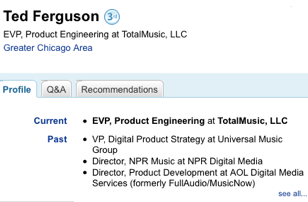
Indeed, TotalMusic lives on, although in a different form. A search on LinkedIn for “TotalMusic” returns four people who list it as their current employer (Ted Ferguson, Troy Denkinger, Robert Broome, and Derek Reeve). All four live in Chicago and all four previously worked at MusicNow, another music service that changed hands between Circuit City, AOL, and ultimately the new Napster (not a good omen). A couple job listings, like this one posted on July 15 for a senior software engineer, describes TotalMusic as being based in Herndon, VA (near AOL old headquarters):
TotalMusic, LLC is a new digital music platform offering the integration of music discovery, streaming and downloads into a wide variety of online and mobile environments. We have solid financial backing and a staff with decades of combined experience in online music.

Compensation is competitive, and the work environment is highly distributed with most members of the team telecommuting, however, our Headquarters is located in Northern Virginia, and have a group in Chicago and Boston. So if you prefer an office environment, Northern Virginia should be your choice.

Free, As in Music

The idea of combining ad-supported streaming with paid downloads is very similar to the upcoming MySpace Music (due to launch next month), except that it will be available to other sites. In that sense, it is closer to what Rhapsody has done, powering music streams for Yahoo Music, iLike, and MTV.com, and trying to up-sell full subscriptions or paid music downloads.

Full-track, on-demand, advertising-supported music streaming (as opposed to randomly-sequenced Internet radio) is gaining steam as a business model. The music labels have licensed their catalogs for uninhibited streaming to imeem and MySpace Music. And a number of other sites, including Lala and Last.fm, have signed more limited deals that still provide access to a broad range of artists. For example, Rhapsody offers a limited version of free streams (25 songs a month) to their songs.

What the music industry should do is make music streaming free. Treat it like a marketing expense to sell digital downloads, concert tickets, and other items. That’s probably not going to happen. But what could happen, and what Web music startups are hoping for, is for the music industry to lower its licensing fees for streaming music.

Or At Least Disruptive Pricing: The $1 CPM

Right now the going rate for streaming music is a penny per track, which comes to an effective CPM (cost per thousand) of $10. That means that music streaming Websites need to be able to charge more than $10 CPMs just to cover the music licensing. And $10 CPMs are not economical. A $1 CPM would make more sense.

As one music startup CEO says, “The only guys who have negotiated terms are guys who have gotten sued.” That is certainly true for imeem and MySpace. With others, the threat of a lawsuit might have been enough to bring them to the table. Although, interestingly, as part of its deal with Warner Music or some time after, imeem received a $15 million investment from Warner, it was revealed today in Warner’s quarterly SEC filing. (Warner also invested $20 million in Lala).

Yet even imeem—which attracts 26 million unique visitors a month to its site, according to comScore, and claims 70 million to 100 million total uniques if you add up its widgets all over the Web—does not expect to make money based on ads related to streaming music alone. It is trying to create a bigger experience that includes videos and photos, and sells other forms of display advertising and sponsorships. MySpace Music, similarly, has its own economies of scale.

For everybody else, offering on-demand streams won’t become feasible until the licensing fees come down. Whether or not TotalMusic is the answer they are waiting for remains to be seen. But don’t count on it. Industries are rarely able to disrupt themselves.

Horror Stories Tend To End Badly

Another, more sinister strategy could be to simply continue to make life difficult for other music streaming services, and let TotalMusic come out with its own a cost-advantaged model. This would be aimed squarely at iTunes as well.

Although it is actively being developed with a rumored time horizon of three to six months, TotalMusic could end up being just a hedge. One source believes the project has yet to receive the final green light from the music-label bosses.

And even if TotalMusic does launch with a disruptive economic model, there are still the antitrust issues to deal with. Since there are only four major music labels, anything that smacks of price-fixing or collusion will be torn down by the Justice Department. The labels need to be very careful about this. (One story I heard: when MusicNet was forming itself among the record labels, it had to rent out an entire hotel floor with a different label in each room, and the lawyers had to go from room to room to seal the deal because the music companies couldn’t be in the same room together).

TotalMusic needs to get around the collusion issue somehow, while still offering a comprehensive catalog. The music industry is desperate to figure out how to shift from physical to digital distribution and it will just keep trying things until it is all spent out. But like any good horror movie, there will always be another sequel.

(Photo by darkpatator).

Advertisement

Comments rss icon

  • I don’t know if it is the “new intern” effect — but the image selection on posts lately has been really good. Nice find!

    • crappy image …

      • Please Michael, remove the picture. I cannot stand having to open TC and viewing this horror picture… :-(

      • Great post,
        However,
        The KEY thing ALWAYS missed in these discussions is around who owns the rights. Rights are limited by territory, term and use.

        With the RARE exception of a 360 deal like PSD, the rights to different aspects of the brand (recording, publishing, touring, merchandise, management etc.) are owned and or controlled by entirely different and competing entities many of whom HATE each other and can only see as far as their own interest in the brand.

        Managers, who some will argue have the MOST influence and control are often the LEAST web savvy and as a result there is little “brand” management from a central internal perspective. The Future of the Industry cannot be in a “Total Music” Reagan era Star Wars like defensive strategy that treats all music like a commodity in the hopes of upselling the fan to purchase other brand related assets from someone ELSE, but rather a direct to consumer offensive strategy that allows for these “competing” entities to cross-manage their brand assets while benefiting from the overall brand strategy put together by management and the Artist themselves. You know…the one that GIVES all of their rights away in the first place.

        G

    • What’s wrong with that image?

  • Funny how the article mentions Warner’s 15$ Million investment in imeem and the crunchbase entry at the bottom of the article still lists imeem’s funding at $750k (with those kind of visitor numbers imeem should be making that much dough every couple of weeks)

  • Ad-supported streaming (of music) is a step in the right direction. Ad-supported streaming of live events is what will eventually be the monetary backbone of the record industry.

    http://www.snuzu.com

  • “MusicNet (the latter was bought by AOL in 2005, changed its name to MusicNow” – INCORRECT. MusicNet is still alive as an independent entity. MusicNow was a separate company from MusicNet. MusicNow was funded by among others NEA (and of course they lost their shirt on that crap). Pressplay was sold to Napster (that part is correct) – although may I say, what Napster got for 30 million or so was also crap.

    Interesting story – but if you can’t even get your opening lines correct – not sure what to make of your ramblings.

  • The image is very disturbing. Please change it.

  • That image is seriously gruesome… not cool

  • I can’t believe the Republican-created phrase “time horizon” was just used in your column, Erick. :P

  • whoa, for a second there i thought that name was Turd Ferguson.

  • I know he old model for music was that music was sell-thru. But very FEW make any money on the music anyway (save the savvy indie arist who s in control of everything.

    So I agree that the music streaming s/b free. Charge for everything else (merch , ticket sales, clothing, movies, etc). That’s why these so called 360 deals are getting more and more popular. The music is marketing of the artist, not the product.

    Check out this blog on 360 deals…could be off, but the sentiment is there

    http://techmedi...r-the-vertical/

  • Don’t you wonder whether the music industry has been kicking itself for ever introducing free music in the first place? As you point out, perhaps this is another way to creep back from “sampling tool” to “pay as you go.”

    Smart post. Will be both interesting and tedious to watch it play out… again.

  • the subtle thing you miss is that the record companies hardly ever make money off of the concert sales, which benefit the most from streaming/free downloading… it’s a completely separate business. So what exactly is the “marketing cost” for? merchandise doesn’t make enough money and and neither do paid downloads. It’s not marketing anything…

    Concert sales have gone up a lot since downloading has become widespread and the artists make a lot of money from concerts. That’s why you don’t hear artists complaining so much about downloading, while record companies are always complaining…

    If only it was as simple as you make it out to be.

  • Wonder if all this mess will generate new ad products to support the music industry and if so, what will they be? I’m dreading the day tunes will become ‘free’ but carry instream audio ads. Brrr…

  • net labels, events promoters etc. have a raison d’être – old school record companies don’t. young artists are better off just selling tunes on their own blogs with zong.

  • love the image

  • The image of a dying zombie is an accurate metaphor. Not a pretty picture but whose to blame? It could have been different if only if only if only.
    Why is this “industry” so boring, so stubborn, so NOT like the once they represent, musicians?

  • bunch of zombies eating your brain.. fight them: 1) lower licensing fees, make publishing usage stats obigatory and open data 2) collect 15% of bandwitdth costs for copyright owners through ISPs 3) use stats to redistribute cash 3) invest into better audio experience with new formats and devices like video industry 4) make mp3 the tape of the digital age, free and crappy. 5) radio is not dead..

  • @pit: Sounds like you just invented traditional bookkeeping for the internet.
    @Koe: I like this 360 idea a lot, thanks for sharing.

  • why don’t they buy apple.com to run Itunes store.

  • On the imeem funding front- unless Morgenthaler and Sequoia’s repeated investments have only made up $750k, i think your numbers might be very very off…

  • Writer: what a miserably fact-checked story you just published. Imeem’s comScore uniques are 1/4 what you reported — in the 6-7 million range. You use the source comScore irresponsibly and give all bloggers a bad name.

    To see a real report from someone who has access to accurate comScore, click on the link. http://www.flic...N05/2743732437/

    FACT CHECK.

  • Great post Erick. I put up a post about your story and added a few things about TotalMusic’s link to Ruckus. The mailing address on the TotalMusic job posting is the Ruckus mailing address, and the posting’s company contact is the HR Director for Ruckus.

  • in order for a music service to work, the indie labels would have to be on board.

    they are wary of the majors and are loathe to jump on board with any major led iniatitive.

    that said, Total music will fail if the indies don’t come on.

  • I think ad supported anything is a bad idea at this point. Where’s the next model?

    I bought Tivo for a reason, no ads. I paid for a Pandora subscription for a reason, no ads.

    And yes, I still subscribe to the idea that I want to own music, not rent it. Streaming doesn’t appeal to me.

  • Where is the flat rate, all you can listen from any device you can authenticate, infinite library business model. Pandora where you can control every song if you want to, or let it play music to your taste on autopilot. Free with ads and a reasonable fee for no ads.

    I’d pay at least $10/month for that, maybe $30, which is a hell of a lot more than I’ve spent on music since 1999.

    Meanwhile it doesn’t matter what else the labels build. Any attempt to regain dictatorial control over distribution and pricing is a waste of time. Every album of any popularity is available on BitTorrent and can be downloaded in under ten minutes. What we need is a service that’s worth paying for because it’s actually a better experience than file sharing.

  • I guess you guys haven’t seen that THEY ARE streaming their tracks for free. Over 100,000 track streaming for free on myplay.com. Check this out!
    http://myplay.c...allowBrowsing=1

  • The KEY thing ALWAYS missed in these discussions is that rights are limited by territory, term and use. With the RARE exception of a 360 deal like PSD, the rights to different aspects of the brand (recording, publishing, touring, merchandise, management etc.) are owned and or controlled by entirely different and competing entities many of whom HATE each other and can only see as far as their own interest in the brand.

    Managers, who some will argue have the MOST influence and control are often the LEAST web savvy and as a result there is little “brand” management from a central internal perspective. The Future of the Industry cannot be in a “Total Music” Reagan era Star Wars like defensive strategy that treats all music like a commodity in the hopes of upselling the fan to purchase other brand related assets from someone ELSE, but rather a direct to consumer offensive strategy that allows for these “competing” entities to cross-manage their brand assets while benefiting from the overall brand strategy put together by management and the Artist themselves. You know…the one that GIVES all of their rights away in the first place.

    G

  • The music business is having a hard time evolving that it is eminent. This news of Myspace Music getting the big labels to coinvest in it brings a new justification to them to change the old models.
    Streaming with add supported model and premium (no-ad) model will coexist. Some will pay a flat (or tiered pricing to listen to music without any ads) and others won’t mind some ads in the middle.
    Interesting enough the music streaming startups get sued by the labels and the ones that have the guts to stand up and defend the business model end up convincing the labels to cut a deal with them. (So also end up getting investment dollars from them).
    This the VC’s don’t get this and run away when they hear streaming music business. If they had good understanding of business they would understand that the good ones build the business and the flaky ones disappear.
    This is great news for us bravehearts who are working on this direction of building genuine music evangelicalism by bringing in technological innovation to this space.
    Great job Pandora, IMEEM, Last.fm, Myspace and the business ‘yours truely’ is building.

    Thx
    sganguly@yahoo.com

Leave Comment

Commenting Options

Enter your personal information to the left, or sign in with your Facebook account by clicking the button below.

Alternatively, you can create an avatar that will appear whenever you leave a comment on a Gravatar-enabled blog.

Trackback URL
bugbugbug
Techcrunch on Facebook