
Taking social networks abroad – Why MySpace and Facebook are failing in Japan
by Serkan Toto on August 3, 2008


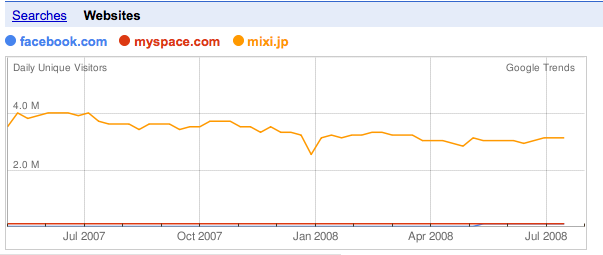
Sized at an estimated $5.6 billion in 2007, Japan boasts one of the biggest online advertising markets in the world – a huge potential just waiting to be tapped by foreign social networks. The world’s two largest social networks, MySpace and Facebook, barely register in Japan. As the Google Trends for Websites chart above shows, local social network Mixi is outpacing both in Japan. On Alexa, Mixi is ranked the No. 6 most popular site in Japan, compared to No. 95 for MySpace (Facebook doesn’t even make it into the top 100). MySpace and Facebook are trying – but why are they failing?

Complacency and failure to adopt to cultural differences

Social networks have become integrative elements of modern American youth culture over the last years, shaping social patterns and changing the ways that people communicate. When taken abroad, these services have to deal with a large number of cross-cultural peculiarities by their very nature.

Societal and cultural gaps are particularly evident in the case of Japan. Market entry in this country with a “What works in the US must also work over there”-attitude is going awry for both Facebook and MySpace. It’s not a stereotype that communication tends to be nonverbal in Japan. The society generally puts more emphasis on the community rather than on the individual. Also, security plays a major role in many aspects of Japanese life.

These cultural distinctions largely explain why social networks from abroad have a hard time winning over Japan’s 90 million web users. Mixi, the country’s biggest social network, positioned itself as a tool for communicating at a distance through diaries and communities to meet like-minded members. It doesn’t primarily exist to make new friends (poking is restricted) or as a platform for public self-presentation.

A perfect example of a cultural misconception: Mark Zuckerberg recently said in Tokyo one of Facebook’s unique selling points is the usage of real names and photos in profiles. This may be true but it’s exactly what Japanese web users usually try to avoid. And they already have a high-trust, invitation-based social network anyway: Mixi.

Lost in Translation (Without Mobile, You’re Dead)

MySpace opened a Tokyo office in 2006, three years after launch in the US. It took Facebook four years to initiate a user-generated translation of their site. Too late – in the meantime Mixi developed into a $1 billion-listed company without the slightest competition from abroad.

Facebook’s hands-off approach especially leaves a lot to be desired. The quality of the site’s translation is amateurish in parts (at least in the initial version), a challenge MySpace’s local team was at least able to master. In addition, due to relatively weak English skills, most of the Facebook applications are pointless in the eyes of Japanese users. Without apps that make sense, Facebook is crippled. Facebook is also missing the function Japanese consumers deem fundamental in a social network: blogging. This paradox may be the site’s biggest drawback in blog-crazy Japan.

Perhaps an even bigger problem is that both Facebook and MySpace fail to offer an optimized version for Japanese handsets. Millions of Japanese are accustomed to using one thumb, a dialpad and a jog dial on their phones when accessing the web during their commutes to school and work. In this country, the mobile web is bigger than the PC web.

Success factors in Japan: Get in fast, show some respect, and find a local partner

Offering a country-specific version before a local copycat beats you to it is an obvious key factor for success, and not only in Japan. But being relatively complex entities, social networks face a trade-off between additional risks and potential gains in the course of localization. Overdoing the adoption to local tastes might compromise the big idea and infrastructure of the site (i.e. in the form of cluttered interfaces or fragmentation into culturally and linguistically walled “mini-networks”).

Practical experience from the Japanese web industry has shown that partnering up with a local company is the best way to diminish these dangers (see Yahoo Japan, the No. 1 site in the country, which is a joint venture run by Softbank). Japan has embraced just five American web brands which decided to go solo and none of them is a social network: Wikipedia, Google, YouTube, Twitter and Amazon.

MySpace’s establishing of a physical presence in Japan was received as a sign of long-term commitment, a move which melds with the local mentality. But in Japan, maintaining your autonomy comes with a price: It’s no secret that it usually takes foreign companies years to build up brand identity, trust, industry connections and general market knowledge.

The same is true for complex web products such as a social network – if the company behind it really means it. Currently it seems Facebook and (to a lesser degree) MySpace chose to start working the Japanese market with a minimum of resources. But in most cases, remote management is perceived in insular Japan as second-rate treatment. Apart from M&As, cooperating with an established local partner seems to be the best shortcut option conceivable. It’s almost impossible to win in Japan without close interaction with end users, press, developers, potential employees and advertisers.

But the Japanese market isn’t lost yet for MySpace and Facebook, despite Mixi’s dominance. If millions of Americans don’t mind registering to multiple social networks, why should the Japanese? Growth potential, especially for Facebook, also exists in the realm of connecting professionals online, which may be the reason why LinkedIn is currently pondering a market entry in Japan. In that specific field, they and designated partner Digital Garage (which helped Twitter build traction and earn money in Japan), see practically no competition in this country.

Update:
MySpace has clarified that they entered the Japanese market via a joint venture with Softbank and have a local office in Tokyo with 75 employees. Further, MySpace says they have an “aggressive, localized mobile product in Japan.”

(Editor’s Note: Serkan Toto is a TechCrunch contributor based in Japan).

Advertisement

Responses

Comments rss icon

  • Another post from the same guy telling us why it’s hard for U.S. web companies to make it in Japan?? We get it already. Different market, different audience. Old news. Tell us something new.

    • Geez, relax. Skip his articles. This article might be of interest to others.

    • there’s only 1 rule in business: the first with a boner fucks the others. it’s that simple. in France, dating website Match.com just can’t catch up over Meetic, because the latter’s been there 3 years ahead. Mc Donald’s is number one because they were the first. Same applies to Coca-Cola, Starbucks, Subway etc…

    • primal convoy in Japan - June 29th, 2009 at 7:34 pm PDT

      I have to agree somewhat with what the wtiter has said. However, one could argue that it is the JAPANESE who are being “arrogant” or at least ignorant about the web. Japanese technology, at least in practical applications and day-to-day use is YEARS behind other developed countries. The mobile phones produced are clumsy, badly designed clunky devices with little or no “hot” new apps, plus their are heavily castrated by the 3 fat-cat companies that monopolise the indistry. Most phones cannot view or share videos with youtube, cannot download free MP3’s or other “global” file types and cannot share files between uses via bluetooth (as only a few handsets have this function, plus phones are restricted from sending many file types). Many cannot access world-wide phone sites either.

      Also, Twitter is NOT common or in any way “adoped” or popular over here. The different phones all have different internet and email standards plus there is no universal SMS meaning Twitter isnt even known to most of the general Japanese public.

      In short the what the “great firewall of china” is to China, so the “Expel the Foreign IP Address!” is to Japan.

  • On reason is failing about is because these sites are not designed and planed according to there psyche, Japanese like different from American…

  • I worked in Japan for one year during the CD-ROM multimedia publishing boom. I could not agree more – if you do not show respect and deference to an established partner, it will be an uphill market journey.

    Then culture is fascinating, and the consumer and business habits and outlook are complex.

  • Is this also true for Vietnam, Singapore, Cambodia etc?

    It would be more of a compelling reason to change if this mood was reflected in a wider area. However, if not, it might be more of a compelling reason for Japan to try adapt and integrate with the others

    • Putting Vietnam in the same box as Singapore is a bit of a stretch :-)

      Singapore is a developed country, while Vietnam is developing (fast).

      Per capita nominal GDP (nominal) for of US$ 39,952.44 (USA: $43,594). Vietnam: $3,100.

      To the core of your question: see my comment with German data below — it’s the same for Europe.

    • We have a very similar situation in Russia with the local players outweighing foreign brands heavily (I have done a similar analysis in a post linked to by my name). But in Russia the major reasons are simply love to local brands and their hard work in marketing and PR to make social networking a mainstream trend.

    • I’d like to know about South Korea. I wonder if this relates in any way to the US losing the internet leadership. Which came first? maybe we seek services and applications that don’t really limit technologies – hence don’t require as much R&D.

  • @Doshite … gotta keep telling the message if people keep refusing to heed it. The number of foreign web properties that make weak attempts to enter the Japanese market and fail is steadily growing.
    In the end, without someone local to work with and stop you making many of these mistakes, many continue to do so.

  • It is better that particular cultural groups have their own individual, customized social networks that caters to their groups’ needs. However, there should be a more generic, but highly-customizable and well-moderated version of a social network if global internet users want to connect with each other.

  • Culture is a big wildcard

    Sites that are big in one country, are rarely big in another.

    maybe it’s a combination of: name, colors, design, even headquarters

  • How can one account for Orkut being so successful in Brazil?

    • (also @Lawrence (above)

      Community. Network effects.

      For the little steering (sometimes policing) that every social network has to do you have to have at least 1 person *in* the local market understanding the culture. Plus, for PR with local media.

      Look, I’m in enterprise software, located in Germany, and our growth these days comes mostly from East Asia. We have pretty large teams in these countries, but still I get up at 4am, read Japanese and Chinese online news and then do video conferences with customers starting at 6am my time. Even in unfashionable enterprise software it’s important to know what’s on the minds of your customers every day, and what kind of communication style they prefer. For example, Germans like to start a reply with “No, but…”. Totally unacceptable in most countries of the world, even elsewhere in Europe, but you have to learn this.

  • facebook is dull and boring. That’s why the Japanese don’t care for it. They like fancy flashy stuff, not a boring twitter front end but with just a boring blue and white. A twitter look a like with a few other options is basically all that facebook is now. The apps are so hidden in the new interface that no one ever goes to them.

  • I wouldn’t even really say that Google or YouTube have really “won over” the Japanese markets. Many of Google’s web apps are pretty much ignored by Japanese because of how hard they are to use for them, the fact they aren’t updated as frequently in languages other than English, and Yahoo (like mixi) already existed.

    Twitter is used by Japanese but pretty much only geeks afaict. The same might be said of the English version though ;) I might say this is localized when they support SMS in Japan (probably it works but it’s expensive and unsupported. Settings are only available on the English pages).

    Amazon is the only one you mentioned that seems (to me anyway) like it has a well created, localized version for Japan. It is full of Japanese content and products and has nice Japanese style payment methods (delivery and pay at the convenience store) etc.

    • Supporting SMS in Japan has no impact I think. Most of all cellphone here let you use internet mail (freely under the fixed monthly rate) and people use it. Twitter’s success in Japan is supported by many cellphone applications and mobile proxy services made by third parties in Japanese.

      Recently Japanese iPhone 3G buyers (couple of hundred thousands at most) discovered “SMS” and learning what it is. I read some blog reviews said they might use it like a new twitter.

  • Reason is simple.. and you know it..

  • silicon valley dropout - August 3rd, 2008 at 8:47 am PDT

    the answer is simple the forces that be cant force myspace and facebook down the citizen of japan throats like they do in usa

  • Well done article. I think it applies to many locations other than Japan, but Japan is definitely one of the most cross-culturally rough marketing spots for US products.

    I think what was touched on very briefly but is really a major factor is the mobile usage. The majority of school kids use their mobile instead of a computer for communication and neither MySpace nor Facebook work well that way (especially with bad translations + bad mobile formatting). I’m glad it was mentioned but I’d be curious to know how big of a factor it really is.

  • the answer is the mobile web. they use it everywhere, in the train on the way to school, in the classroom etc, i’ve been living in japan since 97 to 2001, even during that time the mobile is like a moving pc to them..mostly the teenagers, and all the mobile are cutesy kinds, you can read a person character by looking how they decorate their mobiles..the mobile itself has a soul

  • Number-wise the situation in Germany is quite similar, though not as extreme:

    http://trends.g...=all&sort=0

    (The sum of the 3 *vz is equivalent to Facebook, with studiVZ: college, schuelerVZ: high-school, meinVZ: old-farts)

    And in Alexa for Germany, StudiVZ is 7th, and SchuelerVZ 11th.

    In Germany, being first at least with *PR* and marketing is often key to success for US websites: This is true for Google (#1 and #2 in Alexa), but also for Youtube (#3 — even though it does have local competition that arrived early). #4, eBay, shows what you have to do when you fail initially: buy your local competitor (eBay initially tried against Alando and failed miserably until they finally bought Alando).

    WRT PR: Youtube had lots of stories linking to their best videos in the German press almost since they launched. The PR person, who worked on this, deserves a couple of millions…

    The real names issue is a topic in Germany as well, due to a generally higher privacy awareness.

    Takeaway for the Bay area community: get a person in all major markets helping you (part time) with PR, localization, community and marketing RIGHT FROM THE START.

  • The answer lies in the ability to step back from the caricature of community life that exists here in the US. These are simply not useful tools to someone who takes their community and/or civic responsibilities seriously.

  • How many Japanese social networks have made it BIG in the US?

    The idea that US based web companies can or should try to dominate all countries is a myth. Chase the myth and lose millions, perhaps billions.

    Facing your competition is not just about reading the tea leaves. One must also be able to read the writing on the wall.

  • Another point to note is that almost everything concerning the mobile web in Japan (which, as stated in the article, is far larger than the PC web) is so different technology-wise than the rest of the world that almost everything must be rebuilt from scratch.

    Nobody uses SMS; instead all phones use push email in its place. SMS as a functionality does exist, but is buried deep in the sea of menus under the (correct) assumption it will not be used.

    The versions of HTML used in Japanese phones are so full of proprietary extensions that they carry barely enough compatibility to be viewable on PCs and are not even compatible across carriers, requiring developers to use frameworks which serve different pages for different carriers. There are 3 major carriers here, with varying levels of support of various technology, but the utter incompatibility forces developers to develop for the lowest common denominator.

    Even the text encoding set is different across carriers, with each having their own extended pictogram character sets, some of which overlap each other. Viewing a webpage with pictograms intended for a different carrier will not display properly, again necessitating a compatibility layer to convert across different pictogram sets. The pictograms have become deeply ingrained into the cultural fabric, such that if a mobile site does not support them, again, you’re dead.

    Despite being so advanced in aspects such as HTML email editing or video playback, mobile browsers here also lack basics such as cookies, external CSS or proportional font rendering, and is under many restrictions. As far as I can tell Zuckerberg seems completely oblivious to it – when asked about mobile during his Tokyo talk, he noted that Facebook does have a mobile site, but upon trying to load it up on my phone, I couldn’t even log in, due to the site requiring cookies!

    As the differences between the PC and mobile browsers became so huge, and the companies got themselves into a situation where they couldn’t drop the proprietary elements due to the massive ecosystem already built up on it, mobile phones here actually have two different browsers in them – the “mobile” browser, with support for pictograms and such, and the “full” browser, which are meant for the viewing of PC sites. People hardly use the “full” browser though, as its usability is nowhere near that of the “mobile” browser, and it is common practice for mobile-only sites to deny access from non-mobile browsers (PCs or “full” browsers) outright, only allowing access to mobile browsers and nothing else.
    (Going on another tangent, the iPhone made waves across the geek crowd but were ridiculed from the general public, not because it was primitive, but more due to its non-support of the various aforementioned Japanese de facto standards.)

    BTW, there’s been multiple mentions of mixi on TechCrunch, where’s mention of Mobage Town? That social network (mbga.jp) is the second largest in Japan, which grew far faster than mixi and recently surpassed 10 million members. Of course, using Google Trends to track it would be fruitless: Mobage is a mobile-only site, with no PC version at all. Only recently did Mobage begin a PC version, and even that PC version is merely a straight port of the mobile site. That’s right, it shows you a long vertical page on a PC screen, with no reformatting whatsoever. That’s how much they value the PC web. And they can get away with it because the mobile web is so huge.

    So there – both the tech and culture have become extremely different, isolating itself from the rest of the world. I frequently hear the word “Galapagos island” to describe the situation. On one hand, it is true that Japan’s mobile phones and its mobile web culture is one of the most advanced in the world; on the other hand, hardly any of it makes an impact outside of the country. I don’t know whether this is good or bad in the long term.

    • Generally agree with everything you’ve said, and have found it frustrating/ridiculous on occasion. The way the internet is used over here seems to be a strong desire to access information via at least one extra layer of intermediaries than what most of the English web is used to—exemplified in the amount of advertising that favours displaying a search box with a likely term in it as opposed to giving a website, or even just assuming that users will type “x.com” (which may not work due to many companies failing to support the feature that allows their page to be accessed without a “www.”).

      But as a slight counterpoint, I started using the on-board Opera browser due to the multitude of inconsistencies and unsupported features I found in the mobile-browser. Facebook, is, however, perfectly accessible through AU’s mobile browser and Opera browser, besides the fact that occasionally an error occurs wherein you need to use the ‘HTML’ version of the login page. The problem is the utter lack of features that carry through. You can see status updates, some recent activity, messages, walls, and photos, albeit tiny tiny versions. The usability of these features is reasonable, though newer features like being able to reply to any of the above are limited or non-existant (no wall-to-wall, even).
      I can see where all the complaints are coming from, but I thought this point needed a bit of clarification.

      As a web designer, failure it standards compliance equals failure at implementation of one of the fundamental concepts of the web.

    • The problem with this chart is that the (different) local competitors, except Mixi, are left out. You need to compare to the champion in every market to make up for the missing absolute numbers (German answer, starting with the problem YOU created :-)

      Yes, Facebook is growing, but mostly in the English-speaking world: UK, Canada, India (kind of English-speaking), Australia. Turkey ramped on during a 6 month period and is now flat. Globally, Facebook already is the large social network, but it is loosing in a number of markets, such as Japan, China, Germany, …

      What I find amusing is that the number of Japanese ex-pats and tourists in China is large enough (and the usage of both Facebook and MySpace small enough) that Mixi clearly shows up in the “region” graph for China :-)

  • For the same reason Facebook and Myspace fails [for example] in Central and Eastern Europe.

  • Malik Aleem Ahmed - August 3rd, 2008 at 10:50 am PDT

    This is well written blog and I completly agree that the contents and how to operate and sustain an information or web system should be done after considering the variations in cultural and societal values. Yeah as mentioned in the blog there are technolgical and management issues which have to be considered.

  • Malik Aleem Ahmed - August 3rd, 2008 at 10:53 am PDT

    @ Yesubut, this blog is only about japanses social networking market and you have searched for all regions. The author has meintioned the fact that maxi.jp is popular in japan not all over the world.

    • Yes, but the article had this somewhat indignant tone that the big boys need to pay attention… or it could be just me wanting to inflict drama into a dry subject. Mixi is big, but why would Facebook and Myspace need a market that from where they’re sitting is parallel to the x-axis and not far from it?

  • First off, Mixi has been around longer than the both of these, so you cannot expect users to just leave that network and join Facebook or MySpace. Second off, It was created in Japan, so I’m sure it has advance features that its users find helpful.
    http://blabtech.blogspot.com

  • Galapagos hit the nail on the head. You wouldn’t believe how backwards and forwards Japan is! Mobile is king for sure. It’s a country of trains, buses, and subways so a most of their time on the internet is via the phone.

    On a side note Mixi just made it mandatory to have a Japanese mobile email to register. If you want to play on Mixi you have to do it “their way”.

  • Hey, whadyaknow, not all cultures behave the same ! To be successful in Japan, “global” social networking sites like MySpace and Facebook need to:

    1. Complete Local Market Research (why Japan is different);
    2. Fully Localize their PC and Mobile Sites (not just translated);
    3. Sign Influential Partners (grow sales and consumer relationships);
    4. Generate Japanese Traffic (partnership tie-ups, branding);
    5. Hire Competitive Team (grow aggressive local entity); and
    6. Be Very Very Patient (no, it’s not Ground Hog Day!).

    The target market will also have implications for SNS success, as Japanese consumer demographics, internet behaviour, and social activities differ substantially from those in the Western world.

    It will also be interesting to see if and when Japan can export it’s own mobile SNS globally…now that would be groundbraking!

    • It would be interesting, if anyone (Serkan Toto?) could tell us whether any Japanese SNS is even considering this. Unlike their manufacturing industries (and unlike the Indians), Japanese service industries don’t seem to go abroad.

      • You are right, service industries are rather Japan-focused. Japan’s video game industry is very internationalized though.

        A Japanese SNS currently considering to take their service abroad? Good question, but apart from market leader Mixi (to China), I don’t know of any.

        There are a few brave Japanese web companies currently internationalizing but none of them is a SNS.

  • Ths is further evidence of the arrogance and lack of cultural sensitivty among many in corporate America. It brings to mind US carmakers(GM et al) attempts to sell cars in Japan with the steering wheel on the wrong side. Look at the result of their hubris now…

    Underlying lesson here is that the User Experience isnt a cross cultural, ‘1-size fits all.’

  • Nice article, lot of this applies for other countries as well.

    “Market entry in this country with a “What works in the US must also work over there”-attitude is going awry for both Facebook and MySpace.” Ack. We are not stupid, and after all it is our money you want, nobody does this for charitiy reasons.

    It is a business and should be treated as such, meaning do your homework first.

    Jonas: please do not quote dubious alexa or (to a lesser degree) google numbers when numbers for myspace and studivz from IVW exist and document well the overwhelming success of studivz / schülervz in germany, compared to every other site.

    • Nicole: I used the same sources as the article.

      IVW has (only?) a German user interface (no a good link for TechCrunch), and seems to ignore Google and Youtube (which are probably not paying for IVW).

  • Japan can absolutely be as individualistic as the U.S. or any other developed nation. Just look at the breadth and depth of self-expressions in art, architecture, modern fashion and music.

    The communication protocol in Japan is as verbal and non-verbal as it is here. The difference is what is verbal and what is not. There are plenty of non-verbal communication protocols we follow in the U.S. – we just don’t think about them because they are second-nature to us. Japanese speakers come over here and face the same exact frustration – so much non-verbal communication in the English language.

    Facebook’s failure in Japan has nothing to do with “cultural differences” or “lost in translation” errors. It is a simple case of business strategy; Mixi has had a tremendous early-mover advantage and network benefits. It has also correctly adopted the mobile and other key platforms in that market.

  • Looking forward to the stories of embarrassing mistranslations.

  • maybe its because they live so close to one another. less commute time less need to update your buddies on what your doing in an MS/ FB kind of way.

    How dose that factor in?

  • Cultural differences, failure to secure a domestic partner, no blogging?

    I can’t help but feel like the author is diving a bit too deep on this one.

    When it comes down to it, people join Facebook to write messages on their buddies’ wall, check-up on old friends, and see pictures of themselves. How exactly could people do that with a site that’s had a Japanese version for less than 6 months?

    In my personal experience, however, most of my Japanese friends are on Facebook. Yet, they all speak some degree of English. And they were on the site before they launched a Japanese version.

    PS. Facebook does allow you to post notes. Very similar to a blog.

    PPS. The new Facebook design sucks.

  • Facebook wouldn’t work because of its supposed use of “real names,” as the author pointed out in the article.

    Japanese people loves gossips and people’s privacy. Once you expose who you really are, next thing you know is some strangers that you never heard of are spreading your information.

    • MySpace allows aliases and anonymity and was the biggest and fastest-growing social network in the U.S. Facebook emerged after MySpace to become the hottest social networking tool.

      There’s no reason to believe Facebook-like services, with clear identity and group affiliation, couldn’t replace Mixi in Japan.

      The group vs. individual and other objectification of Japanese consumers is not only offensive but also unhelpful.

      It keeps companies from focusing on real customer needs.

      • Do you know this infamous incident on Mixi, where a guy’s PC got infected with virus and pictures of his girlfriend while having sex leaked to the web.

        Next thing? Someone located who this girl was on Mixi, and her Mixi page was burning on fire because the news spread and bystanders rushed to see the page, just out of curiosity.

        What should be noted is that this girl was not putting up her real name, YET she was identified because someone could tell who she was from the pictures, and spread the news.

        Under such a culture, people are reluctant to give up their real names because there’s just too much to lose for doing so, while not gaining much. Such is the culture in Japanese SNS and blogosphere.

  • “It’s not a stereotype that communication tends to be nonverbal in Japan. The society generally puts more emphasis on the community rather than on the individual. Also, security plays a major role in many aspects of Japanese life.”

    It is a stereotype. You don’t make it less of a stereotype by baldly stating it is not. The two succeeding statements are also stereotypes, I’m afraid, and not very accurate either. The reasons for the problems these US services are facing is much more in the detail of the particular services already available in Japan, as parts of the rest of the article and the comments make clear. The fundamental reality is that Japanese tech companies are highly sophisticated and therefore you cannot get a lead in the market with a half hearted “let’s do it over there too” approach. There are differences between the US and Japanese internet: the Japanese internet has always tended, well before these new social platforms arrived, to be more based around individual (though, yes, often anonymous) publishing with communities of internet friends networking together. Most of the content is in this form rather than the large scale broadcasting that accounts for a lot of the English language interenet. This is so because of the particular history and development of Japan online, rather than any general cultural characteristics, and this means any facebook style services are coming into a market with a lot of furniture already sitting around (not just mixi, by the way: much more than that). US companies need to understand that environment thoroughly and interact with it flexibly if they are going to succeed.

    Of course, you could turn round the basic question of this article: “Why is it that it is so hard for big US services to get into the Japanese market?” and ask” Why is it so easy for said services to get into a few other markets?”. I think, given an equality of technical knowhow, that we should really be expecting these services to experience difficulty transplanting reliably into alien markets. It is a bit like the film industry. Yes, places like the UK were overrun by Holywood because the English language made it so easy to transplant and so easy for talent to leave for the US but in large parts of the world, particularly in places like Japan where the language prevented a flow of talent out and easy transplantation of products into the country, the penetration was much more limited and unpredictable and the domestic industry far more healthy.

  • Without going too deep into the specifics, it is probably worth noting that Cyworld has not taken off in the US either.

  • Another reason that Mixi is so well received by Japanese is that it is structured similarly to the way relationships in Japan are. That is, in both Japanese society and in Mixi there is a clear distinction between being within the group (”uchi” in Japanese) and outside of the group (”soto”).

    Facebook kind of works the same way but Mixi takes it one step further in that you have to be invited by a friend to even join.

  • Ah who cares about japan. Myspace like totally ROCKS in the US and thats all that counts!

    JT
    http://www.Ulti...e-Anonymity.com

  • I think facebook could be succesful in Japan if they let Japanese people develop it. Making the site cultural specific. I think that’s the biggest problem. It’s to Americanized. But what else is it suppose to be?

  • I agree with Keir. Facebook is way too Americanized, not to mention their insane advertising guidelines.

  • Fast Paced Communities Like WeGIF.com the currently have mobile creation already integrated will be perfect to harness this market.

  • “Find a local partner”? This article’s writer seems to ignore that MySpace is a joint venture with Softbank, who is behind Yahoo! Japan, the broadband ISP Yahoo! BB, and one of the 3 main mobile phone operators. How would you get a better local partner?

    • Yes, they are cooperating but the partnership hardly shows on the Japanese web sites of these companies (something one could expect). I also don’t see any steps in localization, which can be attributed to Yahoo! Japan’s help.
      But agreed, I should have at least mentioned that MySpace made a right move here.

    • > Yves

      There are no words or links to MySpace Japan on Yahoo! Japan’s top page. If there was, MySpace Japan could have gotten a lot of help for their taking off in Japanese.

      I do not know why this happens but Yahoo! Japan has their own (quite unpopular) Social Network Service Yahoo! Days.

  • There’s a recent post on Joi Ito’s blog titled “Why you need a local partner in Japan” [http://joi.ito.com/weblog/2008/07/25/why-you-need-a.html] that addresses issues related to this post.
    Comments are also worth reading.

  • Cultural differences across the web is a great topic.

    Here’s a posting with why Yahoo beat Google in Asia:

    http://www.thom...asia-hong-kong/

  • Very rarely does an American company carry its success overseas.

  • The key for user growth in social networks is migration from one network to another.
    In the US the userbase for MySpace is very different from Facebook – MySpace has non-real life relationships (friends with artists and strangers), is geared towards teenagers and their need for self-representation, while Facebook represents authentic people and trusted relationships.
    As a result user migration from MySpace to Facebook is reasonable because they represent two different markets and an evident age-based user path from MySpace to Facebook (it’s like MTV to VH1 :) ).
    In foreign territories such as Japan or Germany the local established networks are more similar to Facebook – authentic relationships for users 18+. There is no need for users to migrate over from their established network that hosts their photos and activities and history and friends.

    As a result it is difficult for Facebook to grow users there.

    They have a few options:
    - Merge/Acquire entire network
    - Sublicense Facebook’s vastly advanced technology as scaleable cross-platform functionality becomes a requirement

    Considering the isolated nature of Japan – few Japanese people have close relationships with the rest of the world and those who have outside friends already having Facebook/MySpace accounts for that matter, I think it makes more sense for Facebook to become a technology vendor in Japan (think ‘Mixi, powered by Facebook’).

    Now, having worked for Japan for 9 years, what I am wondering about is the potential of the Korean market…

  • Thanks for this well written article. It has give me some pictures why may last project didnt work. If you want to target the local market, be local dont be too international. Personalization is important.

    Understanding this niche market is tough but its possible.

  • Have any of you non-Japanese speakers actually looked/register/used mixi?
    It should be boring, since 99% of the registered users are Japanese,
    99% of the contents are in Japanese.

    My point is, this goes vice versa.
    The sad but true fact, is that most Japanese teens can’t speak nor understand English, well maybe 1% can.
    If most of the users and content are for MySpace and Facebook are in English,
    Japanese users will tend to stick with mixi.

    To be precise, MySpace is growing gradually in Japan.
    My hypothesis is, MySpace supports music better than mixi.
    Music is universal, unlike text.
    I think the same goes for YouTube.
    Visuals are also universal.
    You don’t have to understand English to enjoy the Coke Mentos clip, right?

    go ahead and deny/neglect/tramp over my comment.

    • How much overlap is there between J-Pop and the Billboard Top 100?

      • ahhhh….
        I’d guess very minimal.
        Especially if you’re looking at J-pop.
        There is a definate overlap for Oricon(Jpn version of the billboard)
        and the Billboard top 100.
        http://www.oric...o.jp/rank/ja/y/
        Avril, Neyo, Linkin, Maroon, Nora are just a few off the top.
        (should get back to the topic..)
        So yes, Japanese teens are interested in foreign music,
        even if they can’t understand the lyrics.

  • Different strokes for different people. Wal-Mart, a giant American firm, is a doing poorly in Japanese market. Facebook and Myspace must get into deeper study of International Marketing.

  • Glocalisation especially China, Japan, Korea

Leave Comment

Commenting Options

Enter your personal information to the left, or sign in with your Facebook account by clicking the button below.

Alternatively, you can create an avatar that will appear whenever you leave a comment on a Gravatar-enabled blog.

Trackback URL
bugbugbugbug
Techcrunch on Facebook